

What you'll learn
- How organic compounds can be shown using empirical, molecular, general, structural, displayed and skeletal formulae.
- What a homologous series is, and why members of one series behave similarly.
- How to apply core IUPAC naming rules for simple chains and rings up to six carbon atoms.
- How to go both ways: from structure to name, and from name to structure.
Why nomenclature matters
Organic chemistry contains a huge number of compounds because carbon atoms can form chains, branches and rings. Nomenclature means the systematic naming of compounds. A good name is like a set of instructions: it tells you the carbon skeleton, important functional groups and where everything is positioned.
IUPAC nomenclature
IUPAC nomenclature is the internationally agreed system for naming chemical compounds. IUPAC names aim to be unambiguous: one correct name should point to one clear structure.
At A-Level, you are expected to name and draw relatively simple organic compounds, especially chains and rings with up to six carbon atoms each.
Different ways to represent organic compounds
Chemists use different formula types depending on how much detail they need.
| Representation | What it tells you | Example using butane |
|---|---|---|
| Empirical formula | Simplest whole-number ratio of atoms | C2H5 |
| Molecular formula | Actual number of each type of atom in one molecule | C4H10 |
| General formula | Formula for all members of a homologous series | Alkanes: CnH2n+2 |
| Structural formula | How atoms are connected, written compactly | CH3CH2CH2CH3 |
| Displayed formula | Every atom and every bond shown | Full drawing with all C–H and C–C bonds |
| Skeletal formula | Carbon framework shown as lines; most C and H atoms omitted | Zig-zag line for a carbon chain |
Displayed, structural and skeletal formulae
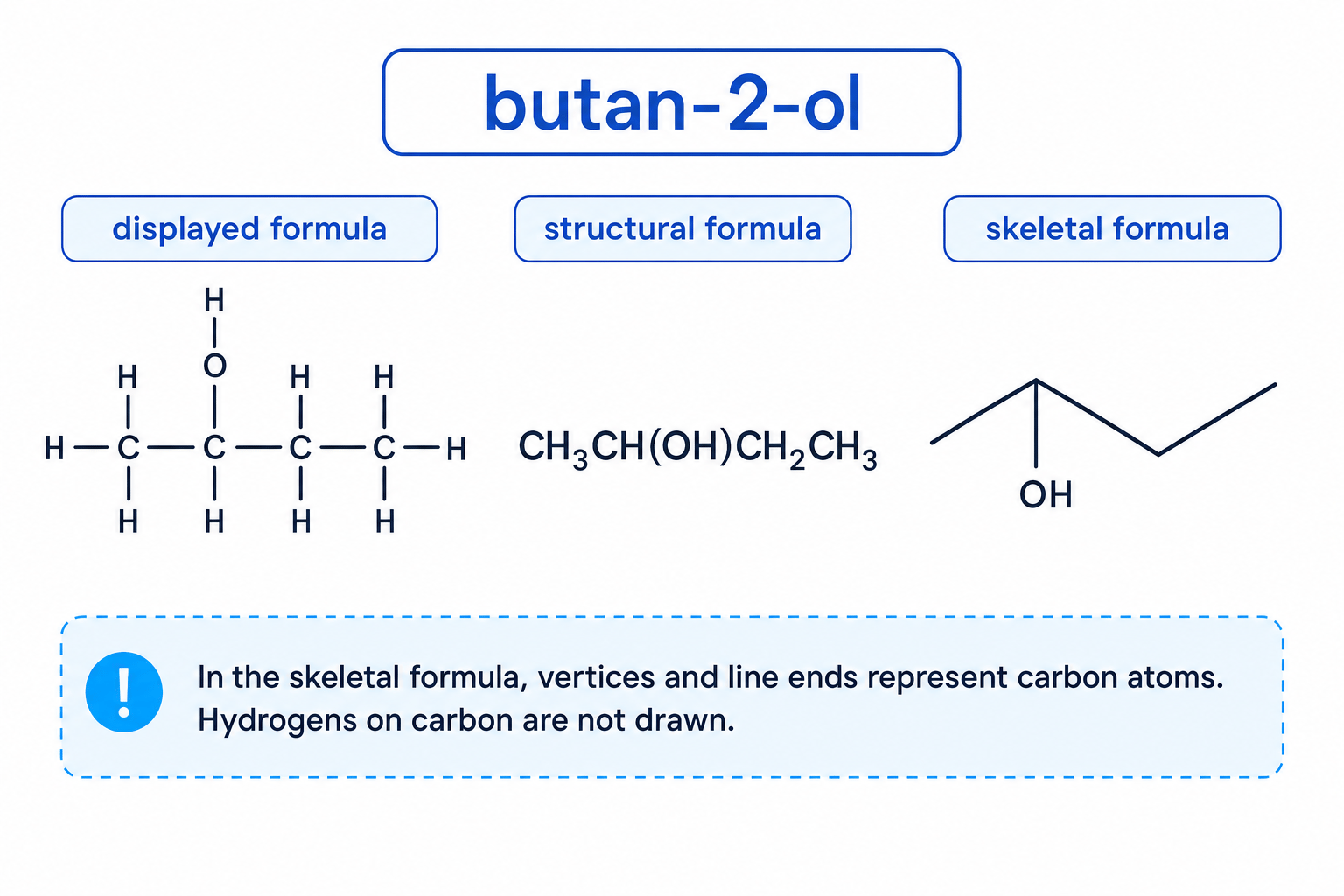
A displayed formula shows every atom and bond. A structural formula shows the arrangement of atoms in a compact written form. A skeletal formula shows the carbon skeleton using lines: each line end or vertex is a carbon atom, and hydrogen atoms bonded to carbon are not drawn.
The diagram below compares the three most important structure representations for the same molecule, butan-2-ol.
Forgetting hidden hydrogens in skeletal formulae
In skeletal formulae, hydrogen atoms bonded to carbon are still there — they are just not drawn. Hydrogen atoms bonded to heteroatoms, such as the H in an –OH group, are usually shown.
Working between formula types
A compound has molecular formula C5H10 and belongs to the alkene homologous series. Find its empirical formula and check that it fits the general formula for alkenes.
-
Compare the atom numbers in the molecular formula: there are 5 carbon atoms and 10 hydrogen atoms, giving the ratio 5:10.
-
Simplify the ratio by dividing both numbers by 5, giving 1:2.
-
Write the empirical formula from this simplest ratio: CH2.
-
Check against the alkene general formula CnH2n. If n is 5, the formula is C5H10, so it fits.
Homologous series
A homologous series is a family of organic compounds with the same functional group and similar chemical properties.
Functional group
A functional group is the atom or group of atoms in an organic molecule responsible for its characteristic reactions. For example, the C=C group is the functional group in alkenes, and the –OH group is the functional group in alcohols.
Members of a homologous series have several shared features:
- They have the same functional group.
- They have the same general formula.
- Neighbouring members differ by CH2.
- They show similar chemical reactions.
- Their physical properties, such as boiling point, change gradually as chain length increases.
For example, methane, ethane, propane and butane are all alkanes. Alkanes are saturated hydrocarbons, meaning they contain only carbon and hydrogen and have only single C–C bonds.
Homologous series pattern
In a homologous series, the functional group controls the chemical reactions, while the carbon chain length affects physical properties such as boiling point.
Recognising a homologous series
Decide whether CH3CH2OH and CH3CH2CH2OH are in the same homologous series.
-
Identify the functional group in each molecule. Both contain an –OH group, so both are alcohols.
-
Compare the carbon chains. The first molecule has 2 carbon atoms and the second has 3 carbon atoms.
-
Check the difference between the formulae. The second molecule has one extra CH2 unit, which is the expected difference between neighbouring members of a homologous series.
-
Conclude that they are in the same homologous series: the alcohols.
The building blocks of IUPAC names
Most simple organic names are built from three parts:
- Prefix — groups attached to the main chain, such as methyl-, bromo- or chloro-.
- Stem — number of carbon atoms in the parent chain or ring.
- Suffix — main functional group or type of carbon–carbon bonding, such as -ane, -ene or -ol.
Carbon chain stems
You must know the stems for one to six carbon atoms:
| Number of carbon atoms | Stem |
|---|---|
| 1 | meth- |
| 2 | eth- |
| 3 | prop- |
| 4 | but- |
| 5 | pent- |
| 6 | hex- |
So a six-carbon alkane is hexane, while a three-carbon alcohol is based on propan-.
Parent chain and locants
Parent chain and locant
The parent chain is the main carbon chain used as the basis of the name, usually the longest chain containing the main functional group. A locant is a number showing the position of a branch, bond or functional group.
For example, in butan-2-ol, the parent chain has 4 carbon atoms, and the locant 2 shows that the –OH group is on carbon 2.
Lowest numbers win
When numbering the parent chain, choose the direction that gives the important group, double bond or branch the lowest possible locant.
Naming simple chains
For simple A-Level structures, use this method.
Step 1: Choose the parent chain
Find the longest continuous carbon chain. It should include the main functional group and any C=C double bond if present.
Step 2: Number the chain
Number from the end that gives the lowest useful locants. Functional groups and double bonds usually matter more than simple alkyl branches.
Step 3: Identify prefixes
Branches such as –CH3 are named as prefixes. A –CH3 branch is methyl-, and a –CH2CH3 branch is ethyl-.
Halogen atoms are also prefixes:
- fluoro-
- chloro-
- bromo-
- iodo-
Step 4: Add the suffix
Common suffixes include:
| Type of compound | Key feature | Name ending |
|---|---|---|
| Alkane | C–C single bonds only | -ane |
| Alkene | C=C double bond | -ene |
| Alcohol | –OH group | -ol |
| Aldehyde | –CHO group at chain end | -al |
| Ketone | C=O within chain | -one |
| Carboxylic acid | –COOH group | -oic acid |
Choosing a short chain by accident
Do not choose the most horizontal or neat-looking chain automatically. The parent chain must be the longest suitable continuous carbon chain.
Naming a branched alkane
Name CH3CH(CH3)CH2CH3.
-
Find the longest continuous carbon chain. The longest chain contains 4 carbon atoms, so the parent alkane is butane.
-
Identify the branch. The extra CH3 group is a methyl branch.
-
Number the chain from the end nearest the branch. This gives the methyl group locant 2 rather than 3.
-
Assemble the name using locant, prefix and parent name: 2-methylbutane.
Naming an alcohol
Name CH3CH2CH(OH)CH3.
-
Find the parent chain. There are 4 carbon atoms in the longest chain, so the stem is but-.
-
Identify the functional group. The –OH group means the compound is an alcohol, so the suffix is -ol.
-
Number from the end nearest the –OH group. This places the –OH group on carbon 2, not carbon 3.
-
Combine the parts. A four-carbon alcohol with the –OH group on carbon 2 is butan-2-ol.
Punctuation in organic names
IUPAC names use punctuation very carefully.
- Use commas between numbers: 2,3-dimethylbutane.
- Use hyphens between numbers and words: 2-methylbutane.
- Do not put spaces inside a name: write 2-methylbutane, not 2 methyl butane.
- Use di-, tri- and tetra- for repeated identical groups: 2,2-dichloropropane.
Name punctuation check
If two numbers touch, separate them with a comma. If a number touches a word, separate them with a hyphen.
Naming rings
A compound with carbon atoms joined in a ring is called a cyclic compound. For simple carbon rings, add cyclo- before the parent name.
For example:
- A three-carbon alkane ring is cyclopropane.
- A six-carbon alkane ring is cyclohexane.
- A methyl group attached to cyclohexane gives methylcyclohexane.
If a ring has more than one substituent, use locants to show their positions.
Naming a substituted ring
Name a cyclohexane ring with chlorine atoms on two adjacent carbon atoms.
-
Identify the parent ring. The ring has 6 carbon atoms and only single C–C bonds, so the parent is cyclohexane.
-
Identify the substituents. There are two chlorine atoms, so the prefix is dichloro-.
-
Number the ring to give the lowest locants. Adjacent substituents are on carbons 1 and 2.
-
Combine the locants, prefix and parent name: 1,2-dichlorocyclohexane.
Drawing a structure from a name
When you are given a name, reverse the naming process.
- Start with the parent chain or ring.
- Add the main suffix group, such as C=C or –OH, at the numbered position.
- Add branches or halogen substituents at their locants.
- Check each carbon has four bonds.
Drawing from an IUPAC name
Draw the structure of 3-bromo-2-methylpentane.
-
Identify the parent chain. Pentane means a 5-carbon chain with single C–C bonds.
-
Number the chain from one end. Draw five carbon atoms in a row and label them 1 to 5 temporarily.
-
Add the substituents. Put a methyl group on carbon 2 and a bromine atom on carbon 3.
-
Fill the remaining bonds with hydrogen atoms if drawing a displayed or structural formula. The condensed structural formula is CH3CH(CH3)CH(Br)CH2CH3.
Some locants are unnecessary
If there is only one possible position for a group, the number is often omitted. For example, ethanol does not need to be called ethan-1-ol because both carbon atoms are equivalent.
A reliable naming checklist
When you name an organic compound, ask yourself:
- What is the longest suitable carbon chain or ring?
- Which functional group gives the suffix?
- Which direction gives the lowest locants?
- What branches or halogens need prefixes?
- Have I used commas, hyphens and no spaces correctly?
In the exam
-
Number the carbon chain lightly on the structure before naming it, then check whether numbering from the other end gives lower locants.
-
For skeletal formulae, count every line end and vertex as a carbon atom; do not forget hidden hydrogens on carbon.
-
When drawing from a name, build the parent chain first, add groups second, then check that each carbon has four bonds.
Check yourself
-
What is the difference between molecular formula and empirical formula?
-
Why are CH3CH2OH and CH3CH2CH2OH members of the same homologous series?
-
Draw the structural formula for 2-chlorobutane and then write its skeletal formula.
