

What you'll learn:
- How atomic radius, first ionisation energy, and melting point change from magnesium to barium.
- The trends in their reactivity with water and the solubility of their hydroxides and sulfates.
- Important industrial and medical applications of Group 2 metals and compounds.
- The chemical test for sulfate ions using acidified barium chloride.
Trends in physical properties (Mg to Ba)
The elements from magnesium (Mg) to barium (Ba) are known as the alkaline earth metals. Like all chemical groups, their physical properties follow distinct patterns as you move down the periodic table.
Atomic radius
Atomic radius increases as you go down Group 2. As you move from magnesium down to barium, each element has an extra electron shell compared to the one above it. This extra shell means the outer electrons are physically further from the nucleus. Although the nuclear charge (number of protons) also increases, the extra inner shells provide shielding (or screening), which cancels out the effect of the extra protons. Therefore, the overall size of the atom increases.
First ionisation energy
First Ionisation Energy
The enthalpy change when one mole of gaseous atoms forms one mole of gaseous ions with a single positive charge.
M(g)→M(g)++e− \text{M}_{(g)} \to \text{M}^+_{(g)} + \text{e}^- M(g)→M(g)++e−The first ionisation energy decreases as you go down Group 2. Although the nuclear charge increases, the atomic radius increases and there is more shielding from inner electron shells. The outermost electrons are further away from the positive nucleus and experience a weaker electrostatic attraction, making them easier (requiring less energy) to remove.
Melting point
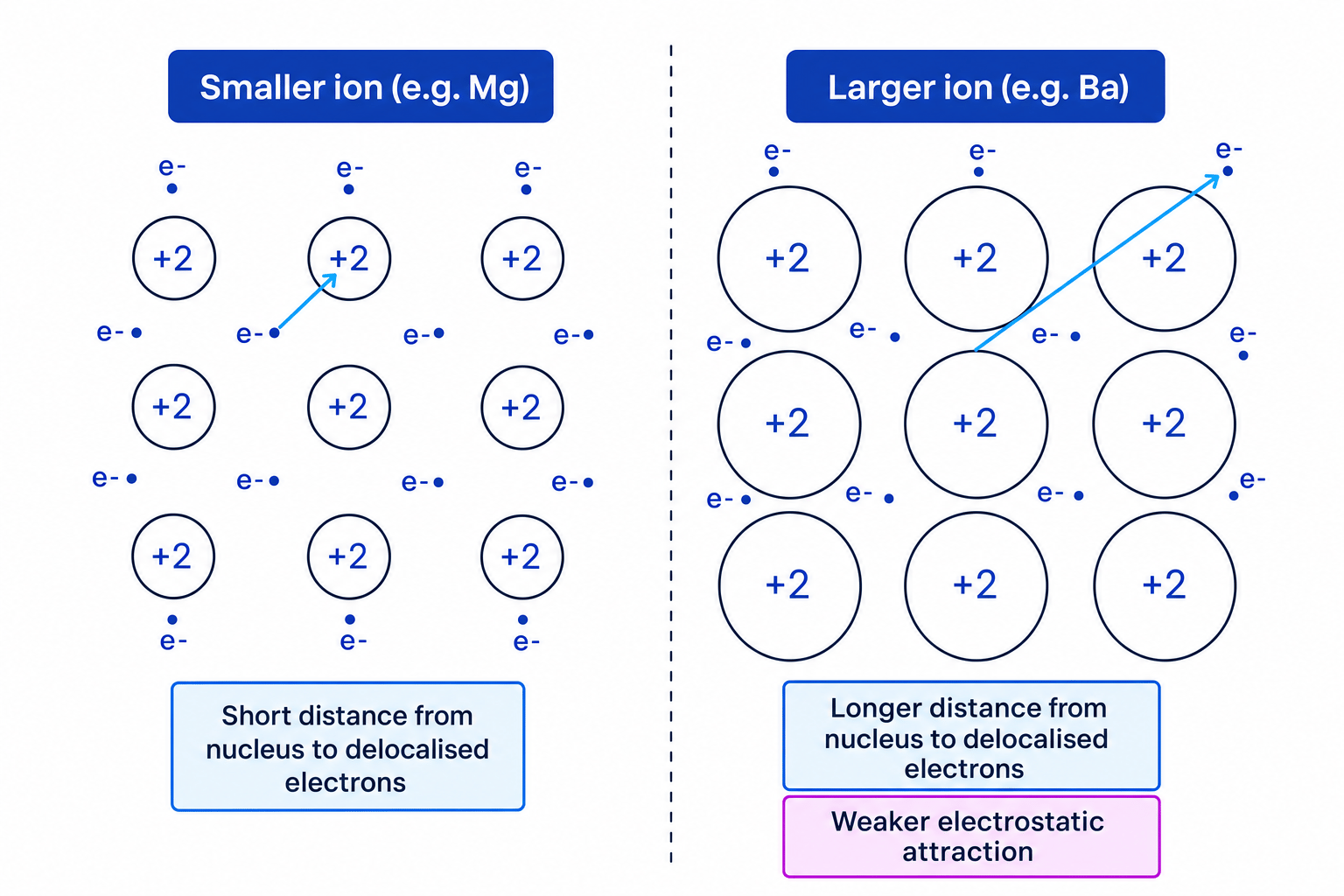
The melting point generally decreases as you go down Group 2. Group 2 elements have a giant metallic structure. The metal atoms lose their two outer electrons to form a "sea" of delocalised electrons, leaving behind a lattice of +2+2+2 ions. As you go down the group, the charge on the ion remains +2+2+2 and the number of delocalised electrons per atom remains 2. However, the ionic radius increases. Because the ions get larger, the distance between the positive metal nucleus and the delocalised electrons increases, which weakens the electrostatic attraction. Less energy is needed to break these metallic bonds.
The Magnesium anomaly
You might notice if you look at a data sheet that the melting point of magnesium (650 ∘C650 \ ^\circ\text{C}650 ∘C) is unusually low compared to calcium (839 ∘C839 \ ^\circ\text{C}839 ∘C), breaking the general trend. This is due to magnesium having a different crystal lattice arrangement to the rest of the group. You don't need to explain why this happens, just remember that the overall trend from Ca to Ba is a decrease.
Chemical reactions of Group 2 elements
Reaction with water
The reactivity of Group 2 elements with water increases down the group. They undergo a redox reaction to form a metal hydroxide and hydrogen gas. For a general Group 2 metal (MMM), the equation is:
M(s)+2H2O(l)→M(OH)2(aq)+H2(g) \text{M}_{(s)} + 2\text{H}_2\text{O}_{(l)} \to \text{M(OH)}_{2(aq)} + \text{H}_{2(g)} M(s)+2H2O(l)→M(OH)2(aq)+H2(g)- Magnesium reacts very slowly with cold liquid water, taking days to produce a few bubbles of hydrogen and a weakly alkaline solution of sparingly soluble magnesium hydroxide.
- Calcium, Strontium, and Barium react increasingly vigorously with cold water, producing noticeable effervescence (fizzing) as hydrogen gas is released.
Because magnesium reacts so poorly with cold water, we typically react it with steam instead. This is a much faster reaction and produces magnesium oxide (a white solid) instead of magnesium hydroxide:
Mg(s)+H2O(g)→MgO(s)+H2(g) \text{Mg}_{(s)} + \text{H}_2\text{O}_{(g)} \to \text{MgO}_{(s)} + \text{H}_{2(g)} Mg(s)+H2O(g)→MgO(s)+H2(g)Extraction of titanium
Titanium is a highly useful metal (light, strong, anti-corrosive), but it cannot be extracted using carbon because it reacts to form titanium carbide, making the metal brittle. Instead, magnesium is used as a reducing agent to extract titanium from titanium(IV) chloride (TiCl4\text{TiCl}_4TiCl4).
The process happens at very high temperatures in an inert argon atmosphere (to prevent magnesium reacting with oxygen):
TiCl4(g)+2Mg(l)→Ti(s)+2MgCl2(l) \text{TiCl}_4{(g)} + 2\text{Mg}_{(l)} \to \text{Ti}_{(s)} + 2\text{MgCl}_{2(l)} TiCl4(g)+2Mg(l)→Ti(s)+2MgCl2(l)Trends in solubility
You must know the solubility trends for two types of Group 2 compounds: hydroxides (OH−\text{OH}^-OH−) and sulfates (SO42−\text{SO}_4^{2-}SO42−).
Solubility trends
The trends are complete opposites. To remember them:
- Hydroxides get more soluble as you go down the group.
- Sulfates get less soluble as you go down the group.
Solubilities of the Hydroxides
Solubility increases down the group.
- Magnesium hydroxide (Mg(OH)2\text{Mg(OH)}_2Mg(OH)2) is classed as sparingly soluble (almost insoluble).
- Barium hydroxide (Ba(OH)2\text{Ba(OH)}_2Ba(OH)2) is highly soluble, forming a strongly alkaline solution.
Solubilities of the Sulfates
Solubility decreases down the group.
- Magnesium sulfate (MgSO4\text{MgSO}_4MgSO4) is highly soluble.
- Barium sulfate (BaSO4\text{BaSO}_4BaSO4) is completely insoluble.
Uses of Group 2 compounds
The unique solubilities of Group 2 compounds dictate how we use them in industry and medicine.
- Magnesium hydroxide in medicine: Because it is sparingly soluble, it barely dissolves to release hydroxide ions. This makes it safe to use as an antacid (like "Milk of Magnesia") to safely neutralise excess stomach acid without damaging tissue.
- Calcium hydroxide in agriculture: Known as "slaked lime", Ca(OH)2\text{Ca(OH)}_2Ca(OH)2 is spread on fields to neutralise acidic soils, raising the pH to an optimal level for crop growth.
- Calcium oxide or calcium carbonate in industry: Used in "flue gas desulfurisation". When fossil fuels burn, they release toxic sulfur dioxide (SO2\text{SO}_2SO2). A slurry of CaO\text{CaO}CaO or CaCO3\text{CaCO}_3CaCO3 is sprayed into the exhaust flues to neutralise the acidic SO2\text{SO}_2SO2 gas, producing harmless calcium sulfite (CaSO3\text{CaSO}_3CaSO3).
- Barium sulfate in medicine: Used as a "Barium meal". Patients swallow a suspension of BaSO4\text{BaSO}_4BaSO4 before an X-ray. Barium absorbs X-rays well, outlining the gut. Barium compounds are highly toxic, but because BaSO4\text{BaSO}_4BaSO4 is entirely insoluble, it cannot be absorbed into the blood and safely passes through the digestive system.
Testing for sulfate ions
We can use the insolubility of barium sulfate as a definitive chemical test for sulfate ions (SO42−\text{SO}_4^{2-}SO42−) in an unknown solution.
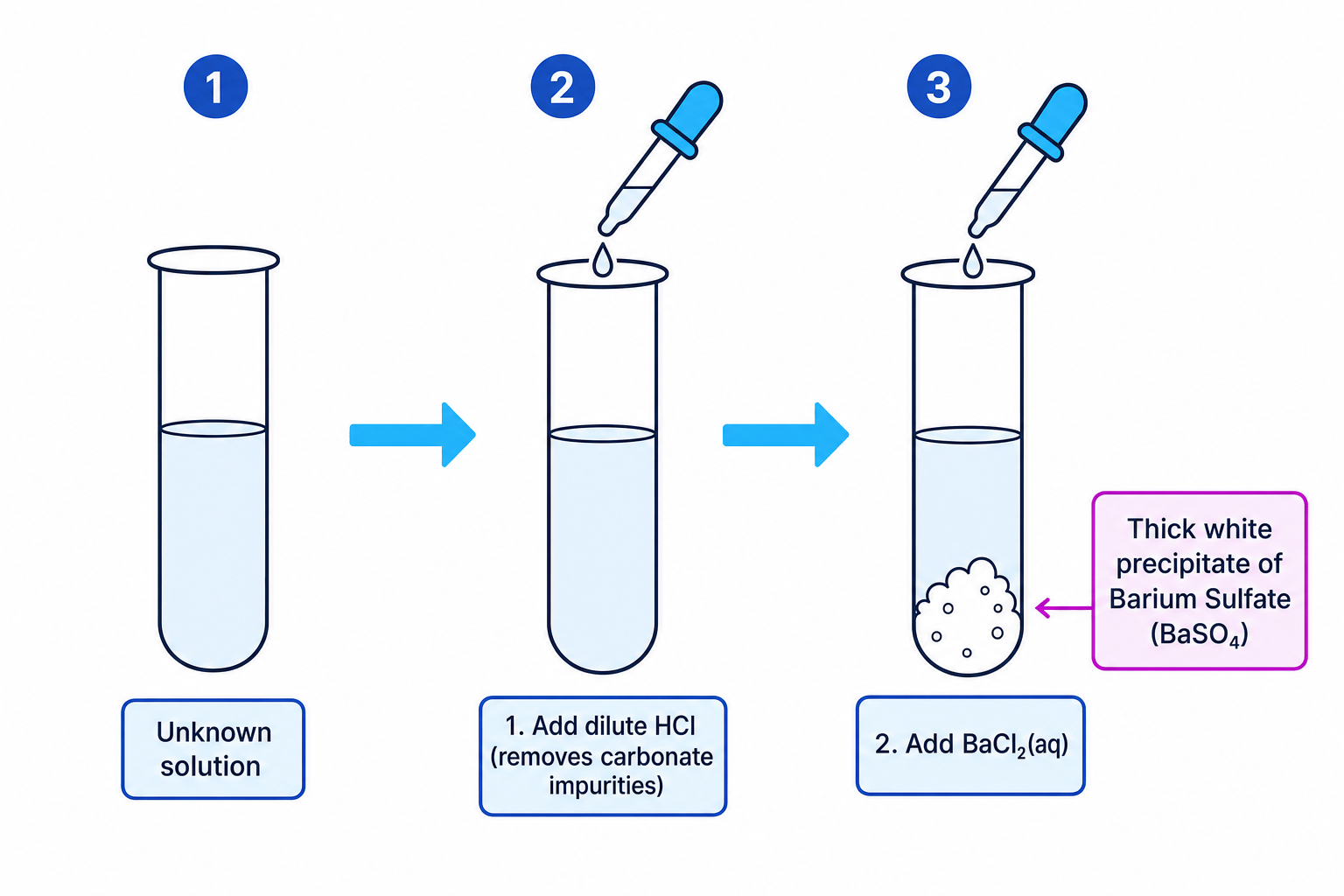
To carry out the test:
- Add a small volume of dilute hydrochloric acid (or dilute nitric acid) to the unknown solution.
- Add a few drops of barium chloride solution (BaCl2\text{BaCl}_2BaCl2).
- If sulfate ions are present, a thick white precipitate of solid barium sulfate instantly forms.
The ionic equation for the positive result is:
Ba(aq)2++SO4(aq)2−→BaSO4(s) \text{Ba}^{2+}_{(aq)} + \text{SO}^{2-}_{4(aq)} \to \text{BaSO}_{4(s)} Ba(aq)2++SO4(aq)2−→BaSO4(s)Acidifying the sulfate test
Students often forget to explain why the acid is added first. The acid is there to react with and remove any carbonate (CO32−\text{CO}_3^{2-}CO32−) or sulfite ions that might be hiding in the unknown solution. If you didn't add the acid, the barium ions would react with the carbonate ions to form barium carbonate (BaCO3\text{BaCO}_3BaCO3), which is also a white precipitate. This would give you a false positive result!
Choosing the right acid
You must never use sulfuric acid (H2SO4\text{H}_2\text{SO}_4H2SO4) to acidify the mixture. Sulfuric acid contains sulfate ions, so adding it would guarantee a massive white precipitate of barium sulfate regardless of what was originally in the test tube! Always use HCl\text{HCl}HCl or HNO3\text{HNO}_3HNO3.
In the exam
- Be precise with state symbols when writing the test for sulfate ions. Barium sulfate is a solid precipitate, so ensure it has an (s)(s)(s) state symbol: BaSO4(s)\text{BaSO}_{4(s)}BaSO4(s).
- Read the water question carefully. If a question asks about magnesium reacting with water, write the equation producing Mg(OH)2\text{Mg(OH)}_2Mg(OH)2. If it specifically asks about steam, ensure you write the equation producing MgO\text{MgO}MgO.
- Link melting point to distance. When explaining the decreasing melting point trend, always explicitly mention the increasing distance between the positive metal ions and the delocalised electrons.
Check yourself
- Why does atomic radius increase as you go down Group 2, despite the nuclear charge increasing?
- What are the differing products when magnesium reacts with cold water versus when it reacts with steam?
- Which is more soluble in water: magnesium hydroxide or barium hydroxide?
- Why is barium sulfate safe to consume in a "barium meal" given that barium is highly toxic?
- Why must you add dilute HCl\text{HCl}HCl or HNO3\text{HNO}_3HNO3 before testing a solution for sulfate ions?
