

Welcome to the preparation of amines! Amines are incredibly versatile nitrogen-containing compounds used to manufacture everything from polymers and pharmaceuticals to synthetic dyes. In this section, we will look at how to build them in the lab and in industry.
What you'll learn:
- How to synthesize primary aliphatic amines from halogenoalkanes and nitriles.
- Why making amines from nitriles often yields a purer product.
- How to prepare aromatic amines from nitro compounds, and what they are used for.
Making Aliphatic Amines from Halogenoalkanes
We can prepare primary aliphatic amines directly by reacting a halogenoalkane with ammonia (NH3\text{NH}_3NH3).
Because the nitrogen atom in ammonia has a lone pair of electrons, it acts as a nucleophile. It attacks the electron-deficient (δ+\delta^+δ+) carbon atom in the halogenoalkane.
Nucleophile
A nucleophile is an electron-pair donor. It is a species that is attracted to an electron-deficient centre, where it donates a pair of electrons to form a new covalent bond.
Reagents and conditions
To make this reaction work efficiently, we heat the halogenoalkane with excess ethanolic ammonia in a sealed copper tube under pressure. We use ethanol as the solvent rather than water. If we used water, the halogenoalkane could undergo a hydrolysis reaction with the water to form an alcohol instead.
Here is the nucleophilic substitution mechanism for the reaction between bromoethane and ammonia:
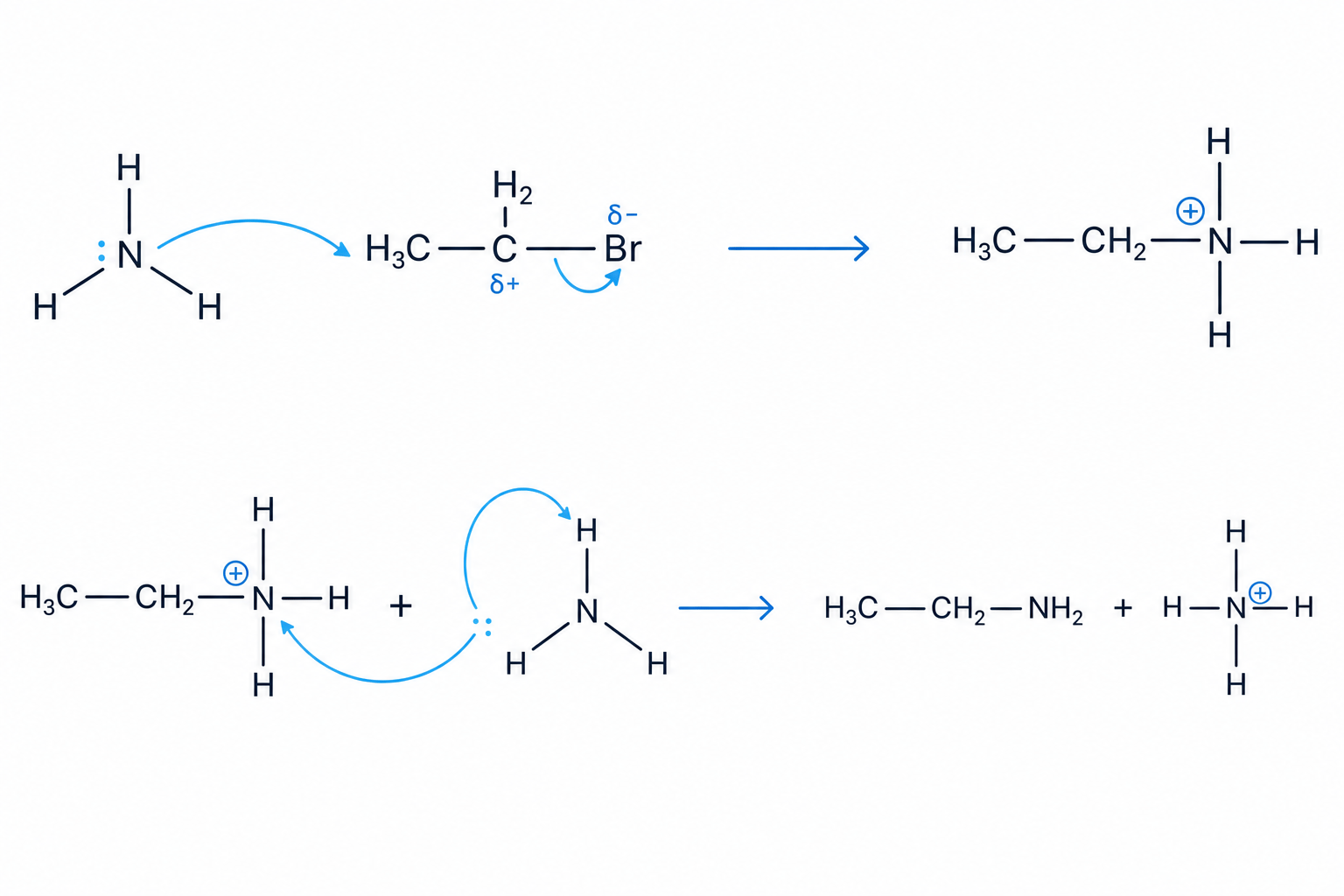
Notice that the reaction happens in two stages. First, an ammonia molecule attacks the bromoethane to form an intermediate ethylammonium ion. Then, a second ammonia molecule acts as a base (a proton acceptor) to remove a hydrogen ion from the intermediate, generating the primary amine (ethylamine) and an ammonium ion (NH4+\text{NH}_4^+NH4+).
Forgetting the excess ammonia
A very common error is failing to specify that the ammonia must be in excess. If you don't use excess ammonia, the primary amine you just made (which also has a lone pair on its nitrogen) will act as a nucleophile itself, attacking unreacted halogenoalkane molecules to form secondary and tertiary amines.
Making Aliphatic Amines from Nitriles
Because the direct reaction with a halogenoalkane can lead to a messy mixture of primary, secondary, and tertiary amines, chemists often prefer an alternative two-step route: converting a halogenoalkane into a nitrile, and then reducing the nitrile.
Step 1: Forming the nitrile
First, the halogenoalkane is reacted with potassium cyanide (KCN\text{KCN}KCN) dissolved in aqueous ethanol. The mixture is heated under reflux. The cyanide ion (CN−\text{CN}^-CN−) acts as a nucleophile, replacing the halogen to form a nitrile.
Extending the carbon chain
Reacting a halogenoalkane with a cyanide ion adds a carbon atom to the molecule. This is an incredibly useful synthetic tool if you need to build a longer carbon chain! For example, bromoethane (2 carbons) reacts with KCN\text{KCN}KCN to form propanenitrile (3 carbons).
Step 2: Reducing the nitrile
Once we have our nitrile, we need to convert the carbon-nitrogen triple bond (C≡N\text{C}\equiv\text{N}C≡N) into a single bond (C-N\text{C-N}C-N) while adding hydrogen atoms. This is a reduction reaction.
There are two main ways to reduce a nitrile to a primary amine:
1. Catalytic hydrogenation (Industrial preference) Hydrogen gas (H2\text{H}_2H2) and a nickel (Ni\text{Ni}Ni) catalyst are added to the nitrile at a high temperature and pressure.
CH3CH2CN+2H2→CH3CH2CH2NH2 \text{CH}_3\text{CH}_2\text{CN} + 2\text{H}_2 \to \text{CH}_3\text{CH}_2\text{CH}_2\text{NH}_2 CH3CH2CN+2H2→CH3CH2CH2NH2This is the preferred method in industry because it is cheaper and greener; the only byproduct is empty space, and hydrogen gas is relatively inexpensive.
2. Chemical reduction (Laboratory preference) The nitrile is reduced using a strong reducing agent called lithium tetrahydridoaluminate (LiAlH4\text{LiAlH}_4LiAlH4), dissolved in a non-aqueous solvent like dry ether. This is followed by the addition of some dilute acid.
CH3CH2CN+4[H]→CH3CH2CH2NH2 \text{CH}_3\text{CH}_2\text{CN} + 4\text{[H]} \to \text{CH}_3\text{CH}_2\text{CH}_2\text{NH}_2 CH3CH2CN+4[H]→CH3CH2CH2NH2Here, we use [H]\text{[H]}[H] in the equation to represent hydrogen from the reducing agent. This method is too expensive for large-scale industrial use, but it is excellent for small-scale lab work.
Designing a synthesis pathway for propylamine
Suppose you need to synthesize a pure sample of propylamine (CH3CH2CH2NH2\text{CH}_3\text{CH}_2\text{CH}_2\text{NH}_2CH3CH2CH2NH2). Evaluate the choice between using 1-bromopropane or bromoethane as your starting organic material.
- First, check the carbon chain lengths. Propylamine has a 3-carbon chain. 1-bromopropane also has a 3-carbon chain. Bromoethane has a 2-carbon chain.
- Evaluate the 1-bromopropane route. We could react 1-bromopropane directly with excess ammonia. While this works in a single step, the resulting propylamine can act as a nucleophile, reacting with further 1-bromopropane to form secondary and tertiary amine impurities. The yield of pure primary amine is reduced.
- Evaluate the bromoethane route. We can react bromoethane with KCN\text{KCN}KCN to form propanenitrile, extending the carbon chain from 2 to 3.
- Select the final step for the bromoethane route. Reducing the propanenitrile (using H2\text{H}_2H2 / Ni\text{Ni}Ni) yields propylamine. Because there are no halogenoalkanes left in the second step, the primary amine cannot undergo further substitution. This two-step route gives a much purer yield of the primary amine.
Making Aromatic Amines from Nitro Compounds
Aromatic amines, like phenylamine (C6H5NH2\text{C}_6\text{H}_5\text{NH}_2C6H5NH2), have the amine group directly attached to a benzene ring. We cannot make these using nucleophilic substitution because the electron-rich delocalised ring repels incoming nucleophiles. Instead, we prepare them by reducing aromatic nitro compounds.
The reduction of nitrobenzene
To make phenylamine, we start with nitrobenzene (C6H5NO2\text{C}_6\text{H}_5\text{NO}_2C6H5NO2). The reduction is carried out by heating nitrobenzene under reflux with a mixture of tin (Sn\text{Sn}Sn) and concentrated hydrochloric acid (HCl\text{HCl}HCl).
Tin and hydrochloric acid react to generate hydrogen in situ, which reduces the nitro group (-NO2\text{-NO}_2-NO2) to an amine group (-NH2\text{-NH}_2-NH2). The overall equation using [H]\text{[H]}[H] for the reducing agent is:
C6H5NO2+6[H]→C6H5NH2+2H2O \text{C}_6\text{H}_5\text{NO}_2 + 6\text{[H]} \to \text{C}_6\text{H}_5\text{NH}_2 + 2\text{H}_2\text{O} C6H5NO2+6[H]→C6H5NH2+2H2O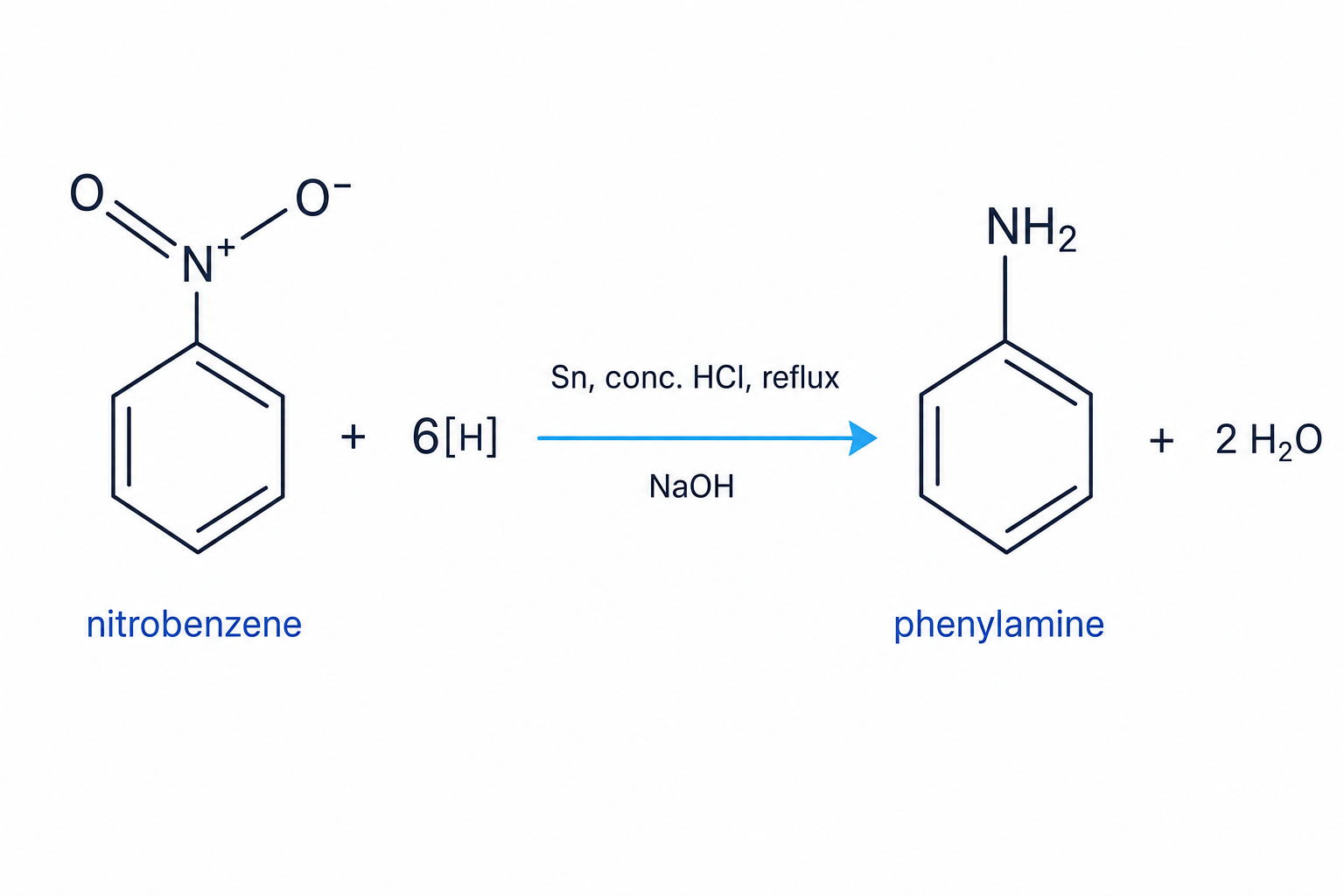
Because the reaction takes place in heavily acidic conditions (concentrated HCl\text{HCl}HCl), the amine is initially protonated to form a salt, phenylammonium chloride (C6H5NH3+Cl−\text{C}_6\text{H}_5\text{NH}_3^+\text{Cl}^-C6H5NH3+Cl−).
To liberate the free, neutral amine, we must cool the mixture and add a strong alkali, such as sodium hydroxide (NaOH\text{NaOH}NaOH).
C6H5NH3+Cl−+NaOH→C6H5NH2+H2O+NaCl \text{C}_6\text{H}_5\text{NH}_3^+\text{Cl}^- + \text{NaOH} \to \text{C}_6\text{H}_5\text{NH}_2 + \text{H}_2\text{O} + \text{NaCl} C6H5NH3+Cl−+NaOH→C6H5NH2+H2O+NaClUses of aromatic amines
Why go through the trouble of making phenylamine? Aromatic amines are highly prized in chemical industry as precursors for making azo dyes. These are brightly coloured synthetic compounds used extensively to dye fabrics, plastics, and paints.
In the exam
- If an exam question asks for the conditions required to favour a primary aliphatic amine over secondary/tertiary amines, write excess ammonia. Do not just write "ammonia".
- Watch out for chain lengths! If a question asks you to make butylamine (C4\text{C}_4C4) from a halogenoalkane via a nitrile, you must start with a propyl (C3\text{C}_3C3) halogenoalkane, because the cyanide ion adds the fourth carbon.
- For the reduction of nitrobenzene, remember that stating "Sn\text{Sn}Sn and concentrated HCl\text{HCl}HCl" will only earn you the first reagent mark. You must also state that an alkali (like NaOH\text{NaOH}NaOH) is added afterwards to get the final mark.
Check yourself
- What are the reagents and conditions needed to chemically reduce a nitrile to a primary amine in the laboratory?
- Why is the catalytic hydrogenation of nitriles preferred in industry over chemical reduction?
- Write the balanced equation for the reduction of nitrobenzene to phenylamine, using [H]\text{[H]}[H] to represent the reducing agent.
