

What you'll learn
- Why amines are classified as weak bases.
- The critical concept of lone pair availability in determining base strength.
- How the positive inductive effect makes primary aliphatic amines stronger bases than ammonia.
- How electron delocalisation makes primary aromatic amines weaker bases than ammonia.
Why are amines basic?
Amines are derivatives of ammonia (NH3\text{NH}_3NH3). In an amine, one or more hydrogen atoms have been replaced by an organic group (an alkyl or aryl group).
Just like ammonia, the nitrogen atom in an amine has a lone pair of electrons. Because it can use this lone pair to accept a proton (H+\text{H}^+H+), an amine acts as a base.
Brønsted–Lowry Base
A species that acts as a proton acceptor. It must have a lone pair of electrons that can be used to form a dative covalent (coordinate) bond with an H+\text{H}^+H+ ion.
When dissolved in water, amines accept a proton to form a positively charged alkylammonium ion and a hydroxide ion. For example, with a general primary amine (RNH2\text{RNH}_2RNH2):
RNH2+H2O⇌RNH3++OH− \text{RNH}_2 + \text{H}_2\text{O} \rightleftharpoons \text{RNH}_3^+ + \text{OH}^- RNH2+H2O⇌RNH3++OH−Amines are weak bases. This means the equilibrium lies heavily to the left; only a small proportion of the amine molecules react with water to accept a proton at any one time.
The golden rule of amine base strength
Not all amines have the same base strength. In fact, altering the group attached to the nitrogen changes how well the amine acts as a base.
Lone Pair Availability
The base strength of an amine depends entirely on the availability of the lone pair of electrons on the nitrogen atom. The higher the electron density on the nitrogen, the more readily its lone pair can attract and accept a proton, making it a stronger base.
To figure out if an amine is a stronger or weaker base than ammonia, you just need to look at whether the attached organic group pushes electrons towards the nitrogen or pulls electrons away from it.
Primary aliphatic amines: The electron pushers
Aliphatic amines have alkyl groups (like methyl, ethyl, or propyl) attached to the nitrogen atom.
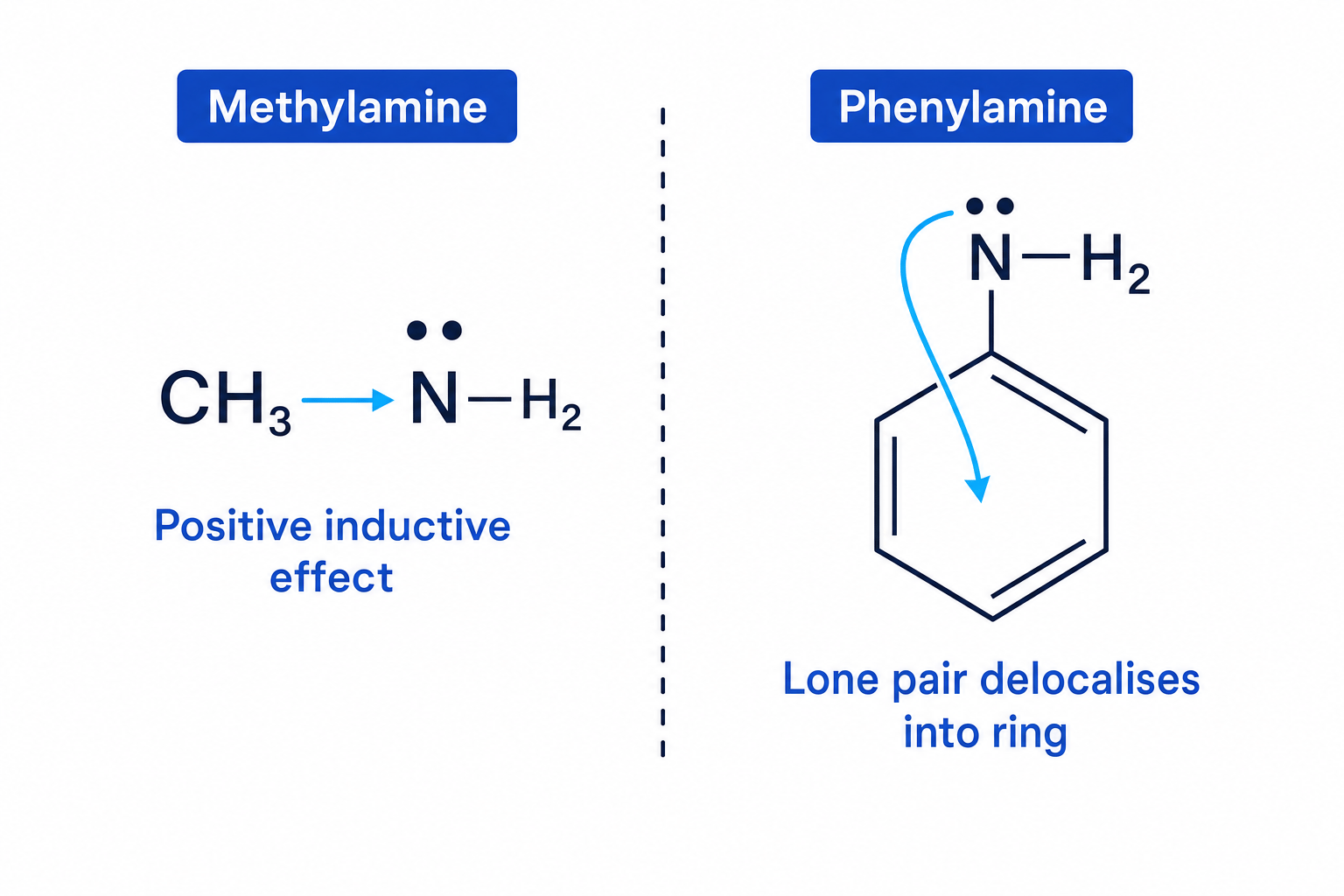
Alkyl groups are "electron-releasing". They push electron density away from themselves and towards the nitrogen atom. This is known as the positive inductive effect.
By pushing extra electron density onto the nitrogen, the alkyl group increases the overall electron density on the nitrogen atom. This makes the lone pair much more attractive to incoming H+\text{H}^+H+ ions.
Because the lone pair is more available, primary aliphatic amines are stronger bases than ammonia.
More carbons, more push?
As you increase the length of the alkyl chain (e.g., from methylamine to ethylamine to propylamine), the base strength increases slightly because longer alkyl chains have a slightly larger positive inductive effect. However, the most significant jump in base strength is always between ammonia (no alkyl groups) and a primary aliphatic amine.
Primary aromatic amines: The electron pullers
Aromatic amines, like phenylamine (C6H5NH2\text{C}_6\text{H}_5\text{NH}_2C6H5NH2), have a benzene ring attached directly to the nitrogen atom.
Benzene rings contain a delocalised ring of pi electrons. When an NH2\text{NH}_2NH2 group is attached directly to the ring, the lone pair of electrons on the nitrogen atom partially delocalises into the ring's pi system.
Because the lone pair is being pulled into the ring, the electron density on the nitrogen atom decreases significantly. This makes the lone pair much less available to attract a proton.
As a result, primary aromatic amines are weaker bases than ammonia.
Confusing the direction of electron flow
A very common mistake is mixing up which group does what. Remember:
- Alkyl groups push electrons towards the nitrogen (increasing base strength).
- Benzene rings pull electrons away from the nitrogen (decreasing base strength).
Putting it all together
If you are asked to rank amines by their base strength, you can reliably use this hierarchy (from strongest to weakest base):
- Primary aliphatic amines (e.g., ethylamine) — highest electron density on N due to the positive inductive effect.
- Ammonia (NH3\text{NH}_3NH3) — the baseline. No inductive effect, but no delocalisation either.
- Primary aromatic amines (e.g., phenylamine) — lowest electron density on N because the lone pair delocalises into the benzene ring.
Deducing relative base strength
A student prepares 0.10 mol dm−30.10 \text{ mol dm}^{-3}0.10 mol dm−3 aqueous solutions of methylamine (CH3NH2\text{CH}_3\text{NH}_2CH3NH2) and phenylamine (C6H5NH2\text{C}_6\text{H}_5\text{NH}_2C6H5NH2). Explain which solution will have the higher pH.
- State which amine is the stronger base. Methylamine is a primary aliphatic amine, whereas phenylamine is a primary aromatic amine. Methylamine is the stronger base.
- Explain the electron-releasing effect for the stronger base. The methyl (CH3\text{CH}_3CH3) group in methylamine exerts a positive inductive effect, pushing electron density towards the nitrogen atom.
- Explain the electron-withdrawing effect for the weaker base. In phenylamine, the lone pair of electrons on the nitrogen atom delocalises into the pi system of the benzene ring.
- Compare lone pair availability. Because of the inductive effect, the electron density on the nitrogen in methylamine is higher, making its lone pair more available to accept a proton (H+\text{H}^+H+) than the lone pair in phenylamine.
- Link to pH. As a stronger base, methylamine will accept more protons from water, creating a higher concentration of OH−\text{OH}^-OH− ions in solution. Therefore, the methylamine solution will have the higher pH.
Watch out for 'hidden' aromatic amines
For the lone pair to delocalise into the ring, the nitrogen must be attached directly to the benzene ring. If there is a carbon atom between them (e.g., in phenylmethylamine, C6H5CH2NH2\text{C}_6\text{H}_5\text{CH}_2\text{NH}_2C6H5CH2NH2), the lone pair cannot overlap with the pi system. This molecule would behave like an aliphatic amine, not an aromatic one!
In the exam
- When answering base strength questions, you must always explicitly mention the "availability of the lone pair on the nitrogen atom" — this is usually a standalone marking point.
- Use the exact phrase "positive inductive effect" when discussing aliphatic amines.
- Use the exact phrase "lone pair delocalises into the benzene ring" (or "pi system") when discussing aromatic amines.
- Ensure you state both sides of the comparison (e.g., talk about both the alkyl group and the lack thereof in ammonia) to secure full marks in explanation questions.
Check yourself
- What feature of an amine molecule allows it to act as a Brønsted-Lowry base?
- Place the following in order of increasing base strength: ammonia, propylamine, phenylamine.
- Why does the positive inductive effect make an aliphatic amine a stronger base?
- What happens to the nitrogen's lone pair in an aromatic amine?
