

Welcome to one of the most important classes of reaction in aromatic chemistry! In this topic, we will look at how the stable benzene ring reacts.
What you'll learn:
- Why benzene undergoes substitution reactions rather than addition reactions.
- How to draw the mechanism for electrophilic aromatic substitution.
- The reagents, conditions, and mechanisms for nitration and Friedel–Crafts acylation.
- How to write the equations for generating the electrophiles in these reactions.
Why does benzene undergo substitution?
Benzene has a delocalised ring of π\piπ (pi) electrons above and below the plane of its carbon atoms. This ring is extremely stable.
If benzene were to undergo an addition reaction (like an alkene does), the delocalised ring would be permanently broken, and that special thermodynamic stability would be lost. Instead, benzene prefers to undergo substitution.
Electrophilic substitution
A reaction where an electrophile (an electron-pair acceptor) replaces an atom — usually a hydrogen atom — on an aromatic ring.
Because the delocalised ring is an area of high electron density, it naturally attracts electrophiles. When the electrophile attacks, the delocalised ring temporarily breaks to form an intermediate. However, the ring is quickly restored when a hydrogen atom is kicked out as an H+\text{H}^+H+ ion. At A-Level, we restrict our focus to monosubstitutions (replacing just one hydrogen atom at a time).
Reaction 1: Nitration
Nitration replaces a hydrogen atom on the benzene ring with a nitro group (-NO2\text{-NO}_2-NO2).
Why is nitration important?
Nitration is a crucial step in industrial organic synthesis. It is used to manufacture explosives (like TNT, trinitrotoluene) and to make aromatic amines (which are further used to manufacture industrial dyes).
Reagents and conditions
To nitrate benzene, you must heat it with a mixture of two concentrated acids:
- Reagents: Concentrated nitric acid (HNO3\text{HNO}_3HNO3) and concentrated sulfuric acid (H2SO4\text{H}_2\text{SO}_4H2SO4).
- Conditions: 50 ∘C50\text{ }^\circ\text{C}50 ∘C.
Temperature control
If the temperature rises much above 50 ∘C50\text{ }^\circ\text{C}50 ∘C, you risk multiple substitutions occurring (such as forming dinitrobenzene). Keeping the temperature strictly at 50 ∘C50\text{ }^\circ\text{C}50 ∘C ensures you primarily get a monosubstitution.
Generating the electrophile
The actual electrophile in this reaction is the nitronium ion, NO2+\text{NO}_2^+NO2+. Nitric acid alone is not a strong enough acid to generate this effectively, which is why we add concentrated sulfuric acid.
Here, sulfuric acid is a stronger acid than nitric acid, so it forces nitric acid to act as a base (a proton acceptor):
HNO3+H2SO4⇌H2NO3++HSO4− \text{HNO}_3 + \text{H}_2\text{SO}_4 \rightleftharpoons \text{H}_2\text{NO}_3^+ + \text{HSO}_4^- HNO3+H2SO4⇌H2NO3++HSO4−The protonated nitric acid is unstable and immediately decomposes to form water and the powerful nitronium ion electrophile:
H2NO3+→NO2++H2O \text{H}_2\text{NO}_3^+ \to \text{NO}_2^+ + \text{H}_2\text{O} H2NO3+→NO2++H2OCombining these gives the overall generation equation you should memorise:
HNO3+H2SO4→NO2++HSO4−+H2O \text{HNO}_3 + \text{H}_2\text{SO}_4 \to \text{NO}_2^+ + \text{HSO}_4^- + \text{H}_2\text{O} HNO3+H2SO4→NO2++HSO4−+H2OThe Nitration Mechanism
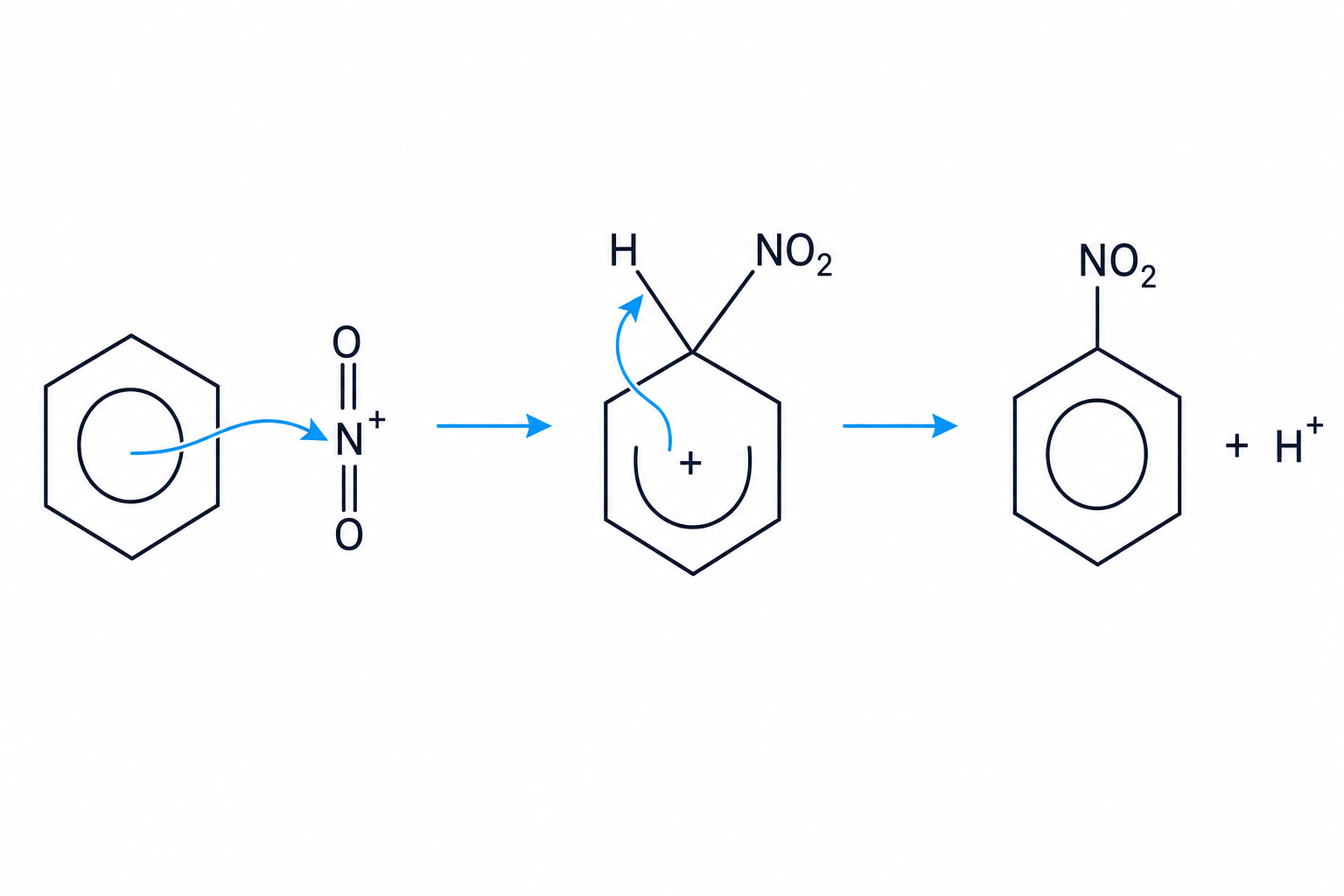
Here is exactly what is happening in the mechanism steps:
- Attack: A pair of electrons from the delocalised π\piπ ring moves to the positively charged nitrogen atom on the NO2+\text{NO}_2^+NO2+ ion.
- Intermediate: The delocalised ring is temporarily broken. The intermediate is drawn with a "horseshoe" shaped partial ring and a positive charge in the centre. Both the new -NO2\text{-NO}_2-NO2 group and the old hydrogen atom are currently attached to the same top carbon.
- Restoration: The electrons from the C-H\text{C-H}C-H bond move back into the ring. The delocalised system is restored, nitrobenzene is formed, and an H+\text{H}^+H+ ion is released.
Drawing the horseshoe
When drawing the unstable intermediate, the open gap of the "horseshoe" must face the carbon atom where the substitution is taking place. The horseshoe should comfortably span the other 5 carbon atoms. Do not close the circle, and make sure the positive charge (+++) is drawn inside the horseshoe, not outside it!
Reaction 2: Friedel–Crafts Acylation
Friedel–Crafts acylation replaces a hydrogen atom on the benzene ring with an acyl group (R-C=O\text{R-C=O}R-C=O).
Why is acylation important?
Acylation allows chemists to add carbon atoms to the benzene ring. Forming new carbon-carbon bonds is one of the most difficult and important tasks in organic synthesis, allowing us to build larger, more complex molecules.
Reagents and conditions
- Reagents: An acyl chloride (e.g., ethanoyl chloride, CH3COCl\text{CH}_3\text{COCl}CH3COCl) and an aluminium chloride catalyst (AlCl3\text{AlCl}_3AlCl3).
- Conditions: Anhydrous (dry) conditions.
Generating the electrophile
The electrophile is an acylium ion (e.g., CH3CO+\text{CH}_3\text{CO}^+CH3CO+). The polar C-Cl\text{C-Cl}C-Cl bond in the acyl chloride is not reactive enough on its own to break the stable benzene ring.
We use AlCl3\text{AlCl}_3AlCl3 as a halogen carrier. The aluminium atom in AlCl3\text{AlCl}_3AlCl3 is electron-deficient, so it aggressively accepts a lone pair from the chlorine atom of the acyl chloride, breaking the C-Cl\text{C-Cl}C-Cl bond:
CH3COCl+AlCl3→CH3CO++AlCl4− \text{CH}_3\text{COCl} + \text{AlCl}_3 \to \text{CH}_3\text{CO}^+ + \text{AlCl}_4^- CH3COCl+AlCl3→CH3CO++AlCl4−The Acylation Mechanism
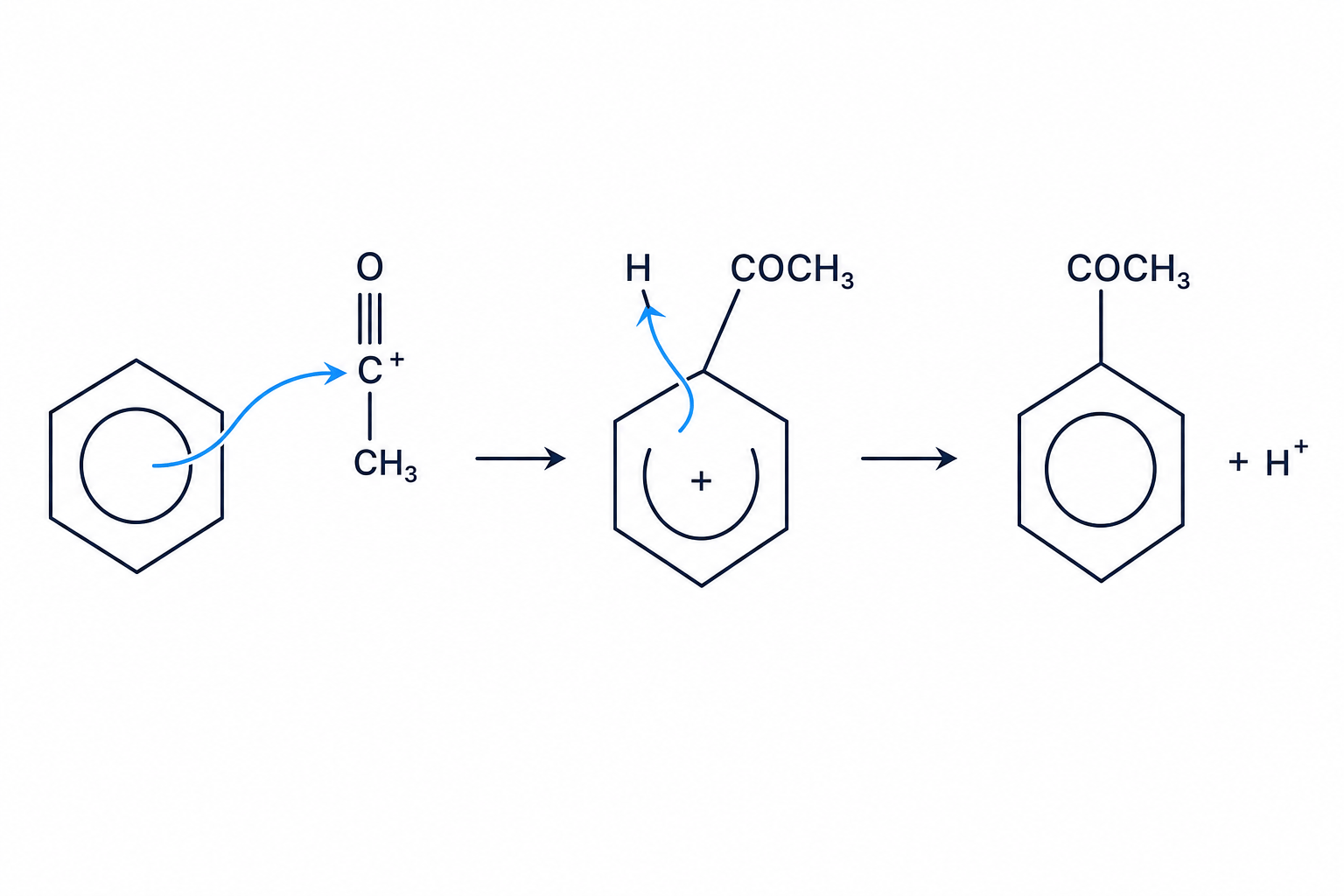
The mechanism follows the exact same logic as nitration:
- Electrons from the delocalised ring attack the positively charged carbon on the acylium ion.
- The horseshoe intermediate forms.
- The C-H\text{C-H}C-H bond breaks, throwing its electrons back into the ring to restore stability, ejecting an H+\text{H}^+H+ ion.
Regenerating the catalyst
Because AlCl3\text{AlCl}_3AlCl3 is a catalyst, it must be regenerated at the end of the reaction. The H+\text{H}^+H+ ion kicked out of the benzene ring reacts with the AlCl4−\text{AlCl}_4^-AlCl4− ion formed earlier:
H++AlCl4−→AlCl3+HCl \text{H}^+ + \text{AlCl}_4^- \to \text{AlCl}_3 + \text{HCl} H++AlCl4−→AlCl3+HClNotice that misty white fumes of hydrogen chloride (HCl\text{HCl}HCl) gas are produced as a byproduct of this reaction.
Deducing equations for Friedel-Crafts acylation
Suppose you need to synthesise 1-phenylpropan-1-one (C6H5COCH2CH3\text{C}_6\text{H}_5\text{COCH}_2\text{CH}_3C6H5COCH2CH3) from benzene. Write the equations showing the generation of the electrophile and the regeneration of the catalyst.
- Identify the necessary acyl group. To make 1-phenylpropan-1-one, we need to attach a propanoyl group. This means we must start with propanoyl chloride (CH3CH2COCl\text{CH}_3\text{CH}_2\text{COCl}CH3CH2COCl) and AlCl3\text{AlCl}_3AlCl3.
- Write the equation for generating the electrophile. The AlCl3\text{AlCl}_3AlCl3 removes the chloride ion from propanoyl chloride:
- Write the catalyst regeneration step. The H+\text{H}^+H+ ion released during the substitution mechanism reacts with the complex ion:
A Note on Practical Skills
You may carry out a nitration in the lab — a common experiment is the nitration of methyl benzoate to produce methyl 3-nitrobenzoate. Because the product is a solid at room temperature, it provides an excellent opportunity to practice purification.
You would purify the crude product using recrystallisation (dissolving the product in the minimum volume of hot solvent, letting it cool to form pure crystals, and filtering under reduced pressure). Finally, you would determine its melting point to check its purity; a narrow melting point range that matches the data book value indicates a pure sample.
In the exam
- Perfect your curly arrows: The arrow from the intermediate back into the ring must start clearly from the middle of the C-H\text{C-H}C-H bond, and point clearly inside the positive horseshoe.
- Identify the catalyst role: Examiners love asking about the role of AlCl3\text{AlCl}_3AlCl3. It is a catalyst, but specifically acts as a Lewis acid (electron pair acceptor) to generate the electrophile.
- Acid-base roles in nitration: Be ready to state that in the nitration mixture, H2SO4\text{H}_2\text{SO}_4H2SO4 acts as an acid (donates a proton) and HNO3\text{HNO}_3HNO3 acts as a base (accepts a proton).
Check yourself
- Why is the intermediate in electrophilic substitution drawn with an incomplete circle?
- What are the reagents and conditions strictly required for the mononitration of benzene?
- Write down the overall equation for the generation of the nitronium ion from nitric and sulfuric acids.
- Why does Friedel-Crafts acylation have significant value in industrial organic synthesis?
