

What you'll learn
- How atomic radius changes from Na to Ar, and why.
- Why first ionisation energy generally increases, with two important dips.
- How melting point depends on the structure and bonding in each element.
- How to turn a trend into a clear exam explanation.
The Period 3 setting
The Period 3 elements are:
Na, Mg, Al, Si, P, S, Cl, Ar
A period is a horizontal row in the Periodic Table. Across Period 3, the proton number — the number of protons in the nucleus — increases by one each time.
All Period 3 elements have their outer electrons in the third principal shell, which is the main energy level labelled 3. Within that shell, electrons occupy subshells, such as 3s and 3p. A subshell contains orbitals, which are regions that can each hold up to two electrons.
The outer electron configurations are:
- Na: [Ne]3s1\text{[Ne]}3s^1[Ne]3s1
- Mg: [Ne]3s2\text{[Ne]}3s^2[Ne]3s2
- Al: [Ne]3s23p1\text{[Ne]}3s^2 3p^1[Ne]3s23p1
- Si: [Ne]3s23p2\text{[Ne]}3s^2 3p^2[Ne]3s23p2
- P: [Ne]3s23p3\text{[Ne]}3s^2 3p^3[Ne]3s23p3
- S: [Ne]3s23p4\text{[Ne]}3s^2 3p^4[Ne]3s23p4
- Cl: [Ne]3s23p5\text{[Ne]}3s^2 3p^5[Ne]3s23p5
- Ar: [Ne]3s23p6\text{[Ne]}3s^2 3p^6[Ne]3s23p6
Shielding and effective nuclear charge
Shielding is the reduction in attraction between the nucleus and an outer electron caused by repulsion from inner-shell electrons. The effective nuclear charge, often written as ZeffZ_\text{eff}Zeff, is the net positive pull felt by an outer electron after shielding is considered.
Across Period 3, nuclear charge increases because there are more protons. The extra electrons are added to the same principal shell, so shielding does not increase very much. This is the key idea behind the atomic radius and first ionisation energy trends.
The diagram below summarises the three shapes you need to be able to explain.
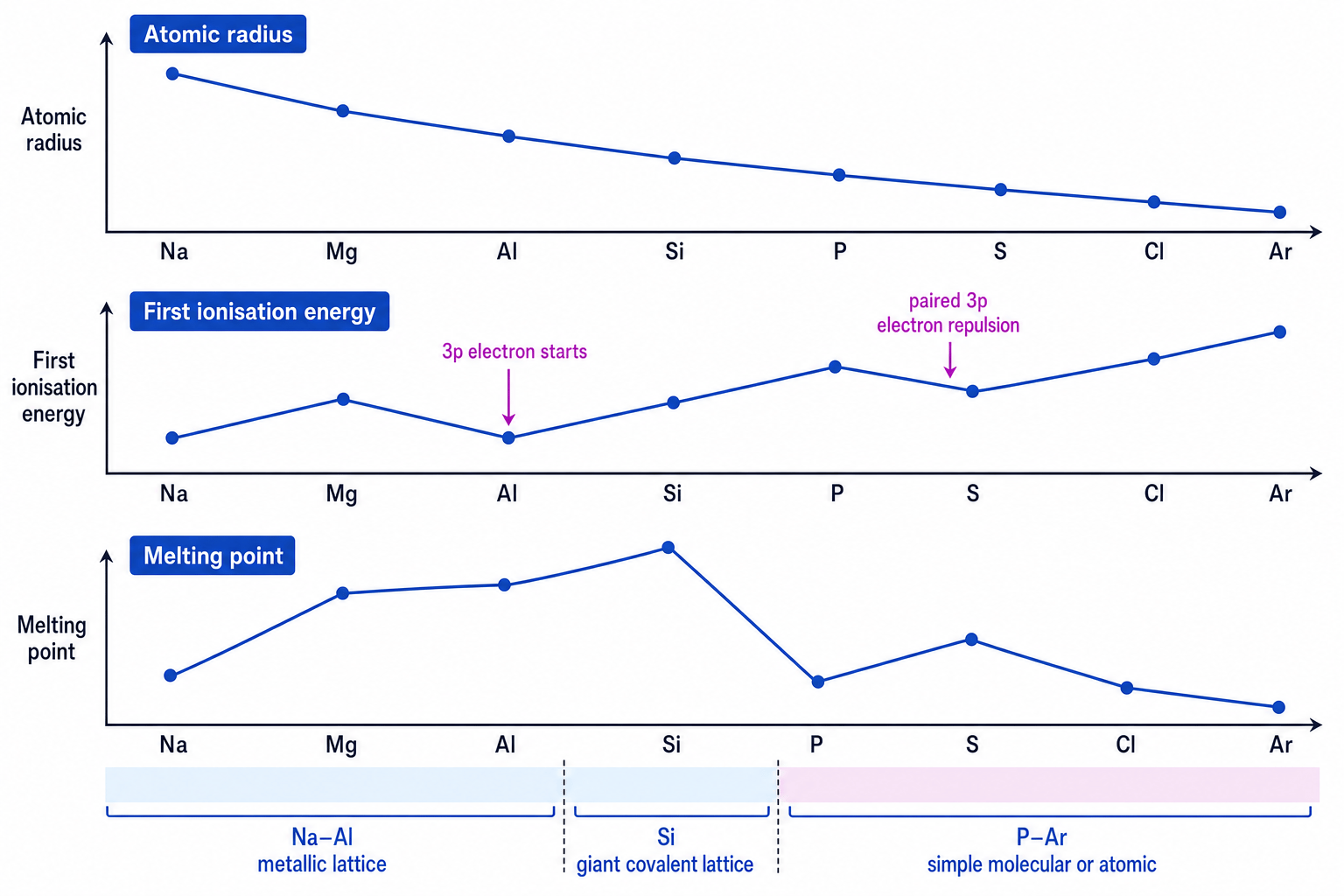
Atomic radius: atoms get smaller across the period
Atomic radius
Atomic radius is a measure of the size of an atom, usually based on the distance from the nucleus to the outer electron shell. In practice, quoted radii are measured from distances between neighbouring atoms.
From Na to Ar, atomic radius decreases.
This might feel odd at first because electrons are being added. However, the extra electrons are being added to the same principal shell. The number of inner shells stays the same, so shielding is fairly similar.
At the same time, the number of protons increases. The stronger nuclear attraction pulls the outer electrons closer to the nucleus, so the atom becomes smaller.
More electrons does not always mean a bigger atom
Across a period, do not simply say “there are more electrons, so the atom is bigger”. The stronger nuclear attraction is more important because the added electrons enter the same shell.
Explaining the decrease in atomic radius
-
Compare the nuclei: chlorine has more protons than sodium, so chlorine has a greater nuclear charge.
-
Compare the electron shells: the outer electrons in both atoms are in the third principal shell, so the increase in shielding is small.
-
Apply the attraction: the greater nuclear charge attracts the outer electrons more strongly, pulling the electron cloud closer to the nucleus.
-
Conclude the trend: chlorine has a smaller atomic radius than sodium, and the radius decreases across Period 3.
First ionisation energy
First ionisation energy
The first ionisation energy is the enthalpy change when one mole of gaseous atoms each loses one electron to form one mole of gaseous 1+ ions.
For an element X:
X(g)→X+(g)+e−\text{X(g)} \to \text{X}^+\text{(g)} + \text{e}^-X(g)→X+(g)+e−The units are kJ mol⁻¹.
First ionisation energy measures how difficult it is to remove the outermost electron from a neutral gaseous atom.
It depends mainly on:
- nuclear charge: more protons attract electrons more strongly;
- distance from the nucleus: electrons further away are easier to remove;
- shielding: more shielding weakens the attraction;
- electron repulsion within orbitals: paired electrons repel each other.
State symbols matter
In the definition and equation for first ionisation energy, the atoms and ions must be gaseous. Do not use Na(s), Cl₂(g), or aqueous ions.
The general increase
From Na to Ar, first ionisation energy generally increases.
This is linked to the atomic radius trend. Across the period, atomic radius decreases, so the outer electron is closer to the nucleus. The nuclear charge also increases, while shielding stays fairly similar. Therefore, more energy is needed to remove the outer electron.
The dip from Mg to Al
Mg has the outer configuration [Ne]3s2\text{[Ne]}3s^2[Ne]3s2.
Al has the outer configuration [Ne]3s23p1\text{[Ne]}3s^2 3p^1[Ne]3s23p1.
The electron removed from aluminium is in a 3p subshell, whereas the electron removed from magnesium is in a 3s subshell. A 3p electron is slightly higher in energy and slightly more shielded than a 3s electron, so it is easier to remove.
That is why Al has a lower first ionisation energy than Mg, even though Al has more protons.
The dip from P to S
P has the outer configuration [Ne]3s23p3\text{[Ne]}3s^2 3p^3[Ne]3s23p3.
S has the outer configuration [Ne]3s23p4\text{[Ne]}3s^2 3p^4[Ne]3s23p4.
In phosphorus, the three 3p electrons occupy separate p orbitals. In sulfur, one 3p orbital contains a pair of electrons. These paired electrons repel each other, making one of them easier to remove.
So S has a slightly lower first ionisation energy than P.
Ionisation energy pattern
First ionisation energy generally increases across Period 3 because nuclear attraction increases, but there are dips at Al and S due to subshell energy and paired-electron repulsion.
Explaining ionisation energy anomalies
-
Compare Mg and Al: Mg loses a 3s electron, while Al loses a 3p electron.
-
Decide which electron is easier to remove: the 3p electron in Al is higher in energy and slightly more shielded than the 3s electron in Mg.
-
Explain the dip: less energy is needed to remove the Al electron, so Al has a lower first ionisation energy than Mg.
-
Compare P and S: P has three separate 3p electrons, while S has one pair of electrons in a 3p orbital.
-
Apply repulsion: the paired electrons in S repel each other, so one is easier to remove, giving S a lower first ionisation energy than P.
Melting point: structure and bonding
Melting point
The melting point is the temperature at which a solid changes into a liquid. For Period 3 explanations, focus on the type and strength of bonding or forces overcome during melting.
A lattice is a regular repeating arrangement of particles. A giant structure is a lattice that extends throughout the solid.
The left panel in the diagram below compares separate metallic lattices for Na, Mg and Al — it is not showing a real mixture of the three metals.
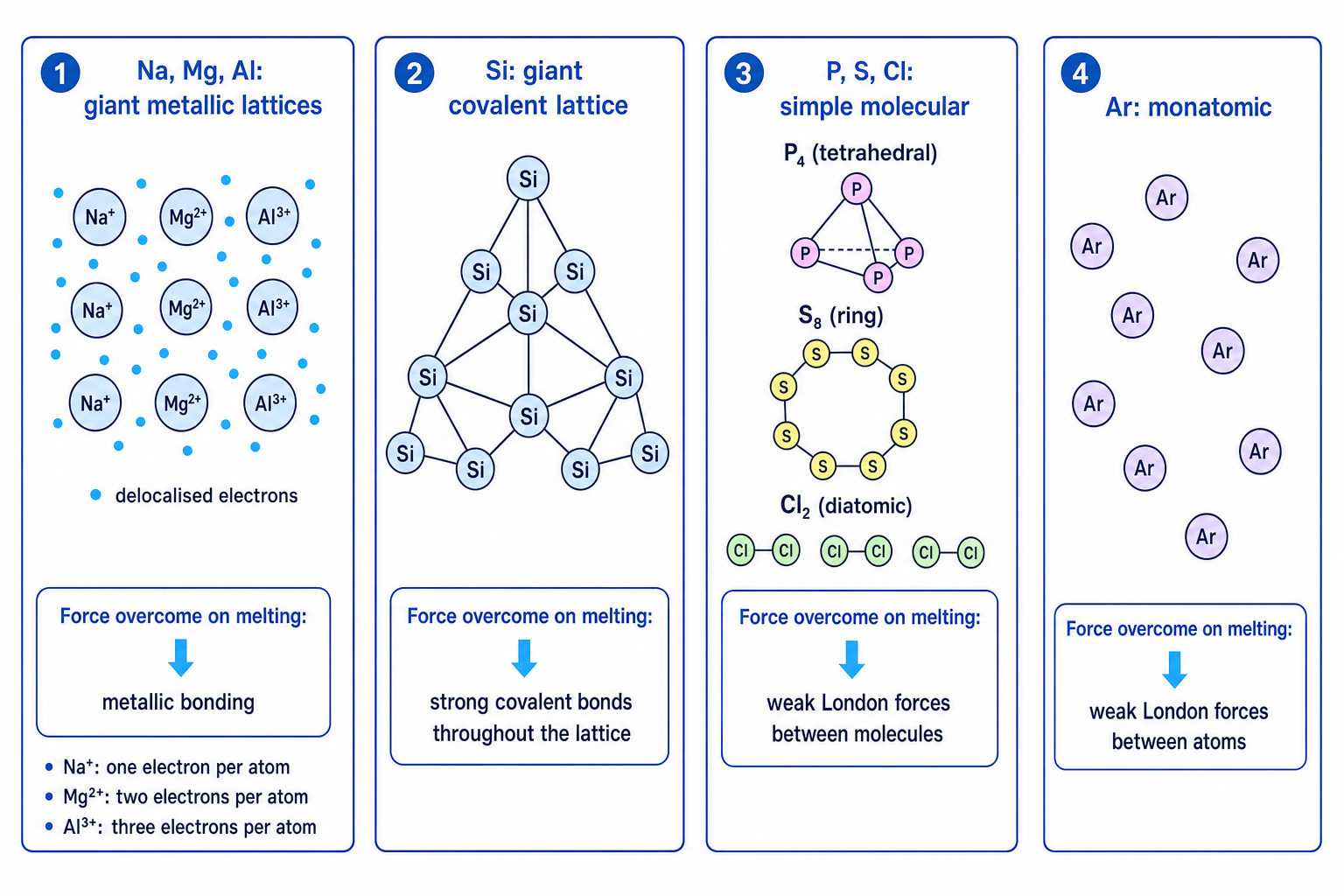
Na, Mg and Al: metallic bonding
Na, Mg and Al are metals. They form giant metallic lattices.
Delocalised electrons are electrons that are free to move through the whole structure. Metallic bonding is the electrostatic attraction between positive metal ions and these delocalised electrons.
From Na to Mg to Al, melting point increases because metallic bonding becomes stronger:
- Na forms Na⁺ ions and contributes one delocalised electron per atom.
- Mg forms Mg²⁺ ions and contributes two delocalised electrons per atom.
- Al forms Al³⁺ ions and contributes three delocalised electrons per atom.
The ions also become smaller and more highly charged, so the attraction between the metal ions and delocalised electrons becomes stronger. More energy is needed to overcome the metallic bonding.
Comparing sodium and magnesium melting points
-
Identify the structures: both sodium and magnesium have giant metallic lattices.
-
Compare the ions and electrons: sodium has Na⁺ ions with one delocalised electron per atom, while magnesium has Mg²⁺ ions with two delocalised electrons per atom.
-
Compare the attraction: Mg²⁺ ions attract the delocalised electrons more strongly than Na⁺ ions do.
-
Conclude the trend: magnesium has stronger metallic bonding, so it has a higher melting point than sodium.
Silicon: a giant covalent lattice
Silicon has a giant covalent lattice. A covalent bond is a shared pair of electrons between atoms.
Each silicon atom is covalently bonded to four other silicon atoms. This creates a huge three-dimensional network.
To melt silicon, many strong covalent bonds throughout the lattice must be broken. This requires a lot of energy, so silicon has the highest melting point in Period 3.
Do not describe silicon as simple molecular
Silicon is not made of small Si molecules. It has a giant covalent lattice, so its high melting point is explained by strong covalent bonds throughout the structure.
P, S, Cl and Ar: simple molecular or atomic substances
Phosphorus, sulfur and chlorine are simple molecular substances, meaning they contain small molecules. Argon is monatomic, meaning it exists as separate atoms.
The structures are:
- phosphorus: P₄ molecules;
- sulfur: S₈ molecules;
- chlorine: Cl₂ molecules;
- argon: separate Ar atoms.
An intermolecular force is an attraction between separate molecules. The main forces here are London forces, which are weak attractions caused by temporary induced dipoles. London forces are present between all atoms and molecules, and they generally get stronger as the number of electrons increases.
When P₄, S₈ or Cl₂ melts, the covalent bonds inside the molecules are not broken. Only the weak London forces between molecules are overcome.
Argon has very weak London forces between atoms, so it has a very low melting point.
Breaking the wrong bonds
For P₄, S₈ and Cl₂, melting does not break the covalent bonds inside the molecules. Melting overcomes weak London forces between the molecules.
Comparing sulfur and phosphorus melting points
-
Identify the particles: phosphorus exists as P₄ molecules, while sulfur exists as S₈ molecules.
-
Identify what is overcome on melting: both are simple molecular substances, so melting overcomes London forces between molecules.
-
Compare molecule size: S₈ has more electrons than P₄, so it has stronger London forces.
-
Conclude the trend: sulfur has a higher melting point than phosphorus because more energy is needed to overcome its stronger London forces.
Melting point storyline
Na to Al increases because metallic bonding strengthens. Si is highest because it has a giant covalent lattice. P, S, Cl and Ar have low melting points because only weak London forces are overcome, with S higher than P because S₈ molecules are larger than P₄ molecules.
In the exam
-
For atomic radius, always link the decrease to increasing nuclear charge, similar shielding, and stronger attraction for the outer electrons.
-
For first ionisation energy, give the general trend first, then explain the two dips: Al starts the 3p subshell, and S has paired 3p electron repulsion.
-
For melting point, identify the structure before explaining the trend: metallic lattice, giant covalent lattice, simple molecular, or monatomic.
-
Be precise about what is overcome on melting: metallic bonding in metals, covalent bonds in silicon, and London forces between particles for P, S, Cl and Ar.
Check yourself
- Why does atomic radius decrease from Na to Ar even though electrons are being added?
- Why is the first ionisation energy of Al lower than Mg, and S lower than P?
- Why does silicon have a much higher melting point than phosphorus, sulfur and chlorine?
