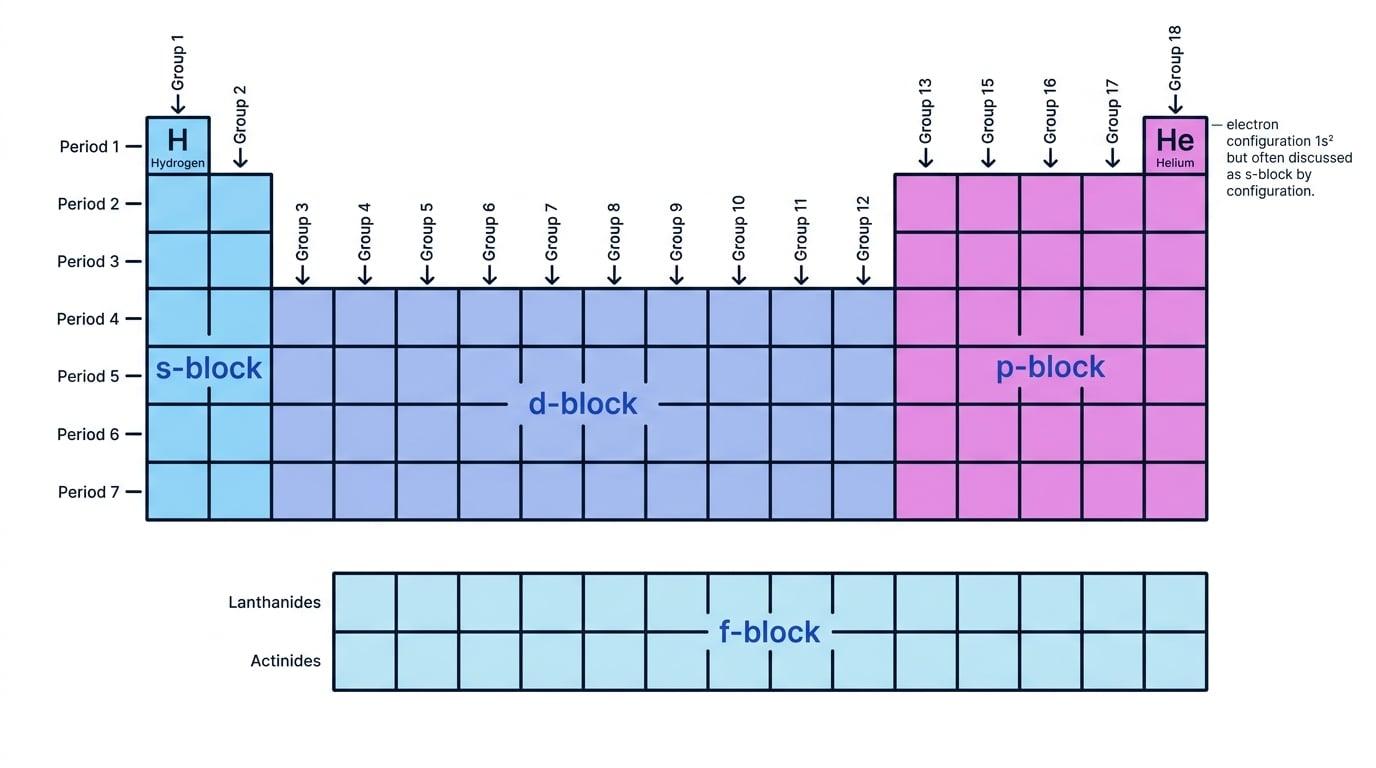
What you'll learn
- How proton number determines an element’s position in the Periodic Table.
- What s-, p-, d- and f-block mean.
- How to classify an element from its position or electron configuration.
- Common exam traps, especially around helium and “atomic mass” wording.
The big picture
The Periodic Table is not just a list of elements. It is a map built around proton number and electron structure.
In this small but important part of Periodicity, you learn how elements are classified into blocks: s-block, p-block, d-block and f-block. This classification helps explain patterns in chemical properties later on, especially in Group 2, Period 3, Group 7 and transition metals.
Elements and proton number
Element
An element is a substance made of atoms that all have the same proton number.
Proton number
The proton number, also called the atomic number, is the number of protons in the nucleus of an atom. It is usually shown by the symbol ZZZ.
For example, every carbon atom has proton number 6. If an atom has 6 protons, it is carbon. If it has 7 protons, it is nitrogen.
The key point is that the proton number defines the element. Different isotopes of the same element have different numbers of neutrons, but they still have the same proton number.
Proton number fixes identity
Changing the number of protons changes the element. Changing the number of neutrons only changes the isotope.
How the Periodic Table is arranged
The modern Periodic Table is arranged in order of increasing proton number.
This means hydrogen, with proton number 1, comes first. Helium, with proton number 2, comes next. Lithium, with proton number 3, follows, and so on.
Periodic Table
The Periodic Table is an arrangement of elements in order of increasing proton number, with elements of similar chemical properties placed in the same vertical columns.
The table has:
- groups: vertical columns
- periods: horizontal rows
Elements in the same group often have similar chemical reactions because they have similar outer-shell electron arrangements.
Group and period
A group is a vertical column in the Periodic Table. A period is a horizontal row.
Using mass instead of proton number
The Periodic Table is arranged by proton number, not by relative atomic mass. In older historical tables, mass was important, but the modern table is based on proton number.
Why electron arrangement matters
A neutral atom has the same number of electrons as protons. So if you know the proton number, you also know how many electrons a neutral atom has.
Those electrons are arranged in shells and subshells.
Shell
A shell is a main energy level occupied by electrons. Shells are labelled with principal quantum numbers such as 1, 2, 3 and 4.
Subshell
A subshell is a region within a shell. The main subshell types you meet at A-Level are s, p, d and f.
The Periodic Table can be split into blocks depending on which type of subshell is being filled as proton number increases.
This is why block classification links Periodicity to electron configuration.
The four blocks of the Periodic Table
Block
A block is a region of the Periodic Table in which the highest-energy electron added to atoms enters a particular type of subshell: s, p, d or f.
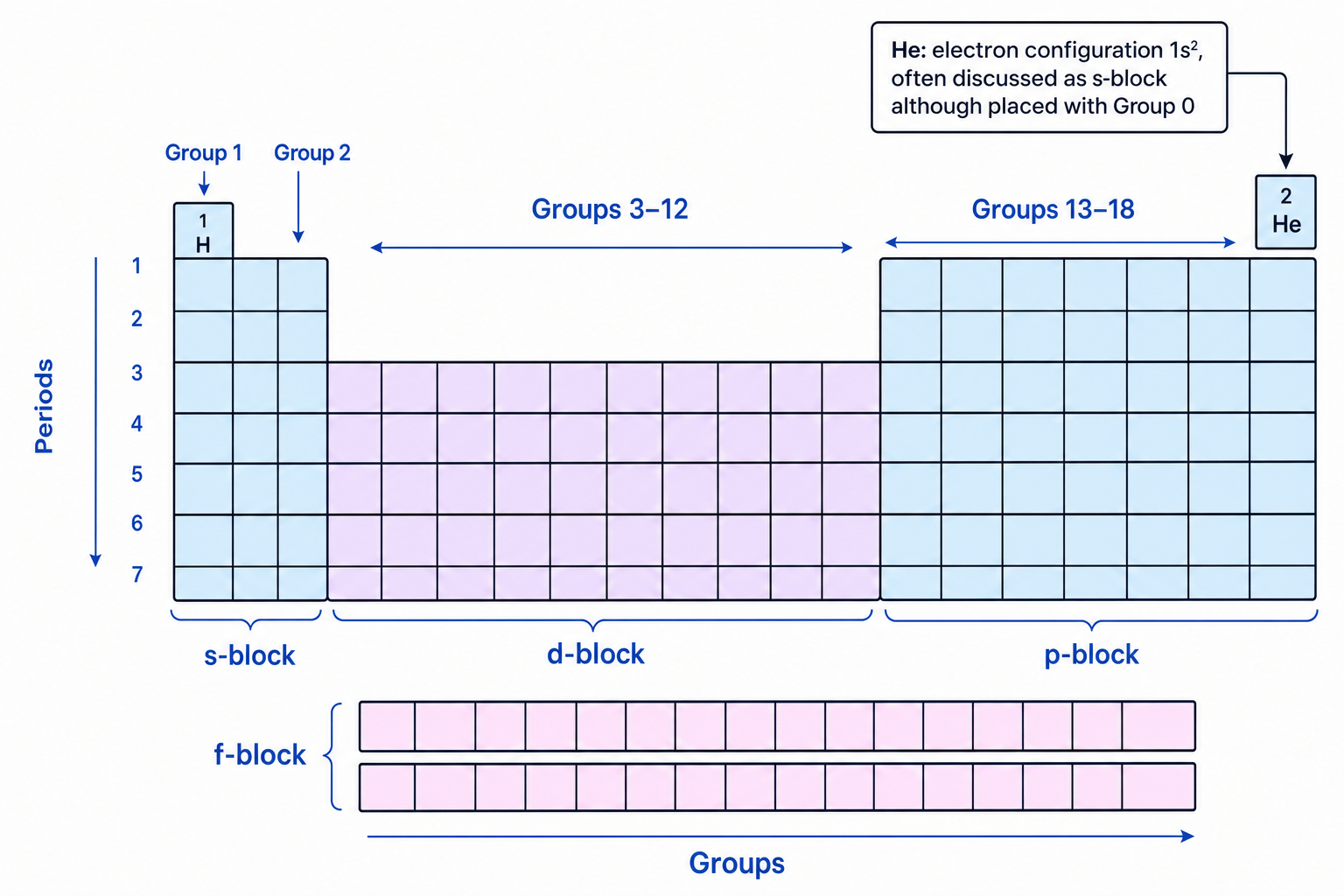
The Periodic Table is divided like this:
- s-block: left-hand side, mainly Groups 1 and 2
- p-block: right-hand side, mainly Groups 13–18, or Groups 3–0 in some UK school tables
- d-block: central block, containing the transition metals
- f-block: two rows usually shown separately at the bottom
The block layout is much easier to see visually.
Block classification
An element is classified as s-, p-, d- or f-block according to its position in the Periodic Table, which is determined by its proton number.
The s-block
The s-block is on the left of the Periodic Table.
It includes:
- Group 1 elements, such as lithium, sodium and potassium
- Group 2 elements, such as magnesium and calcium
- hydrogen, because its electron is in a 1s subshell
- helium by electron configuration, even though it is usually placed with the noble gases
Atoms of s-block elements have their highest-energy electron in an s subshell.
For example:
- sodium: 1s2 2s2 2p6 3s11s^2\,2s^2\,2p^6\,3s^11s22s22p63s1
- magnesium: 1s2 2s2 2p6 3s21s^2\,2s^2\,2p^6\,3s^21s22s22p63s2
Both are s-block because the final electrons are in a 3s subshell.
Classifying calcium
Calcium has proton number 20. Classify it as s-, p-, d- or f-block.
-
A neutral calcium atom has 20 electrons, because its proton number is 20.
-
Fill the subshells in order up to 20 electrons:
-
The highest-energy occupied subshell being filled is 4s4s4s, which is an s subshell.
-
Therefore calcium is an s-block element.
The p-block
The p-block is on the right-hand side of the Periodic Table.
It includes many important non-metals, metalloids and metals, such as:
- carbon
- nitrogen
- oxygen
- sulfur
- chlorine
- aluminium
- silicon
Atoms of p-block elements have their highest-energy electron in a p subshell.
For example, sulfur has electron configuration:
1s2 2s2 2p6 3s2 3p4 1s^2\,2s^2\,2p^6\,3s^2\,3p^4 1s22s22p63s23p4The final electrons are in the 3p subshell, so sulfur is in the p-block.
Classifying sulfur from proton number
Sulfur has proton number 16. Classify it as s-, p-, d- or f-block.
-
A neutral sulfur atom has 16 electrons.
-
Write the electron configuration:
-
The last occupied subshell is 3p3p3p, so the electron being added as you reach sulfur is in a p subshell.
-
Therefore sulfur is a p-block element.
The d-block
The d-block is the central section of the Periodic Table. It contains the transition metals, although not every d-block element is always classified as a transition metal under the stricter A-Level definition.
You will meet the d-block in more detail later when studying transition metals.
For now, the essential idea is:
- d-block elements are in the middle of the Periodic Table
- their atoms are associated with filling d subshells
- examples include iron, copper, zinc, chromium and nickel
Spotting the d-block quickly
If the element is in the central “bridge” between Group 2 and the p-block, it is in the d-block.
Classifying iron
Iron has proton number 26. Classify it as s-, p-, d- or f-block.
-
Iron has 26 protons, so a neutral iron atom has 26 electrons.
-
Its electron configuration is:
-
Iron lies in the central block of the Periodic Table, where the 3d subshell is being filled across the period.
-
Therefore iron is a d-block element.
The f-block
The f-block is usually shown as two detached rows underneath the main Periodic Table.
These elements are associated with filling f subshells. You do not need detailed f-block chemistry at this stage, but you should recognise the block as part of Periodic Table classification.
The f-block contains:
- the lanthanoids
- the actinoids
Lanthanoids and actinoids
The lanthanoids and actinoids are two series of f-block elements usually displayed separately underneath the main body of the Periodic Table.
Using position versus using electron configuration
You can classify an element in two main ways.
Method 1: Use its position
If you are given a Periodic Table, locate the element using its proton number or symbol, then identify which block it sits in.
This is usually the quickest method.
Method 2: Use its electron configuration
If you are given proton number and expected to use electron configuration, write the arrangement and look at the type of subshell being filled.
For main-group elements, this is usually straightforward:
- final electron in s subshell → s-block
- final electron in p subshell → p-block
- d subshell being filled across the central section → d-block
- f subshell being filled → f-block
Reading only the last written subshell
For d-block elements, the electron configuration may end with 4s24s^24s2 when written in full, but the element is still classified by its position in the central d-block. Do not incorrectly call iron an s-block element just because 4s24s^24s2 is written at the end.
The helium issue
Helium is the awkward element in block classification.
Its electron configuration is:
1s2 1s^2 1s2So, by electron configuration, helium is an s-block element.
However, helium is normally placed on the far right of the Periodic Table with the noble gases because it has very similar chemical properties to them: it is extremely unreactive and has a full outer shell.
Helium convention
Helium is usually placed in Group 0 or Group 18 with the noble gases, but its electron configuration is 1s21s^21s2. If an exam question asks about block classification, helium is commonly treated as s-block by electron configuration. If a diagram uses a specific convention, follow the diagram given.
A simple decision process
When classifying an element, ask yourself:
- What is its proton number?
- Where does that place it in the Periodic Table?
- Which block is that region: s, p, d or f?
For most exam questions, you will not need to draw full electron configurations. You just need to understand that proton number determines position, and position determines block.
The chain of reasoning
Proton number → Periodic Table position → block classification
In the exam
-
Use proton number, not mass number or relative atomic mass, to locate an element.
-
If the element is in Groups 1 or 2, it is usually s-block; if it is on the right-hand side, it is usually p-block; if it is in the central section, it is d-block.
-
Be careful with helium: it is placed with the noble gases, but its electron configuration is 1s21s^21s2, so it is usually treated as s-block for block classification.
Check yourself
- Why does proton number determine the identity of an element?
- What block is magnesium in, and how do you know?
- Why can helium cause confusion when classifying elements by block?