What you'll learn
- Why ozone in the upper atmosphere is useful to life on Earth.
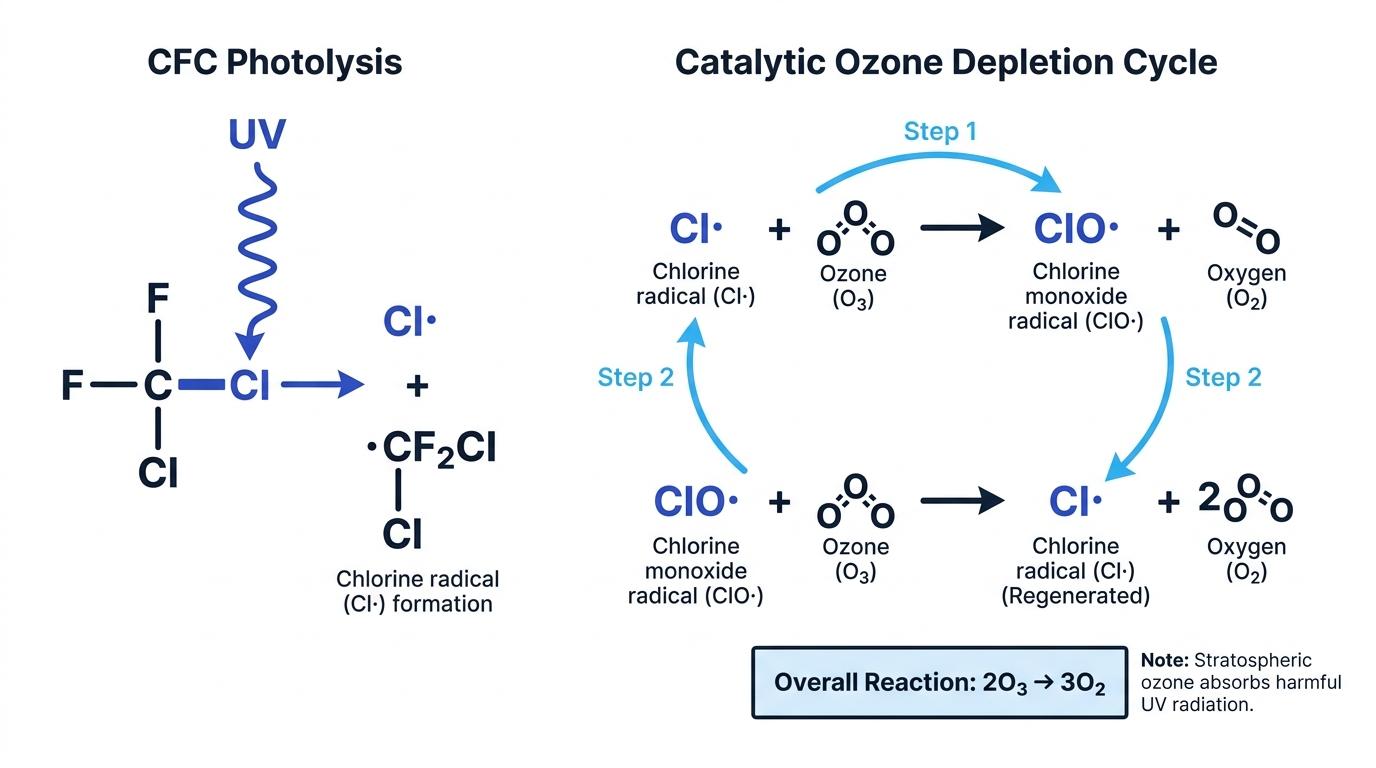
- How ultraviolet radiation breaks C–Cl bonds in CFCs to form chlorine radicals.
- How chlorine radicals catalyse the decomposition of ozone.
- How scientific evidence led to legislation banning many uses of CFCs.
The ozone layer: why ozone matters
Ozone is a form of oxygen found naturally in the upper atmosphere. Most atmospheric ozone is in a region of the stratosphere often called the ozone layer.
Ozone
Ozone is a molecule with the formula O3O_3O3. It contains three oxygen atoms bonded together.
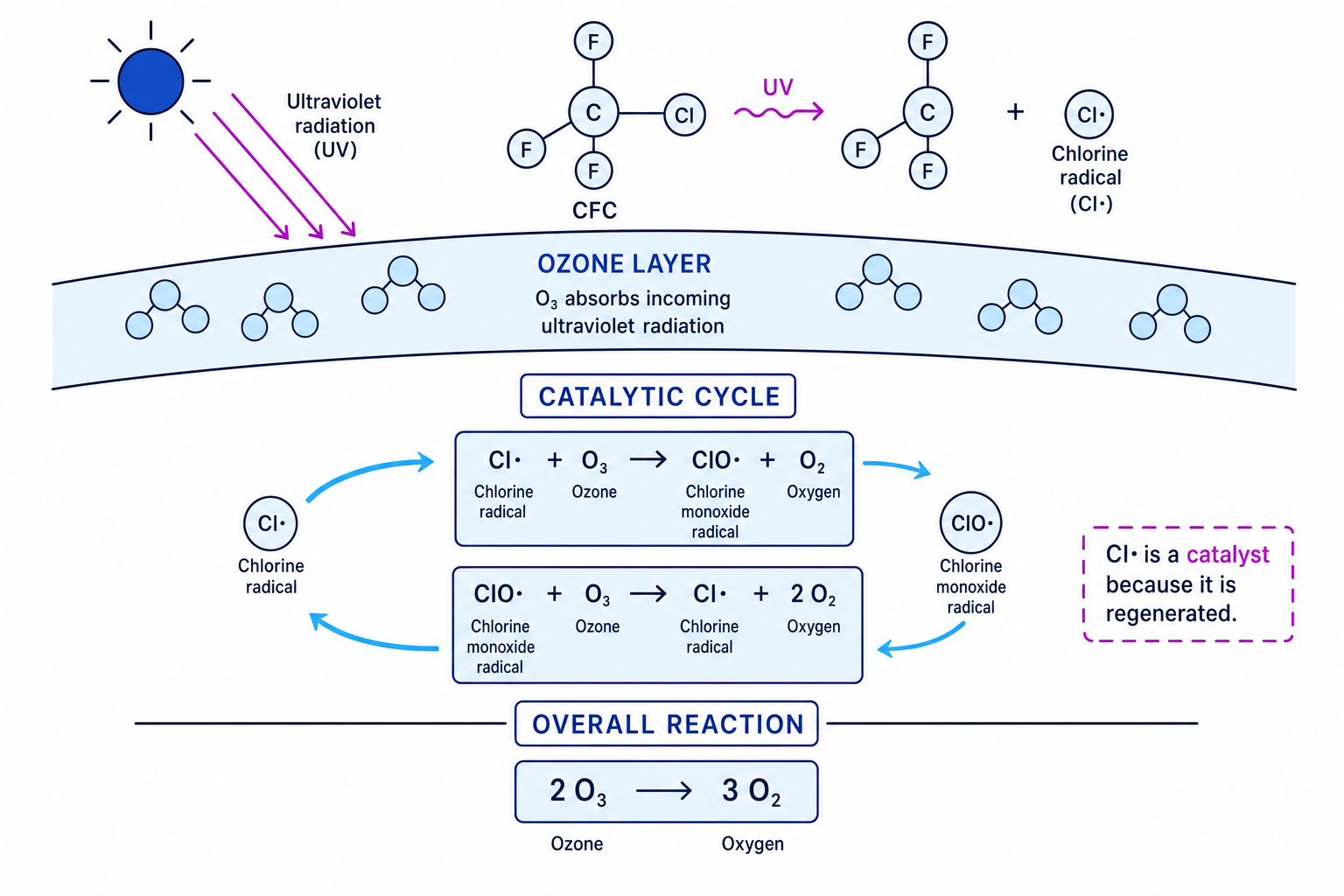
Ozone is beneficial because it absorbs a significant amount of incoming ultraviolet radiation from the Sun. This matters because ultraviolet radiation can damage biological molecules, increasing risks such as skin cancer and harm to ecosystems.
Ultraviolet radiation
Ultraviolet radiation, often shortened to UV, is high-energy electromagnetic radiation from the Sun. It has shorter wavelength and higher energy than visible light.
Ozone is not “good” or “bad” in every context. In the upper atmosphere, it protects us. Near ground level, ozone can be a pollutant and irritant. In this topic, you are concerned with upper-atmosphere ozone.
Why the ozone layer is protective
Upper-atmosphere ozone is useful because it absorbs ultraviolet radiation before much of that radiation reaches Earth’s surface.
CFCs: where chlorine radicals come from
The substances linked to ozone depletion in this topic are chlorofluorocarbons, usually shortened to CFCs.
Chlorofluorocarbon
A chlorofluorocarbon, or CFC, is a compound containing carbon, chlorine and fluorine atoms only.
CFCs were widely used as refrigerants and as solvents. They were useful because they are chemically quite unreactive in the lower atmosphere. That low reactivity made them seem safe in everyday use.
However, this stability also means CFC molecules can survive long enough to diffuse up into the upper atmosphere. There, they are exposed to more energetic ultraviolet radiation.
When a CFC absorbs enough UV energy, a C–Cl bond can break.
Radical
A radical is a species with an unpaired electron. Radicals are often very reactive. A chlorine radical is written as Cl⋅\text{Cl}\cdotCl⋅, where the dot represents the unpaired electron.
The bond-breaking is homolytic fission.
Homolytic fission
Homolytic fission is bond breaking in which each bonded atom takes one electron from the shared pair, forming radicals.
For a CFC containing a C–Cl bond, the key idea is:
C–Cl→UVC⋅+Cl⋅\text{C--Cl} \xrightarrow{\text{UV}} \text{C}\cdot + \text{Cl}\cdotC–ClUVC⋅+Cl⋅The exact carbon-containing radical depends on the particular CFC, but for A-Level ozone depletion you usually only need to focus on the chlorine radical formed.
Forgetting the dot
A chlorine atom acting in ozone depletion is usually written as Cl⋅\text{Cl}\cdotCl⋅, not just Cl, because it is a radical with an unpaired electron.
How chlorine radicals destroy ozone
A chlorine radical can react with ozone. The important reaction is:
Cl⋅+O3→ClO⋅+O2\text{Cl}\cdot + O_3 \rightarrow \text{ClO}\cdot + O_2Cl⋅+O3→ClO⋅+O2This forms oxygen, O2O_2O2, and a chlorine monoxide radical, ClO⋅\text{ClO}\cdotClO⋅.
Chlorine monoxide radical
The chlorine monoxide radical, ClO⋅\text{ClO}\cdotClO⋅, is a reactive radical containing chlorine and oxygen. It is an intermediate in ozone decomposition.
The chlorine monoxide radical can then react with another ozone molecule:
ClO⋅+O3→Cl⋅+2O2\text{ClO}\cdot + O_3 \rightarrow \text{Cl}\cdot + 2O_2ClO⋅+O3→Cl⋅+2O2Notice what has happened: the chlorine radical has been regenerated. It was used in the first step, then produced again in the second step.
Why chlorine is a catalyst
Catalyst
A catalyst is a substance that increases the rate of a reaction without being used up overall.
In these reactions, the chlorine radical is a catalyst because it appears as a reactant in the first step and is regenerated as a product in the second step.
The two steps are:
Cl⋅+O3→ClO⋅+O2\text{Cl}\cdot + O_3 \rightarrow \text{ClO}\cdot + O_2Cl⋅+O3→ClO⋅+O2 ClO⋅+O3→Cl⋅+2O2\text{ClO}\cdot + O_3 \rightarrow \text{Cl}\cdot + 2O_2ClO⋅+O3→Cl⋅+2O2If you add the two equations together, species that appear on both sides cancel. Here, Cl⋅\text{Cl}\cdotCl⋅ cancels, and ClO⋅\text{ClO}\cdotClO⋅ cancels.
The overall reaction is:
2O3→3O22O_3 \rightarrow 3O_22O3→3O2So, overall, ozone has been converted into oxygen.
Deriving the overall ozone decomposition equation
-
Add the two propagation equations together:
Cl⋅+O3→ClO⋅+O2ClO⋅+O3→Cl⋅+2O2\begin{aligned} \text{Cl}\cdot + O_3 &\rightarrow \text{ClO}\cdot + O_2 \\ \text{ClO}\cdot + O_3 &\rightarrow \text{Cl}\cdot + 2O_2 \end{aligned}Cl⋅+O3ClO⋅+O3→ClO⋅+O2→Cl⋅+2O2 -
Cancel species that appear unchanged on both sides. Cl⋅\text{Cl}\cdotCl⋅ appears on the left of the first equation and the right of the second, so it cancels. ClO⋅\text{ClO}\cdotClO⋅ appears on the right of the first equation and the left of the second, so it cancels.
-
Combine what remains. On the left there are two ozone molecules, and on the right there are three oxygen molecules:
2O3→3O22O_3 \rightarrow 3O_22O3→3O2
The catalytic role of chlorine radicals
A single chlorine radical can destroy many ozone molecules because the chlorine radical is regenerated and can enter the cycle again.
Why this contributes to the ozone hole
The ozone layer is not literally a physical sheet, and the “hole” is not an empty gap. The ozone hole means a region where the concentration of ozone in the upper atmosphere is much lower than usual.
Chlorine radicals contribute to this thinning because they speed up the conversion of ozone, O3O_3O3, into oxygen, O2O_2O2.
The important point is catalytic efficiency. One chlorine radical is not limited to destroying just one ozone molecule. Because it is regenerated, it can keep reacting again and again until it is removed by some other reaction.
Spotting catalysts in equations
If a species is used in one step and regenerated in a later step, it is acting as a catalyst in the overall reaction.
The role of scientific evidence
Ozone depletion is a good example of chemistry affecting society. Different research groups collected evidence showing links between CFCs, chlorine radicals and thinning of the ozone layer.
This scientific evidence supported legislation to ban or restrict many uses of CFCs, especially as solvents and refrigerants.
Chemists then helped develop alternatives. A key improvement was the development of chlorine-free compounds, because compounds without C–Cl bonds cannot form chlorine radicals in the same way.
Chemistry and legislation
Research evidence from the scientific community helped justify laws restricting CFC use, and chemists developed safer replacement compounds.
What you need to be able to explain
For this part of the specification, you should be comfortable linking the story together:
-
Ozone, O3O_3O3, forms naturally in the upper atmosphere.
-
Ozone absorbs ultraviolet radiation, so it protects living organisms.
-
CFCs can reach the upper atmosphere because they are relatively unreactive lower down.
-
Ultraviolet radiation breaks C–Cl bonds in CFCs.
-
This produces chlorine radicals, Cl⋅\text{Cl}\cdotCl⋅.
-
Chlorine radicals catalyse ozone decomposition.
-
The overall reaction is conversion of ozone into oxygen:
2O3→3O22O_3 \rightarrow 3O_22O3→3O2
Saying chlorine is used up
Do not say chlorine radicals are used up in the reaction. They are regenerated, which is why they act as catalysts.
In the exam
- When asked to explain ozone depletion, include both stages: UV breaks C–Cl bonds in CFCs, then chlorine radicals catalyse ozone decomposition.
- Use the radical dots in equations: write Cl⋅\text{Cl}\cdotCl⋅ and ClO⋅\text{ClO}\cdotClO⋅ where appropriate.
- To prove catalysis, state that Cl⋅\text{Cl}\cdotCl⋅ is regenerated and show cancellation to give the overall equation 2O3→3O22O_3 \rightarrow 3O_22O3→3O2.
Check yourself
- Why is ozone in the upper atmosphere beneficial?
- How does ultraviolet radiation produce chlorine radicals from CFCs?
- Why is Cl⋅\text{Cl}\cdotCl⋅ described as a catalyst in ozone decomposition?