

What you'll learn:
- How a hydroxide ion can act as a base rather than a nucleophile.
- The curly-arrow mechanism for the elimination of a halogenoalkane.
- How changing the reaction conditions shifts the balance between substitution and elimination.
When you mix a halogenoalkane with a hydroxide ion (like from potassium hydroxide, KOH), two completely different reactions can happen at the exact same time: nucleophilic substitution and elimination. Which one "wins" depends on the reaction conditions and the structure of the halogenoalkane.
The Dual Personality of the Reagent
You already know that the hydroxide ion (OH−\text{OH}^-OH−) has a lone pair of electrons, making it an excellent nucleophile. It loves to attack the slightly positive carbon atom (Cδ+\text{C}^{\delta+}Cδ+) in a carbon–halogen bond, swapping out the halogen to make an alcohol.
However, OH−\text{OH}^-OH− has a second, equally important chemical personality. It can act as a base.
Base
In organic chemistry, a base is a species that acts as a proton acceptor. It uses its lone pair to bond to a hydrogen ion (H+\text{H}^+H+) from another molecule.
In an elimination reaction, the OH−\text{OH}^-OH− ion ignores the Cδ+\text{C}^{\delta+}Cδ+ completely. Instead, it steals a hydrogen atom from the carbon next to the carbon–halogen bond.
The Elimination Mechanism
Let's look at what happens when 2-bromopropane reacts with a hydroxide ion acting as a base.
The carbon atom bonded directly to the bromine is sometimes called the "alpha" (α\alphaα) carbon. The carbons directly attached to it are the "beta" (β\betaβ) carbons. The base targets a hydrogen atom on one of these beta carbons.
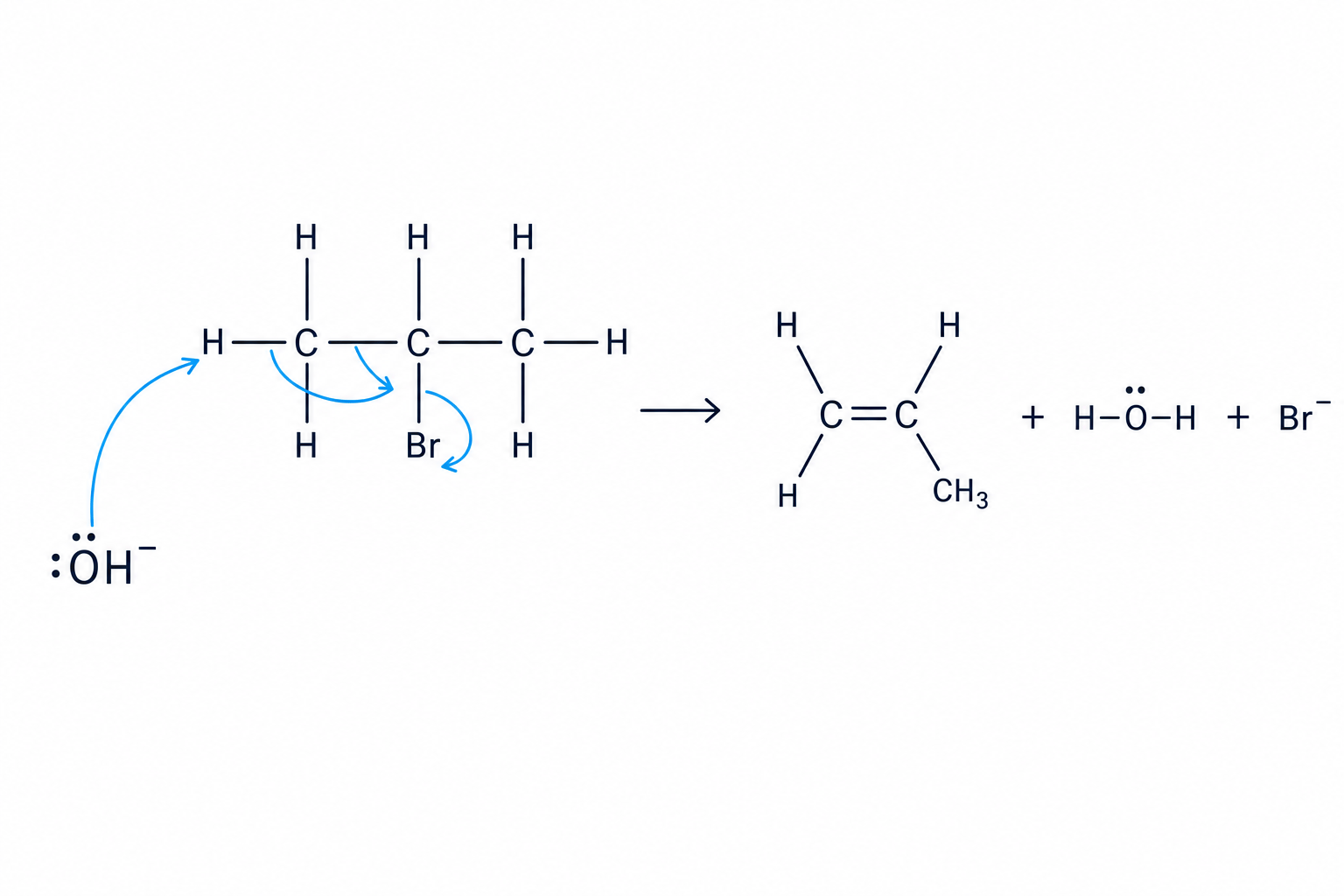
The Three Arrows of Elimination
The mechanism requires three simultaneous movements of electron pairs:
- A curly arrow goes from the lone pair on the OH−\text{OH}^-OH− ion to a hydrogen atom on a β\betaβ-carbon, forming water (H2O\text{H}_2\text{O}H2O).
- A curly arrow goes from that C−H\text{C}-\text{H}C−H bond to the adjacent C−C\text{C}-\text{C}C−C single bond, forming a new C=C\text{C}=\text{C}C=C double bond.
- A curly arrow goes from the C−Br\text{C}-\text{Br}C−Br bond to the bromine atom, breaking the bond and expelling a bromide ion (Br−\text{Br}^-Br−).
Because a small molecule (hydrogen bromide, which reacts with the hydroxide to become water and a bromide ion) has been entirely removed from the starting molecule to form a double bond, we call this an elimination reaction. The organic product is an alkene (in this case, propene).
The Tug of War: Substitution vs Elimination
Substitution and elimination are concurrent reactions. This means they are often happening at the same time in the same flask, competing with one another.
Chemists use the reaction conditions to heavily favour one path over the other:
- To favour substitution: Use an aqueous solution of potassium hydroxide (dissolved in water) and warm it gently. The OH−\text{OH}^-OH− acts primarily as a nucleophile, and you get an alcohol.
- To favour elimination: Use an ethanolic solution of potassium hydroxide (dissolved in ethanol) and heat it strongly under reflux. The OH−\text{OH}^-OH− acts primarily as a base, and you get an alkene.
Remembering the conditions
A handy mnemonic to remember the elimination conditions is Elimination loves Ethanol.
Forgetting the solvent
In exam questions, simply writing "KOH" is not enough to secure the mark for the reagent. You must specify whether it is aqueous KOH or ethanolic KOH, as the solvent completely changes the major product.
Does the Halogenoalkane Matter?
The structure of the halogenoalkane also plays a massive role in deciding which reaction wins the tug of war.
- Primary halogenoalkanes (where the halogen carbon is attached to only one other carbon) heavily favour nucleophilic substitution. They will form alcohols even if you try to push them toward elimination.
- Tertiary halogenoalkanes (where the halogen carbon is attached to three other carbons) heavily favour elimination. They will form alkenes almost exclusively.
- Secondary halogenoalkanes (like 2-bromopropane) sit in the middle. They will undergo a mixture of both, making the choice of solvent (water vs ethanol) absolutely critical to control the outcome.
Crowded Carbons
Why do tertiary halogenoalkanes prefer elimination? Imagine the Cδ+\text{C}^{\delta+}Cδ+ is a popular celebrity surrounded by three bulky bodyguards (the alkyl groups). The nucleophile (OH−\text{OH}^-OH−) tries to attack the celebrity but can't squeeze past the bodyguards. Frustrated, it just grabs a stray hat (a proton, H+\text{H}^+H+) from the edge of the crowd instead, acting as a base.
Predicting Elimination Products
When secondary or tertiary halogenoalkanes undergo elimination, there are often multiple beta carbons to choose from. If the molecule is asymmetrical, the base can remove a proton from different sides, leading to a mixture of isomeric alkenes.
Predicting the products of elimination
When 2-bromobutane is heated with hot ethanolic potassium hydroxide, an elimination reaction occurs. Let's predict the possible alkene products.
- Locate the alpha-carbon: First, identify the carbon atom bonded to the halogen. In 2-bromobutane, this is carbon-2.
- Identify the beta-carbons: Look at the carbon atoms directly adjacent to carbon-2. In this molecule, these are carbon-1 (a CH3\text{CH}_3CH3 group) and carbon-3 (a CH2\text{CH}_2CH2 group).
- Remove a proton from the first beta-carbon: If the hydroxide ion removes a hydrogen atom from carbon-1, the new double bond forms between C1 and C2. This produces the alkene but-1-ene.
- Remove a proton from the second beta-carbon: If the hydroxide ion removes a hydrogen atom from carbon-3 instead, the new double bond forms between C2 and C3. This produces but-2-ene (which will actually exist as a mixture of E and Z stereoisomers).
Because the halogen is not perfectly in the middle of the chain, eliminating in different directions yields different structural isomers. You should expect a mixture of both in the final product.
In the exam
- Check the conditions immediately: The moment you see a halogenoalkane reacting with KOH\text{KOH}KOH or NaOH\text{NaOH}NaOH, scan the text for the words "aqueous" or "ethanolic".
- Name the role correctly: If asked for the role of the hydroxide ion, state "nucleophile" for aqueous conditions and "base" for ethanolic conditions.
- Draw arrows precisely: When drawing the mechanism, ensure the first curly arrow starts exactly from the lone pair (or the negative charge) on the OH−\text{OH}^-OH− and points directly to the hydrogen atom, not the space near it.
- Watch for mixtures: If asked to draw the products of elimination for a chain with more than 3 carbons, check if a mixture of isomeric alkenes can form.
Check yourself
- What are the ideal reagent, solvent, and temperature conditions to maximise the yield of an alkene from a halogenoalkane?
- In terms of electron movement, what is the difference between a nucleophile and a base?
- If you heat 2-bromo-2-methylbutane with ethanolic KOH, how many different structural isomeric alkenes can be produced?
