

What you'll learn
- How to identify an asymmetric carbon atom (a chiral centre) in a molecule.
- How to draw the 3D structures of optical isomers (enantiomers).
- How enantiomers interact differently with plane-polarised light.
- What a racemic mixture is, why it is optically inactive, and how it forms during chemical reactions.
What is stereoisomerism?
During your AS studies, you encountered stereoisomerism in the form of E/ZE/ZE/Z isomerism (often seen in alkenes). As a quick recap, stereoisomers are molecules that have the exact same structural formula, but a different arrangement of atoms in 3D space.
At A-level, you are introduced to a second type of stereoisomerism: optical isomerism. This type of isomerism does not rely on a rigid carbon-carbon double bond. Instead, it occurs entirely because of a property called chirality.
Chiral centre
A chiral centre (often called an asymmetric carbon atom) is a carbon atom that is bonded to four completely different groups.
If a molecule contains a single chiral centre, it will exhibit optical isomerism.
Enantiomers: Non-superimposable mirror images
When a carbon atom is bonded to four different groups in a tetrahedral arrangement, those groups can be arranged in two distinct ways. These two arrangements are mirror images of each other.
Crucially, no matter how much you rotate these two mirror-image molecules in 3D space, you cannot place one exactly on top of the other so that all four groups match up perfectly. We say they are non-superimposable.
Enantiomer
Enantiomers are a pair of optical isomers that exist as non-superimposable mirror images of each other.
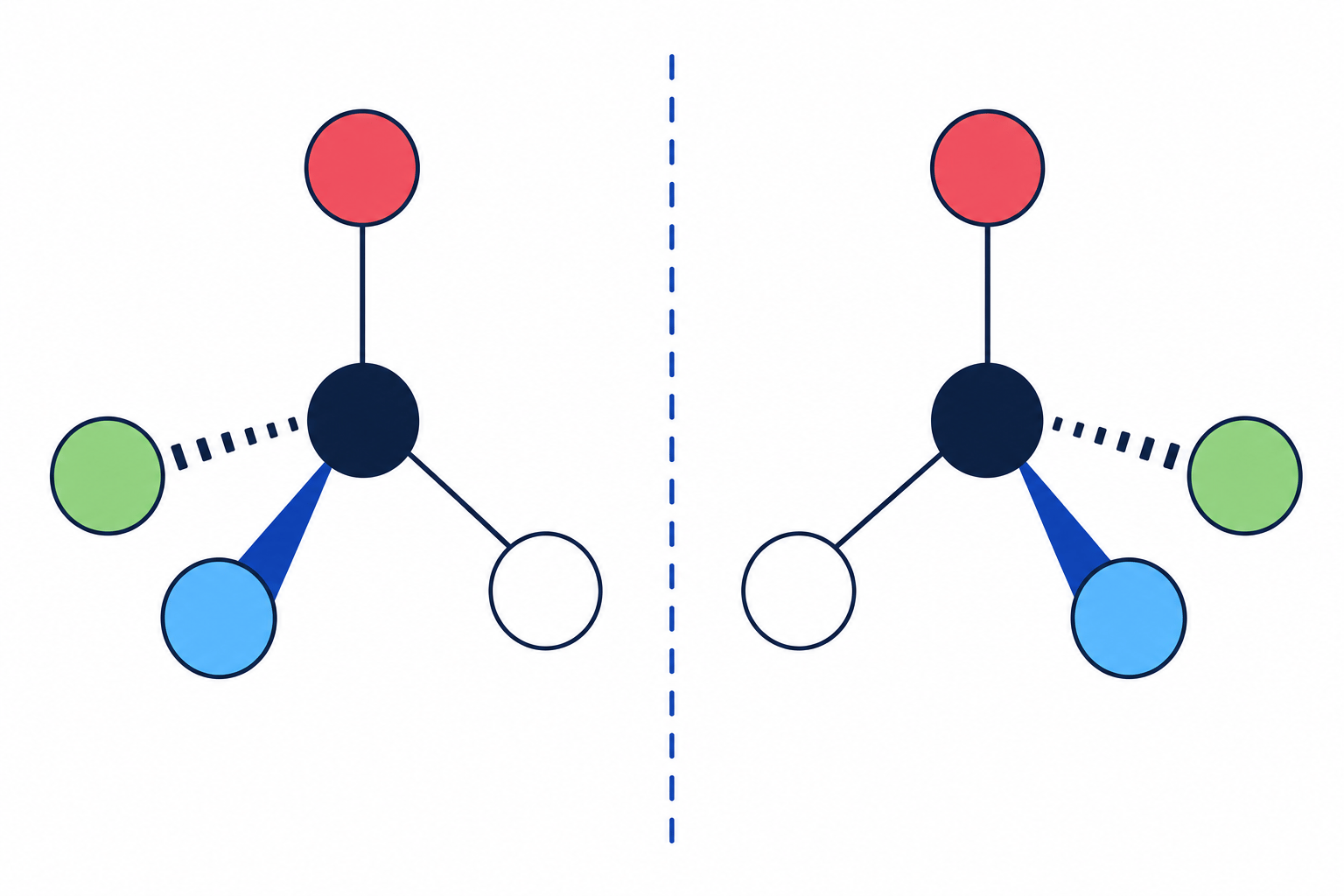
The 'Hand' analogy
Hold your hands out in front of you. Your left hand and right hand are mirror images of each other. However, if you try to place your left hand perfectly on top of your right hand (both palms facing down), your thumbs and pinky fingers will not line up. Your hands are non-superimposable mirror images. Molecules with a chiral centre behave in exactly the same way!
Drawing optical isomers
To get the marks in the exam, you must draw optical isomers in 3D using standard stereochemical notation (wedges and dashes).
- A plain line represents a bond in the plane of the page.
- A solid wedge represents a bond coming out of the page towards you.
- A dashed line represents a bond going into the page away from you.
Drawing the enantiomers of butan-2-ol
- Locate the chiral centre: Scan the carbon chain for a carbon atom bonded to four different groups. In butan-2-ol (CH3CH(OH)CH2CH3\text{CH}_3\text{CH(OH)CH}_2\text{CH}_3CH3CH(OH)CH2CH3), Carbon-2 is bonded to a hydrogen atom (-H\text{-H}-H), a hydroxyl group (-OH\text{-OH}-OH), a methyl group (-CH3\text{-CH}_3-CH3), and an ethyl group (-C2H5\text{-C}_2\text{H}_5-C2H5). Carbon-2 is our asymmetric carbon.
- Draw the 3D scaffold for the first enantiomer: Draw a central C\text{C}C atom. Draw two plain lines pointing roughly upwards in a V-shape. Draw a solid wedge pointing down and left, and a dashed line pointing down and right.
- Attach the groups: Place the four groups (-H\text{-H}-H, -OH\text{-OH}-OH, -CH3\text{-CH}_3-CH3, -C2H5\text{-C}_2\text{H}_5-C2H5) onto the four bonds in any order. This is your first enantiomer.
- Set up the mirror plane: Draw a vertical dashed line to the right of your molecule. This represents the mirror.
- Draw the reflection: On the right side of the mirror line, draw the exact reflection of your first molecule. A group pointing towards the mirror on the left must point towards the mirror on the right. A solid wedge remains a solid wedge, and a dashed line remains a dashed line.
Identifying the four 'groups'
A common error is looking only at the immediate atom attached to the chiral carbon. If a carbon is bonded to a -CH3\text{-CH}_3-CH3 group and a -CH2CH3\text{-CH}_2\text{CH}_3-CH2CH3 group, these are different groups, even though the immediate attached atom in both cases is carbon. Always look at the entire group.
Plane-polarised light
A pair of enantiomers will have identical chemical properties (when reacting with non-chiral substances) and identical physical properties (like boiling point, melting point, and density). So, how do we tell them apart?
We use their effect on plane-polarised light.
Normal light oscillates in all directions perpendicular to the direction of travel. When normal light is passed through a special polarising filter, all the oscillations are blocked except those in a single plane. We call this plane-polarised light.
When plane-polarised light passes through a solution containing a single enantiomer, the plane of the light is rotated.
- One enantiomer will rotate the light clockwise.
- The other enantiomer will rotate the light anti-clockwise by the exact same angle.
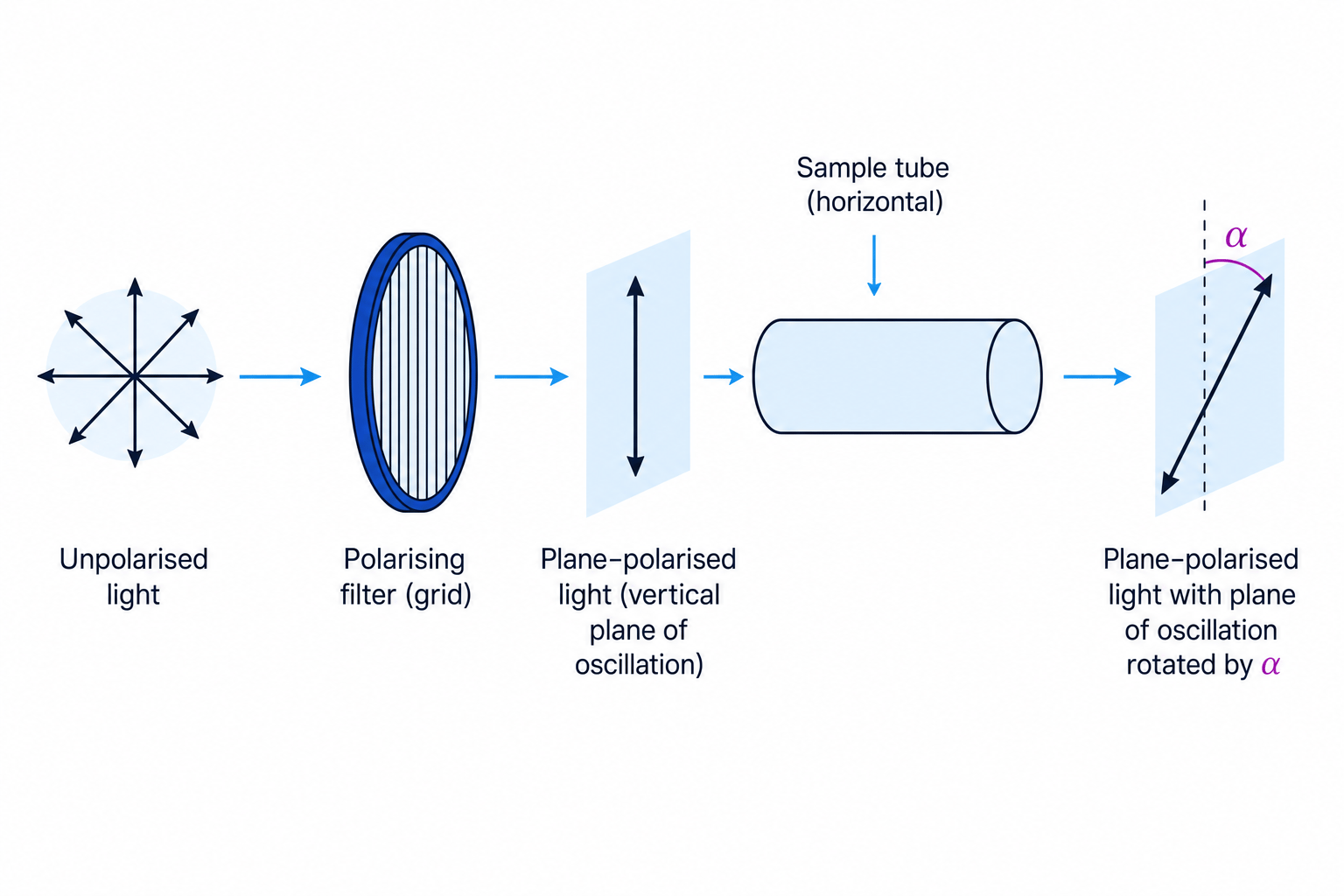
Because of this unique interaction with light, enantiomers are often said to be "optically active".
Required practical link
In the lab, a device called a polarimeter is used to measure optical rotation. You may do a practical where you pass plane-polarised light through a solution of sucrose (a chiral sugar molecule) to observe this rotation directly.
Racemic mixtures (Racemates)
In a laboratory setting, synthesising a molecule with a chiral centre often results in a 50:50 mixture of both enantiomers.
Racemic mixture (racemate)
A racemic mixture (or racemate) is a mixture containing exactly equal amounts of two enantiomers.
If you put a racemic mixture into a polarimeter, the plane of polarised light will not rotate.
Why are racemic mixtures optically inactive?
Because the mixture contains equal amounts of both enantiomers, the clockwise rotation caused by one enantiomer is exactly cancelled out by the anti-clockwise rotation caused by the other enantiomer. The net rotation is zero.
How are racemic mixtures formed?
You are expected to understand why laboratory synthesis so frequently yields a racemate. The most common scenario involves nucleophilic addition to a carbonyl group (which you will study in the aldehydes and ketones topic).
A carbonyl group (C=O\text{C=O}C=O) is planar (flat). If a nucleophile (like a cyanide ion, CN−\text{CN}^-CN−) attacks an unsymmetrical planar carbonyl group, it has an equal probability of attacking from directly above the plane or directly below the plane.
- Attack from above creates one enantiomer.
- Attack from below creates the other enantiomer.
Because the chances of top-attack and bottom-attack are exactly equal, you end up with a 50:50 mixture of the two enantiomers—a racemate. (In contrast, biological systems use highly specific 3D enzymes to synthesize molecules, which is why nature usually produces only one specific enantiomer, not a racemate).
In the exam
- When asked to identify a chiral centre on a complex structural formula, mark it clearly with a small asterisk (
*). - If asked to draw enantiomers, strictly use the wedge and dash 3D notation. Drawing a flat 2D cross will score zero marks for 3D representation.
- If an exam question asks why a synthesised product has no effect on plane-polarised light, do not just write "it's racemic". You must state that it is a racemic mixture (equal amounts of both enantiomers) AND explain that the rotations cancel each other out.
- When explaining the formation of a racemate via nucleophilic addition, always mention that the initial molecule (the carbonyl) is planar, and therefore attack by the nucleophile from above or below is equally likely.
Check yourself
- What are the required conditions for a carbon atom to be considered a chiral centre?
- If enantiomer A rotates plane-polarised light by +15∘+15^\circ+15∘, what effect will a pure sample of enantiomer B have on the light?
- Why does a racemic mixture have no overall effect on plane-polarised light?
- Geometrically, why does nucleophilic attack on propanal usually yield a racemic mixture?
