What you'll learn:
- How to classify an alcohol as primary, secondary, or tertiary.
- The conditions and apparatus needed to oxidise primary alcohols to either aldehydes or carboxylic acids.
- How secondary alcohols are oxidised to ketones.
- Why tertiary alcohols are not easily oxidised.
- How to use Tollens' reagent and Fehling's solution to distinguish between aldehydes and ketones.
Classifying alcohols
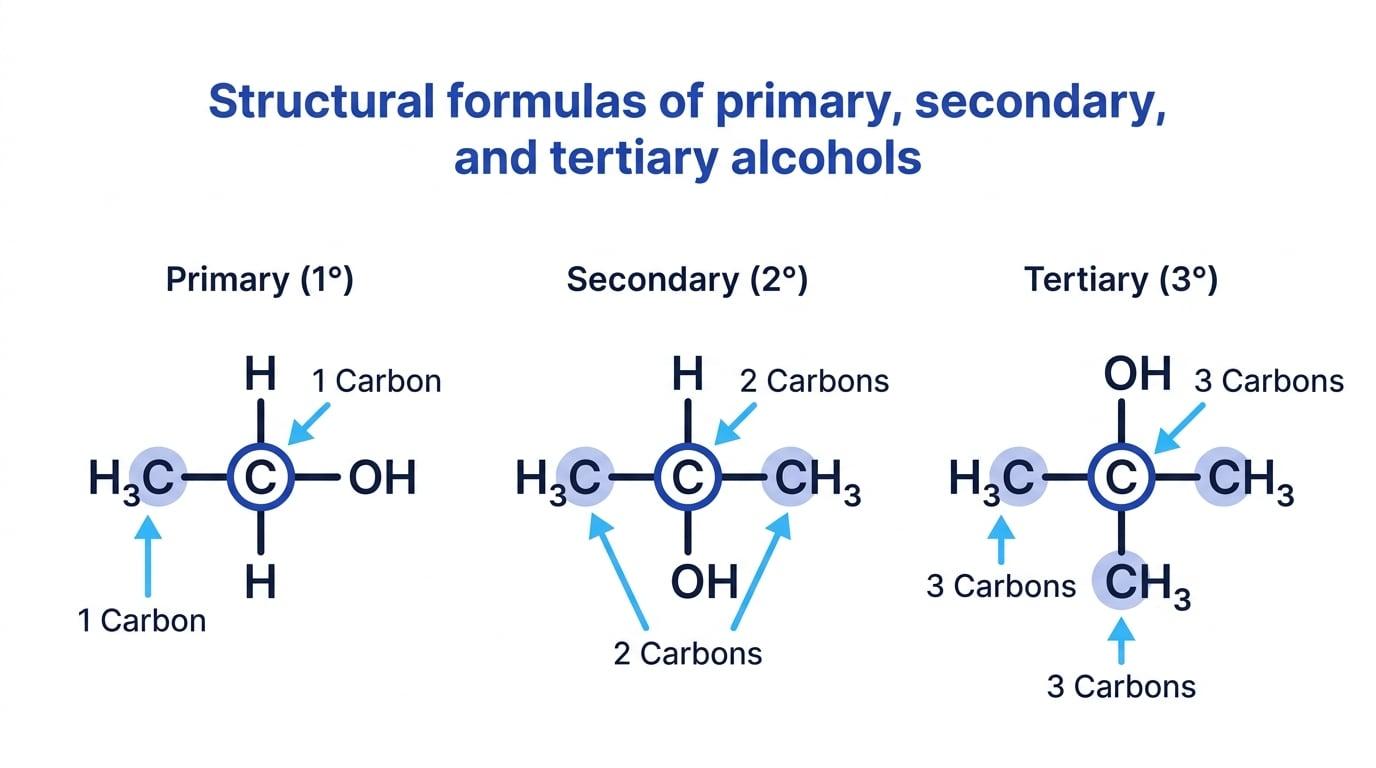
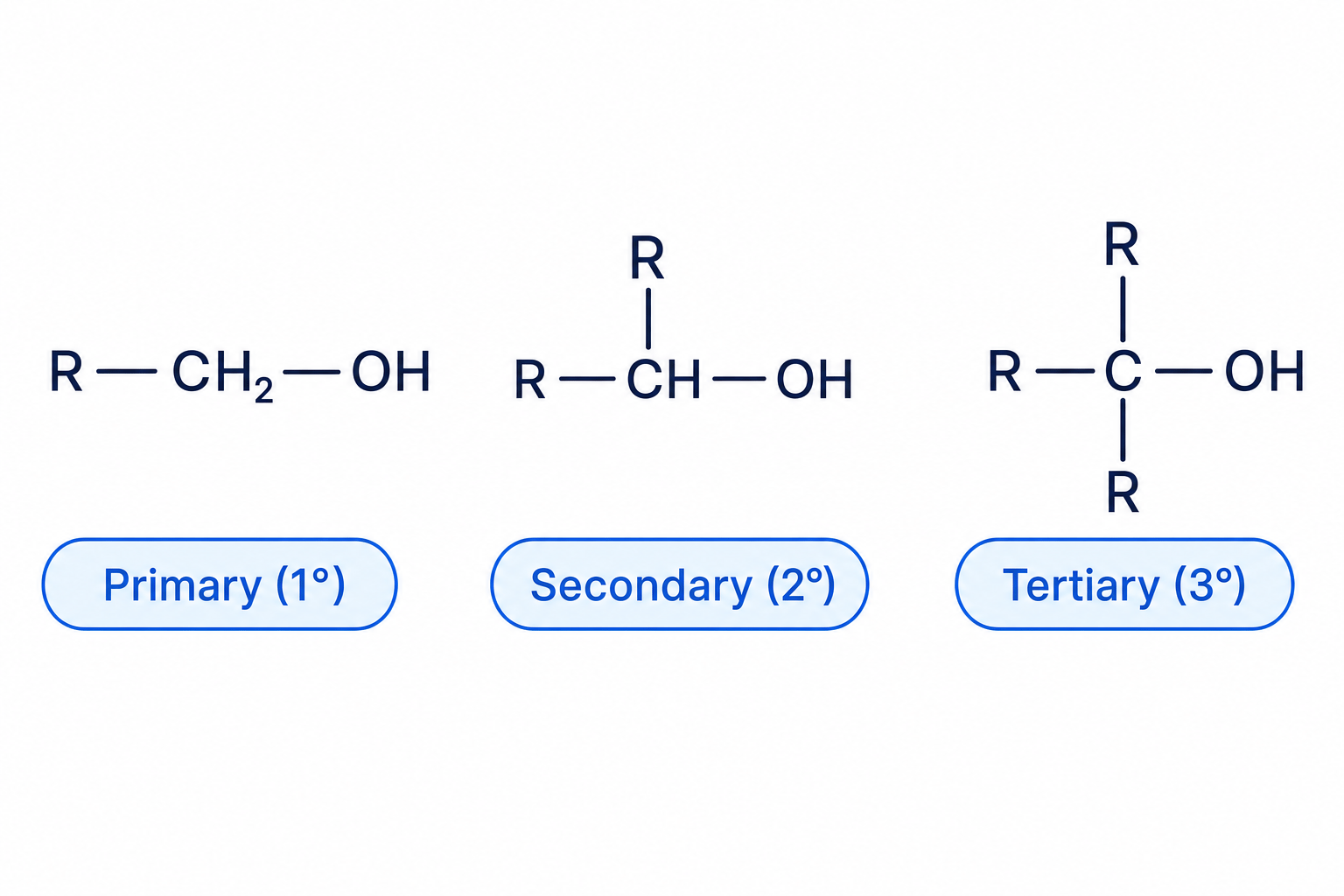
Before you can predict what an alcohol will oxidise into, you need to be able to classify it. We group alcohols based on how many alkyl groups (carbon chains) are attached to the carbon atom that holds the -OH\text{-OH}-OH group.
Primary, secondary, and tertiary alcohols
- Primary (1∘1^\circ1∘): The carbon bonded to the -OH\text{-OH}-OH group is attached to one other carbon atom (or none, in the case of methanol).
- Secondary (2∘2^\circ2∘): The carbon bonded to the -OH\text{-OH}-OH group is attached to two other carbon atoms.
- Tertiary (3∘3^\circ3∘): The carbon bonded to the -OH\text{-OH}-OH group is attached to three other carbon atoms.
The oxidising agent
To oxidise an alcohol, we need a suitable oxidising agent. The standard choice at A-Level is acidified potassium dichromate(VI).
This reagent is made by mixing potassium dichromate(VI) (K2Cr2O7\text{K}_2\text{Cr}_2\text{O}_7K2Cr2O7) with dilute sulfuric acid (H2SO4\text{H}_2\text{SO}_4H2SO4). In chemical equations, writing out the full dichromate formula can be unnecessarily complicated, so we represent the oxidising agent simply as [O][\text{O}][O].
The hallmark colour change
When acidified potassium dichromate(VI) successfully oxidises an alcohol, the dichromate(VI) ion (Cr2O72−\text{Cr}_2\text{O}_7^{2-}Cr2O72−) is reduced to the chromium(III) ion (Cr3+\text{Cr}^{3+}Cr3+). You will observe a distinct colour change from orange to green.
Oxidising primary alcohols
Primary alcohols are uniquely versatile. Because the end-carbon has two hydrogen atoms available to lose, a primary alcohol can be oxidised twice:
- First, it oxidises to an aldehyde.
- If oxidised further, the aldehyde becomes a carboxylic acid.
As a chemist, you need to control the reaction so it stops exactly where you want it to. The trick isn't changing the chemicals; it's changing the apparatus.
Stopping at the aldehyde: Distillation
If you want to produce an aldehyde, you must remove it from the reaction mixture before it can oxidise any further. You do this by heating the reaction mixture gently using distillation equipment.
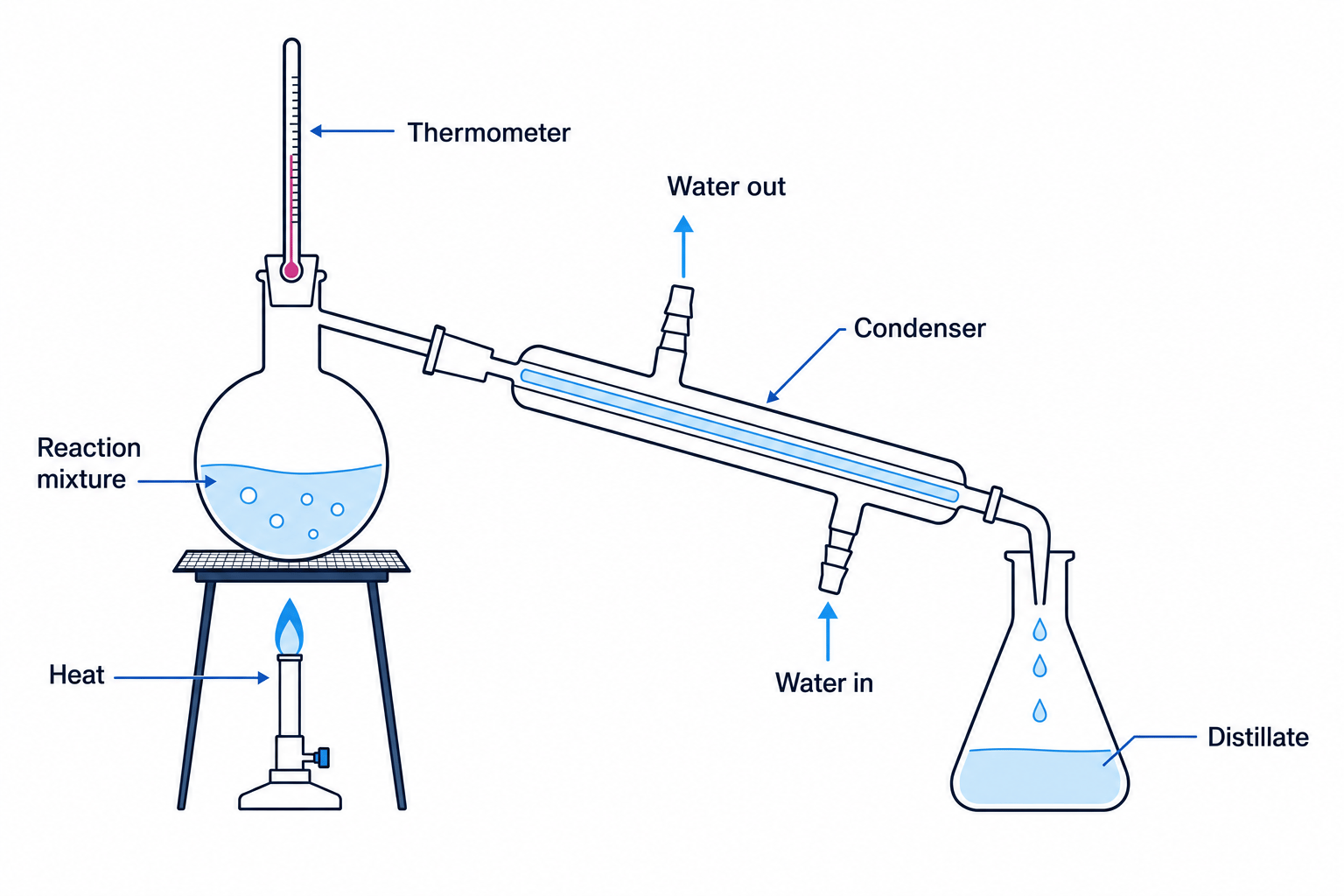
Aldehydes have lower boiling points than their corresponding alcohols because they cannot form hydrogen bonds with themselves. As soon as the aldehyde forms, it vaporises, travels up into the condenser, cools back into a liquid, and drips into the collecting flask safely away from the oxidising agent.
Writing the equation for partial oxidation of a primary alcohol
Let's write the equation for the oxidation of ethanol to ethanal.
- Identify the starting material and the target product: Ethanol is a primary alcohol (CH3CH2OH\text{CH}_3\text{CH}_2\text{OH}CH3CH2OH). The target is an aldehyde, so we change the ending to '-al', giving ethanal (CH3CHO\text{CH}_3\text{CHO}CH3CHO).
- Set up the skeletal equation using the oxidising agent: We place ethanol and [O][\text{O}][O] on the left, and ethanal on the right.
- Balance the hydrogen and oxygen atoms: Ethanol has 666 hydrogen atoms, but ethanal only has 444. The two missing hydrogens combine with the oxygen from the oxidising agent to form a molecule of water (H2O\text{H}_2\text{O}H2O).
Going all the way to a carboxylic acid: Reflux
If you want to make a carboxylic acid, you must ensure the primary alcohol is completely oxidised. To achieve this, we use an excess of acidified potassium dichromate(VI) and heat the mixture under reflux.
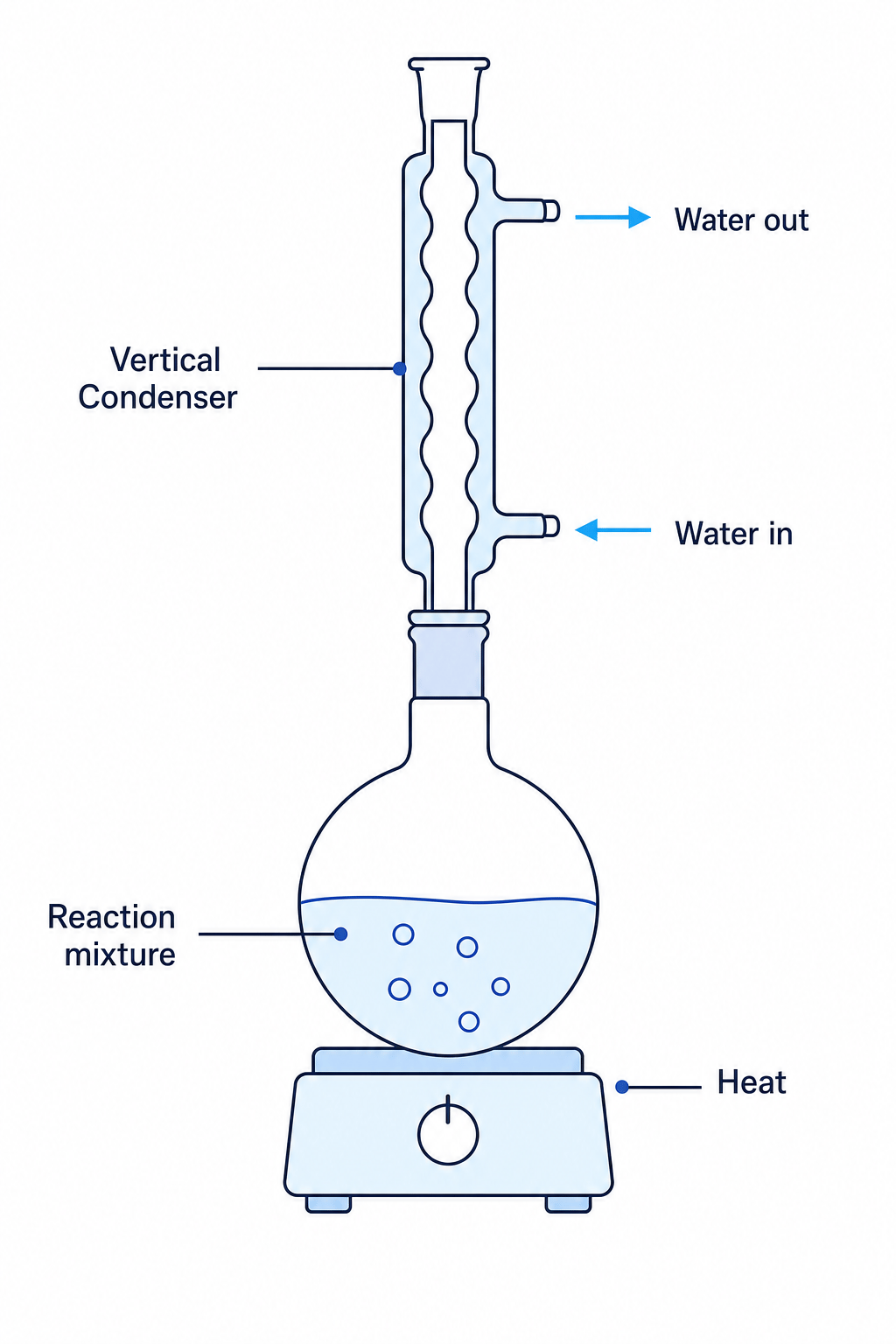
In a reflux setup, the condenser is mounted completely vertically above the flask. When the mixture boils, any volatile aldehyde that evaporates will hit the cold condenser, liquefy, and drop straight back down into the hot oxidising mixture to react again. Nothing escapes until the oxidation to a carboxylic acid is complete.
Writing the equation for full oxidation of a primary alcohol
Let's write the equation for the oxidation of propan-1-ol to propanoic acid.
- Identify the organic species: Propan-1-ol is CH3CH2CH2OH\text{CH}_3\text{CH}_2\text{CH}_2\text{OH}CH3CH2CH2OH. The fully oxidised product is propanoic acid, CH3CH2COOH\text{CH}_3\text{CH}_2\text{COOH}CH3CH2COOH.
- Set up the skeletal equation:
- Balance the oxygen and hydrogen atoms: The starting alcohol has 111 oxygen atom, while the carboxylic acid has 222. Also, the alcohol has 888 hydrogens, and the acid has 666, meaning a water molecule (H2O\text{H}_2\text{O}H2O) must also be formed. Therefore, we need two atoms of oxygen from the oxidising agent in total (one to join the molecule, one to form water).
Missing the coefficient on [O]
When writing the full oxidation to a carboxylic acid, students often forget to write 2[O]2[\text{O}]2[O]. A primary alcohol requires two 'doses' of oxidation to reach the carboxylic acid stage. If you only write [O][\text{O}][O], your equation will not balance.
Never seal a reflux apparatus
You'll notice the top of the reflux condenser is completely open to the air. Never put a stopper in the top of a condenser while heating. This creates a sealed system. As the gases expand upon heating, the pressure will build up until the glass shatters or explodes.
Oxidising secondary alcohols
Secondary alcohols only have one hydrogen atom on the carbon holding the -OH\text{-OH}-OH group. Consequently, they can only be oxidised once, forming a ketone.
Because ketones cannot be oxidised further under normal conditions, you don't have to worry about them accidentally over-oxidising. You can safely heat secondary alcohols under reflux with acidified potassium dichromate(VI) to ensure the reaction goes to completion.
Writing the equation for a secondary alcohol
Let's oxidise butan-2-ol.
- Identify the starting material: Butan-2-ol is a secondary alcohol, CH3CH(OH)CH2CH3\text{CH}_3\text{CH}(\text{OH})\text{CH}_2\text{CH}_3CH3CH(OH)CH2CH3.
- Determine the product: The alcohol group is on carbon-2, so it will form a ketone group on carbon-2. The product is butanone, CH3COCH2CH3\text{CH}_3\text{COCH}_2\text{CH}_3CH3COCH2CH3.
- Write the balanced equation: Just like partial oxidation of a primary alcohol, one [O][\text{O}][O] is needed, and water is a by-product.
Tertiary alcohols
Tertiary alcohols are not easily oxidised.
For oxidation to happen, the oxidising agent needs to remove a hydrogen atom from the -OH\text{-OH}-OH group and a hydrogen atom from the carbon bonded to the -OH\text{-OH}-OH group. Look back at the diagram of the tertiary alcohol at the start of these notes — the central carbon is bonded to three other carbon atoms and zero hydrogen atoms.
Because of this, if you heat a tertiary alcohol with acidified potassium dichromate(VI), no reaction occurs. The solution will remain orange.
Chemical tests to distinguish aldehydes and ketones
Because primary and secondary alcohols oxidise into different products (aldehydes and ketones, respectively), we often use chemical tests to figure out which product we have.
Aldehydes can be oxidised further into carboxylic acids, but ketones cannot. Both of our main chemical tests exploit this exact difference. They are very mild oxidising agents that are strong enough to oxidise an aldehyde, but too weak to oxidise a ketone.
1. Tollens' reagent
Tollens' reagent is a colourless solution containing the complex silver ion [Ag(NH3)2]+[\text{Ag}(\text{NH}_3)_2]^+[Ag(NH3)2]+. When heated gently with an aldehyde, the aldehyde is oxidised to a carboxylic acid, and the silver ions are reduced to solid silver atoms.
- Aldehyde: A brilliant silver mirror forms on the inside of the test tube.
- Ketone: No visible change (remains colourless).
2. Fehling's solution
Fehling's solution contains blue copper(II) ions (Cu2+\text{Cu}^{2+}Cu2+). When heated gently with an aldehyde, the aldehyde is oxidised, and the blue Cu2+\text{Cu}^{2+}Cu2+ ions are reduced to Cu+\text{Cu}^+Cu+ ions, forming a precipitate of copper(I) oxide (Cu2O\text{Cu}_2\text{O}Cu2O).
- Aldehyde: The blue solution produces a brick-red precipitate.
- Ketone: No visible change (remains blue).
Gentle heating
Because these reagents are mild and aqueous, they should be heated gently using a water bath rather than directly over a roaring Bunsen burner flame. Aldehydes and ketones are highly flammable!
In the exam
- Read the apparatus carefully: If an exam question mentions "distillation", you are making an aldehyde. If it mentions "reflux", you are making a carboxylic acid (or a ketone from a secondary alcohol).
- Watch your structural formulas: When writing the formula for an aldehyde, always write CHO\text{CHO}CHO (e.g. CH3CHO\text{CH}_3\text{CHO}CH3CHO). Never write COH\text{COH}COH, as examiners will penalise this because it looks like an alcohol group.
- State the initial colours: When describing a positive test result, always state the starting colour as well as the final appearance. Write "orange solution turns to a green solution" or "blue solution forms a brick-red precipitate".
Check yourself
- What functional group is produced when propan-2-ol is heated under reflux with acidified potassium dichromate(VI)?
- Why is it impossible to oxidise 2-methylpropan-2-ol using acidified potassium dichromate(VI)?
- Write the balanced equation for the oxidation of ethanol to ethanoic acid, using [O][\text{O}][O] as the oxidising agent.