

Welcome to the production of alcohols! In this topic, we will look at how ethanol, one of the most commercially important alcohols, is manufactured on a massive scale.
What you'll learn:
- How to outline the mechanism for producing alcohols via the acid-catalysed hydration of alkenes.
- The specific conditions required to successfully ferment glucose into ethanol.
- How to use chemical equations to prove (and disprove) that biofuels are "carbon-neutral".
- The ethical and environmental implications of relying on biofuels instead of fossil fuels.
Method 1: Industrial Hydration of Alkenes
Alcohols can be produced industrially by reacting alkenes with steam. This is called hydration, as it involves adding the elements of water across the carbon-carbon double bond.
The most common example is the production of ethanol from ethene. It is a reversible reaction that reaches a dynamic equilibrium:
H2C=CH2(g)+H2O(g)⇌CH3CH2OH(g) \text{H}_2\text{C=CH}_2(g) + \text{H}_2\text{O}(g) \rightleftharpoons \text{CH}_3\text{CH}_2\text{OH}(g) H2C=CH2(g)+H2O(g)⇌CH3CH2OH(g)To achieve a good rate and an acceptable yield, industry uses a specific set of conditions:
- A concentrated phosphoric acid catalyst (H3PO4\text{H}_3\text{PO}_4H3PO4). Sulfuric acid can also be used.
- A high temperature of approximately 300 °C.
- A high pressure of approximately 60 atm.
The Mechanism of Hydration
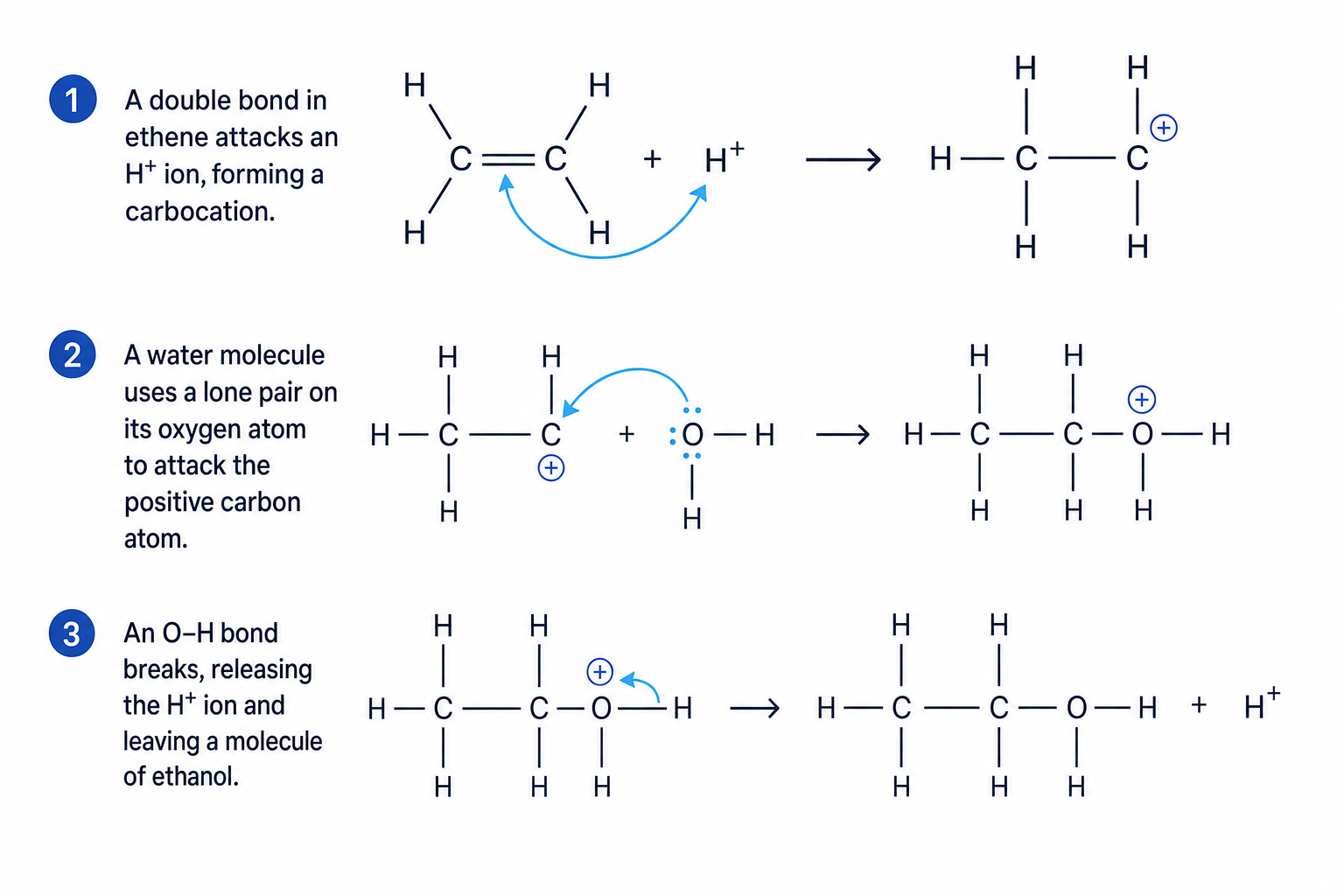
This reaction proceeds via an electrophilic addition mechanism. The acid catalyst provides a hydrogen ion (H+\text{H}^+H+), which acts as the electrophile.
Here is the step-by-step breakdown of how the reaction takes place:
- The electron-rich C=C double bond in the ethene molecule attacks the H+\text{H}^+H+ ion. This breaks the double bond and forms a highly reactive carbocation intermediate.
- A water molecule acts as a nucleophile. One of the lone pairs of electrons on its oxygen atom attacks the positive carbon atom.
- The intermediate is currently positively charged. To stabilise it, an O–H bond breaks, releasing the H+\text{H}^+H+ ion back into the mixture (which regenerates the acid catalyst) and leaving behind a neutral molecule of ethanol.
Method 2: Fermentation of Glucose
The second major way to produce ethanol is by the fermentation of plant sugars like glucose. Unlike hydration, which relies on crude oil to provide the ethene, fermentation is a biological process driven by yeast.
Fermentation
An anaerobic, enzyme-catalysed reaction where sugars are broken down into ethanol and carbon dioxide.
The overall equation for the fermentation of glucose is:
C6H12O6(aq)→2C2H5OH(aq)+2CO2(g) \text{C}_6\text{H}_{12}\text{O}_6(aq) \to 2\text{C}_2\text{H}_5\text{OH}(aq) + 2\text{CO}_2(g) C6H12O6(aq)→2C2H5OH(aq)+2CO2(g)Justifying the conditions for fermentation
You need to be able to state and explain the precise conditions required to make this process work effectively:
- Yeast: Added to the mixture to provide the natural enzymes that act as biological catalysts.
- Anaerobic conditions (no oxygen): This is absolutely crucial. If oxygen is present, the yeast will respire aerobically (producing carbon dioxide and water instead of ethanol). Furthermore, oxygen will cause any ethanol that is produced to oxidise into ethanoic acid (vinegar).
- A warm temperature (≈\approx≈ 35 °C): This is a biological compromise. If the temperature is too low, the reaction is too slow to be economically viable. If the temperature is raised too high, the yeast's enzymes denature and the yeast dies.
- Aqueous solution: The glucose must be dissolved in water so that the reactions can occur in solution.
Purifying the product
Fermentation only ever produces a dilute, impure solution of ethanol. Once the concentration of ethanol in the brewing vat reaches about 15%, the alcohol becomes toxic to the yeast, and the fermentation process stops naturally.
Getting pure ethanol
To obtain pure ethanol from the fermentation mixture, you must separate it using fractional distillation. Ethanol has a lower boiling point (approx 78 °C) than water (100 °C), so the ethanol evaporates first, rises up the fractionating column, and can be condensed and collected.
Biofuels and Carbon Neutrality
Because fermentation uses renewable plant-based sugars rather than finite crude oil, the ethanol produced by this method is classed as a biofuel.
Biofuel
A fuel produced from renewable biological resources, such as plants or animal waste.
Carbon-neutral
A process or fuel that results in no net annual carbon (or greenhouse gas) emissions into the atmosphere.
The theory: proving carbon neutrality
In theory, burning bio-ethanol is entirely carbon-neutral. Proponents of biofuels argue that the carbon dioxide released into the atmosphere when the fuel is burned is perfectly balanced by the carbon dioxide taken out of the atmosphere by the plant when it was growing.
Proving ethanol is mathematically carbon neutral
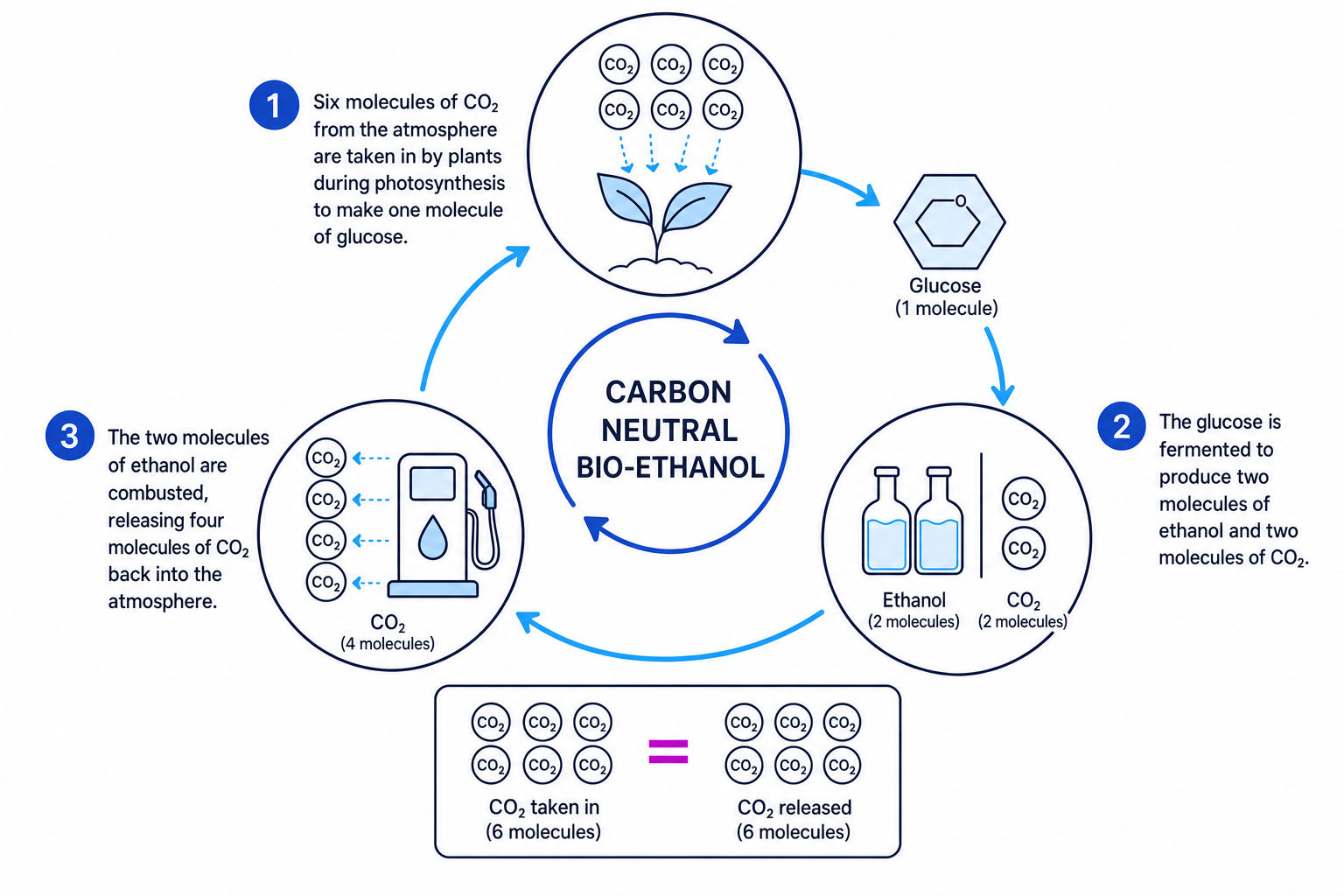
You can prove this claim by tracking the moles of CO2\text{CO}_2CO2 across the three balanced chemical equations that make up the life-cycle of the fuel: photosynthesis, fermentation, and combustion.
- Photosynthesis: The growing plant absorbs 6 moles of CO2\text{CO}_2CO2 from the atmosphere to manufacture 1 mole of glucose.
- Fermentation: That 1 mole of glucose is harvested and fermented, releasing 2 moles of CO2\text{CO}_2CO2.
- Combustion: The resulting 2 moles of ethanol are burned as fuel in a car engine, releasing 4 moles of CO2\text{CO}_2CO2.
Total CO2\text{CO}_2CO2 absorbed = 6 moles. Total CO2\text{CO}_2CO2 released = 2 moles (fermentation) + 4 moles (combustion) = 6 moles. Because the CO2\text{CO}_2CO2 in exactly equals the CO2\text{CO}_2CO2 out, the net carbon emission is theoretically zero.
The reality: why the claim is not fully valid
Although the chemical equations balance perfectly on paper, the claim that biofuels are 100% carbon-neutral is not completely valid in the real world.
Ignoring the full life-cycle
A common pitfall is forgetting the hidden energy costs. When the exam asks why bio-ethanol isn't strictly carbon-neutral, you must remember that fossil fuels are burned at multiple stages: powering the heavy farm machinery used to harvest the crops, transporting the raw materials to the processing plant, and heating the mixture during the fractional distillation process.
Environmental and Ethical Issues
Switching away from fossil fuels to biofuels isn't a perfect silver bullet. When governments and energy companies make decisions about biofuel use, they must weigh up several complex ethical and environmental factors:
- The "Food vs Fuel" debate: Land that is dedicated to growing crops for fuel (like sugar cane or corn) cannot be used to grow crops for food. In some regions, this reduces the food supply and drives up food prices.
- Deforestation: Vast areas of natural forest are sometimes cleared to make room for huge, profitable biofuel plantations. This destroys delicate habitats and ironically removes trees that naturally absorb CO2\text{CO}_2CO2.
- Fertilisers and pesticides: Growing intensive crops demands high volumes of chemical fertilisers, which can easily wash into nearby rivers and lakes, causing severe water pollution and eutrophication.
In the exam
- When asked to "justify" the conditions for fermentation, make sure you link each condition to what would go wrong without it. Don't just say "no oxygen"; say "no oxygen, otherwise the ethanol will oxidise to ethanoic acid".
- If asked to write equations to prove carbon neutrality, make sure you write all three (photosynthesis, fermentation, combustion) and clearly state the final ratio showing that 6 moles go in and 6 moles come out.
- Keep your environmental and ethical points distinct. Deforestation is an environmental issue; poor families unable to afford food is an ethical one.
Check yourself
- What catalyst and temperature are used in the industrial hydration of ethene?
- Why does fermentation stop when the concentration of ethanol reaches about 15%?
- What physical process is required to extract pure ethanol from a fermentation mixture?
- Why is it incorrect to claim that bio-ethanol powered cars have a zero-carbon footprint?
