

What you'll learn
- What happens during the acid-catalysed elimination (dehydration) of alcohols.
- The step-by-step mechanism of how an alcohol loses water to form an alkene.
- Why this reaction provides a sustainable route to plastics without using crude oil.
- How to practically prepare and purify an alkene using distillation (Required Practical 5).
Dehydration of alcohols
Alcohols can be converted into alkenes by removing a molecule of water. Because a small molecule is removed from the reactant to form a double bond, this is classified as an elimination reaction. When the small molecule removed is water, the reaction is specifically called dehydration.
Elimination reaction
A reaction in which a small molecule is removed from a larger molecule, leaving a double bond in its place.
To dehydrate an alcohol, you need harsh conditions. The alcohol is heated with a strong acid catalyst — usually concentrated sulfuric acid (H2SO4\text{H}_2\text{SO}_4H2SO4) or concentrated phosphoric acid (H3PO4\text{H}_3\text{PO}_4H3PO4).
For example, heating ethanol with concentrated sulfuric acid produces ethene and water:
CH3CH2OH→CH2=CH2+H2O \text{CH}_3\text{CH}_2\text{OH} \to \text{CH}_2\text{=CH}_2 + \text{H}_2\text{O} CH3CH2OH→CH2=CH2+H2OThe environmental importance
You might wonder why we would want to turn alcohols into alkenes. The answer lies in plastics.
Currently, most of the alkenes (like ethene and propene) used to make addition polymers come from the cracking of crude oil fractions. Crude oil is finite and non-renewable.
However, ethanol can be produced from renewable resources by fermenting the sugars found in plants (like sugar cane). If we take this bio-ethanol and dehydrate it using an acid catalyst, we get ethene. This ethene can then be polymerised to make poly(ethene).
Sustainable Polymers
Acid-catalysed elimination allows us to manufacture essential addition polymers (plastics) from renewable biological sources, reducing our dependence on crude oil.
The Mechanism
You need to know the exact sequence of electron movements (curly arrows) for this reaction. The catalyst is represented simply as an H+\text{H}^+H+ ion.
The mechanism happens in three stages:
- Protonation: The acid catalyst provides an H+\text{H}^+H+ ion. The alcohol accepts it.
- Loss of water: The carbon–oxygen bond breaks, releasing water and leaving a positively charged carbon atom (a carbocation).
- Deprotonation: The molecule gets rid of an H+\text{H}^+H+ ion to form the double bond. The catalyst is regenerated.
Drawing the elimination mechanism
Let's walk through the exact curly arrows required to draw the dehydration of ethanol (CH3CH2OH\text{CH}_3\text{CH}_2\text{OH}CH3CH2OH) to ethene.
- Draw the alcohol and the proton: Draw ethanol showing the lone pairs on the oxygen atom. Draw an H+\text{H}^+H+ ion nearby. Draw a curly arrow starting exactly from one of the oxygen lone pairs and pointing to the H+\text{H}^+H+. This forms a protonated alcohol intermediate (an oxonium ion) with a positive charge on the oxygen.
- Break the C–O bond: In the protonated intermediate, draw a curly arrow from the middle of the C–O\text{C–O}C–O bond pointing onto the oxygen atom. This shows the electrons moving to oxygen, releasing an H2O\text{H}_2\text{O}H2O molecule and leaving a primary carbocation (CH3CH2+\text{CH}_3\text{CH}_2^+CH3CH2+) with the positive charge on the carbon atom.
- Form the double bond: Look at the carbon atom adjacent to the positive carbon. Draw a curly arrow from the middle of one of its C–H\text{C–H}C–H bonds pointing into the C–C\text{C–C}C–C single bond. This breaks the C–H\text{C–H}C–H bond, releases the H+\text{H}^+H+ ion back into the solution (regenerating the catalyst), and forms the C=C\text{C=C}C=C double bond of ethene.
Forgetting the positive charges
In step 1, once the oxygen atom forms a new bond with the H+\text{H}^+H+ ion, it must have a positive charge. In step 2, when the water molecule leaves, the carbon atom left behind must have a positive charge. If you omit these charges, your mechanism is completely invalid.
Isomeric products
If you are dehydrating a secondary or tertiary alcohol that is not symmetrical (e.g., butan-2-ol), the hydrogen atom removed in Step 3 can come from the carbon on the left or the right of the carbocation. This will yield a mixture of isomeric alkenes (e.g., but-1-ene and but-2-ene), which may also include E/ZE / ZE/Z isomers!
Required Practical 5: Distillation
In the laboratory, you are expected to know how to prepare and purify a liquid alkene from an alcohol. A common example is the dehydration of cyclohexanol to form cyclohexene.
Because organic reactions often produce a mixture of products, unreacted starting materials, and aqueous side-products, you must use distillation to separate the desired alkene as it forms.
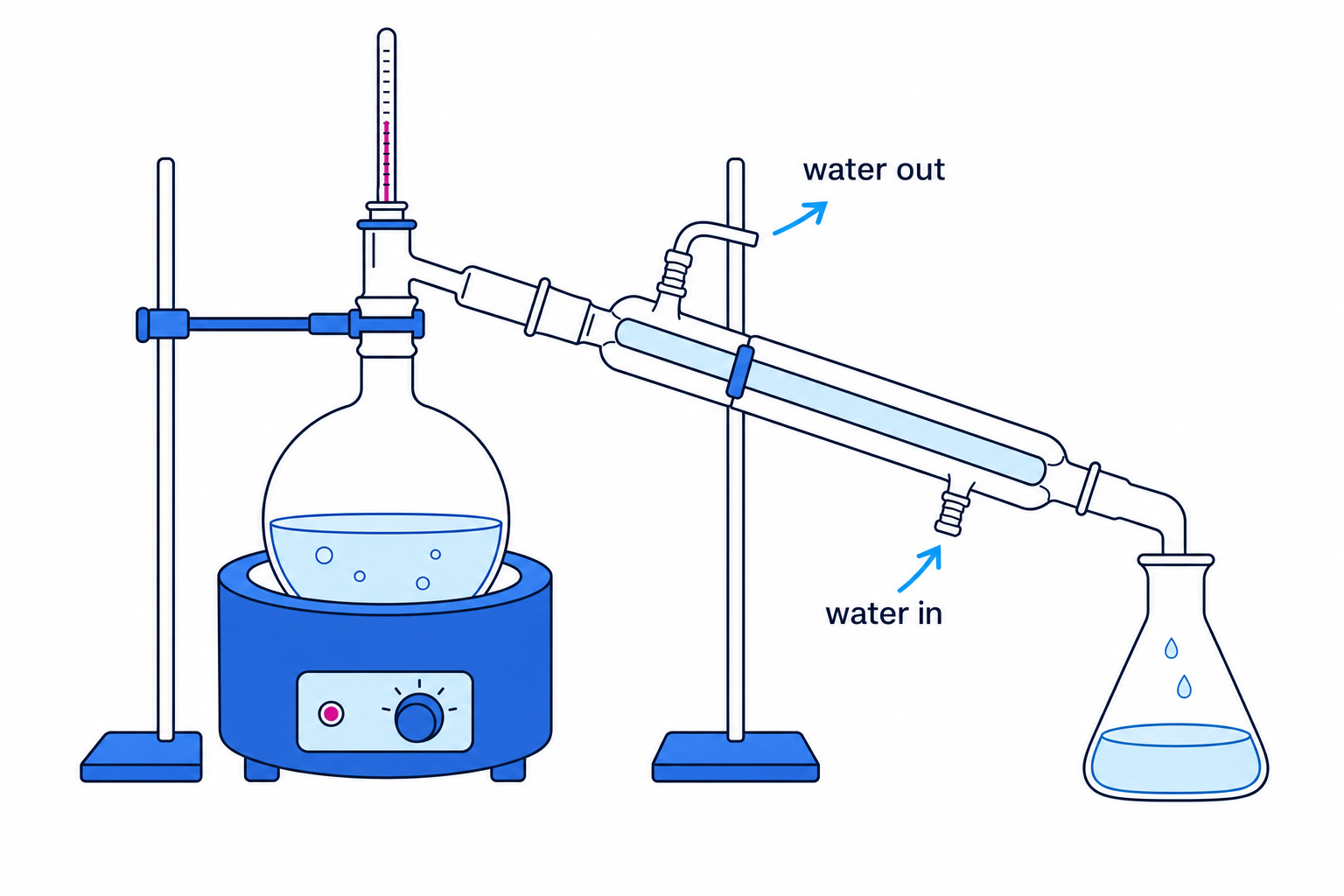
1. The reaction and distillation
The alcohol (cyclohexanol) and the acid catalyst (concentrated H3PO4\text{H}_3\text{PO}_4H3PO4) are placed in a round-bottomed flask along with anti-bumping granules. The mixture is heated.
Cyclohexene has a much lower boiling point than cyclohexanol because cyclohexanol can form strong hydrogen bonds, while cyclohexene only has weak van der Waals forces. As the cyclohexene forms, it boils and turns into a vapour. The vapour travels up the still head, hits the cold Liebig condenser, condenses back into a liquid, and drips into the receiving flask.
Condenser setup
Always ensure the cooling water goes in at the bottom of the condenser and out at the top. This ensures the condenser water jacket is completely full of cold water, maximising cooling efficiency.
2. Purification
The distillate collected is not perfectly pure. It will contain water and likely some unreacted acid and alcohol. To purify it:
- Separating funnel: Pour the mixture into a separating funnel. Water and organic liquids are immiscible (they don't mix). The mixture will form two layers. Run off the lower aqueous layer and keep the upper organic layer (the cyclohexene).
- Neutralisation: You may need to wash the organic layer with a dilute sodium carbonate solution to neutralise any acid that distilled over.
- Drying: Transfer the crude cyclohexene to a conical flask and add a solid drying agent, such as anhydrous calcium chloride (CaCl2\text{CaCl}_2CaCl2) or anhydrous magnesium sulfate (MgSO4\text{MgSO}_4MgSO4). Swirl until the liquid goes from cloudy to clear, indicating the water has been absorbed.
- Redistillation: Finally, filter off the drying agent and redistil the liquid, collecting only the fraction that boils at the exact boiling point of cyclohexene.
In the exam
- When drawing the mechanism, always ensure your curly arrows start precisely from a lone pair or the centre of a bond. An arrow floating vaguely near an atom will lose the mark.
- Remember that the acid catalyst (H+\text{H}^+H+) must be regenerated at the end of the mechanism. If it isn't, something has gone wrong.
- If an exam question asks for a "sustainable" reason for this reaction, always mention that it provides polymers without using crude oil or that it uses renewable plant sugars.
- In distillation diagrams, ensure the system is completely sealed except for the very end where the liquid exits. If you draw a stopper in the receiving flask without a vent, you have drawn a bomb!
Check yourself
- What two acid catalysts are most commonly used for the dehydration of alcohols?
- Why is the boiling point of cyclohexene significantly lower than that of cyclohexanol?
- In the mechanism, what bond breaks to release the water molecule?
- Why do we add anhydrous calcium chloride to the crude alkene during purification?
