

What you'll learn
- How a multi-step organic synthesis is planned using reactions you already know.
- How to spot the key change: functional group, carbon chain, or oxidation level.
- Why greener routes use fewer steps, safer substances, and high atom economy.
- How to write a clear synthesis route of up to four steps.
The big idea: making molecules step by step
Organic synthesis means making an organic compound from other compounds using one or more chemical reactions. In this A-level-only section, the skill is not usually learning brand-new reactions — it is linking reactions from the specification into a sensible route.
A synthesis may involve intermediates: compounds made part-way through the route, which are then used in later steps.
Multi-step synthesis
A multi-step synthesis is a route in which the target compound is made through two or more reactions, with one or more intermediates formed along the way.
Each step needs:
- a starting organic compound,
- a reagent, which is a substance that causes the reaction,
- suitable conditions, such as heat, reflux, distillation, solvent, catalyst, or pressure,
- the organic product of that step.
Reflux means heating a mixture with a condenser so vapour condenses and returns to the flask. This allows prolonged heating without losing volatile substances. Distillation means collecting a volatile product as it forms.
Your reaction toolbox
Most synthesis questions are built from familiar functional group interconversions. A functional group interconversion is a change from one functional group to another, such as alcohol to aldehyde, or haloalkane to nitrile.
Use this map as a starting point for common aliphatic routes. It is not every reaction in the specification, but it shows several high-value links.
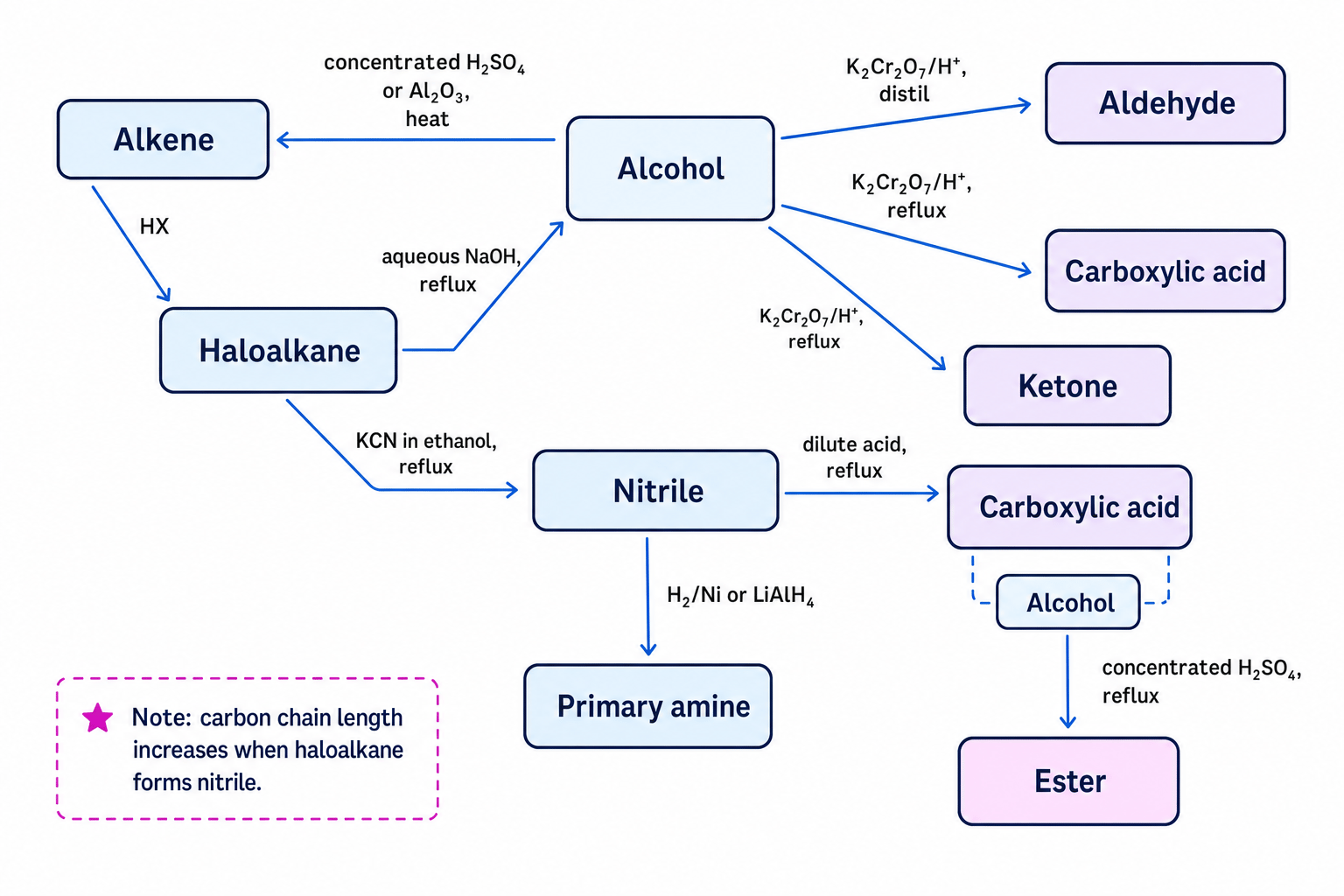
High-value transformations to remember
For synthesis planning, group reactions by what they achieve.
Changing a functional group
- Alkene → alcohol: steam, H₃PO₄ catalyst.
- Alkene → haloalkane: hydrogen halide, HX.
- Haloalkane → alcohol: aqueous NaOH or KOH, reflux.
- Alcohol → alkene: concentrated H₂SO₄ or Al₂O₃, heat.
- Carboxylic acid + alcohol → ester: concentrated H₂SO₄, reflux.
Changing oxidation level
- Primary alcohol → aldehyde: acidified K₂Cr₂O₇, distil.
- Primary alcohol → carboxylic acid: acidified K₂Cr₂O₇, reflux.
- Secondary alcohol → ketone: acidified K₂Cr₂O₇, reflux.
- Aldehyde → carboxylic acid: acidified K₂Cr₂O₇, reflux.
Changing carbon chain length
- Haloalkane → nitrile: KCN in ethanol, reflux. This increases the carbon chain by one carbon.
- Nitrile → carboxylic acid: dilute acid, reflux.
- Nitrile → primary amine: H₂/Ni or LiAlH₄.
Aqueous versus ethanolic hydroxide
Aqueous NaOH or KOH with a haloalkane favours substitution to form an alcohol. Ethanolic KOH favours elimination to form an alkene. The solvent changes the route.
Planning backwards: retrosynthesis
A useful method is retrosynthesis: start with the target molecule, then work backwards to a compound you know how to make or have been given.
Retrosynthesis
Retrosynthesis is planning a synthesis by mentally breaking the target molecule back into simpler possible precursors, then writing the real route forwards.
When you compare the starting compound and target compound, ask three questions:
- Has the functional group changed?
- Has the carbon chain length changed?
- Has the oxidation level changed?
The central strategy
Work backwards to choose the route, but write your final answer forwards with reagents and conditions on each arrow.
Planning ethene to propanoic acid
-
Compare carbon numbers. Ethene has two carbons, but propanoic acid has three carbons, so the route must add one carbon.
-
Choose a reaction that increases chain length by one. Substitution of a haloalkane with CN⁻ forms a nitrile, adding the carbon from the CN group.
-
Make a suitable haloalkane from ethene. Add HBr to ethene to form bromoethane:
CH₂=CH₂ → CH₃CH₂Br. -
Convert the haloalkane into a nitrile using KCN in ethanol under reflux:
CH₃CH₂Br → CH₃CH₂CN. -
Hydrolyse the nitrile to the carboxylic acid using dilute acid under reflux:
CH₃CH₂CN → CH₃CH₂COOH.
Choosing conditions precisely
In synthesis questions, the same starting compound can give different products depending on the conditions. This is especially important for primary alcohols.
For example, ethanol can be oxidised to ethanal or ethanoic acid. To stop at the aldehyde, you distil the aldehyde as it forms. To reach the carboxylic acid, you reflux with excess oxidising agent.
Distil versus reflux
For primary alcohol oxidation: distil to make an aldehyde; reflux to make a carboxylic acid. For secondary alcohols, reflux gives a ketone.
Watch the carbon skeleton
A carbon skeleton is the arrangement and number of carbon atoms in the molecule. Many reactions change the functional group but leave the carbon skeleton unchanged. Others, especially nitrile formation from haloalkanes, change the number of carbons.
Forgetting the carbon count
If the target has one more carbon than the starting compound, consider the haloalkane → nitrile route. If the carbon count is unchanged, do not accidentally insert a nitrile step.
Greener synthesis: why route design matters
Chemists do not only ask, “Can we make it?” They also ask, “Can we make it safely, efficiently, and with little waste?”
Green chemistry aims to reduce environmental impact and hazards while still producing useful compounds.
Avoiding solvents where possible
A solvent is a liquid used to dissolve reactants. Solvents can be useful because they help reactants mix, but they may also be flammable, toxic, volatile, or difficult to separate from the product.
Processes that require no solvent, or use a safer solvent such as water, can reduce:
- waste disposal problems,
- energy needed for purification,
- risk of fire or exposure,
- atmospheric pollution from volatile organic compounds.
Using non-hazardous starting materials
A hazardous substance is one that can cause harm, for example by being toxic, corrosive, flammable, or harmful to the environment.
Chemists aim to use safer starting materials because this reduces risk during storage, transport, handling, reaction, and waste treatment.
Fewer steps usually means better synthesis
Every extra step can reduce the total amount of final product because each reaction has a yield less than 100%. Each step may also need heating, purification, solvent, and time.
Calculating overall yield across steps
-
Suppose a four-step synthesis has a yield of 80% for each step. Convert each percentage into a decimal: 80% becomes 0.80.
-
Multiply the step yields because the product of one step becomes the starting material for the next:
0.804=0.40960.80^4 = 0.40960.804=0.4096. -
Convert back to a percentage. The overall yield is 40.96%, so less than half of the original starting material becomes final product.
-
Compare this with a two-step route at the same yield per step:
0.802=0.640.80^2 = 0.640.802=0.64, so the overall yield is 64%. Fewer steps can dramatically improve efficiency.
Atom economy
Atom economy measures how much of the reactant mass ends up in the desired product. A high atom economy means fewer atoms are wasted in by-products.
Percentage atom economy
Percentage atom economy is calculated using:
% atom economy=Mr of desired product∑Mr of all products×100\% \text{ atom economy} = \frac{M_r \text{ of desired product}}{\sum M_r \text{ of all products}} \times 100% atom economy=∑Mr of all productsMr of desired product×100If there is more than one mole of a product in the balanced equation, multiply its MrM_rMr by its coefficient.
Comparing atom economy for ethanol production
-
Consider hydration of ethene:
C₂H₄ + H₂O → C₂H₅OH.
The only product is ethanol, so all product atoms are in the desired product. -
Calculate the atom economy for hydration:
46.046.0×100=100%\frac{46.0}{46.0} \times 100 = 100\%46.046.0×100=100%. -
Now consider hydrolysis of chloroethane:
C₂H₅Cl + NaOH → C₂H₅OH + NaCl.
The desired product is ethanol, with Mr=46.0M_r = 46.0Mr=46.0. Sodium chloride is a by-product, with Mr=58.5M_r = 58.5Mr=58.5. -
Calculate total product mass:
46.0+58.5=104.546.0 + 58.5 = 104.546.0+58.5=104.5. -
Calculate atom economy:
46.0104.5×100=44.0%\frac{46.0}{104.5} \times 100 = 44.0\%104.546.0×100=44.0%. -
Hydration has the better atom economy. However, the best industrial route also depends on yield, rate, feedstock cost, energy use, hazards, and separation.
Atom economy is not percentage yield
Atom economy is theoretical and depends on the balanced equation. Percentage yield is experimental and depends on how much product is actually obtained.
Writing a synthesis route clearly
In an exam answer, clarity matters. A good route usually looks like this:
Starting compound → intermediate 1 → intermediate 2 → target compound
Put the reagent and conditions above or beside each arrow. If names are ambiguous, use displayed or structural formulae.
For example, “acidified potassium dichromate(VI)” alone is not always enough. You should state distil if you want an aldehyde, or reflux if you want a carboxylic acid.
Mixtures can spoil a route
Adding HX to an unsymmetrical alkene may form more than one product. If a synthesis needs one specific isomer, choose a route that avoids an unwanted mixture where possible.
In the exam
-
Count carbons first, then identify the functional group change needed at each stage.
-
Plan the route backwards, but write the final answer forwards with every reagent and condition shown.
-
Be precise with conditions that change the product, especially reflux versus distillation and aqueous versus ethanolic reagents.
-
If asked about greener synthesis, mention fewer steps, safer starting materials, avoiding solvents, and high atom economy.
Check yourself
-
How could you convert bromoethane into propanoic acid, and why does the carbon chain increase?
-
Why does refluxing a primary alcohol with acidified K₂Cr₂O₇ give a different product from distilling it?
-
What is the difference between high percentage yield and high percentage atom economy?

