

Welcome to the chemistry of the carbonyl group. In this topic, we will look at how the polar C=O\text{C=O}C=O bond dictates the reactions of aldehydes and ketones, expanding on what you learned at AS-level.
What you'll learn:
- How to use chemical tests like Tollens' reagent and Fehling's solution to distinguish between aldehydes and ketones.
- How to write equations and draw mechanisms for the reduction of carbonyls to alcohols.
- How carbonyls react with KCN\text{KCN}KCN to form hydroxynitriles, and the hazards involved.
- Why these addition reactions often produce a racemic mixture of optical isomers.
The carbonyl group
Both aldehydes and ketones contain the carbonyl group, C=O\text{C=O}C=O.
Carbonyl group
A functional group consisting of a carbon atom double-bonded to an oxygen atom. In an aldehyde, the carbonyl group is at the end of the carbon chain. In a ketone, it is found in the middle of the carbon chain.
Oxygen is much more electronegative than carbon, which draws electron density away from the carbon atom. This leaves the carbon with a partial positive charge (δ+\delta^+δ+) and the oxygen with a partial negative charge (δ−\delta^-δ−). Because of this electron-deficient carbon, carbonyl compounds are prime targets for attack by nucleophiles (electron-pair donors).
The fundamental reactivity of carbonyls
The δ+\delta^+δ+ carbon in the C=O\text{C=O}C=O bond is attacked by nucleophiles. This initiates nucleophilic addition reactions, where the double bond breaks to form single bonds with new atoms.
Distinguishing aldehydes from ketones
Because aldehydes have a hydrogen atom attached to the carbonyl carbon (RCHO\text{RCHO}RCHO), they can be easily oxidised to form carboxylic acids (RCOOH\text{RCOOH}RCOOH). Ketones lack this hydrogen and cannot be oxidised under normal conditions.
We can use mild oxidising agents to chemically distinguish between the two. You need to know two specific chemical tests.
Tollens' reagent
Tollens' reagent is a colourless solution of ammoniacal silver nitrate, containing the complex ion [Ag(NH3)2]+[\text{Ag}(\text{NH}_3)_2]^+[Ag(NH3)2]+.
- When warmed with an aldehyde, the aldehyde is oxidised to a carboxylic acid (or rather, a carboxylate ion in alkaline conditions). Simultaneously, the silver ions (Ag+\text{Ag}^+Ag+) are reduced to solid silver atoms (Ag\text{Ag}Ag). This forms a distinctive "silver mirror" on the inside of the test tube.
- When warmed with a ketone, no reaction occurs and the solution remains colourless.
Fehling's solution
Fehling's solution is a blue alkaline solution containing copper(II) ions (Cu2+\text{Cu}^{2+}Cu2+).
- When warmed with an aldehyde, the aldehyde is oxidised to a carboxylic acid, and the blue Cu2+\text{Cu}^{2+}Cu2+ ions are reduced to copper(I) oxide (Cu2O\text{Cu}_2\text{O}Cu2O), which forms a brick-red precipitate.
- When warmed with a ketone, no reaction occurs and the solution remains blue.
Remembering the tests
A simple way to remember: Aldehydes can be Altered (oxidised) further. Tollens' gives Silver, Fehling's goes Red. Ketones keep their original colours!
Reduction of aldehydes and ketones
Just as primary and secondary alcohols can be oxidised to form aldehydes and ketones, the reverse process is also true: aldehydes and ketones can be reduced back to alcohols.
We use sodium tetrahydridoborate(III), NaBH4\text{NaBH}_4NaBH4, in an aqueous solution as the reducing agent.
- Aldehydes are reduced to primary alcohols.
- Ketones are reduced to secondary alcohols.
Writing the overall equations
When writing these equations, we use the symbol [H]\text{[H]}[H] to represent the reducing agent. Because the reduction of a carbonyl group involves adding one hydrogen to the oxygen and one hydrogen to the carbon, you always need 2[H]2\text{[H]}2[H].
For the reduction of ethanal to ethanol:
CH3CHO+2[H]→CH3CH2OH \text{CH}_3\text{CHO} + 2\text{[H]} \to \text{CH}_3\text{CH}_2\text{OH} CH3CHO+2[H]→CH3CH2OHFor the reduction of propanone to propan-2-ol:
CH3COCH3+2[H]→CH3CH(OH)CH3 \text{CH}_3\text{COCH}_3 + 2\text{[H]} \to \text{CH}_3\text{CH(OH)CH}_3 CH3COCH3+2[H]→CH3CH(OH)CH3Mechanism of reduction
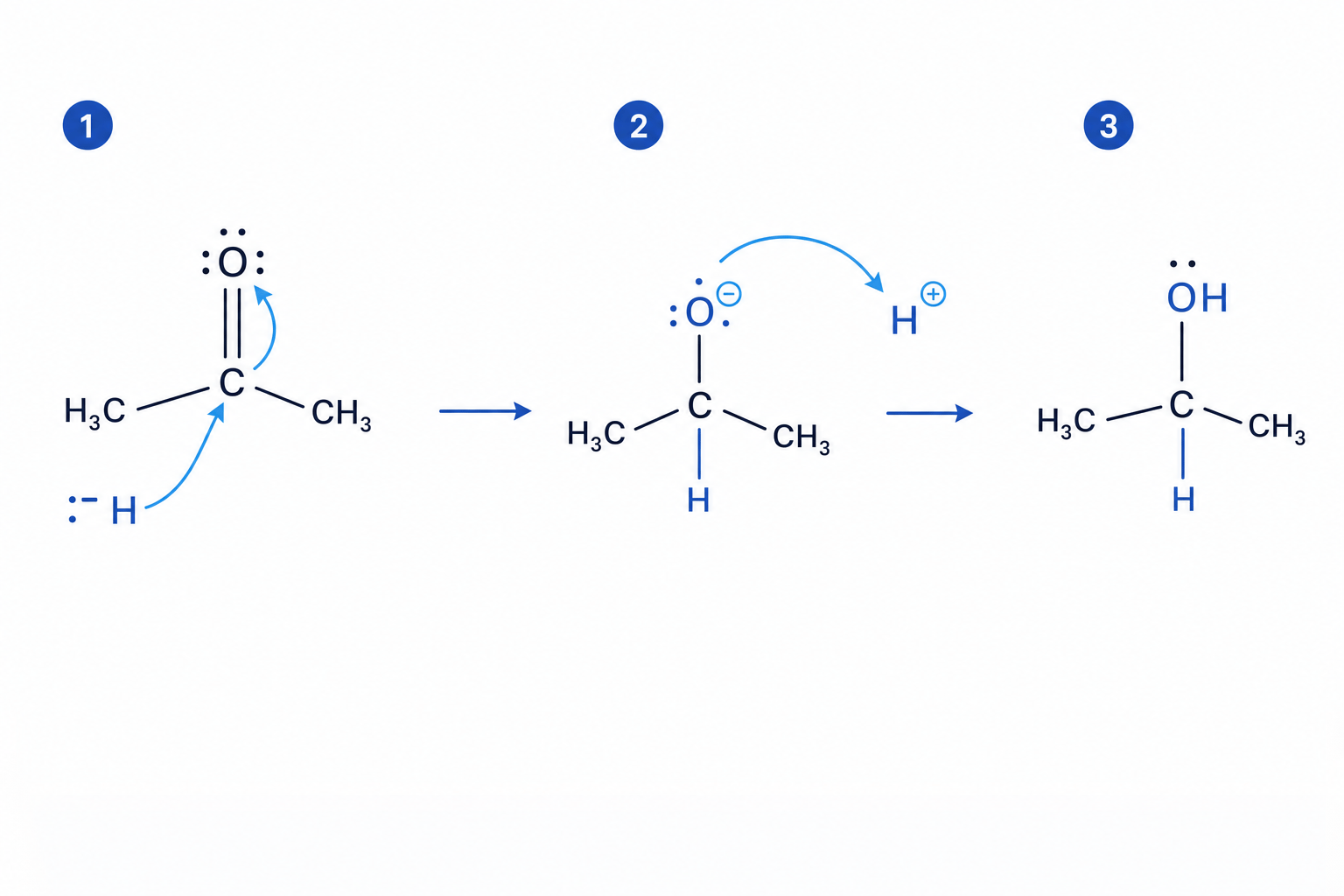
The reduction reaction proceeds via a nucleophilic addition mechanism. The NaBH4\text{NaBH}_4NaBH4 acts as a source of hydride ions, H−\text{H}^-H−. The hydride ion has a lone pair of electrons, making it a nucleophile.
Here is the sequence of events:
- The lone pair on the hydride ion (H−\text{H}^-H−) attacks the δ+\delta^+δ+ carbon of the carbonyl group.
- The carbon-oxygen double bond breaks, and the π\piπ bonding pair of electrons moves fully onto the oxygen atom, forming an intermediate alkoxide ion with an O−\text{O}^-O− charge.
- The negatively charged oxygen donates a lone pair to a hydrogen ion (H+\text{H}^+H+) from the water solvent, forming the final alcohol.
Reaction with potassium cyanide
Another important nucleophilic addition reaction is the reaction of aldehydes and ketones with potassium cyanide (KCN\text{KCN}KCN) followed by dilute acid. This reaction produces hydroxynitriles — molecules containing both a hydroxyl (−OH-\text{OH}−OH) and a nitrile (−CN-\text{CN}−CN) group.
This reaction is exceptionally useful in organic synthesis because it increases the length of the carbon chain by one carbon atom.
Why KCN and not HCN?
Hydrogen cyanide (HCN\text{HCN}HCN) is a highly toxic gas that is difficult and dangerous to handle safely. Furthermore, it is a weak acid, so it only partially dissociates, meaning the concentration of the actual nucleophile (CN−\text{CN}^-CN−) is very low.
Instead, we use a mixture of solid KCN\text{KCN}KCN and dilute acid. KCN\text{KCN}KCN is an ionic solid that fully dissociates in water to provide a high concentration of cyanide ions (CN−\text{CN}^-CN−). The dilute acid then provides the H+\text{H}^+H+ ions needed for the final step of the mechanism.
Hazards of KCN
Potassium cyanide is still highly toxic and lethal if ingested or if its dust is inhaled. Cyanide ions block cellular respiration. When performing these reactions, strict safety precautions must be taken, including the use of a fume cupboard and protective gear.
Equations and mechanism
Although the reaction practically uses KCN\text{KCN}KCN and dilute acid, the specification asks you to write overall equations using HCN\text{HCN}HCN to represent the reagents adding across the double bond.
For the reaction of ethanal with HCN\text{HCN}HCN:
CH3CHO+HCN→CH3CH(OH)CN \text{CH}_3\text{CHO} + \text{HCN} \to \text{CH}_3\text{CH(OH)CN} CH3CHO+HCN→CH3CH(OH)CNThe mechanism is another classic nucleophilic addition, mirroring the NaBH4\text{NaBH}_4NaBH4 reduction.
- The cyanide ion (CN−\text{CN}^-CN−) attacks the δ+\delta^+δ+ carbon.
- The C=O\text{C=O}C=O double bond breaks, pushing electrons onto the oxygen.
- The O−\text{O}^-O− intermediate picks up an H+\text{H}^+H+ ion from the dilute acid.
Deducing the hydroxynitrile from a ketone
Write the overall equation for the reaction between butanone and hydrogen cyanide, and deduce the systematic IUPAC name of the product formed.
- First, identify the formula of butanone. It is a four-carbon chain with a ketone group on the second carbon: CH3COCH2CH3\text{CH}_3\text{COCH}_2\text{CH}_3CH3COCH2CH3.
- Write the balanced equation by adding HCN\text{HCN}HCN to the reactants, and showing both the −OH-\text{OH}−OH and −CN-\text{CN}−CN groups attached to what was the carbonyl carbon:
- To name the product, find the longest carbon chain that includes the nitrile group. The nitrile carbon is always carbon-1. The longest chain starting from the −CN-\text{CN}−CN carbon is 4 carbons long (butanenitrile).
- Identify the substituents. On carbon-2, there is an −OH-\text{OH}−OH group (hydroxy) and a −CH3-\text{CH}_3−CH3 group (methyl).
- Combine the parts in alphabetical order. The product is 2-hydroxy-2-methylbutanenitrile.
Naming hydroxynitriles
When naming a hydroxynitrile, students often forget that the carbon atom in the −CN-\text{CN}−CN group counts as part of the longest chain, and it is automatically assigned position 1. Do not start counting from the carbon bonded to the −OH-\text{OH}−OH!
Optical isomerism from nucleophilic addition
When aldehydes and unsymmetrical ketones react with KCN\text{KCN}KCN (followed by dilute acid), they produce molecules with a chiral centre — a carbon atom bonded to four different groups.
Because a chiral centre is formed, you might expect the product to be optically active (able to rotate plane-polarised light). However, the resulting mixture is almost always optically inactive because it forms a racemic mixture (a 50:50 mixture of two enantiomers).
Why does this happen? We must look at the geometry of the carbonyl group.
The atoms bonded directly to the carbonyl carbon are arranged in a planar (flat) triangle. When the nucleophile (CN−\text{CN}^-CN−) approaches the planar C=O\text{C=O}C=O bond, there is nothing blocking it from either side.
- There is a 50% chance the nucleophile attacks from above the plane.
- There is a 50% chance the nucleophile attacks from below the plane.
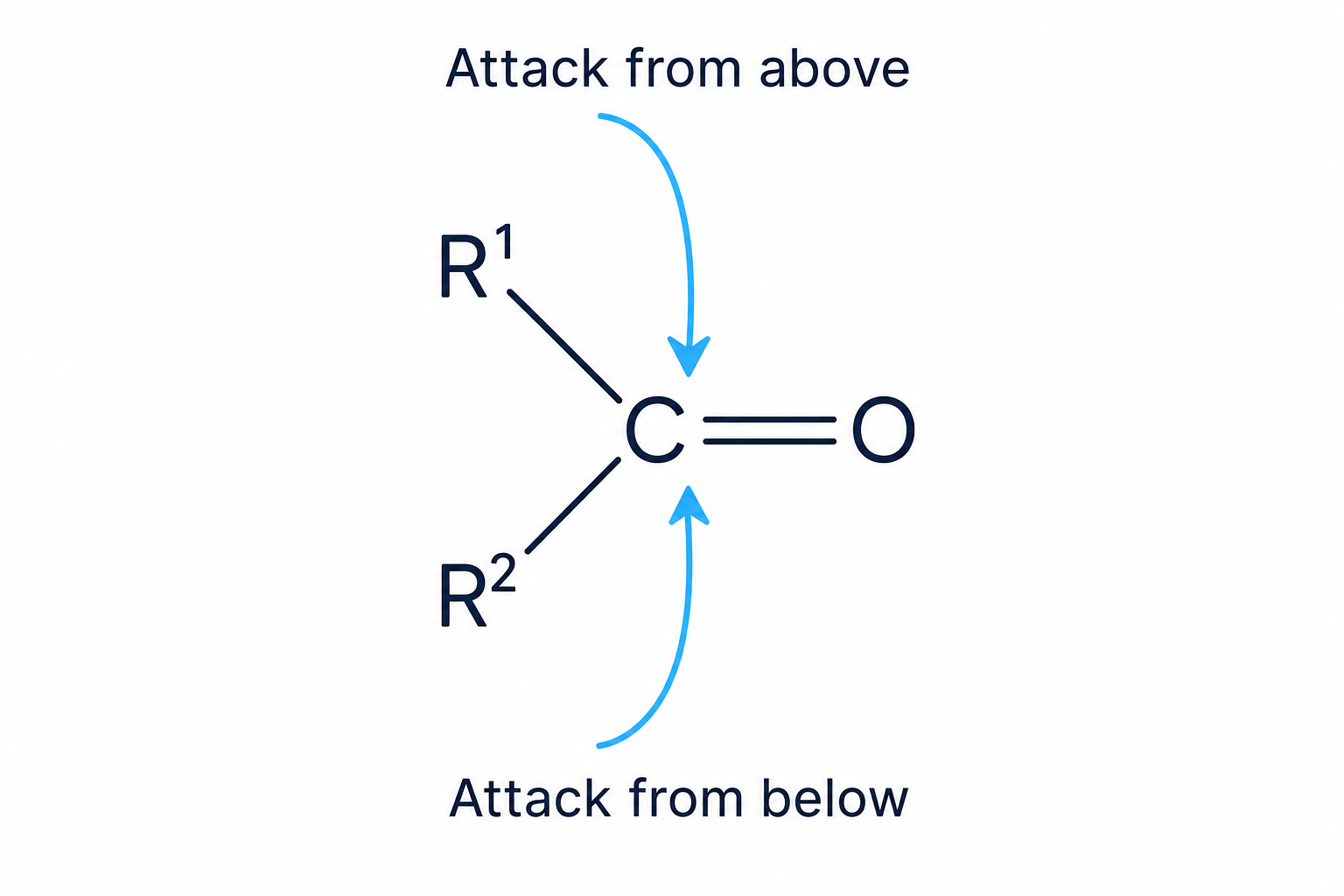
Because attack from either side is equally likely, equal amounts of the two enantiomers are formed. Their opposite effects on plane-polarised light cancel out perfectly, resulting in an optically inactive racemic mixture.
In the exam
- When drawing a nucleophilic addition mechanism, make sure your curly arrow starts precisely from the lone pair or the negative charge on the nucleophile (H−\text{H}^-H− or :CN−:\text{CN}^-:CN−).
- The arrow from the double bond must clearly point to the oxygen atom, not into empty space.
- If asked to explain why a racemic mixture forms, you must use the phrase "planar carbonyl group". Saying "the molecule is planar" is technically incorrect (the rest of the molecule usually isn't) and will lose marks. Say "planar C=O\text{C=O}C=O group" or "planar about the carbonyl carbon".
Check yourself
- What would you observe if you heated Tollens' reagent with propanal?
- Write the balanced equation for the reduction of butanal using [H]\text{[H]}[H].
- Why is a mixture of KCN\text{KCN}KCN and dilute acid used to produce hydroxynitriles rather than HCN\text{HCN}HCN?
- Explain exactly why the reaction of propanal with KCN\text{KCN}KCN followed by dilute acid produces an optically inactive mixture.
