What you'll learn:
- Why the carbon–halogen bond makes halogenoalkanes highly reactive.
- How to draw the curly-arrow mechanisms for reactions with hydroxide, cyanide, and ammonia.
- Why the strength of the carbon–halogen bond—not its polarity—determines how fast the reaction goes.
The polar carbon–halogen bond
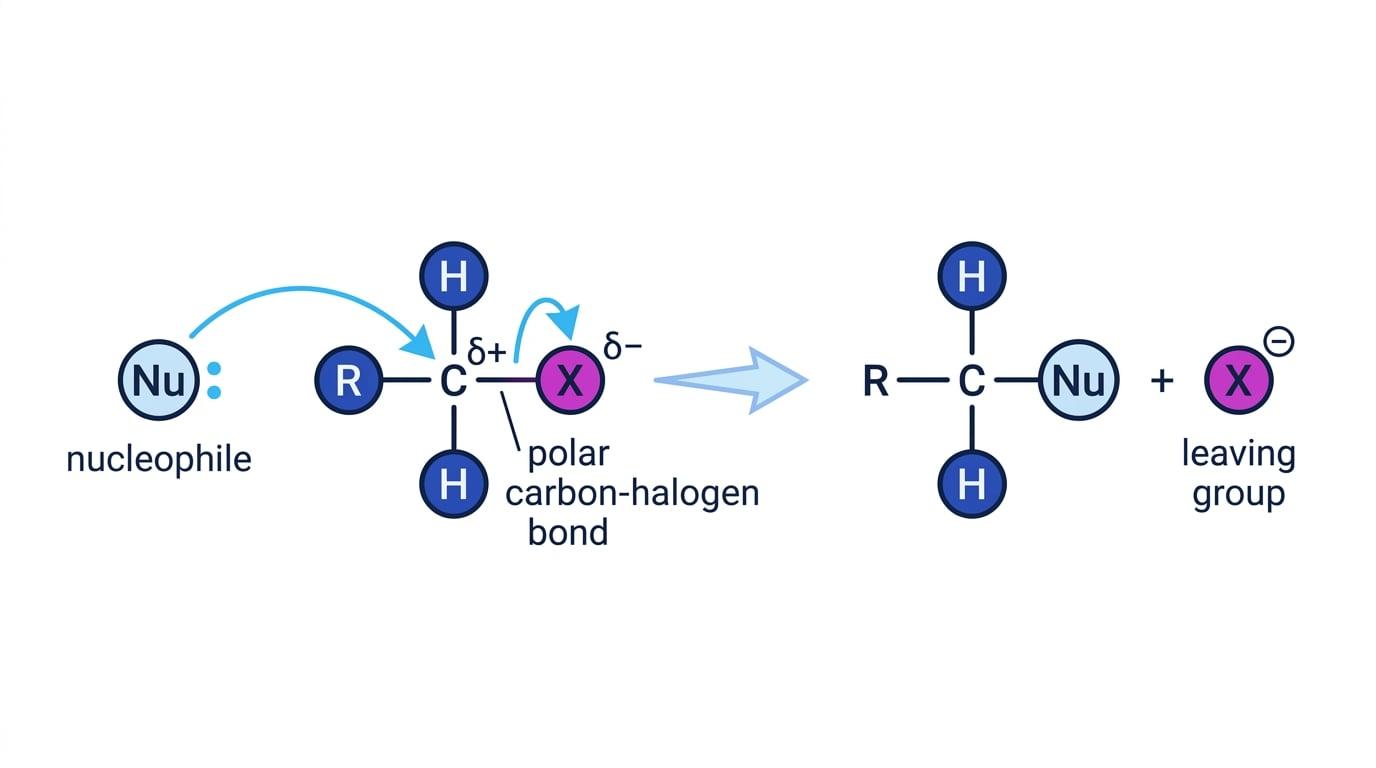
Halogenoalkanes contain a carbon atom covalently bonded to a halogen (fluorine, chlorine, bromine, or iodine). Halogens are more electronegative than carbon, meaning they pull the shared pair of electrons in the covalent bond towards themselves.
This unequal sharing creates a polar bond. The carbon atom becomes slightly positive (δ+\delta+δ+) and the halogen atom becomes slightly negative (δ−\delta-δ−). Because the carbon atom is electron-deficient, it acts as a magnet for any species that is "looking" for a positive charge.
What is a nucleophile?
Nucleophile
A nucleophile is an electron pair donor. It is a species (usually a negative ion or a molecule with a lone pair of electrons) that is attracted to an electron-deficient centre, where it donates a pair of electrons to form a new covalent bond.
In this topic, you need to know three specific nucleophiles:
- The hydroxide ion, OH−\text{OH}^-OH−
- The cyanide ion, CN−\text{CN}^-CN−
- The ammonia molecule, NH3\text{NH}_3NH3
The mechanism in action
When a nucleophile approaches the δ+\delta+δ+ carbon atom, it uses its lone pair to form a new bond with the carbon. Carbon can only form four bonds, so as the new bond forms, the old carbon–halogen bond must break. Both electrons from the breaking bond go to the halogen atom, which leaves as a halide ion (like Cl−\text{Cl}^-Cl− or Br−\text{Br}^-Br−). This is why the halogen is often called the leaving group.
Because the nucleophile is replacing the halogen, we call this a nucleophilic substitution reaction.
Drawing curly arrows
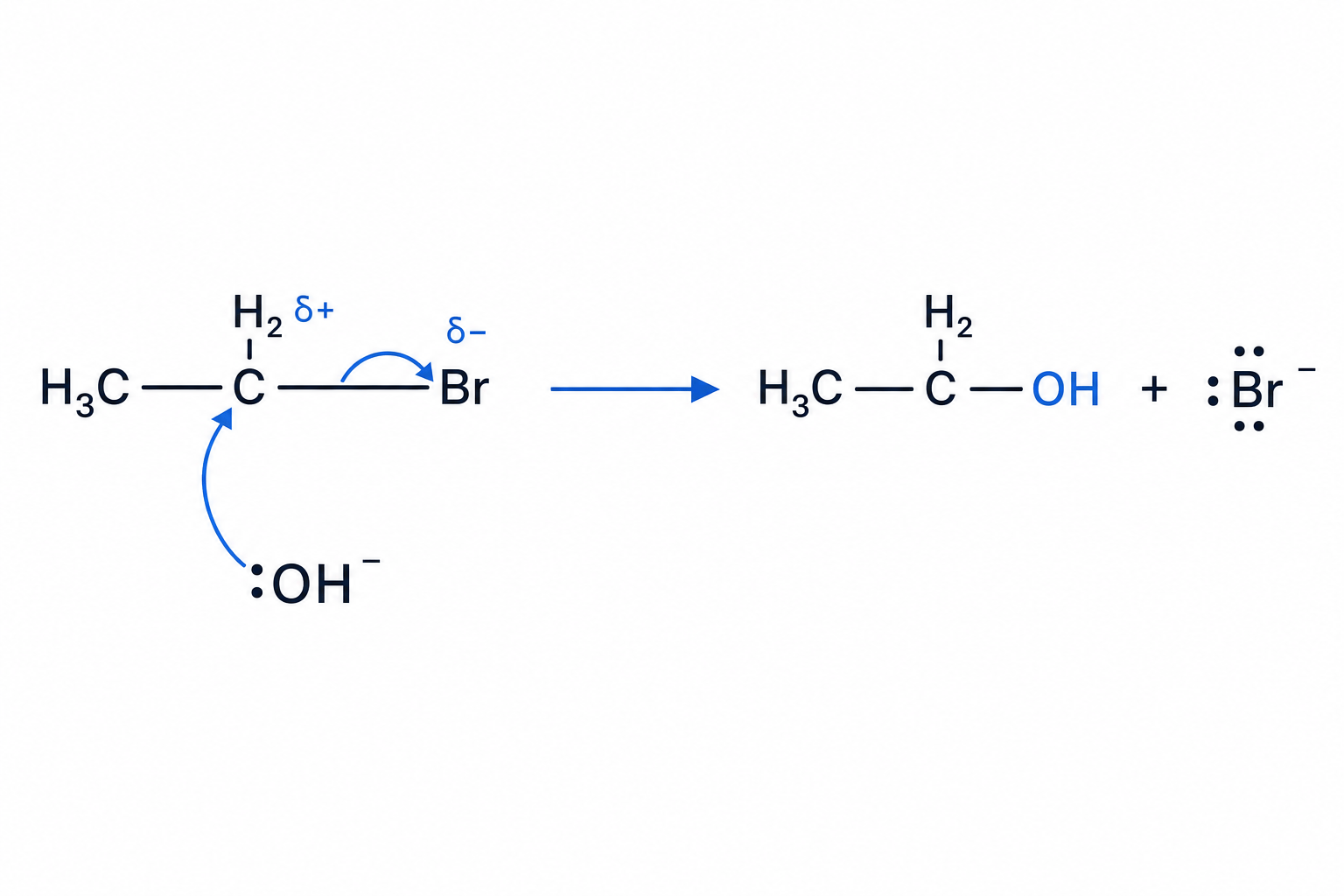
Always start your curly arrow from the exact location of the electrons (the lone pair or the center of the breaking bond) and point it exactly to where those electrons are going (the atom receiving them). Examiners are incredibly strict about this!
Three key reactions to learn
1. Reaction with hydroxide ions (OH−\text{OH}^-OH−)
When a halogenoalkane is warmed with aqueous sodium or potassium hydroxide, the OH−\text{OH}^-OH− ion acts as a nucleophile. The halogen is substituted by the hydroxyl group, forming an alcohol.
- Conditions: Warm, aqueous solution.
- Equation:
2. Reaction with cyanide ions (CN−\text{CN}^-CN−)
If a halogenoalkane is warmed with potassium cyanide (KCN\text{KCN}KCN) dissolved in ethanol (often written as ethanolic KCN\text{KCN}KCN), the CN−\text{CN}^-CN− ion acts as the nucleophile. The product is a nitrile.
- Conditions: Warm, ethanolic solution.
- Equation:
Increasing the carbon chain
Reacting a halogenoalkane with cyanide is extremely useful in organic synthesis because it extends the carbon chain by one carbon atom. For example, bromoethane (2 carbons) reacts to form propanenitrile (3 carbons).
Writing an equation for a cyanide substitution
Write the overall equation for the reaction of 1-chloropropane with ethanolic potassium cyanide, and name the organic product.
- Identify the starting halogenoalkane. 1-chloropropane has the formula CH3CH2CH2Cl\text{CH}_3\text{CH}_2\text{CH}_2\text{Cl}CH3CH2CH2Cl.
- Identify the incoming nucleophile. We are using cyanide (CN−\text{CN}^-CN−), provided by KCN\text{KCN}KCN.
- Substitute the chlorine atom for the cyanide group. The organic product is CH3CH2CH2CN\text{CH}_3\text{CH}_2\text{CH}_2\text{CN}CH3CH2CH2CN.
- Write the balanced equation.
- Name the product. The longest carbon chain that includes the new nitrile carbon is 4 carbons long. Therefore, the product is butanenitrile.
3. Reaction with ammonia (NH3\text{NH}_3NH3)
When a halogenoalkane is heated with an excess of concentrated ammonia in ethanol in a sealed tube, it forms a primary amine.
This mechanism is slightly more complex because it has two distinct steps:
- Attack: An ammonia molecule acts as a nucleophile, attacking the δ+\delta+δ+ carbon to form an intermediate alkylammonium ion.
- Deprotonation: A second ammonia molecule acts as a base, removing a hydrogen ion (H+\text{H}^+H+) from the positively charged nitrogen on the intermediate.
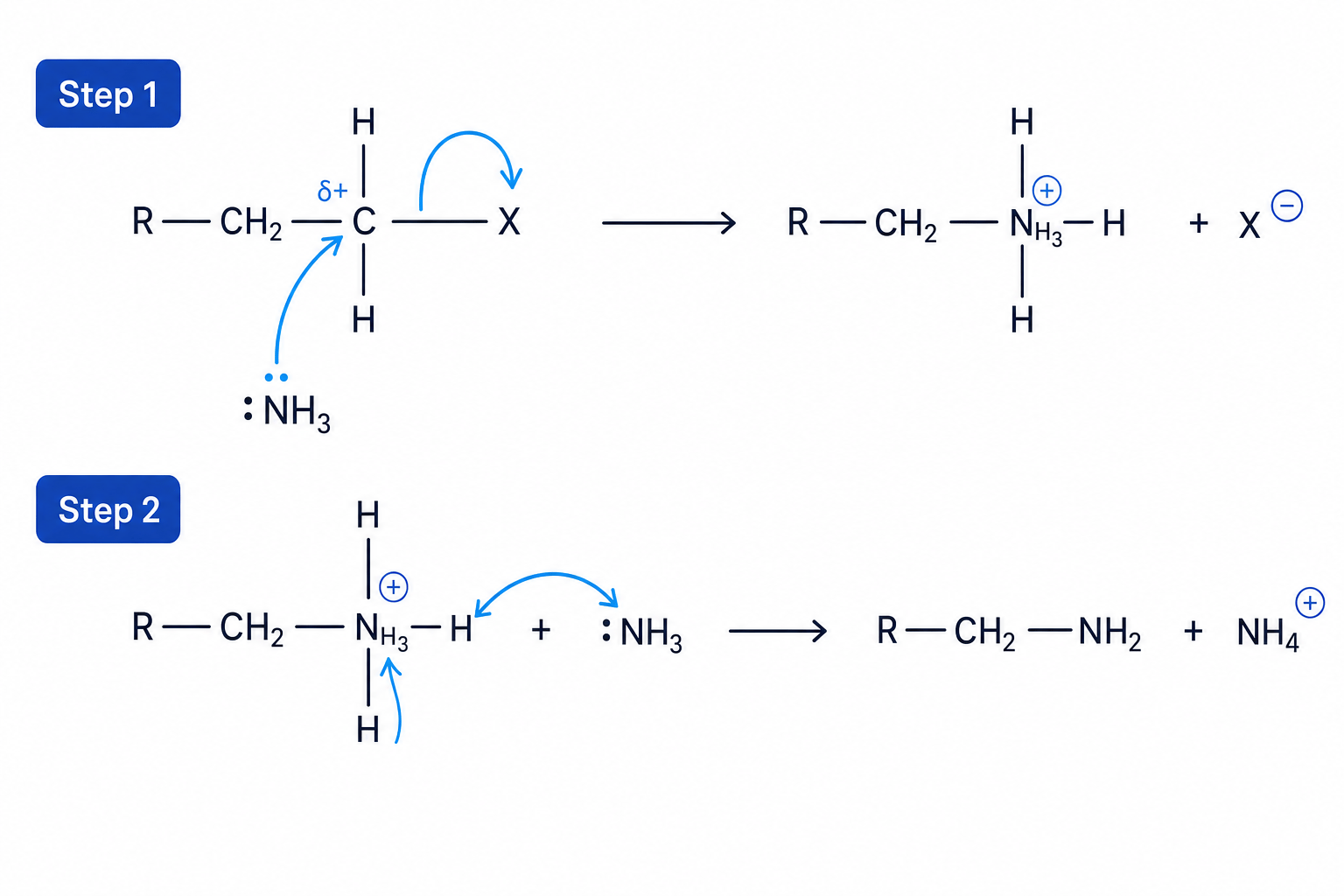
- Conditions: Heat in a sealed tube, excess ammonia in ethanol.
- Overall Equation:
Why excess ammonia?
Using excess ammonia ensures that the second step (deprotonation) is carried out mostly by ammonia rather than the newly formed primary amine. If you don't use excess ammonia, the primary amine product can act as a nucleophile itself, leading to further unwanted substitutions (forming secondary and tertiary amines).
Which halogenoalkane reacts fastest?
Different halogenoalkanes undergo nucleophilic substitution at different rates. If you compare 1-chlorobutane, 1-bromobutane, and 1-iodobutane, you will find they react at significantly different speeds.
There are two conflicting properties at play:
- Bond polarity: The C–F bond is the most polar because fluorine is the most electronegative halogen. You might logically guess that the highly δ+\delta+δ+ carbon would attract nucleophiles fastest.
- Bond enthalpy (strength): The C–I bond is the weakest bond (lowest bond enthalpy) because iodine is a large atom, leading to poor orbital overlap between the carbon and the iodine.
Experimental evidence shows that iodoalkanes react the fastest and fluoroalkanes react the slowest (in fact, fluoroalkanes are usually unreactive).
Confusing polarity with bond enthalpy
Students often incorrectly state that "fluoroalkanes react fastest because the C–F bond is the most polar". The dominant factor in the rate of hydrolysis is bond enthalpy, not bond polarity. The weaker the bond, the easier it is to break, and the faster the reaction proceeds.
Measuring the rate of hydrolysis
You can test this trend in the laboratory by warming different halogenoalkanes with aqueous silver nitrate (AgNO3\text{AgNO}_3AgNO3) in an ethanol solvent and timing how long it takes for a precipitate to form.
As the halogenoalkane hydrolyses, it releases halide ions (X−\text{X}^-X−) into the solution. These immediately react with the silver ions (Ag+\text{Ag}^+Ag+) to form an insoluble silver halide precipitate (AgX\text{AgX}AgX).
- Iodoalkanes form a pale yellow precipitate (AgI\text{AgI}AgI) very quickly.
- Bromoalkanes form a cream precipitate (AgBr\text{AgBr}AgBr) more slowly.
- Chloroalkanes form a white precipitate (AgCl\text{AgCl}AgCl) extremely slowly.
In the exam
- Check the solvent for hydroxide reactions. If an exam question mentions NaOH\text{NaOH}NaOH in water (aqueous), it triggers nucleophilic substitution forming an alcohol. If it mentions NaOH\text{NaOH}NaOH or KOH\text{KOH}KOH in ethanol, it triggers an elimination reaction (which you will cover in a later topic).
- Draw curly arrows precisely. For full marks, the arrow must clearly start from the lone pair (draw the two dots!) or the exact centre of the C–X bond.
- Remember the extra molecule for ammonia. If drawing the full ammonia mechanism, always show the second ammonia molecule acting as a base to remove the proton in step 2.
- State bond enthalpy. When asked to explain the trend in reactivity of halogenoalkanes, explicitly write "C–I has the lowest bond enthalpy" or "the C–X bond enthalpy decreases down the group".
Check yourself
- What two specific features must you draw to accurately represent a nucleophile in a mechanism?
- Why does the reaction of a halogenoalkane with potassium cyanide increase the length of the carbon chain?
- Which halogenoalkane would undergo nucleophilic substitution fastest: 2-chloropropane or 2-bromopropane? Why?
- In the mechanism with ammonia, why is a second molecule of ammonia required?