

What you'll learn
- Why unreactive alkanes need ultraviolet (UV) light to react with halogens.
- The definitions of homolytic fission and free radicals.
- How to write equations for the initiation, propagation, and termination steps of free-radical substitution.
- How the formation of trace products proves the existence of a chain reaction.
Why alkanes are mostly unreactive
Alkanes are generally very unreactive molecules. They are saturated (containing only single bonds) and the C–C\text{C–C}C–C and C–H\text{C–H}C–H bonds have high bond enthalpies, meaning they require a lot of energy to break. Furthermore, because carbon and hydrogen have very similar electronegativities, the bonds are non-polar. As a result, alkanes do not attract attacking species like nucleophiles or electrophiles.
To force an alkane to react with a halogen like chlorine, we have to use energy in the form of ultraviolet (UV) light. This triggers a specific chain reaction known as free-radical substitution.
The Mechanism: Free-Radical Substitution
The reaction between methane and chlorine happens in three distinct stages: initiation, propagation, and termination.
1. Initiation
The reaction begins when UV light provides enough energy to break the covalent bond in a chlorine molecule (Cl2\text{Cl}_2Cl2).
The Cl–Cl\text{Cl–Cl}Cl–Cl bond breaks symmetrically. Instead of both electrons going to one atom to form ions (which would be heterolytic fission), one electron goes to each chlorine atom.
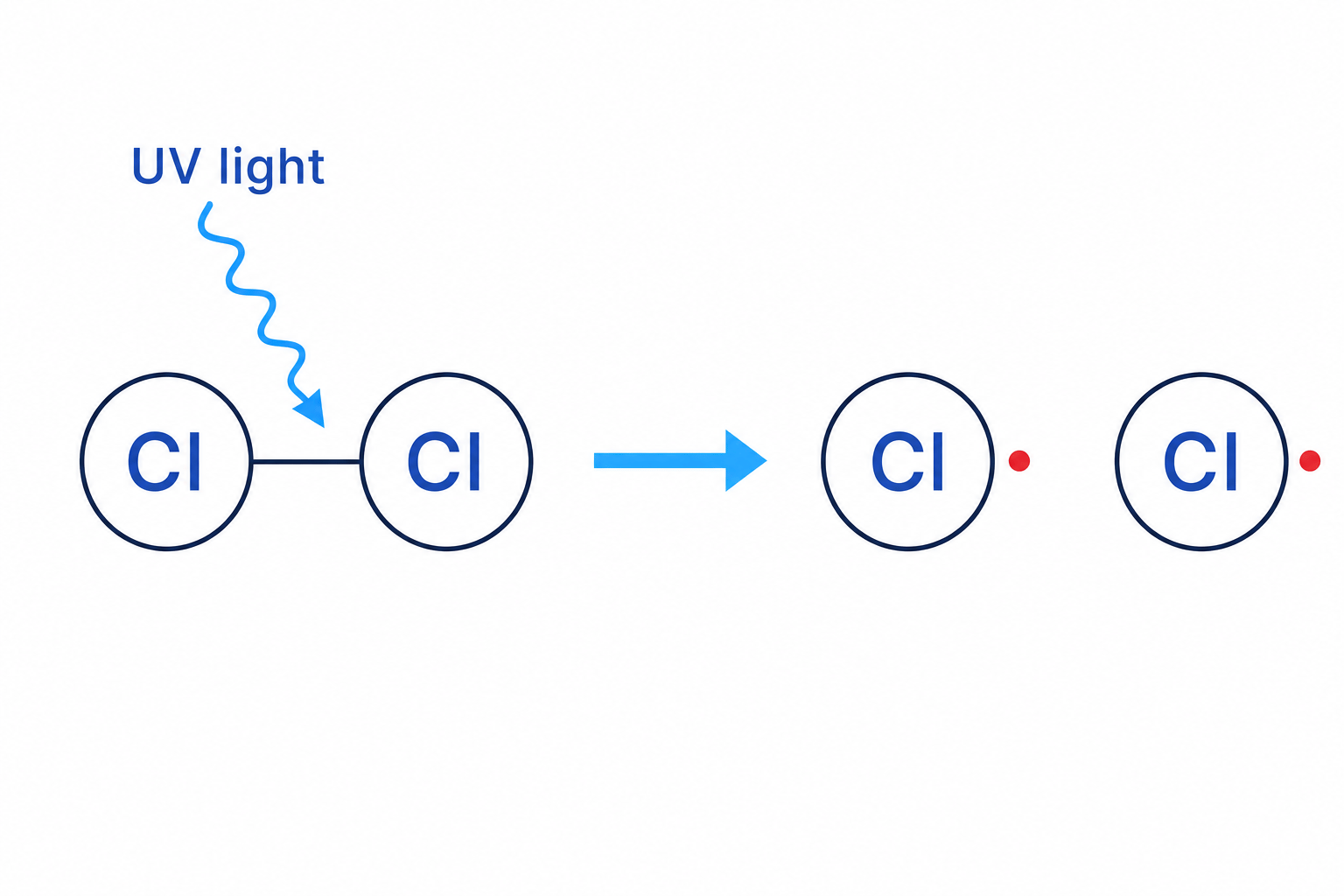
Homolytic fission
The breaking of a covalent bond where each atom takes one of the shared pair of electrons, forming two free radicals.
This process produces two highly reactive species called free radicals.
Free radical
An atom or molecule that contains an unpaired electron. In equations, the unpaired electron is represented by a heavy dot (e.g., Cl∙\text{Cl}^\bulletCl∙).
The equation for the initiation step is simply:
Cl2→UV2Cl∙ \text{Cl}_2 \xrightarrow{\text{UV}} 2\text{Cl}^\bullet Cl2UV2Cl∙2. Propagation
The chlorine free radicals are highly reactive and immediately seek out a full pair of electrons. They attack the unreactive methane molecules. This happens in two steps, which form a continuous chain reaction.
Step 1: The chlorine radical snatches a hydrogen atom from methane (CH4\text{CH}_4CH4). This leaves behind a methyl free radical and forms hydrogen chloride gas.
Cl∙+CH4→HCl+∙CH3 \text{Cl}^\bullet + \text{CH}_4 \rightarrow \text{HCl} + {}^\bullet\text{CH}_3 Cl∙+CH4→HCl+∙CH3Producing a hydrogen radical
A very common error is writing Cl∙+CH4→CH3Cl+H∙\text{Cl}^\bullet + \text{CH}_4 \rightarrow \text{CH}_3\text{Cl} + \text{H}^\bulletCl∙+CH4→CH3Cl+H∙. The C–H\text{C–H}C–H bond is stronger than the C–Cl\text{C–Cl}C–Cl bond, so the reaction will never produce a free hydrogen radical (H∙\text{H}^\bulletH∙). Always form HCl\text{HCl}HCl in the first propagation step!
Step 2: The newly formed methyl radical (∙CH3{}^\bullet\text{CH}_3∙CH3) is also highly reactive. It collides with an unreacted chlorine molecule (Cl2\text{Cl}_2Cl2), taking one chlorine atom to form chloromethane (CH3Cl\text{CH}_3\text{Cl}CH3Cl) and leaving behind a brand new chlorine radical.
∙CH3+Cl2→CH3Cl+Cl∙ {}^\bullet\text{CH}_3 + \text{Cl}_2 \rightarrow \text{CH}_3\text{Cl} + \text{Cl}^\bullet ∙CH3+Cl2→CH3Cl+Cl∙Notice what has happened: we used up a Cl∙\text{Cl}^\bulletCl∙ radical in Step 1, but we generated a new one in Step 2. This new radical can now go and attack another methane molecule, repeating the cycle thousands of times. This is why it is called a chain reaction.
Placement of the radical dot
Whenever you draw an organic free radical, try to place the dot on the exact atom that holds the unpaired electron. Writing ∙CH3{}^\bullet\text{CH}_3∙CH3 (dot on the carbon) is chemically better than CH3∙\text{CH}_3^\bulletCH3∙, though the exam board will usually accept either as long as it isn't completely ambiguous.
3. Termination
The chain reaction cannot continue forever. Eventually, two free radicals will collide with each other. When they do, their unpaired electrons join to form a stable covalent bond. Because no new radicals are produced, the chain reaction stops (terminates).
There are three possible ways this can happen in the methane-chlorine reaction, depending on which two radicals collide:
- Two chlorine radicals collide to reform chlorine gas:
- A methyl radical and a chlorine radical collide to form the main product:
- Two methyl radicals collide to form a trace amount of ethane:
The smoking gun for the mechanism
The fact that small amounts of ethane (C2H6\text{C}_2\text{H}_6C2H6) are found in the final reaction mixture is crucial proof that the reaction proceeds via a methyl free radical. Methane is a 111-carbon chain, so finding a 222-carbon chain means two carbon-containing fragments must have joined together!
Applying the mechanism to other alkanes
The exact same mechanism applies to other alkanes reacting with other halogens (like bromine). You simply follow the same pattern: split the halogen, let the halogen radical steal a hydrogen, then let the new carbon radical steal a halogen.
Writing the mechanism for ethane reacting with bromine
- Write the initiation step: The UV light breaks the halogen (Br2\text{Br}_2Br2) into two radicals.
- Write the first propagation step: The halogen radical (Br∙\text{Br}^\bulletBr∙) steals a hydrogen from ethane (C2H6\text{C}_2\text{H}_6C2H6), leaving an ethyl radical (∙C2H5{}^\bullet\text{C}_2\text{H}_5∙C2H5).
- Write the second propagation step: The ethyl radical (∙C2H5{}^\bullet\text{C}_2\text{H}_5∙C2H5) attacks a full halogen molecule (Br2\text{Br}_2Br2), taking one bromine atom and regenerating the bromine radical.
- Determine the overall equation: Add the two propagation steps together and cancel out the radicals that appear on both sides (the Br∙\text{Br}^\bulletBr∙ and the ∙C2H5{}^\bullet\text{C}_2\text{H}_5∙C2H5).
Further substitution
Once chloromethane (CH3Cl\text{CH}_3\text{Cl}CH3Cl) is formed, the reaction doesn't necessarily stop. There are still hydrogen atoms attached to the carbon. If there is a high concentration of chlorine in the reaction mixture, another chlorine radical can attack the chloromethane molecule, substituting a second hydrogen to form dichloromethane (CH2Cl2\text{CH}_2\text{Cl}_2CH2Cl2), and eventually trichloromethane (CHCl3\text{CHCl}_3CHCl3) and tetrachloromethane (CCl4\text{CCl}_4CCl4).
To minimise these unwanted side reactions and favour the formation of purely monosubstituted chloromethane, chemists ensure the reaction is carried out with an excess of methane. This means a chlorine radical is far more likely to bump into a fresh methane molecule than a chloromethane molecule.
In the exam
- Always write the dot clearly when representing a free radical. If the examiner cannot see it, you will lose the mark.
- In propagation steps, remember the rule: "Radical in →\rightarrow→ Radical out". Every propagation equation must have exactly one radical on the left and exactly one radical on the right.
- In termination steps, it's "Radicals in →\rightarrow→ No radicals out". Two radicals combine to make a stable molecule.
- If you are asked to provide an overall equation for the reaction, do not include any radicals. Just add the two propagation steps together and cancel the radicals out.
Check yourself
- Can you write the equation for the initiation of bromine gas by UV light?
- Can you write the two propagation steps for the reaction of chlorine with propane to form 1-chloropropane?
- What are the three possible termination products when ethane reacts with chlorine?
- Why do we sometimes use an excess of the alkane in these reactions?
