

What you'll learn:
- Why ammonia and amines are highly effective nucleophiles.
- The mechanism of nucleophilic substitution with halogenoalkanes and why it produces a mixture of products.
- What quaternary ammonium salts are and how they are used as cationic surfactants.
- The nucleophilic addition–elimination mechanism of ammonia and primary amines with acyl chlorides and acid anhydrides.
Why are amines nucleophiles?
To understand how amines react, we just need to look closely at the nitrogen atom.
Nucleophile
An electron-pair donor. Nucleophiles are attracted to electron-deficient (partially positive or δ+\delta+δ+) atoms.
Both ammonia (NH3\text{NH}_3NH3) and amines (like methylamine, CH3NH2\text{CH}_3\text{NH}_2CH3NH2) contain a nitrogen atom with an active lone pair of electrons. This lone pair is eager to donate itself to form a new covalent bond. Whenever you see ammonia or an amine in a reaction, your first thought should be: the nitrogen lone pair is going to attack a δ+\delta+δ+ carbon.
Nucleophilic Substitution with Halogenoalkanes
Halogenoalkanes contain a polar carbon–halogen bond. Because halogens are more electronegative than carbon, the carbon atom becomes partially positive (δ+\delta+δ+) and the halogen becomes partially negative (δ−\delta-δ−). Ammonia and amines can attack this electron-deficient carbon.
The mechanism
When ammonia reacts with a halogenoalkane (like bromoethane), it undergoes nucleophilic substitution. The reaction happens in two main stages:
- Attack: The lone pair on the ammonia nitrogen attacks the δ+\delta+δ+ carbon, breaking the carbon–halogen bond and kicking out the halide ion. This forms a positively charged intermediate called an alkylammonium ion.
- Deprotonation: A second ammonia molecule acts as a base and uses its lone pair to remove a proton (H+\text{H}^+H+) from the intermediate, forming the final primary amine and an ammonium ion.
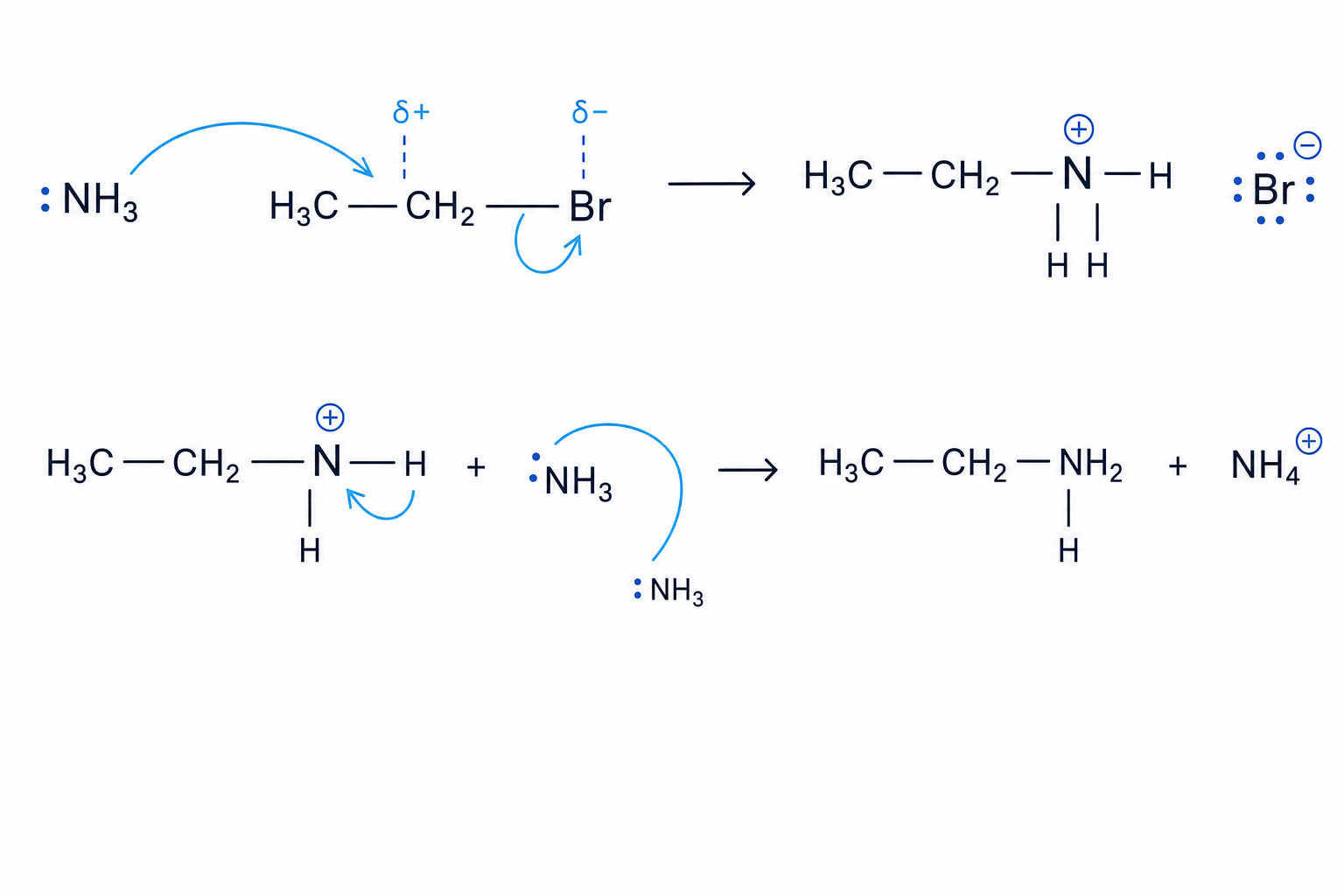
Missing the positive charge
Students frequently forget to draw the positive charge on the nitrogen atom in the intermediate step. Nitrogen usually forms 3 bonds; when it forms 4, it carries a +1+1+1 formal charge!
Further substitution (The mixture problem)
You might think the reaction stops neatly at the primary amine. However, the primary amine product (e.g. ethylamine) also has a lone pair on its nitrogen atom.
Inductive effects make amines stronger nucleophiles
Alkyl groups push electron density towards the nitrogen atom (a positive inductive effect). This means the primary amine is actually a stronger nucleophile than the original ammonia!
Because the primary amine is a stronger nucleophile, it will rapidly attack another halogenoalkane molecule, undergoing a second substitution to form a secondary amine. This secondary amine can then react to form a tertiary amine, and finally a quaternary ammonium salt. The result is a messy mixture of primary, secondary, and tertiary amines, plus quaternary ammonium salts.
Controlling the product
To favour the primary amine, use a large excess of ammonia. This ensures the halogenoalkane is far more likely to collide with ammonia than with the newly formed primary amine. To favour the quaternary ammonium salt, use a large excess of halogenoalkane.
Quaternary ammonium salts as surfactants
If substitution happens four times, the nitrogen atom bonds to four alkyl groups and loses all its hydrogen atoms. This forms a quaternary ammonium salt.
Quaternary ammonium salt
An ionic compound containing a positively charged nitrogen atom bonded to four alkyl groups, paired with a negative counter-ion (usually a halide).
These salts have highly specific real-world applications as cationic surfactants (surface-active agents), frequently used in fabric softeners and hair conditioners.
They work beautifully because of their structure:
- They have a long, non-polar hydrocarbon "tail" that mixes well with grease or oil.
- They have a positively charged nitrogen "head".
When fabrics or hair get wet, they tend to pick up a slight negative charge on their surface. The positively charged head of the cationic surfactant binds strongly to these negative charges, coating the surface in a smooth, lubricating layer of alkyl chains that prevents static and reduces friction.
Nucleophilic Addition–Elimination
Amines and ammonia also react vigorously with acyl chlorides (RCOCl\text{RCOCl}RCOCl) and acid anhydrides ((RCO)2O(\text{RCO})_2\text{O}(RCO)2O). In these molecules, the carbonyl carbon (C=O\text{C=O}C=O) is strongly δ+\delta+δ+ because it is bonded to two electronegative atoms (an oxygen and either a chlorine or another oxygen).
The mechanism with acyl chlorides
The reaction between an acyl chloride and an amine is called nucleophilic addition–elimination. It proceeds in three key steps:
- Addition: The nitrogen lone pair attacks the carbonyl carbon. The C=O\text{C=O}C=O double bond breaks, pushing a pair of electrons onto the oxygen to form a negatively charged intermediate.
- Elimination: The lone pair on the oxygen drops back down to reform the C=O\text{C=O}C=O double bond, which forces the carbon–chlorine bond to break, kicking out the chloride ion (Cl−\text{Cl}^-Cl−).
- Deprotonation: Another molecule of the amine removes a proton from the positively charged nitrogen, resulting in an amide.
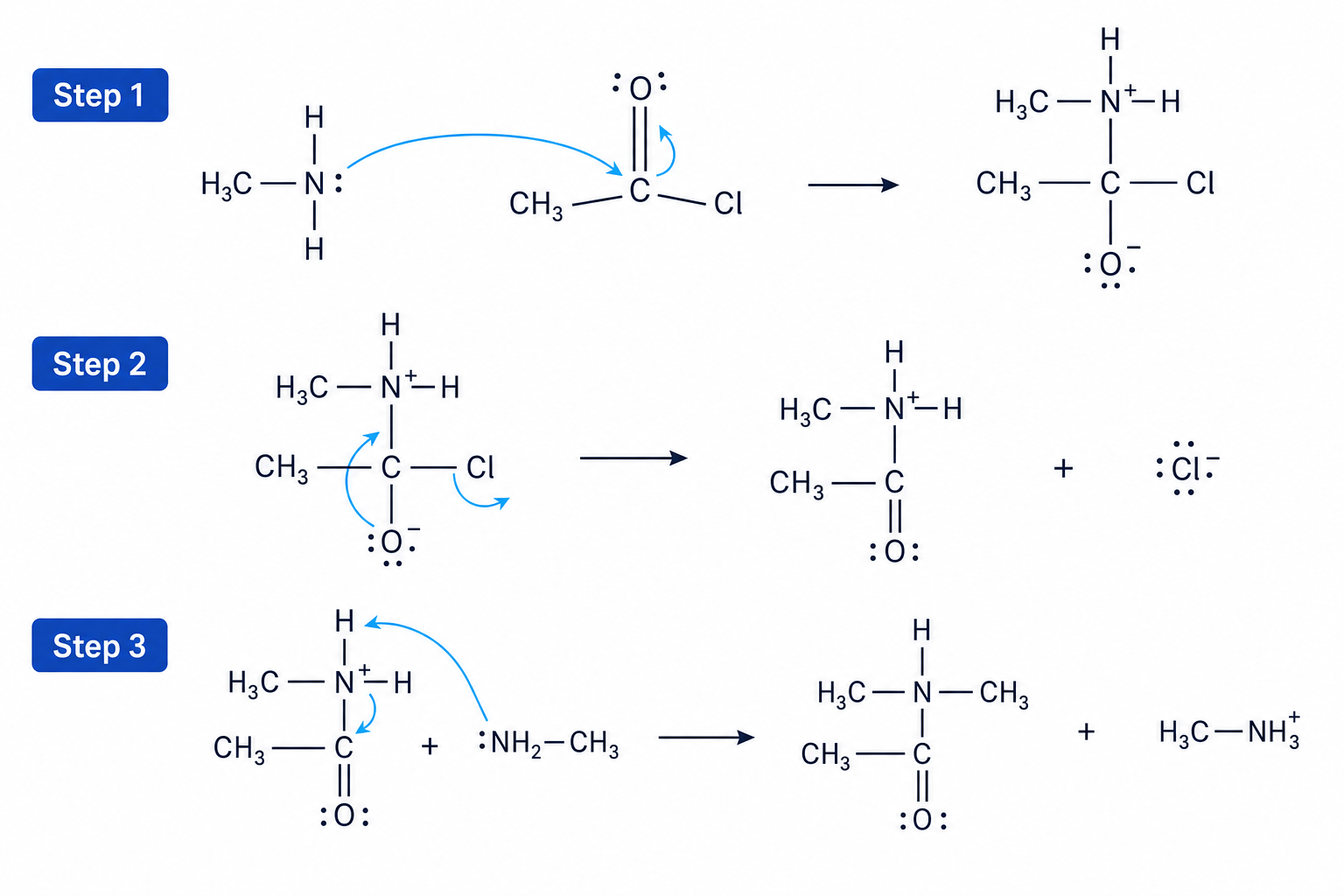
When ammonia reacts with an acyl chloride, it forms a primary amide (e.g. ethanamide). When a primary amine reacts, it forms an NNN-substituted amide (e.g. NNN-methylethanamide).
Predicting the product of an addition-elimination reaction
- Identify the acyl group: Suppose you are reacting propanoyl chloride (CH3CH2COCl\text{CH}_3\text{CH}_2\text{COCl}CH3CH2COCl) with ethylamine (CH3CH2NH2\text{CH}_3\text{CH}_2\text{NH}_2CH3CH2NH2). First, identify the acyl group and remove the leaving group. Here, remove the −Cl-\text{Cl}−Cl to leave the propanoyl fragment (CH3CH2CO−\text{CH}_3\text{CH}_2\text{CO}-CH3CH2CO−).
- Identify the amine fragment: Take your amine and remove one hydrogen atom from the nitrogen. For ethylamine, this leaves −NHCH2CH3-\text{NHCH}_2\text{CH}_3−NHCH2CH3.
- Join the fragments: Attach the nitrogen directly to the carbonyl carbon. The skeletal structure is joined to give the final product: CH3CH2CONHCH2CH3\text{CH}_3\text{CH}_2\text{CONHCH}_2\text{CH}_3CH3CH2CONHCH2CH3.
- Name the secondary amide: The parent chain comes from the acyl group (3 carbons = propanamide). The alkyl group on the nitrogen is an ethyl group. So, the full name is NNN-ethylpropanamide.
Acid anhydrides vs Acyl chlorides
Acid anhydrides undergo the exact same nucleophilic addition–elimination mechanism, but the leaving group is a carboxylate ion instead of a chloride ion. This means the side product is a carboxylic acid rather than hydrogen chloride gas (HCl\text{HCl}HCl).
In industry, acid anhydrides are often preferred over acyl chlorides because they are cheaper, less heavily regulated, and less corrosive (since they don't produce toxic HCl\text{HCl}HCl gas).
In the exam
- Read the reaction conditions carefully. If the question states "excess ammonia", you must draw the substitution mechanism for making a primary amine. If it states "excess halogenoalkane", state that a quaternary ammonium salt is the major product.
- When drawing mechanisms, double-check that every curly arrow starts exactly from a lone pair or the centre of a bond, and points exactly to the destination atom or bond space. A sloppy arrow will cost you the mark.
- Don't forget the positive charge on the nitrogen intermediate in both mechanisms! Examiners specifically look for this when awarding mechanism marks.
- Remember the difference in naming: if the reactant is a halogenoalkane, it's nucleophilic substitution. If the reactant has a carbonyl group (acyl chloride/anhydride), it's nucleophilic addition–elimination.
Check yourself
- What is the structural difference between a primary amine and a primary amide?
- Why do nucleophilic substitution reactions with ammonia tend to produce a mixture of products?
- How is a cationic surfactant able to bind effectively to wet fabrics or hair?
- What is the organic side-product when an amine reacts with an acid anhydride?
