What you'll learn
- What makes a polymer a condensation polymer, rather than an addition polymer.
- How polyesters and polyamides form from common monomers.
- How to draw a repeating unit from monomers, and work backwards to find monomers.
- Why condensation polymers have different properties, especially due to intermolecular forces.
The big idea: small molecules join, and something is eliminated
You already know that a polymer is a long-chain molecule made from many smaller molecules called monomers. In this topic, the monomers must usually have two reactive functional groups, one at each end, so the chain can keep growing.
A functional group is the atom or group of atoms that gives an organic molecule its characteristic reactions, such as –COOH, –OH or –NH₂.
Condensation polymerisation
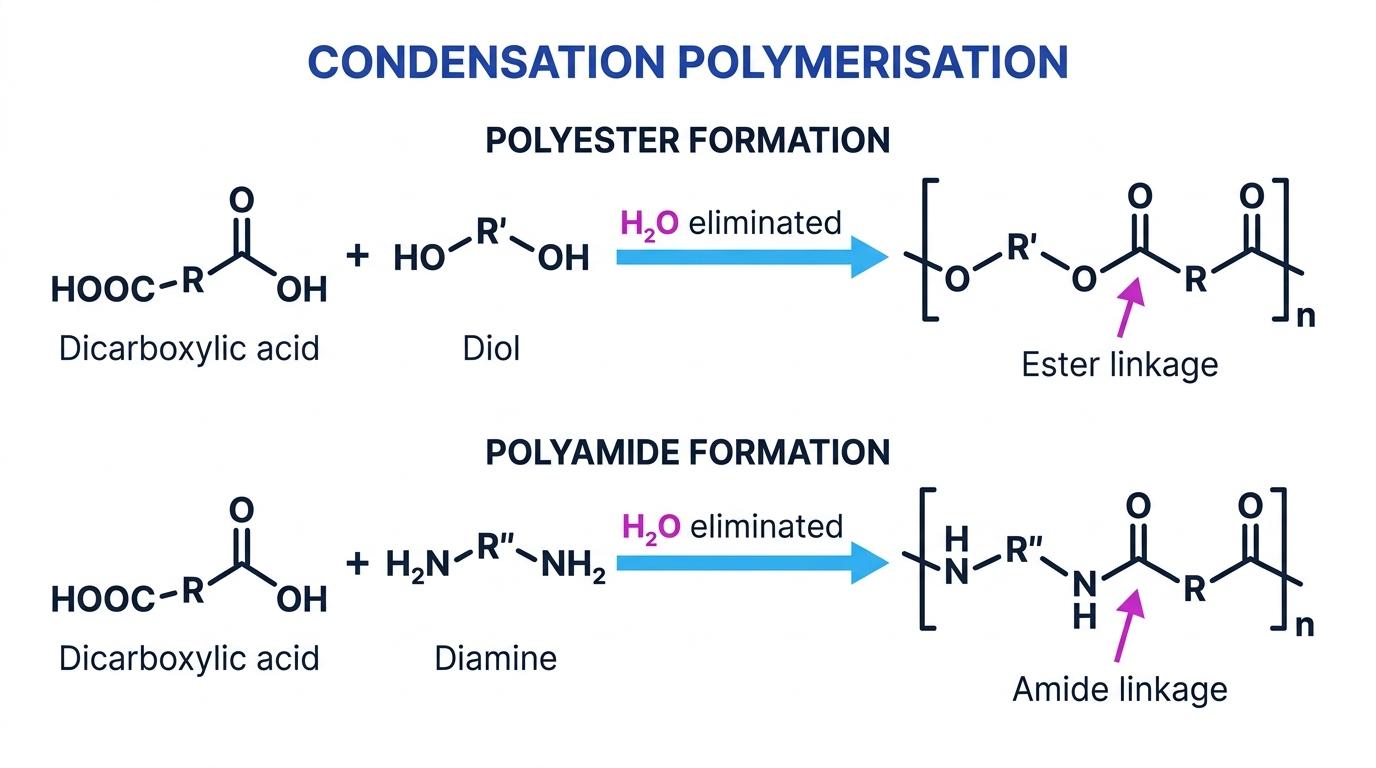
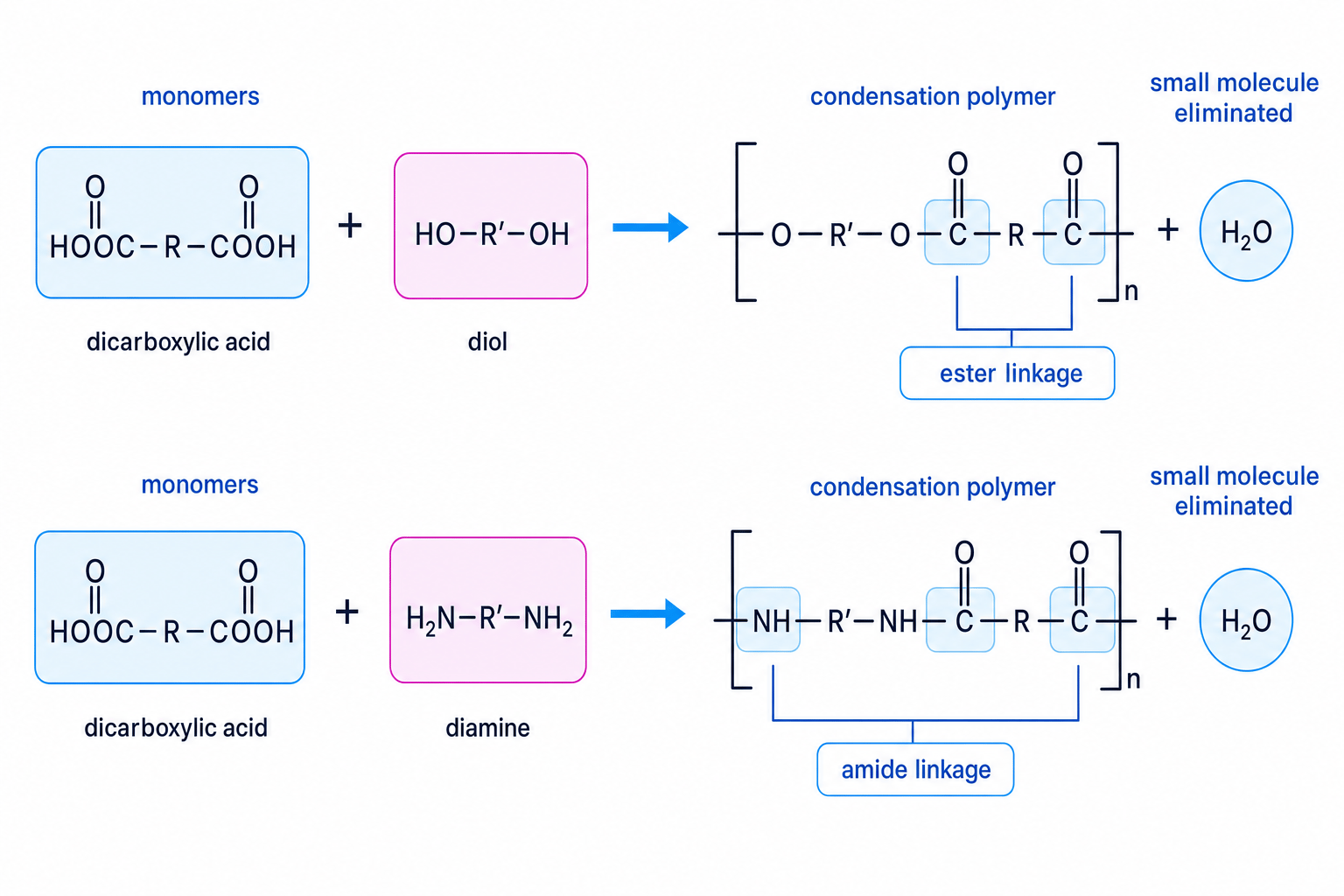
Condensation polymerisation is the formation of a polymer from monomers, with the elimination of a small molecule each time a new link forms. The small molecule is often water, H₂O.
This is different from addition polymerisation, where alkene monomers join together and no small molecule is lost.
The monomers you need to recognise
Dicarboxylic acids
A dicarboxylic acid has two carboxylic acid groups, –COOH.
Example:
HOOC–(CH₂)₄–COOH
This is hexanedioic acid, one monomer used to make nylon 6,6.
Diols
A diol has two alcohol groups, –OH.
Example:
HO–CH₂CH₂–OH
This is ethane-1,2-diol, one monomer used to make Terylene.
Diamines
A diamine has two amine groups, –NH₂.
Example:
H₂N–(CH₂)₆–NH₂
This is hexane-1,6-diamine, one monomer used to make nylon 6,6.
Amino acids
An amino acid contains both an amine group, –NH₂, and a carboxylic acid group, –COOH, in the same molecule. Because one molecule has both reactive ends, amino acids can join together to form condensation polymers called polypeptides.
Why two functional groups matter
A monomer needs two reactive ends to form a chain. If it only had one reactive group, it could react once and stop; it could not keep extending into a polymer.
Polyesters: dicarboxylic acid + diol
A polyester is a condensation polymer containing ester linkages.
An ester linkage is the group:
–COO–
More structurally, you may see it written as:
–C(=O)–O–
It forms when a carboxylic acid group reacts with an alcohol group. The –OH from the carboxylic acid and the H from the alcohol are removed to form water.
For a polyester:
- the dicarboxylic acid supplies two –COOH groups
- the diol supplies two –OH groups
- each new ester linkage eliminates one molecule of water
A key example is Terylene, also called PET. It is made from benzene-1,4-dicarboxylic acid and ethane-1,2-diol. Terylene is used in clothing fibres, plastic bottles, films and food packaging.
Drawing the repeating unit of Terylene
Draw the repeating unit formed from benzene-1,4-dicarboxylic acid, HOOC–C₆H₄–COOH, and ethane-1,2-diol, HO–CH₂CH₂–OH.
- Identify the reacting groups: the dicarboxylic acid has two –COOH groups and the diol has two –OH groups, so this will form a polyester with ester linkages.
- Join each carboxylic acid carbonyl carbon to an oxygen from the diol, removing –OH from –COOH and H from –OH to make water.
- Keep the carbon skeletons from both monomers in the chain: C₆H₄ from the acid and CH₂CH₂ from the diol.
- Write the repeating section as: –O–CH₂CH₂–O–C(=O)–C₆H₄–C(=O)–, then put square brackets around it with continuation bonds and nnn outside.
Polyamides: dicarboxylic acid + diamine
A polyamide is a condensation polymer containing amide linkages.
An amide linkage is the group:
–CONH–
More structurally, you may see it written as:
–C(=O)–NH–
It forms when a carboxylic acid group reacts with an amine group. The –OH from the carboxylic acid and one H from –NH₂ are removed to form water.
For a polyamide:
- the dicarboxylic acid supplies two –COOH groups
- the diamine supplies two –NH₂ groups
- each new amide linkage eliminates one molecule of water
A key example is nylon 6,6, made from hexanedioic acid and hexane-1,6-diamine. It is used in clothing, ropes, carpets, fishing lines and engineering plastics.
The repeating unit of nylon 6,6 can be represented as:
–NH–(CH₂)₆–NH–C(=O)–(CH₂)₄–C(=O)–
Where the name nylon 6,6 comes from
The two numbers refer to the number of carbon atoms in each monomer: hexane-1,6-diamine has 6 carbons, and hexanedioic acid has 6 carbons in total.
Kevlar
Kevlar is also a polyamide. It is made from aromatic monomers, commonly represented at A-Level as benzene-1,4-dicarboxylic acid and 1,4-diaminobenzene.
Because the benzene rings make the chains rigid and straight, Kevlar chains can pack closely together. Strong hydrogen bonding between chains gives Kevlar very high tensile strength. It is used in bullet-resistant body armour, helmets, composites, ropes and high-performance tyres.
Amino acids form polyamides too
Amino acids can form condensation polymers because each molecule contains both:
- an amine group, –NH₂
- a carboxylic acid group, –COOH
When amino acids join, the –COOH group of one amino acid reacts with the –NH₂ group of another. The linkage formed is still an amide linkage, but in biological molecules it is usually called a peptide link.
So a polypeptide is a type of polyamide.
How to draw a repeating unit from monomers
This is one of the most common exam skills in this topic. The trick is to focus on the functional groups first, then tidy up the carbon skeleton.
Method
- Identify whether the monomers are a dicarboxylic acid plus diol, dicarboxylic acid plus diamine, or amino acid.
- Decide the linkage: ester for –COOH + –OH, amide for –COOH + –NH₂.
- Remove –OH from the carboxylic acid and H from the alcohol or amine.
- Join the remaining atoms to make –C(=O)–O– or –C(=O)–NH–.
- Put the repeating unit in square brackets with bonds going through the brackets and nnn outside.
Losing the carbonyl oxygen
When you remove water from a carboxylic acid, you remove the –OH part of –COOH, not the C=O oxygen. The carbonyl group, C=O, stays in the polymer chain.
Working backwards: finding monomers from a polymer
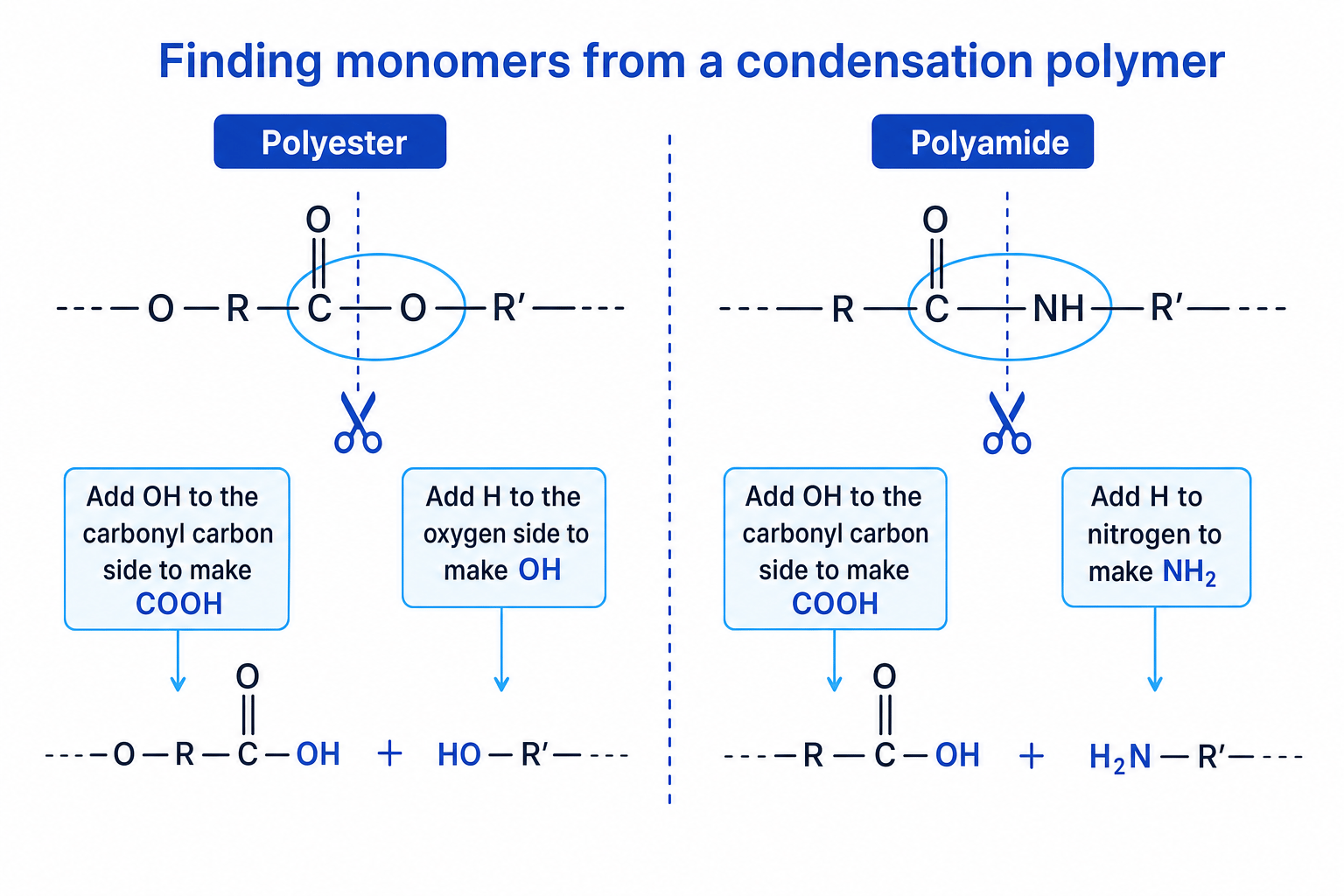
You can also be given a section of polymer and asked to identify the monomers. This feels harder, but it is just the reverse process.
For a polyester, cut the ester linkage between C(=O) and O.
For a polyamide, cut the amide linkage between C(=O) and NH.
Then add back the atoms of water:
- add –OH to the carbonyl carbon side to reform –COOH
- add H to the oxygen or nitrogen side to reform –OH or –NH₂
Finding the monomers of nylon 6,6
A polymer section contains the repeating pattern –NH–(CH₂)₆–NH–C(=O)–(CH₂)₄–C(=O)–. Identify the monomers.
- Recognise the linkage as an amide linkage because the chain contains –C(=O)–NH– groups, so the monomers must be a dicarboxylic acid and a diamine.
- Cut the chain at the C(=O)–NH bonds. The nitrogen-containing section is –NH–(CH₂)₆–NH–, which must have come from a diamine.
- Add H atoms back to the nitrogens to get H₂N–(CH₂)₆–NH₂, which is hexane-1,6-diamine.
- The carbonyl-containing section is –C(=O)–(CH₂)₄–C(=O)–. Add –OH to each carbonyl carbon to get HOOC–(CH₂)₄–COOH, which is hexanedioic acid.
Intermolecular forces in condensation polymers
Condensation polymers are long molecules, so they always have London forces between chains. These get stronger as the chains get longer and as the surface contact between chains increases.
Polyesters contain polar ester groups, so they also have permanent dipole-dipole interactions. However, polyester chains usually cannot form hydrogen bonds with each other because they do not contain O–H or N–H bonds along the chain.
Polyamides contain amide groups, which can form hydrogen bonds between chains. The N–H group acts as a hydrogen bond donor, and the C=O oxygen acts as a hydrogen bond acceptor.
This helps explain why many polyamides, such as nylon and Kevlar, are strong and have relatively high melting points compared with similar-sized polymers that cannot hydrogen bond.
Properties come from chain attractions
Stronger intermolecular forces between polymer chains usually mean higher melting points, greater strength and less chain movement. Polyamides are often strong because their chains can hydrogen bond.
Making nylon 6,6 in the lab
In school demonstrations, nylon 6,6 is often made using a more reactive acid derivative, such as a diacyl chloride, instead of the dicarboxylic acid. A solution containing hexane-1,6-diamine is carefully layered with a solution containing hexanedioyl dichloride. Nylon forms at the interface and can be pulled out as a thread.
The linkage formed is still an amide linkage, but the small molecule eliminated is hydrogen chloride, HCl, rather than water.
Lab route versus exam monomers
For drawing nylon 6,6 from the specification, you are usually expected to use hexanedioic acid and hexane-1,6-diamine as the monomers. The lab preparation may use a diacyl chloride because it reacts faster.
In the exam
- Circle the linkages first: –C(=O)–O– means polyester; –C(=O)–NH– means polyamide.
- When drawing a repeating unit, keep all carbon atoms from the monomers and only remove the atoms needed to make water.
- When finding monomers, cut at the linkage and add back –OH to the carbonyl side plus H to the O or N side.
Check yourself
- What small molecule is usually eliminated when a dicarboxylic acid reacts with a diol?
- How would you recognise an amide linkage in a section of polymer chain?
- Why does Kevlar have strong attractions between polymer chains?