

What you'll learn:
- The economic reasons why oil refineries must "crack" alkanes.
- The chemical principles behind cracking (breaking strong C–C bonds).
- The difference between thermal cracking and catalytic cracking (conditions and products).
Crude oil is a fantastic raw material, but straight out of the fractional distillation column, the quantities of the different fractions rarely match what society actually wants to buy. This is where chemical modification comes in.
The economics of cracking
Fractional distillation separates crude oil into fractions based on their boiling points, which depend on the length of the hydrocarbon chain. However, there is a fundamental mismatch in the market:
- Long-chain fractions (like fuel oil and bitumen) are produced in large quantities, but they have a low economic value and are in low demand. They don't flow easily, are hard to ignite, and are generally less useful.
- Short-chain fractions (like petrol/naphtha) are highly prized. We need millions of tonnes of them for motor vehicle fuels and as raw materials (feedstock) for the chemical industry, but crude oil doesn't contain enough of them.
To solve this, refineries use a process called cracking to convert the surplus of cheap, heavy fractions into more valuable, lighter fractions.
Cracking
The industrial process of breaking down large, long-chain hydrocarbon molecules into smaller, more useful molecules (usually a mixture of shorter alkanes and alkenes) by breaking carbon–carbon (C–C) covalent bonds.
The fundamental goal of cracking
Cracking bridges the gap between the high supply of long-chain hydrocarbons and the high demand for short-chain alkanes (fuels) and alkenes (polymers). It is driven entirely by economics.
How cracking works chemically
Carbon–carbon (C–C) single bonds are strong. Breaking them requires a lot of energy, meaning cracking is always a high-temperature process.
When a long alkane molecule is heated, the thermal energy causes the bonds to vibrate vigorously until eventually, a C–C bond snaps. Because the break can happen at any point along the chain, cracking a batch of long alkanes will produce a random mixture of different products. However, there is one absolute rule: the cracking of an alkane must produce at least one alkene alongside a shorter alkane. There simply aren't enough hydrogen atoms to make two saturated alkanes.
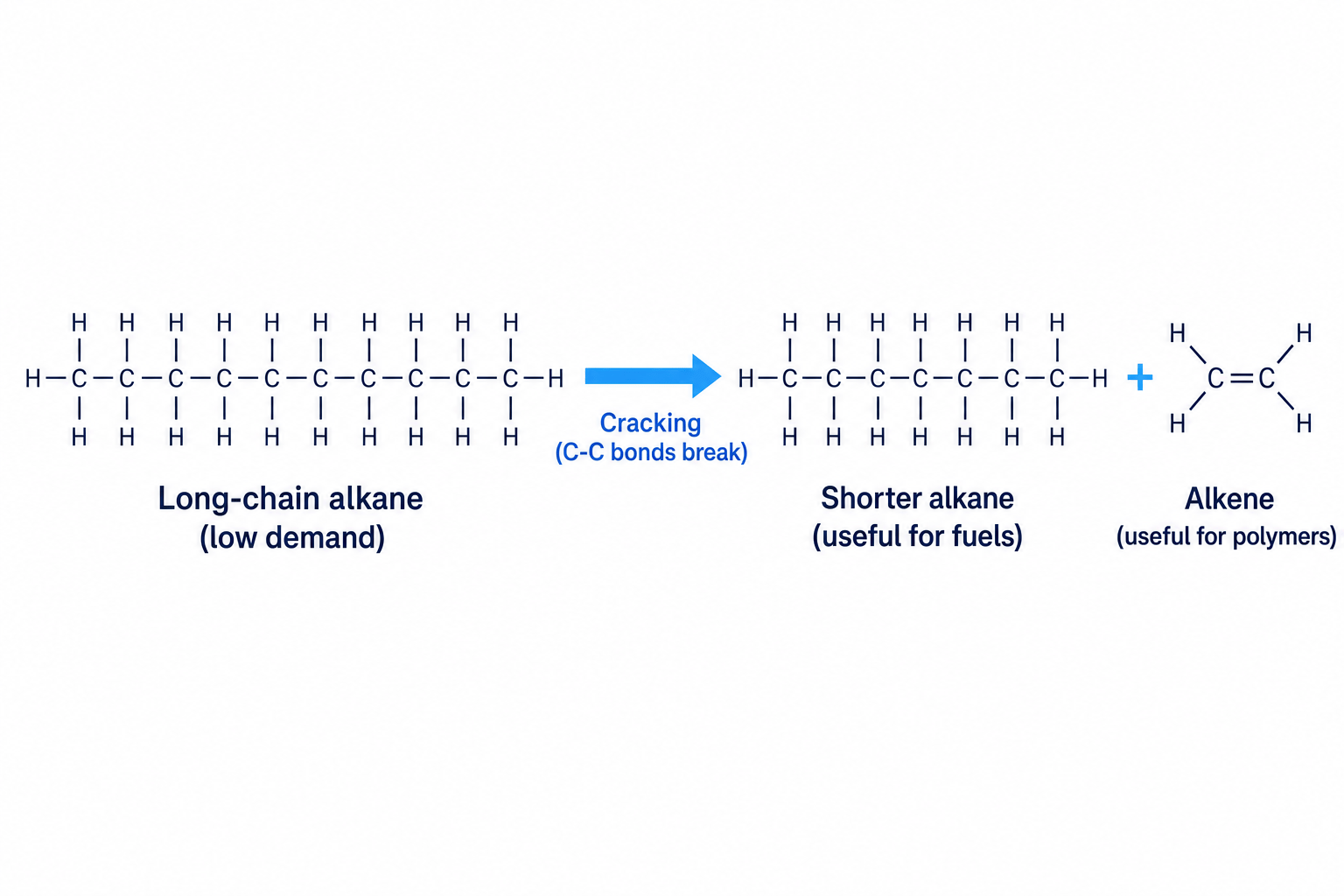
Balancing a cracking equation
A molecule of hexadecane, C16H34\text{C}_{16}\text{H}_{34}C16H34, is cracked to produce one molecule of an unknown alkane, and three molecules of ethene, C2H4\text{C}_2\text{H}_4C2H4. Determine the formula of the unknown alkane.
- First, write down the skeletal framework of the reaction with the known amounts:
- Calculate the total number of carbon atoms used up by the alkenes:
- Subtract this from the original alkane's carbon count to find xxx:
- Calculate the total number of hydrogen atoms used up by the alkenes:
- Subtract this from the original alkane's hydrogen count to find yyy:
- Combine these to identify the unknown alkane as decane:
(Check: Does C10H22C_{10}H_{22}C10H22 fit the general formula for an alkane CnH2n+2C_nH_{2n+2}CnH2n+2? Yes, 2(10)+2=222(10) + 2 = 222(10)+2=22.)
Producing hydrogen gas
In A-Level questions, you may sometimes be asked to balance a cracking equation that produces hydrogen gas (H2\text{H}_2H2) as one of the products alongside alkenes. Don't panic if this happens — just balance the atoms mathematically on both sides in the exact same way.
The two types of cracking
There are two distinct industrial methods used to crack alkanes. You need to know the conditions and the typical products for both. No mechanism is required for either process in the AQA specification.
1. Thermal cracking
Thermal cracking relies purely on extreme heat and pressure to rip the molecules apart. The reaction takes place via a free radical mechanism (though again, you don't need to know the steps for this specific reaction).
- Conditions: High temperature (typically 700 K700\text{ K}700 K to 1200 K1200\text{ K}1200 K) and very high pressure (up to 7000 kPa7000\text{ kPa}7000 kPa).
- Products: A high percentage of alkenes (such as ethene and propene).
- Use: These alkenes are hugely important as the starting materials for producing addition polymers (like poly(ethene) and poly(propene)) and other industrial chemicals, such as ethanol.
2. Catalytic cracking
By adding a catalyst, we can crack large hydrocarbons using considerably less energy. This process tends to happen via a carbocation intermediate, which encourages the carbon chains to rearrange themselves into more complex shapes.
- Conditions: High temperature (approx. 720 K720\text{ K}720 K), but only a slight pressure (just above atmospheric, often around 100 kPa100\text{ kPa}100 kPa to 200 kPa200\text{ kPa}200 kPa), and the presence of a zeolite catalyst.
- Products: Produces mainly branched alkanes, cycloalkanes, and aromatic hydrocarbons (like benzene rings).
- Use: These branched and cyclic compounds are perfectly suited for motor fuels. Straight-chain alkanes tend to "knock" or auto-ignite too early in a car engine, whereas branched and aromatic hydrocarbons burn much more smoothly, giving them a higher "octane rating".
Remembering the products
Catalytic cracking = Catalytic for Cars. It produces the branched and ring-shaped hydrocarbons that make excellent motor fuels. Thermal cracking = Thermal for Two bonds (alkenes).
The Zeolite Catalyst
The zeolite catalyst used in catalytic cracking is an acidic lattice consisting of silicon dioxide and aluminium oxide. It has a microscopic honeycomb structure, which gives it an enormous surface area. This vast surface area provides plenty of active sites for the long-chain alkanes to bind to, dramatically speeding up the rate of reaction and reducing the required pressure and temperature compared to thermal cracking.
In the exam
When answering questions on this topic, remember these key points:
- Always read the question carefully to see if it specifically asks for thermal or catalytic conditions.
- If asked for the "economic reasons", you must mention both the high supply/low demand of heavy fractions AND the low supply/high demand of light fractions. Don't just say "we want more petrol".
- When balancing cracking equations, always double-check your total carbon and hydrogen atoms on the right. They must exactly equal the single reactant molecule on the left.
Check yourself
- What type of catalyst is required for catalytic cracking?
- Which type of cracking operates at extreme pressures of up to 7000 kPa7000\text{ kPa}7000 kPa?
- Why do the products of catalytic cracking make excellent motor fuels?
- Can you write a balanced equation for the cracking of pentadecane (C15H32\text{C}_{15}\text{H}_{32}C15H32) to produce one molecule of propene and one other straight-chain alkane?
