

Alkanes are generally quite unreactive molecules, but their most important reaction—and the reason they run the global economy—is combustion.
What you'll learn:
- Why alkanes are used as fuels and the difference between complete and incomplete combustion.
- The major pollutants produced by the internal combustion engine and how catalytic converters remove them.
- How sulfur impurities cause acid rain, and how flue gas desulfurization solves the problem.
Alkanes as fuels
A fuel is any substance that releases heat energy when it undergoes combustion. Alkanes make fantastic fuels because their combustion is highly exothermic, releasing a huge amount of heat per mole. We burn methane in our central heating, and longer liquid alkanes (like petrol and diesel) to power vehicles.
Combustion
The rapid chemical reaction of a substance with oxygen, producing heat and light. In the case of organic fuels, the bonds in the fuel and in oxygen are broken, and new, stronger bonds are formed in the products, making the overall process exothermic.
Complete vs Incomplete Combustion
The exact products of alkane combustion depend entirely on how much oxygen is available.
Complete combustion happens when there is an excess of oxygen. All of the carbon atoms in the alkane are fully oxidized to form carbon dioxide (CO2\text{CO}_2CO2), and all the hydrogen atoms are oxidized to form water (H2O\text{H}_2\text{O}H2O).
Incomplete combustion occurs when oxygen is limited. Because there isn't enough oxygen to fully oxidize the carbon, you get carbon monoxide (CO\text{CO}CO) or even solid carbon soot (C\text{C}C) instead of carbon dioxide. The hydrogen still forms water.
Products of combustion
- Complete: Produces CO2\text{CO}_2CO2 and H2O\text{H}_2\text{O}H2O only.
- Incomplete: Produces CO\text{CO}CO and/or C\text{C}C, along with H2O\text{H}_2\text{O}H2O.
When writing balanced equations for these reactions, always balance the atoms in the order Carbon, then Hydrogen, then Oxygen.
Balancing complete combustion equations
Balance the equation for the complete combustion of octane (C8H18\text{C}_8\text{H}_{18}C8H18).
- Write out the skeletal equation with the correct formulas for the reactants and the complete combustion products:
- Balance the carbon atoms by placing an 8 in front of the CO2\text{CO}_2CO2 to match the 8 carbons in octane:
- Balance the hydrogen atoms by taking the 18 hydrogens from octane and dividing by 2 to find the number of water molecules, giving a 9 in front of the H2O\text{H}_2\text{O}H2O:
- Count the total oxygen atoms on the right-hand side. There are 16 from the CO2\text{CO}_2CO2 (8×28 \times 28×2) and 9 from the H2O\text{H}_2\text{O}H2O, giving a total of 25 oxygen atoms.
- Divide the required 25 oxygen atoms by 2 to find the coefficient for the diatomic O2\text{O}_2O2 molecule. You can write this as a decimal or a fraction:
Fractional oxygen coefficients
Do not be afraid of fractions like 252\frac{25}{2}225 or decimals like 12.512.512.5 for O2\text{O}_2O2 in combustion equations. They are perfectly acceptable at A-Level and save you from having to double every other number in the equation.
The internal combustion engine
The petrol engine in a car works by drawing in a mixture of alkane vapour and air, compressing it, and igniting it with a spark. While this releases the energy needed to turn the wheels, the extreme conditions inside the engine cylinder lead to several harmful pollutants:
- Nitrogen oxides (NOx\text{NO}_xNOx): At normal temperatures, the nitrogen gas (N2\text{N}_2N2) and oxygen gas (O2\text{O}_2O2) in the air do not react. However, the high temperature and the spark inside a car engine provide enough energy to break the strong triple bond in N2\text{N}_2N2, causing it to react with O2\text{O}_2O2 to form nitrogen monoxide (NO\text{NO}NO) and nitrogen dioxide (NO2\text{NO}_2NO2). These gases can dissolve in rainwater to form nitric acid (acid rain) and contribute to photochemical smog.
- Carbon monoxide (CO\text{CO}CO): A toxic, odourless gas produced by incomplete combustion. It is poisonous because it binds strongly to haemoglobin in the blood, preventing the transport of oxygen.
- Carbon particulates (Soot): Also formed by incomplete combustion. These tiny solid particles exacerbate respiratory issues like asthma and can cause global dimming by reflecting sunlight back into space.
- Unburned hydrocarbons: Some fuel inevitably passes through the engine without burning. In the atmosphere, these can react with nitrogen oxides in the presence of sunlight to form dangerous photochemical smog.
Where the nitrogen comes from
A classic error is stating that NOx\text{NO}_xNOx comes from "nitrogen impurities in the fuel". Alkanes do not contain nitrogen. The nitrogen comes directly from the air drawn into the engine for combustion.
Catalytic converters
To reduce the emission of these toxic gases, modern cars are fitted with catalytic converters in their exhaust systems.
A catalytic converter contains a honeycomb ceramic structure coated with a thin layer of precious transition metals, usually platinum, palladium, and rhodium. The honeycomb structure is crucial because it provides a massive surface area, ensuring a fast rate of reaction while using the minimum amount of expensive catalyst.
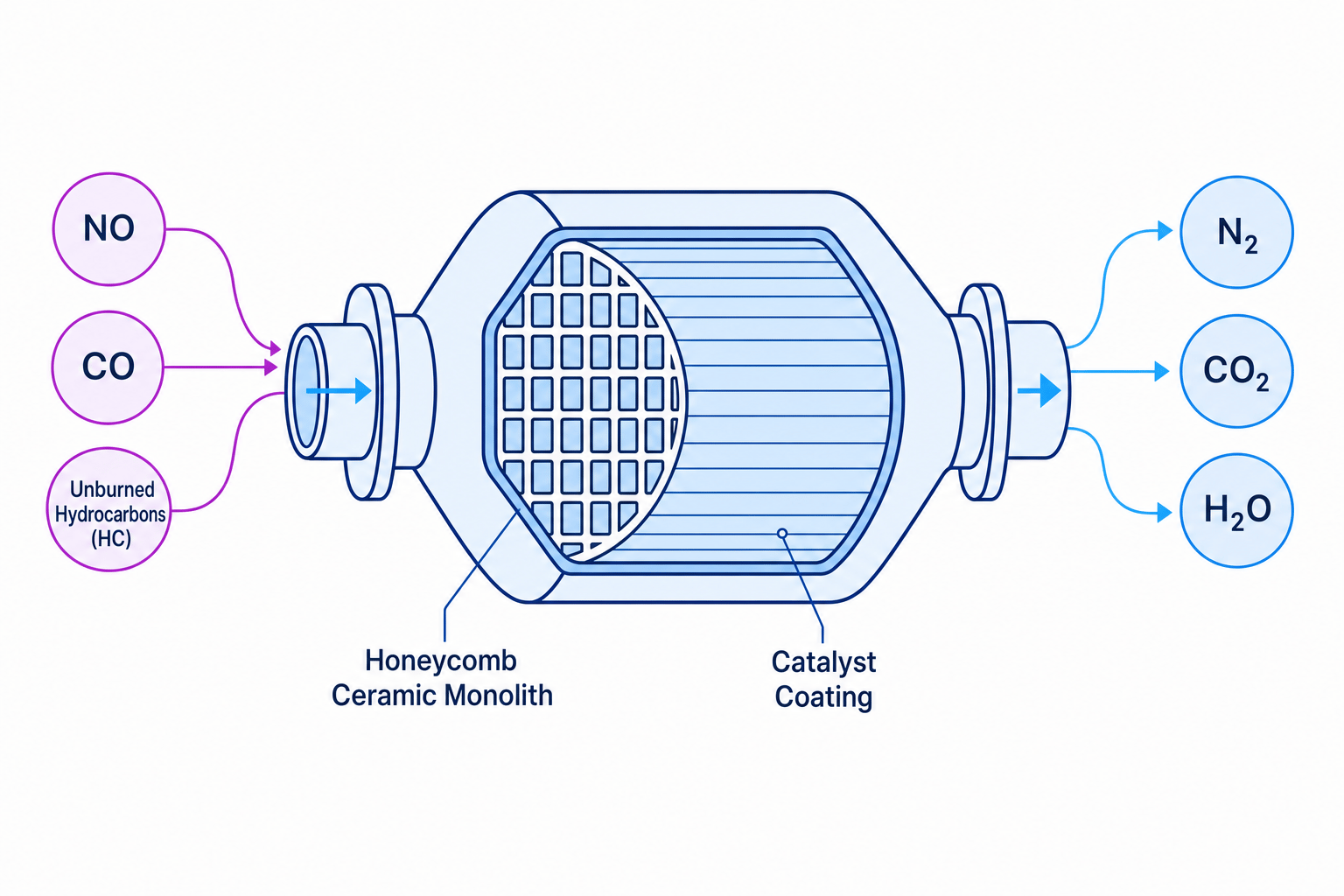
As the exhaust gases pass over the hot catalyst, they react with each other to form less harmful products. The key reaction to learn is the one between carbon monoxide and nitrogen monoxide:
2CO+2NO→2CO2+N2 2\text{CO} + 2\text{NO} \to 2\text{CO}_2 + \text{N}_2 2CO+2NO→2CO2+N2Unburned hydrocarbons can also react with the nitrogen oxides, oxidizing the carbon and hydrogen while reducing the nitrogen:
C8H18+25NO→8CO2+9H2O+12.5N2 \text{C}_8\text{H}_{18} + 25\text{NO} \to 8\text{CO}_2 + 9\text{H}_2\text{O} + 12.5\text{N}_2 C8H18+25NO→8CO2+9H2O+12.5N2The result is that toxic CO\text{CO}CO, NO\text{NO}NO, and hydrocarbons are converted into CO2\text{CO}_2CO2, H2O\text{H}_2\text{O}H2O, and harmless nitrogen gas (N2\text{N}_2N2).
Sulfur impurities and flue gas desulfurization
Cars aren't the only source of pollution from fuels. Fossil fuels burned in power stations—particularly coal and crude oil fractions—often contain sulfur impurities.
When these fuels are burned, the sulfur is oxidized to produce sulfur dioxide gas (SO2\text{SO}_2SO2):
S+O2→SO2 \text{S} + \text{O}_2 \to \text{SO}_2 S+O2→SO2If sulfur dioxide escapes into the atmosphere, it dissolves in water vapour to form weak sulfurous acid (H2SO3\text{H}_2\text{SO}_3H2SO3) and can be further oxidized to form sulfuric acid (H2SO4\text{H}_2\text{SO}_4H2SO4). This falls as acid rain, which destroys vegetation, kills fish in lakes, and corrodes limestone buildings.
To prevent this, power stations use a process called flue gas desulfurization (often called "scrubbing") to remove the SO2\text{SO}_2SO2 before it can leave the chimney.
Sulfur dioxide is an acidic gas. Therefore, it can be removed via an acid-base neutralization reaction. A slurry of a cheap base—either calcium oxide (CaO\text{CaO}CaO) or calcium carbonate (CaCO3\text{CaCO}_3CaCO3)—is sprayed into the flue gases.
The acidic SO2\text{SO}_2SO2 reacts with the basic calcium compounds to form a harmless solid, calcium sulfite (CaSO3\text{CaSO}_3CaSO3):
Using calcium oxide:
CaO+SO2→CaSO3 \text{CaO} + \text{SO}_2 \to \text{CaSO}_3 CaO+SO2→CaSO3Using calcium carbonate:
CaCO3+SO2→CaSO3+CO2 \text{CaCO}_3 + \text{SO}_2 \to \text{CaSO}_3 + \text{CO}_2 CaCO3+SO2→CaSO3+CO2The solid calcium sulfite can then be collected and safely oxidized to calcium sulfate (CaSO4\text{CaSO}_4CaSO4), which is sold to make plasterboard for the construction industry.
In the exam
- Read the question carefully to see if it specifies complete or incomplete combustion before writing an equation.
- If asked to explain the formation of NO\text{NO}NO in an engine, you must mention both the high temperature/spark and that the nitrogen and oxygen come from the air.
- If asked why CaO\text{CaO}CaO or CaCO3\text{CaCO}_3CaCO3 are used in desulfurization, state explicitly that SO2\text{SO}_2SO2 is an acidic gas and these compounds are bases, so a neutralization reaction occurs.
Check yourself
- Can you write the balanced equation for the incomplete combustion of butane (C4H10\text{C}_4\text{H}_{10}C4H10) to form carbon monoxide and water?
- What are the three precious metals commonly used as catalysts in a catalytic converter?
- Why does the catalytic converter use a honeycomb structure?
- Which gas is responsible for the formation of acid rain from coal power stations?
