

What you'll learn
- Why crude oil is a mixture made mainly of alkane hydrocarbons.
- How chain length affects boiling point, volatility and fraction position.
- How an industrial fractionating column separates crude oil.
- How the same idea appears in the school practical using a crude oil substitute.
1. The chemical starting point: alkanes and crude oil
A hydrocarbon is a compound containing hydrogen and carbon only.
A saturated hydrocarbon contains only carbon-carbon single bonds. This matters because saturated molecules have the maximum number of hydrogen atoms possible for their carbon skeleton.
Alkane
An alkane is a saturated hydrocarbon. Straight-chain alkanes have the general formula CnH2n+2\text{C}_n\text{H}_{2n+2}CnH2n+2, for example methane, ethane, propane and butane.
Petroleum, often called crude oil before it is processed, is not one compound. It is a thick, dark mixture containing many different hydrocarbons, mainly alkanes, with different chain lengths.
Because crude oil is a mixture, it does not have a single sharp boiling point. Different hydrocarbons in it boil at different temperatures.
Crude oil is a mixture
Fractional distillation works because crude oil contains many hydrocarbons with different boiling points, not because it contains one substance that “splits up”.
2. Why boiling points are different
The boiling point of a substance is the temperature at which it changes from liquid to gas at a given pressure.
A volatile substance evaporates easily and has a relatively low boiling point.
Alkanes are non-polar molecules, so the main attractions between their molecules are London forces: weak attractions caused by temporary dipoles inducing dipoles in neighbouring molecules.
As the alkane chain gets longer:
- the molecule has more electrons
- there is a larger surface area for contact between molecules
- London forces are stronger
- more energy is needed to separate the molecules
- the boiling point increases
So smaller alkanes tend to be gases or very runny liquids, while longer-chain alkanes are thicker liquids or solids.
Predicting relative boiling points
Pentane boils at a lower temperature than decane. Here is the reasoning.
- Compare chain length: pentane has 5 carbon atoms, while decane has 10 carbon atoms.
- Link chain length to intermolecular forces: decane has more electrons and a larger surface area, so it has stronger London forces between molecules.
- Decide the boiling point order: more energy is needed to overcome the forces between decane molecules, so decane has the higher boiling point.
Breaking the wrong forces
During fractional distillation, covalent bonds inside alkane molecules are not broken. Heating overcomes intermolecular forces between molecules. Breaking carbon-carbon covalent bonds happens in cracking, not distillation.
3. Fractions: what you actually collect
A fraction is a mixture of hydrocarbons with similar boiling points. It is not usually a single pure compound.
Fraction
A fraction is a group of hydrocarbons collected over a particular boiling range during fractional distillation.
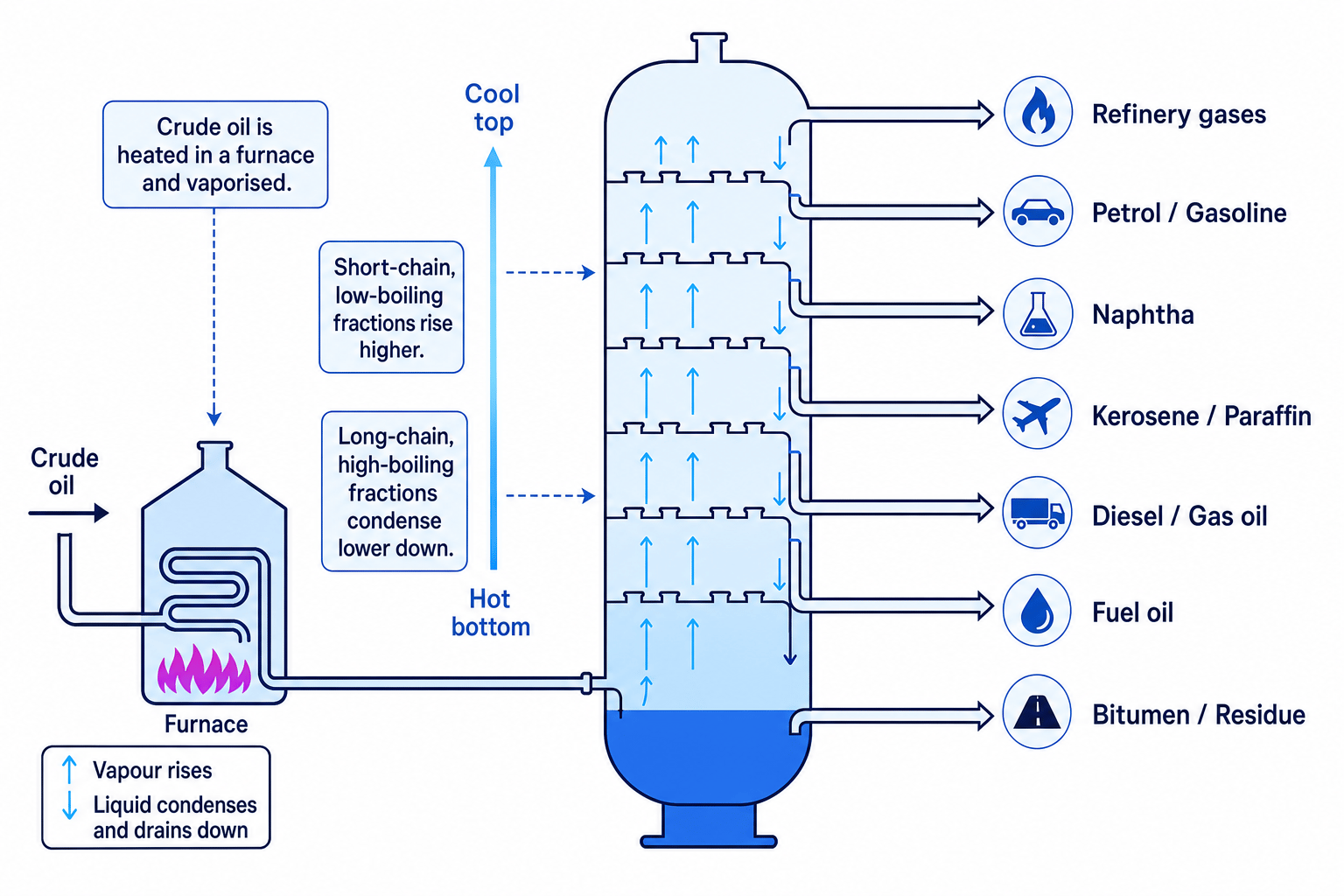
Typical crude oil fractions, from top to bottom of the industrial column, are:
| Position in column | Fraction | General pattern |
|---|---|---|
| Top | Refinery gases | Smallest molecules, lowest boiling points |
| High up | Petrol | Small molecules, volatile and flammable |
| Upper middle | Naphtha | Used as a chemical feedstock |
| Middle | Kerosene / paraffin | Larger molecules than petrol |
| Lower middle | Diesel / gas oil | Higher boiling than kerosene |
| Low down | Fuel oil | Long-chain molecules |
| Bottom | Bitumen / residue | Largest molecules, highest boiling points |
You do not usually need to memorise exact boiling ranges for AQA here. Focus on the trend: smaller, lower-boiling molecules leave higher up; larger, higher-boiling molecules leave lower down.
4. Industrial fractional distillation
Fractional distillation
Fractional distillation is a separation technique in which a mixture of liquids is separated into fractions by repeated evaporation and condensation, using differences in boiling point.
In an oil refinery, crude oil is first heated strongly in a furnace. Most of it vaporises and enters the bottom of a tall fractionating column.
A fractionating column is a column with a temperature gradient: it is hot at the bottom and cooler at the top. Vapours rise up the column and cool down as they rise.
The process works like this:
- Crude oil is heated so that many hydrocarbons become vapours.
- The vapours enter the bottom of the fractionating column.
- As vapours rise, the temperature around them decreases.
- Each hydrocarbon condenses when it reaches a part of the column below its boiling point.
- Liquids are drawn off at different heights as fractions.
- Very high-boiling substances do not vaporise fully and leave near the bottom as residue.
Predicting where molecules are collected
Two hydrocarbons are present in crude oil. One has a boiling point of 70 °C and the other has a boiling point of 250 °C. Decide which is collected higher up the column.
- Use the temperature gradient: the column is hottest at the bottom and coolest at the top.
- Compare boiling points: the 70 °C hydrocarbon can stay as a vapour until it reaches a much cooler region.
- Place the fractions: the 70 °C hydrocarbon is collected higher up, while the 250 °C hydrocarbon condenses lower down in a warmer part of the column.
Quick column logic
Low boiling point means more volatile, so the substance travels further up the column before condensing.
5. The school practical: crude oil substitute
In the lab, you may carry out fractional distillation using a crude oil substitute rather than real crude oil. This is a safer mixture chosen to behave in a similar way.
The apparatus includes:
- a flask containing the mixture and anti-bumping granules
- a fractionating column, often packed to increase surface area
- a thermometer with its bulb level with the side-arm
- a Liebig condenser to cool vapour back into liquid
- a receiving flask or test tube to collect the distillate
The distillate is the liquid collected after vapour has condensed. Anti-bumping granules help the liquid boil more smoothly.
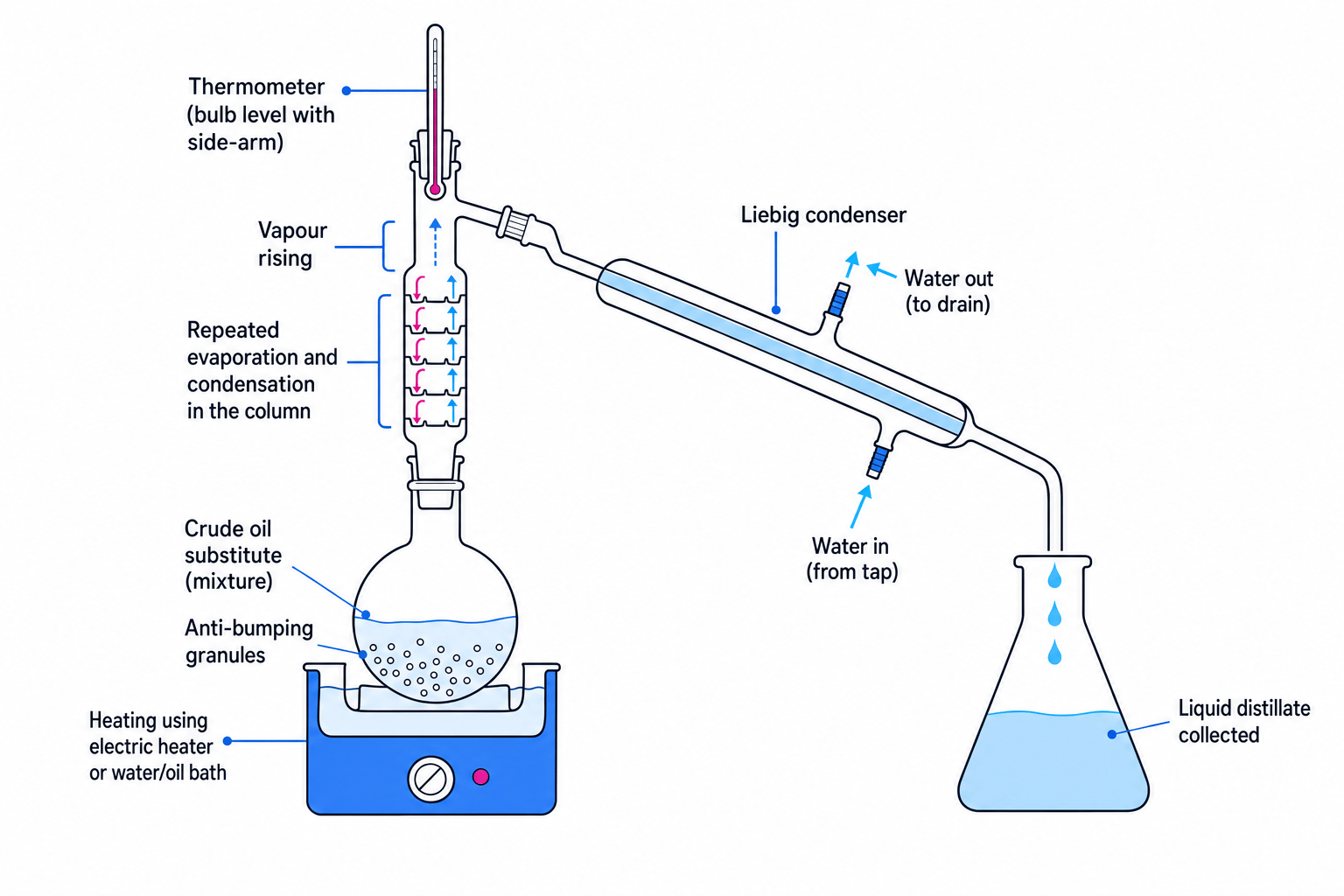
The fractionating column improves separation because vapour repeatedly condenses and re-evaporates on surfaces inside the column. This gives lower-boiling components more chance to reach the condenser first.
Cold water should enter the condenser at the lower end and leave at the upper end, so the water jacket stays full and cooling is efficient.
Collecting fractions from thermometer readings
During a distillation, the thermometer stays around 65–75 °C for a while, then rises quickly, then stays around 140–160 °C. Explain how you would collect the fractions.
- Identify the first boiling range: the 65–75 °C range suggests lower-boiling components are distilling first, so collect this liquid in one labelled receiver.
- Respond to the temperature rise: when the temperature climbs quickly, change the receiver because a different set of substances is beginning to distil.
- Identify the second boiling range: collect the 140–160 °C liquid separately because it contains higher-boiling components.
Thermometer position
The thermometer bulb should be level with the side-arm, where vapour passes into the condenser. If it is too high or too low, the recorded boiling temperature may be inaccurate.
6. What this separation does — and does not — do
Fractional distillation is a physical separation. The hydrocarbons are separated by boiling point, but their molecules are not chemically changed.
The fractions are useful because different chain lengths have different properties. For example, small molecules are more volatile and useful as fuels such as petrol, while very large molecules are less volatile and may be used in bitumen for road surfaces.
The essential explanation
Crude oil is separated by fractional distillation because its hydrocarbons have different boiling points, which depend mainly on chain length and intermolecular forces.
In the exam
- State that crude oil is a mixture mainly of alkane hydrocarbons.
- Explain separation using different boiling points, not different melting points or densities.
- Link column position to boiling point: low boiling point = condenses higher up, high boiling point = condenses lower down.
- If asked about the practical, mention the fractionating column, thermometer position, condenser, and collecting fractions over temperature ranges.
Check yourself
- Why do longer-chain alkanes generally have higher boiling points?
- Why is a fraction from crude oil not usually a pure substance?
- In a fractionating column, why are petrol-like fractions collected higher up than diesel-like fractions?
