What you'll learn
- How scientists’ ideas about atomic structure have changed over time.
- The three fundamental particles in atoms: protons, neutrons and electrons.
- The relative charges and relative masses of these particles.
- How the nucleus and surrounding electrons make up an atom.
Why atomic structure matters
Chemistry is about atoms rearranging, sharing electrons, forming ions, and making bonds. Before you can understand any of that, you need a clear picture of what an atom is made from.
At A-Level Chemistry, the key “fundamental particles” of atoms are protons, neutrons and electrons. Strictly, in particle physics, protons and neutrons are made of smaller particles, but that is not needed for this chemistry topic.
Atomic models have evolved over time
Scientists did not always know that atoms contained smaller particles. Atomic structure is a good example of how scientific models change when new evidence appears.
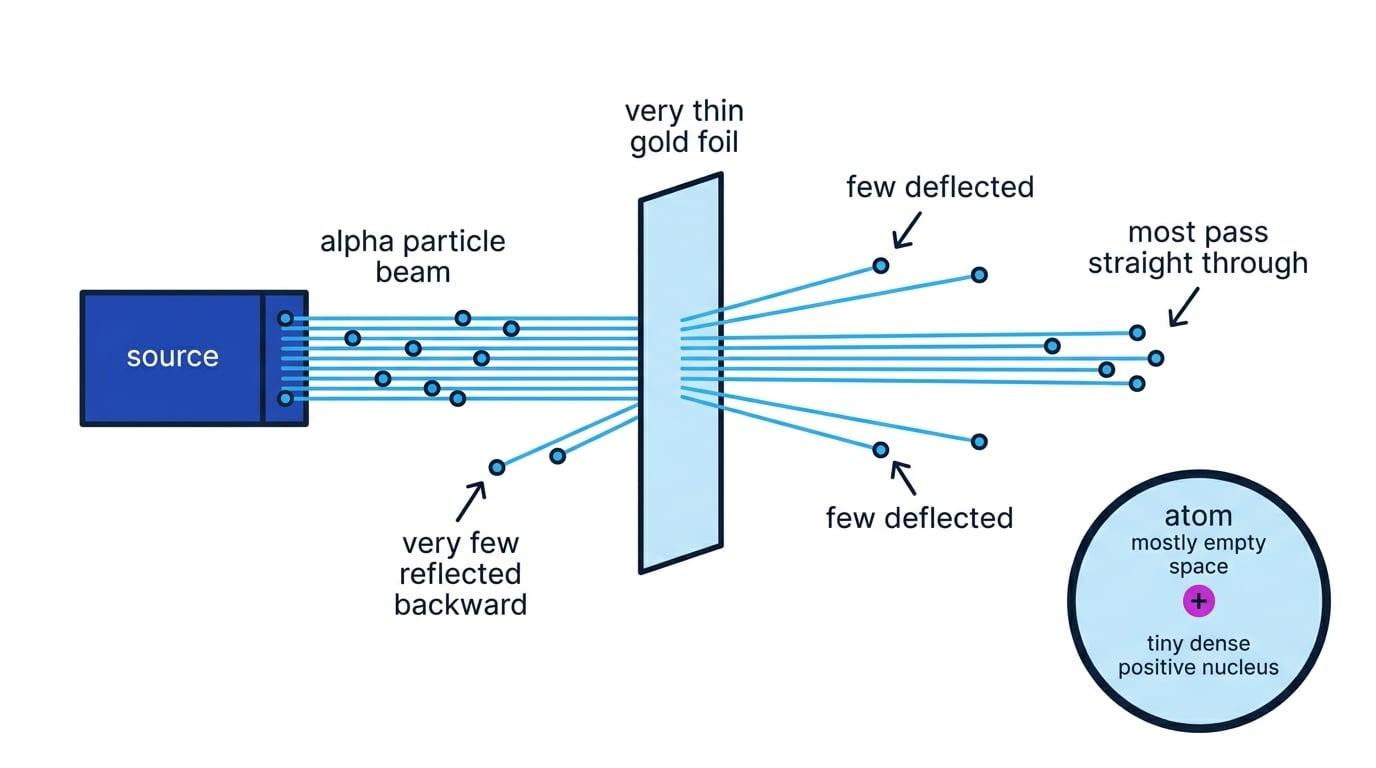
Early ideas treated atoms as tiny, solid, indivisible spheres. Later, the discovery of the electron showed that atoms had internal structure. Scattering experiments then showed that atoms have a tiny, dense, positively charged centre called the nucleus.
Models change with evidence
Scientific models are not “guesses”; they are explanations based on evidence. When new observations cannot be explained by the old model, the model is improved or replaced.
A simple timeline
- Dalton’s model: atoms were tiny solid spheres.
- Thomson’s model: electrons were discovered, so atoms must contain smaller negative particles.
- Rutherford’s nuclear model: most of the atom is empty space, with a tiny positive nucleus.
- Chadwick’s discovery: neutrons were identified, helping explain the mass of nuclei without adding extra charge.
- Modern model: electrons are found in regions around the nucleus, not fixed solid “planetary” paths.
Using scattering evidence to infer atomic structure
A beam of positively charged alpha particles is fired at very thin gold foil. Most pass straight through, but a very small number are strongly deflected backwards. What does this show about the atom?
-
Since most alpha particles pass straight through, most of the atom must be empty space rather than solid matter.
-
Since a few alpha particles are strongly deflected, the positive charge and most of the mass must be concentrated in a very small region.
-
Since alpha particles are positive and are repelled by this small region, that region must also be positive: this is evidence for a tiny, dense, positive nucleus.
The three subatomic particles
A subatomic particle is a particle smaller than an atom. In this topic, you need to know three of them.
Fundamental particles in atoms
An atom contains protons and neutrons in the nucleus, with electrons outside the nucleus.
Here is the essential information:
| Particle | Symbol | Relative charge | Relative mass | Position in the atom |
|---|---|---|---|---|
| Proton | p+ | +1 | 1 | In the nucleus |
| Neutron | n0 | 0 | 1 | In the nucleus |
| Electron | e− | −1 | about 1/1836 | Outside the nucleus |
The electron’s relative mass is so small that, for many A-Level chemistry calculations, it is treated as negligible.
Relative charge
Charge is a property of particles that causes electrical attraction or repulsion. Opposite charges attract; like charges repel.
Relative charge
Relative charge compares the charge of a particle with the charge of a proton, which is assigned a value of +1.
So:
- a proton has relative charge +1
- an electron has relative charge −1
- a neutron has relative charge 0
A neutral atom has no overall charge because it has the same number of protons and electrons. The positive charges from the protons cancel the negative charges from the electrons.
Calculating overall charge
A particle contains 13 protons, 14 neutrons and 10 electrons. Work out its overall charge.
-
Add the proton contribution: 13 protons each have charge +1, so the total positive charge is +13.
-
Add the electron contribution: 10 electrons each have charge −1, so the total negative charge is −10.
-
Neutrons have charge 0, so they do not affect the charge. The overall charge is therefore +13+(−10)=+3+13 + (-10) = +3+13+(−10)=+3.
Neutrons are not negative
The word neutron means neutral, not negative. Neutrons have relative charge 0, so they do not change the overall charge of an atom or ion.
Relative mass
Mass is the amount of matter in a particle or object. At this level, you compare subatomic particle masses using relative mass rather than kg.
Relative mass
Relative mass compares particle masses on a scale where a proton has mass 1. It has no unit.
Protons and neutrons have almost the same mass, so they are both given relative mass 1. Electrons are much lighter, with relative mass about 11836\frac{1}{1836}18361.
This means nearly all the mass of an atom is in its nucleus.
Comparing mass contributions in an atom
An atom contains 6 protons, 6 neutrons and 6 electrons. Estimate how much of its relative mass comes from electrons.
- Work out the contribution from protons and neutrons:
- Work out the contribution from electrons:
- Compare the two values: 0.00327 is tiny compared with 12, so the electron mass is negligible. Almost all the atom’s mass is in the nucleus.
Mass and charge shortcut
For most basic atomic-structure questions: protons and neutrons give the mass, while protons and electrons determine the charge.
The structure of an atom
An atom has a tiny central nucleus containing protons and neutrons. Electrons are found outside the nucleus. The nucleus is very small compared with the whole atom, so most of the atom is empty space.
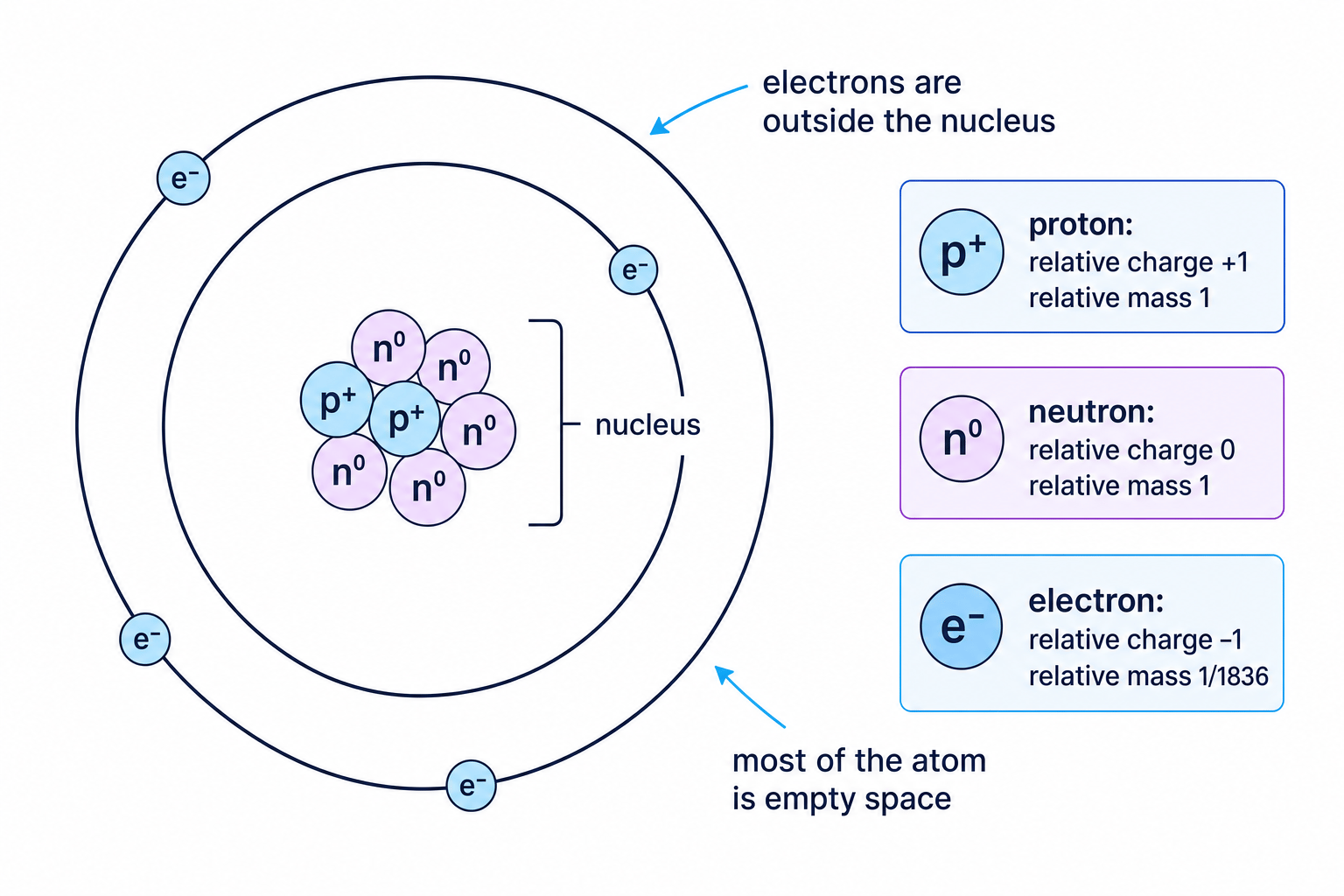
The nucleus is positively charged because it contains protons and neutrons, but only the protons have charge. Neutrons add mass without adding charge.
The electrons are negative and are attracted to the positive nucleus by electrostatic attraction, which means attraction between opposite electrical charges.
Diagrams are not to scale
Atomic diagrams usually make the nucleus look much larger than it really is. In reality, the nucleus is tiny compared with the whole atom, and most of the atom is empty space.
Putting it together
For this first atomic-structure section, you should be comfortable with three main ideas:
- Atomic models have changed over time because of new experimental evidence.
- Atoms contain protons, neutrons and electrons.
- Protons, neutrons and electrons differ in charge, mass and position.
The core picture
An atom has a tiny positive nucleus containing protons and neutrons, with negative electrons outside the nucleus. Protons and neutrons provide almost all the mass; protons and electrons determine charge.
In the exam
-
If asked for relative charges and masses, include the signs: proton +1, neutron 0, electron −1.
-
When calculating overall charge, count protons and electrons only; neutrons have no charge.
-
If explaining evidence for the nuclear model, link observations to conclusions: most particles pass through, so most of the atom is empty space; a few are strongly deflected, so the nucleus is tiny, dense and positive.
Check yourself
- What are the relative charges and relative masses of protons, neutrons and electrons?
- Why does a neutral atom have no overall charge?
- Why is most of an atom’s mass found in the nucleus?