This question is about measuring the rates of chemical reactions.
A student investigates the rate of reaction between magnesium ribbon and an excess of dilute hydrochloric acid.
Mg(s)+2HCl(aq)→MgCl2(aq)+H2(g) \text{Mg(s)} + 2\text{HCl(aq)} \rightarrow \text{MgCl}_2\text{(aq)} + \text{H}_2\text{(g)} Mg(s)+2HCl(aq)→MgCl2(aq)+H2(g)To do this, the reaction is carried out in a conical flask, and the volume of hydrogen gas evolved is collected and measured over a period of time.
Suggest a reason why using a thermostatted water bath to maintain a constant temperature of the reaction mixture, rather than letting the flask stand on the open laboratory bench, gives more accurate rate measurements in this experiment.
Figure 1 shows the results of this experiment when a 0.12 g magnesium ribbon reacts with an excess of 1.00 mol dm-3 hydrochloric acid at 35∘C35^\circ\text{C}35∘C.
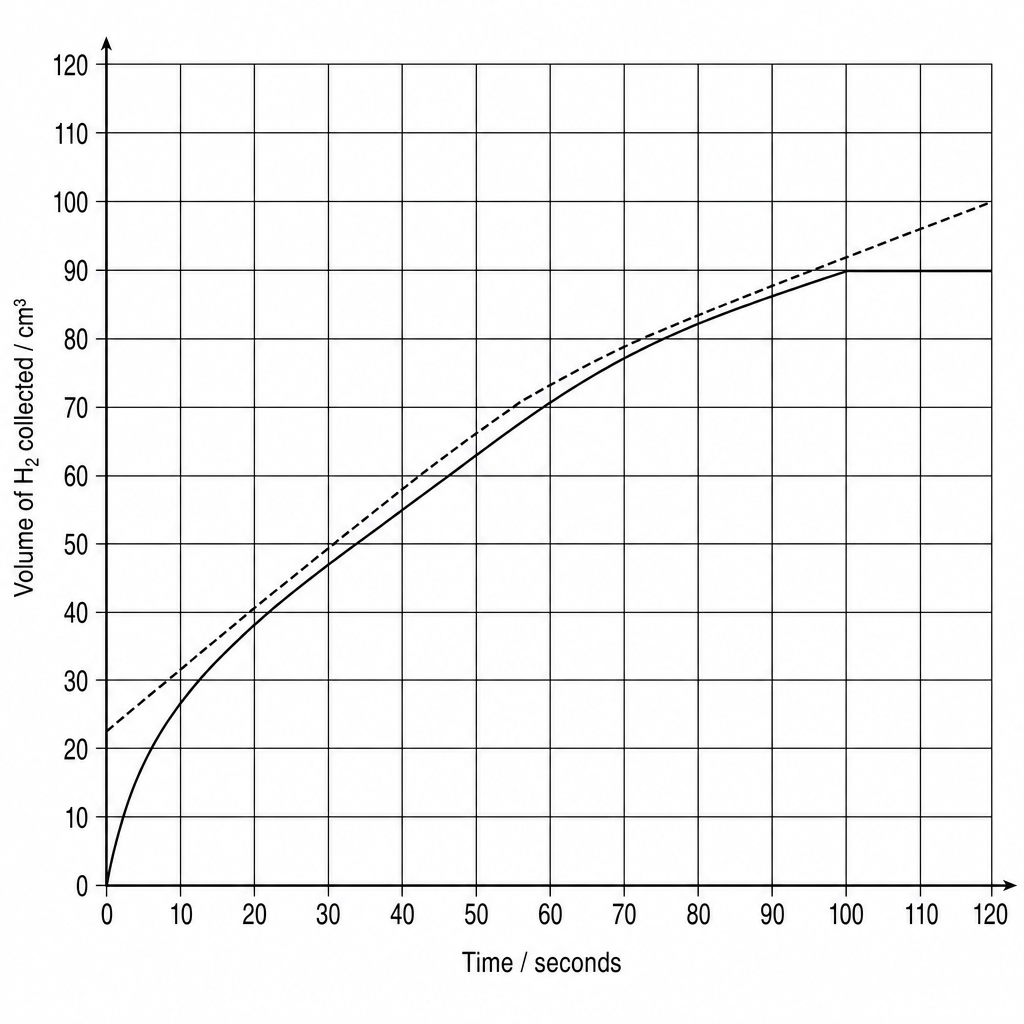
Use Figure 1 to calculate the rate of reaction at 40 seconds40\text{ seconds}40 seconds. Deduce the units of your calculated rate.
The student repeats the experiment using the same mass of magnesium ribbon and the same volume and concentration of hydrochloric acid, but at a higher temperature of 55∘C55^\circ\text{C}55∘C instead of 35∘C35^\circ\text{C}35∘C.
Describe how the curve for the reaction at 55∘C55^\circ\text{C}55∘C would compare to the curve at 35∘C35^\circ\text{C}35∘C shown in Figure 1.
Explain, in terms of collision theory and the Maxwell–Boltzmann distribution, why a higher temperature increases the rate of reaction.