For a chemical reaction, the relationship between the rate constant, kkk, and the temperature, TTT, is shown by the Arrhenius equation: k=Ae−EaRTk = A e^{-\frac{E_a}{RT}}k=Ae−RTEa
For the thermal isomerisation of gaseous cyclopropane:
- the activation energy, Ea=272 kJ mol−1E_a = 272 \text{ kJ mol}^{-1}Ea=272 kJ mol−1
- the Arrhenius constant, A=5.90×10¹⁵ s−1A = 5.90 \times 10^{15} \text{ s}^{-1}A=5.90×10¹⁵ s−1
At temperature T1T_1T1, the rate constant is k=6.55×10⁻⁴ s−1k = 6.55 \times 10^{-4} \text{ s}^{-1}k=6.55×10⁻⁴ s−1.
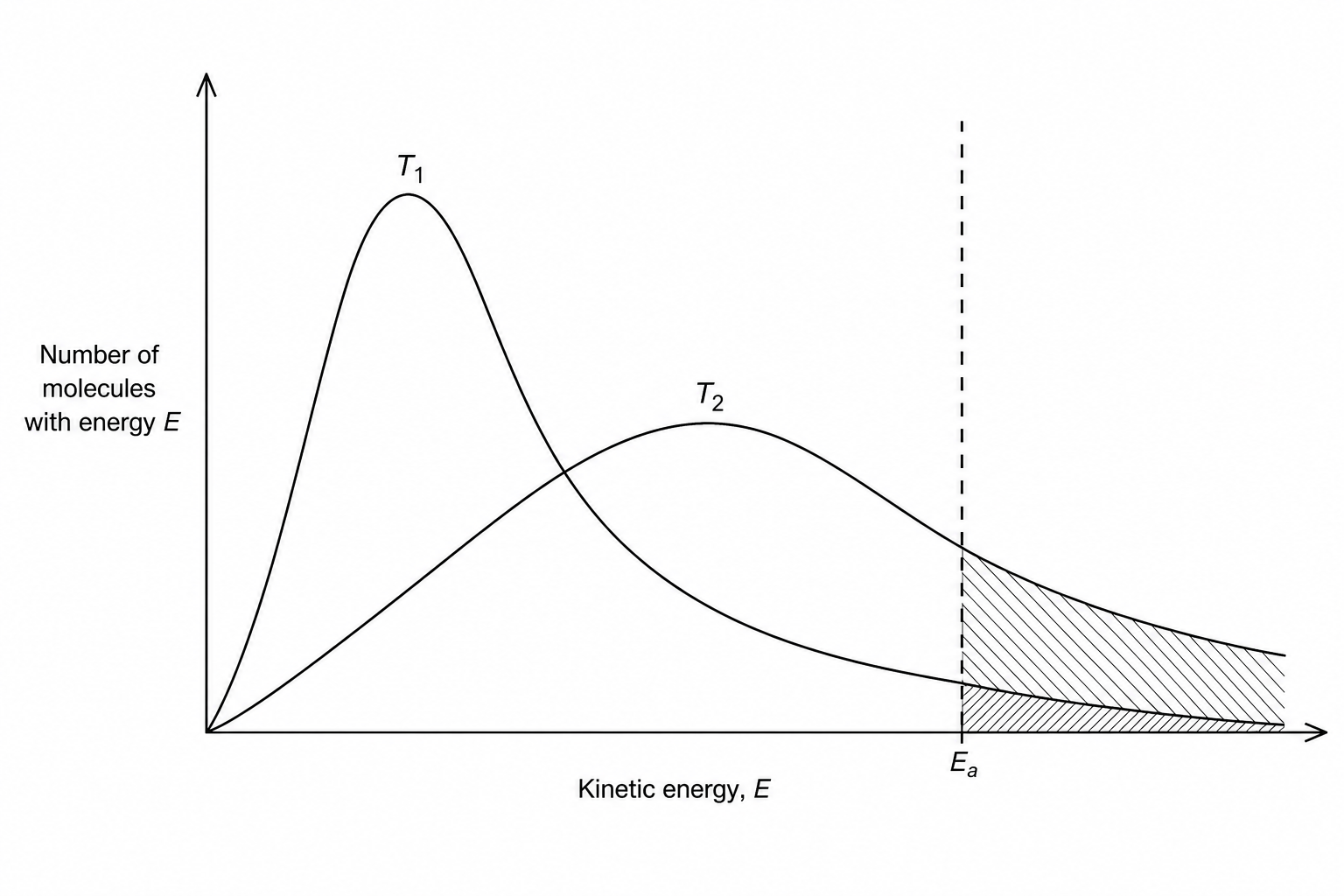
The Maxwell–Boltzmann distribution curves for the reactant molecules at temperatures T1T_1T1 and T2T_2T2 (where T2>T1T_2 > T_1T2>T1) are shown below:
Calculate the temperature T1T_1T1 in Kelvin. The gas constant, R=8.31 J K−1 mol−1R = 8.31 \text{ J K}^{-1} \text{ mol}^{-1}R=8.31 J K−1 mol−1
Explain why the rate of reaction is faster at the higher temperature T2T_2T2 than at T1T_1T1, with reference to the Maxwell–Boltzmann distribution shown.