Carboxylic acids and esters (A-level only)
What you'll learn:
- How carboxylic acids behave as weak acids.
- How to synthesise esters from alcohols and carboxylic acids, and how to name them.
- The critical differences between acid-catalysed and alkaline hydrolysis of esters.
- The structure of fats and oils, and how they are used to make soap and biodiesel.
Carboxylic acids as weak acids
Carboxylic acids contain the functional group -COOH\text{-COOH}-COOH. The oxygen atoms in the carboxyl group pull electron density away from the hydrogen atom, allowing the O-H\text{O-H}O-H bond to break and release an H+\text{H}^+H+ ion.
However, carboxylic acids are weak acids. This means they only partially dissociate in water. For example, ethanoic acid sets up the following equilibrium:
CH3COOH(aq)⇌CH3COO−(aq)+H+(aq) \text{CH}_3\text{COOH(aq)} \rightleftharpoons \text{CH}_3\text{COO}^-\text{(aq)} + \text{H}^+\text{(aq)} CH3COOH(aq)⇌CH3COO−(aq)+H+(aq)Because they are acids, they will react with bases, but their hallmark reaction in A-Level Chemistry is their reaction with carbonates. Carboxylic acids are strong enough to liberate carbon dioxide gas from metal carbonates (like sodium carbonate, Na2CO3\text{Na}_2\text{CO}_3Na2CO3) or hydrogencarbonates (like NaHCO3\text{NaHCO}_3NaHCO3).
2CH3COOH+Na2CO3→2CH3COONa+H2O+CO2 2\text{CH}_3\text{COOH} + \text{Na}_2\text{CO}_3 \to 2\text{CH}_3\text{COONa} + \text{H}_2\text{O} + \text{CO}_2 2CH3COOH+Na2CO3→2CH3COONa+H2O+CO2The classic test for a carboxylic acid
If you add a spatula of sodium carbonate to an unknown organic liquid and observe fizzing (effervescence), with the gas turning limewater cloudy, the unknown liquid is almost certainly a carboxylic acid. Other organic compounds containing -OH\text{-OH}-OH (like alcohols or phenols) are not acidic enough to react with carbonates.
Making esters: Esterification
When you heat a carboxylic acid with an alcohol in the presence of a strong acid catalyst (usually concentrated sulfuric acid, H2SO4\text{H}_2\text{SO}_4H2SO4), they react to form an ester and water.
Esterification
A condensation reaction between a carboxylic acid and an alcohol that produces an ester and water.
The reaction is reversible and reaches a dynamic equilibrium.
Carboxylic Acid+Alcohol⇌Ester+Water \text{Carboxylic Acid} + \text{Alcohol} \rightleftharpoons \text{Ester} + \text{Water} Carboxylic Acid+Alcohol⇌Ester+WaterBelow is the reaction between ethanoic acid and ethanol to form ethyl ethanoate. Notice that the -OH\text{-OH}-OH group is lost from the carboxylic acid, and the H\text{H}H atom is lost from the alcohol.
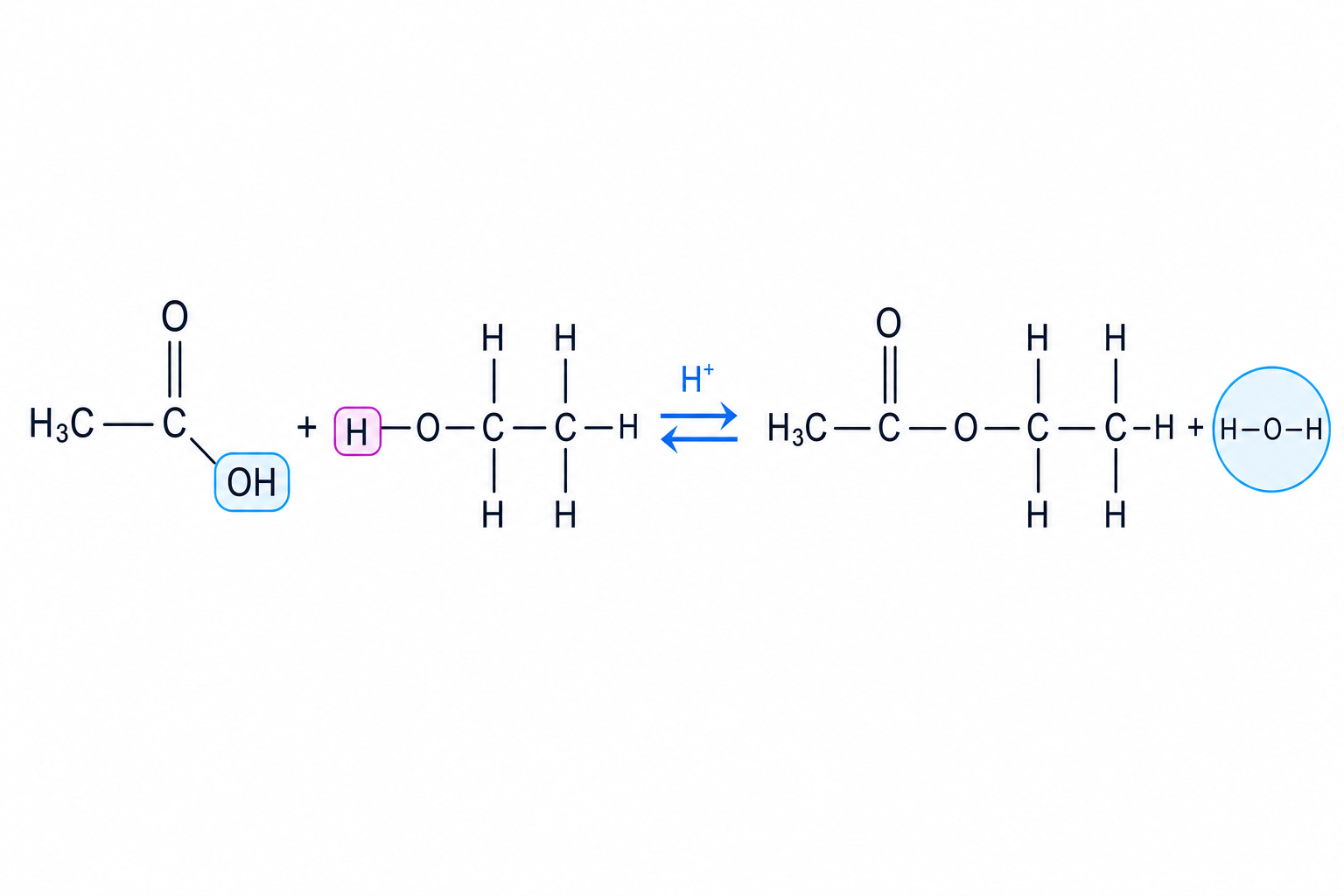
Naming esters
Esters contain the functional group -COO-\text{-COO-}-COO-. Their names are made of two parts:
- The first part comes from the alcohol and ends in -yl (e.g., methanol →\to→ methyl).
- The second part comes from the carboxylic acid and ends in -oate (e.g., propanoic acid →\to→ propanoate).
Reversing the name
Students frequently look at a structure like CH3CH2COOCH3\text{CH}_3\text{CH}_2\text{COOCH}_3CH3CH2COOCH3 and read it left-to-right as "ethyl methanoate". Look at the C=O\text{C=O}C=O bond. The chain attached to the carbon of the C=O\text{C=O}C=O comes from the acid (propanoic acid →\to→ propanoate). The chain attached to the single-bonded oxygen comes from the alcohol (methanol →\to→ methyl). The correct name is methyl propanoate.
Uses of esters
Esters have distinctive physical properties that make them incredibly useful in industry:
- Perfumes and food flavourings: Short-chain esters are volatile liquids with sweet, fruity smells.
- Solvents: Esters are polar liquids but lack hydrogen bonding between their own molecules, giving them low boiling points. They make excellent volatile solvents for polar organic compounds (e.g., ethyl ethanoate is used in nail varnish remover and glues).
- Plasticisers: Esters are added to rigid polymers (like PVC) during manufacturing. The ester molecules slip between the polymer chains, pushing them apart and weakening the intermolecular forces. This makes the plastic flexible.
Hydrolysis of esters
Hydrolysis is the exact reverse of esterification. You are using water to break the ester bond (-COO-\text{-COO-}-COO-) apart. Because water alone is very slow, hydrolysis is done under either acidic or alkaline conditions. The choice of condition changes the final products.
Acid vs Alkaline Hydrolysis
Acid hydrolysis is reversible and forms a carboxylic acid and an alcohol. Alkaline hydrolysis goes to completion and forms a carboxylate salt and an alcohol.
1. Acid hydrolysis
Heating an ester under reflux with a dilute acid (like dilute HCl\text{HCl}HCl or H2SO4\text{H}_2\text{SO}_4H2SO4) splits the ester back into its parent carboxylic acid and alcohol. Because the reaction is reversible, you never get a 100% yield; it reaches equilibrium.
CH3COOCH2CH3+H2O⇌CH3COOH+CH3CH2OH \text{CH}_3\text{COOCH}_2\text{CH}_3 + \text{H}_2\text{O} \rightleftharpoons \text{CH}_3\text{COOH} + \text{CH}_3\text{CH}_2\text{OH} CH3COOCH2CH3+H2O⇌CH3COOH+CH3CH2OH2. Alkaline hydrolysis
Heating an ester under reflux with a dilute alkali (like aqueous NaOH\text{NaOH}NaOH) splits the ester into an alcohol and a carboxylate salt. Because the carboxylic acid that would be formed immediately reacts with the alkali to form a salt, the products cannot recombine. The reaction is irreversible and goes to completion, making it the preferred method in industry.
CH3COOCH2CH3+NaOH→CH3COONa+CH3CH2OH \text{CH}_3\text{COOCH}_2\text{CH}_3 + \text{NaOH} \to \text{CH}_3\text{COONa} + \text{CH}_3\text{CH}_2\text{OH} CH3COOCH2CH3+NaOH→CH3COONa+CH3CH2OHDeducing the products of alkaline hydrolysis
Write the full equation for the alkaline hydrolysis of propyl methanoate using aqueous potassium hydroxide.
- Identify the parent molecules of the ester "propyl methanoate". The "propyl" part comes from propan-1-ol (CH3CH2CH2OH\text{CH}_3\text{CH}_2\text{CH}_2\text{OH}CH3CH2CH2OH). The "methanoate" part comes from methanoic acid (HCOOH\text{HCOOH}HCOOH).
- Deduce the products of alkaline hydrolysis. The alcohol (propan-1-ol) is formed as normal. The acid reacts with the base (KOH\text{KOH}KOH) to form the potassium salt of the acid: potassium methanoate (HCOOK\text{HCOOK}HCOOK).
- Construct the balanced equation.
Fats, oils, and soaps
Animal fats and vegetable oils are naturally occurring esters. Specifically, they are esters made from long-chain carboxylic acids (often called fatty acids) and a single alcohol that contains three -OH\text{-OH}-OH groups.
This alcohol is propane-1,2,3-triol, commonly known as glycerol. Because glycerol has three -OH\text{-OH}-OH groups, it can form three ester bonds with three fatty acid molecules. The resulting molecule is called a triglyceride.
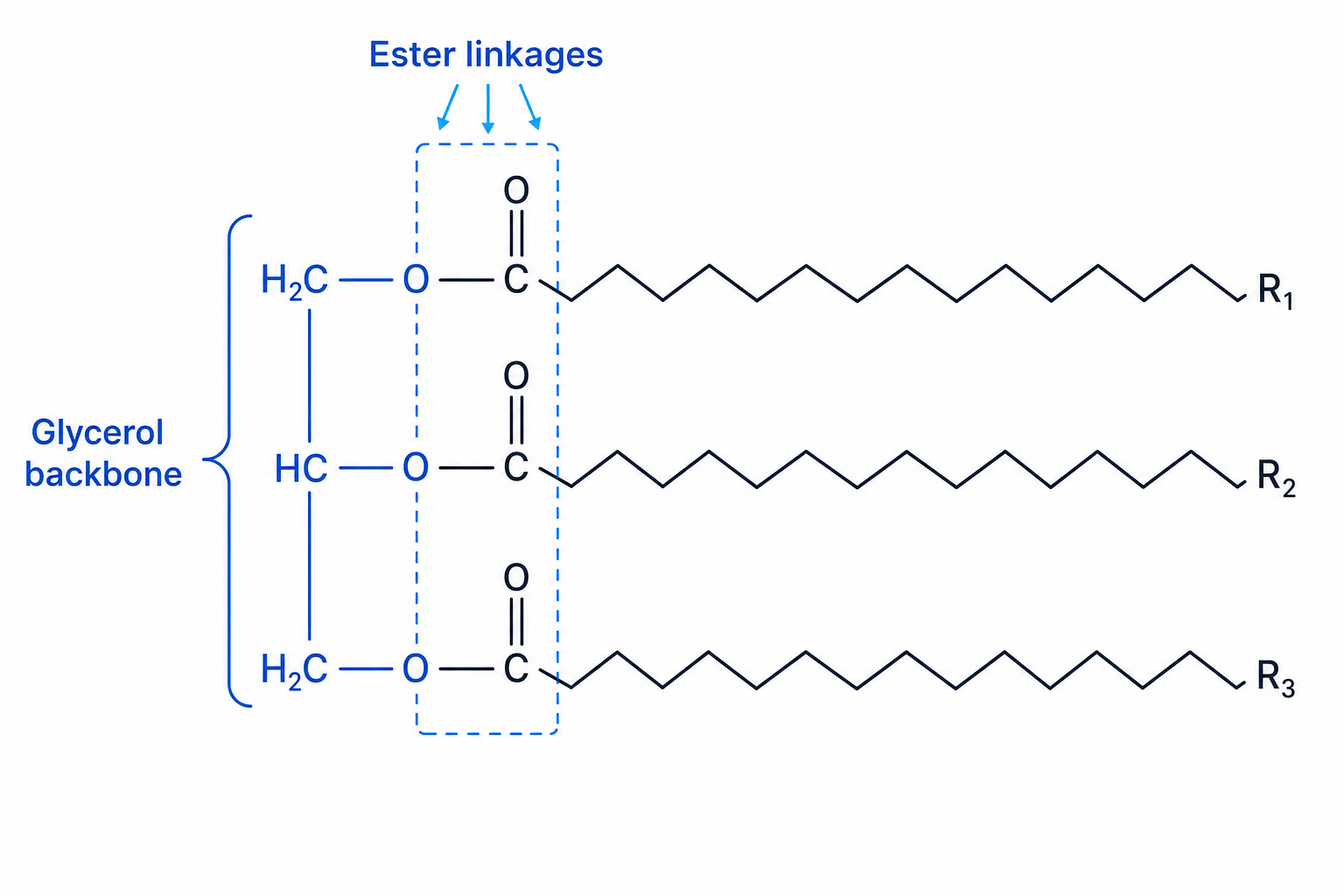
Saponification (Making soap)
If you hydrolyse a fat or oil under alkaline conditions (heating with concentrated NaOH\text{NaOH}NaOH), the three ester linkages break.
This produces:
- One molecule of glycerol (propane-1,2,3-triol).
- Three molecules of the sodium salt of the long-chain carboxylic acid.
These sodium salts of long-chain fatty acids are exactly what soap is.
Triglyceride+3NaOH→Glycerol+3Sodium Carboxylate Salts (Soap) \text{Triglyceride} + 3\text{NaOH} \to \text{Glycerol} + 3\text{Sodium Carboxylate Salts (Soap)} Triglyceride+3NaOH→Glycerol+3Sodium Carboxylate Salts (Soap)Biodiesel
Vegetable oils are renewable but too viscous to be used directly in standard diesel engines. However, they can be converted into biodiesel, which flows much more easily.
Biodiesel
Biodiesel is a mixture of methyl esters of long-chain carboxylic acids.
To make biodiesel, vegetable oils (triglycerides) are reacted with methanol in the presence of a strong alkaline catalyst (like potassium hydroxide). This reaction swaps the heavy glycerol backbone for three small methyl groups.
Because we are swapping one alcohol (glycerol) out of the ester for another alcohol (methanol), this specific type of reaction is called transesterification.
Triglyceride+3CH3OH→KOH catalystGlycerol+3Methyl Esters (Biodiesel) \text{Triglyceride} + 3\text{CH}_3\text{OH} \xrightarrow{\text{KOH catalyst}} \text{Glycerol} + 3\text{Methyl Esters (Biodiesel)} Triglyceride+3CH3OHKOH catalystGlycerol+3Methyl Esters (Biodiesel)Biodiesel vs Standard Diesel
Standard crude-oil-derived diesel is a mixture of long-chain alkanes. Biodiesel is a mixture of long-chain methyl esters. You must mention the "methyl ester" part in your exams when defining biodiesel.
In the exam
- When deducing an ester's structure from a skeletal formula, draw a line directly through the single C-O\text{C-O}C-O bond in the ester linkage. The side with the C=O\text{C=O}C=O is your acid derivative; the side with the -O-\text{-O-}-O- is your alcohol derivative.
- In multi-step synthesis questions, remember that forming an ester from an acid and alcohol requires an acid catalyst (H+\text{H}^+H+), while breaking it apart completely (for high yield) requires alkaline hydrolysis (OH−\text{OH}^-OH−).
- If asked to draw the structure of glycerol from memory, draw a vertical column of three carbon atoms, attach one -OH\text{-OH}-OH group to each carbon, and fill the remaining bonds with hydrogen atoms (propane-1,2,3-triol).
Check yourself
- Why do carboxylic acids react with sodium carbonate but alcohols do not?
- What are the IUPAC names of the two products formed when butyl propanoate is heated under reflux with dilute hydrochloric acid?
- What is the structural difference between a standard diesel molecule and a biodiesel molecule?
- During saponification, what are the names of the two products formed from the alkaline hydrolysis of a triglyceride?