

What you'll learn
- Why enzymes are proteins and how their folded structure creates an active site.
- How enzymes act as catalysts by forming enzyme–substrate complexes.
- Why a stereospecific active site can distinguish between two enantiomers.
- How some drugs work as enzyme inhibitors, and how computers help design them.
Enzymes are proteins
Enzymes are biological catalysts. In chemistry terms, they speed up reactions without being used up overall.
They are made from proteins, which are long chains of amino acids folded into a specific three-dimensional shape. The exact sequence of amino acids affects how the protein folds, and that folded shape controls what the enzyme can do.
Enzyme
An enzyme is a protein that acts as a biological catalyst, increasing the rate of a reaction without being permanently changed or used up.
The key point for this topic is that enzymes are not just “general blobs” of protein. Their catalytic behaviour depends on a very precise three-dimensional arrangement of atoms.
Shape controls function
For enzymes, the folded three-dimensional structure of the protein determines the shape and chemical environment of the active site, so it determines which molecules can bind.
Catalysts and activation energy
A catalyst increases the rate of a chemical reaction by providing an alternative reaction pathway with a lower activation energy.
Activation energy
The activation energy, EaE_aEa, is the minimum energy that reacting particles must have for a reaction to occur.
Enzymes do not change the overall enthalpy change of a reaction. They do not change the position of equilibrium either. Instead, they make it easier for the reaction to happen by lowering EaE_aEa.
In enzyme reactions, this often involves holding reacting groups close together, putting bonds under strain, or stabilising the transition state.
Catalysts and equilibrium
A catalyst speeds up both the forward and reverse reactions. It helps equilibrium be reached faster, but it does not change the equilibrium yield.
The active site and substrate
Only a small part of an enzyme is directly involved in catalysis. This region is called the active site.
Active site and substrate
The active site is the region of an enzyme where the reactant binds and the reaction is catalysed. The substrate is the reactant molecule that binds to the active site.
When the substrate binds to the active site, an enzyme–substrate complex forms. The binding usually involves temporary intermolecular attractions such as hydrogen bonds, ionic interactions, permanent dipole–dipole attractions and induced dipole–dipole attractions.
These interactions are strong enough to hold the substrate in place, but weak enough that products can leave after the reaction.
Enzyme–substrate complex
An enzyme–substrate complex is the temporary structure formed when a substrate molecule is bound in the active site of an enzyme.
A simple way to picture this is:
enzyme + substrate → enzyme–substrate complex → enzyme + product
The enzyme appears again at the end, so it has not been consumed.
Stereospecific active sites
This is the crucial A-Level-only part of this topic: enzyme active sites are stereospecific.
Stereospecific
A stereospecific active site has a three-dimensional shape and arrangement of binding groups that allows it to bind only one particular stereoisomer effectively.
A stereoisomer has the same structural formula as another molecule, but a different arrangement of atoms in space. A very important type is an enantiomer.
Enantiomers
Enantiomers are non-superimposable mirror-image stereoisomers. They usually occur when a molecule contains a chiral centre, such as a carbon atom bonded to four different groups.
Because an enzyme active site is three-dimensional, it can distinguish between enantiomers. One enantiomer may line up correctly with several binding points in the active site. The mirror-image enantiomer cannot usually make the same set of interactions at the same time.
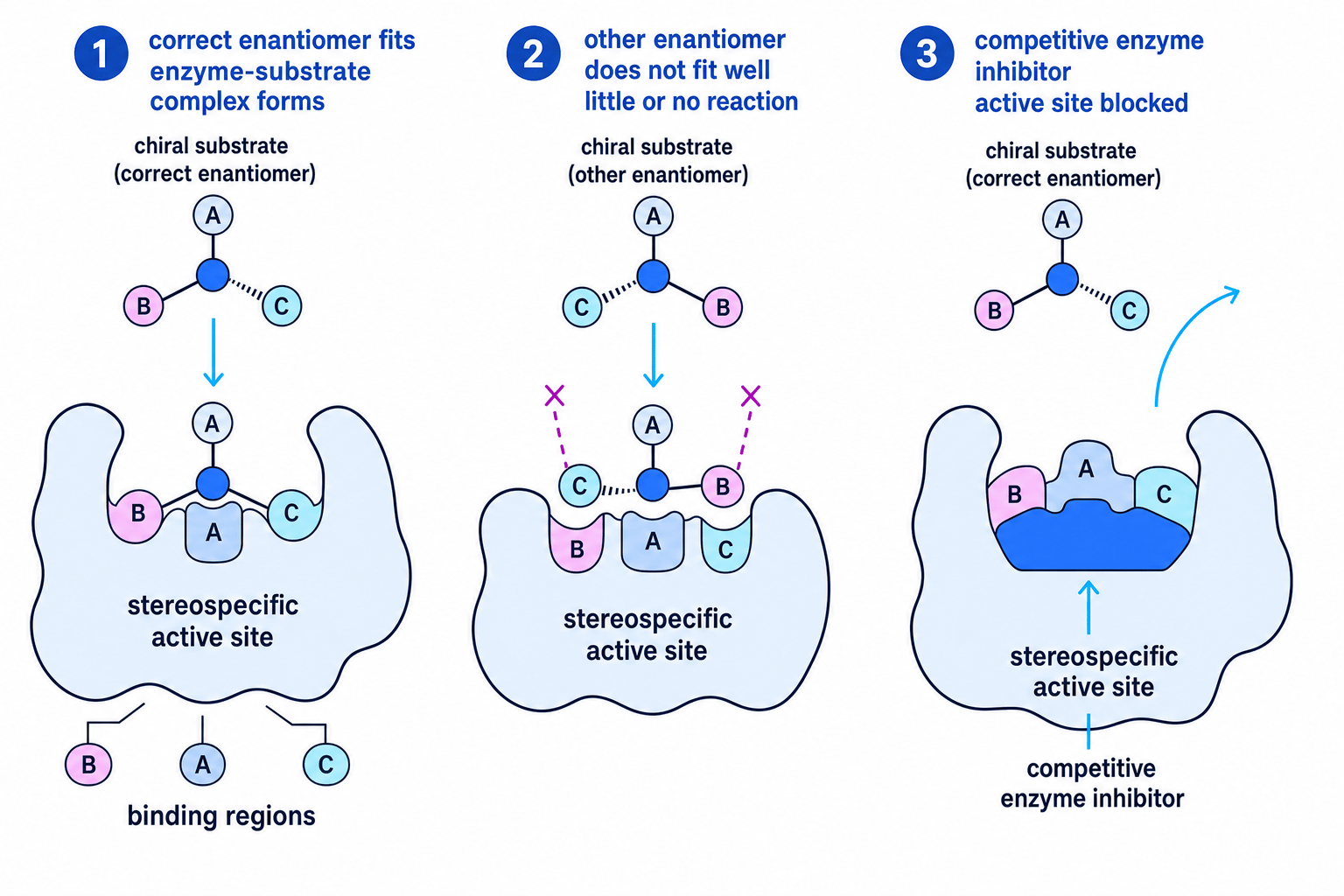
Why only one enantiomer may bind
Imagine the active site has three binding regions. For a substrate to bind effectively, three groups on the substrate must line up with those regions.
For one enantiomer, all three groups can match the active site. For the mirror-image enantiomer, perhaps one or two groups line up, but not all three. The fit is therefore much weaker, or the molecule cannot bind in the correct orientation for reaction.
A useful mental picture
Think of a right hand fitting into a right-handed glove. The left hand has the same fingers and thumb, but the mirror-image arrangement means it does not fit the same glove properly.
Explaining why only one enantiomer reacts
A substrate has two enantiomers. Only one is converted into product by a particular enzyme. Explain why.
-
The enzyme is a protein with a folded three-dimensional structure, so its active site has a specific shape and arrangement of binding groups.
-
The two enantiomers are mirror images, so their groups are arranged differently in three-dimensional space even though they have the same connectivity.
-
Only one enantiomer can position its groups so that enough interactions form with the active site at the same time.
-
The other enantiomer cannot bind in the correct orientation, so the enzyme–substrate complex is not formed effectively and little or no reaction occurs.
Saying just ‘same shape’
Avoid saying the substrate and active site have “the same shape”. The better idea is that they are complementary: their shapes and binding groups match each other in a way that allows binding.
Enzyme inhibitors as drugs
Some drugs work by acting as enzyme inhibitors.
Enzyme inhibitor
An enzyme inhibitor is a substance that reduces or prevents the activity of an enzyme.
In this specification point, the focus is on a drug blocking the active site. If the inhibitor binds in the active site, the normal substrate cannot bind there. This reduces the formation of enzyme–substrate complexes, so the reaction rate decreases.
This is often called competitive inhibition, because the inhibitor and substrate compete for the same active site.
Blocking the active site
If a drug binds to the active site of an enzyme, it can prevent the substrate from binding, so the enzyme-catalysed reaction is slowed or stopped.
For a drug to be an effective active-site inhibitor, it usually needs a shape and arrangement of functional groups that are complementary to the active site. This is why stereochemistry matters: one enantiomer of a drug may fit the active site much better than the other.
Predicting the effect of an active-site inhibitor
A drug molecule has a similar three-dimensional arrangement of binding groups to the normal substrate. It binds strongly to the active site but is not converted into product. Predict its effect on the enzyme-catalysed reaction.
-
Since the drug has a complementary arrangement of groups, it can bind to the enzyme’s active site.
-
Because it occupies the active site, fewer substrate molecules can bind and fewer enzyme–substrate complexes form.
-
Since the drug is not converted into product, it effectively blocks the catalytic pathway rather than being used as a normal substrate.
-
The rate of the enzyme-catalysed reaction decreases.
Inhibitor does not always destroy the enzyme
Do not assume an inhibitor “kills” or permanently denatures the enzyme. Some inhibitors bind reversibly, especially competitive inhibitors, so their effect can depend on concentration.
Drug design and computers
Modern drug design often uses computers to model the structure of an enzyme active site. This is especially useful when scientists know the three-dimensional structure of the target enzyme.
Computer modelling can help chemists:
- visualise the active site shape
- identify possible binding regions
- design molecules with complementary shapes and functional groups
- compare how different enantiomers might fit
- predict which molecules are likely to be effective inhibitors before making them in the lab
This does not remove the need for experimental testing. A computer model is a prediction. The drug must still be synthesised, tested for binding, tested for biological activity, and checked for safety.
How to phrase computer-aided design
A strong answer says that computers model the three-dimensional active site, then help design molecules with complementary shapes and functional groups that can bind to or block that active site.
Pulling the ideas together
Enzymes are proteins, so their shapes come from amino acid chains folding into specific three-dimensional structures. The active site is only a small part of the enzyme, but its shape and chemical groups control which molecules bind.
Because many biological molecules are chiral, enzyme active sites are often stereospecific. One enantiomer may bind strongly and react, while the mirror-image enantiomer may not fit properly.
Drug molecules can take advantage of this. If a drug is designed to fit the active site of an enzyme, it can block the substrate from binding and inhibit the enzyme.
In the exam
-
Link enzyme action to protein structure: folded protein → specific active site → complementary binding.
-
For stereospecificity, explicitly mention three-dimensional arrangement and one enantiomer fitting better than the mirror image.
-
For inhibitor drugs, say that the drug binds to or blocks the active site, so fewer enzyme–substrate complexes form.
Check yourself
-
Why can a stereospecific active site distinguish between two enantiomers?
-
How does an enzyme lower activation energy without changing the overall reaction enthalpy?
-
How can computer modelling help chemists design an enzyme-inhibiting drug?
