What you'll learn
- What phosphate, 2-deoxyribose and DNA bases are.
- How these parts combine to make a nucleotide.
- How nucleotides join by covalent bonds to form a single DNA strand.
- Why hydrogen bonding between bases produces two complementary strands in a double helix.
Big picture: DNA as a chemical polymer
DNA stands for deoxyribonucleic acid. In Chemistry, you should think of DNA as a large polymer: a molecule made by joining many smaller repeating units called monomers.
The monomers in DNA are called nucleotides. This section is A-level only, so the emphasis is not on genetics in detail, but on the chemical structure and bonding.
The two bonding levels in DNA
DNA uses covalent bonds to build each strand, and hydrogen bonds to hold the two strands together.
The parts of a DNA nucleotide
The structures of the phosphate ion, 2-deoxyribose and the four bases are given in the Chemistry Data Booklet. You do not need to memorise every displayed formula, but you do need to understand how the parts connect.
Phosphate ion
A phosphate ion has the formula PO43−\text{PO}_4^{3-}PO43−. In DNA, phosphate units become part of the repeating chain that links the sugar units together. Once it is covalently attached in DNA, it is often called a phosphate group.
2-deoxyribose
2-deoxyribose is a pentose sugar, meaning a sugar containing five carbon atoms. The “deoxy” part means it has one fewer oxygen atom than ribose.
In DNA diagrams, 2-deoxyribose is often shown as a ring. It is the central connector in each nucleotide: it bonds to the phosphate group and to one base.
The four DNA bases
The four bases in DNA are:
- adenine, usually abbreviated to A
- cytosine, usually abbreviated to C
- guanine, usually abbreviated to G
- thymine, usually abbreviated to T
These bases contain nitrogen and oxygen atoms in positions that allow them to form hydrogen bonds with specific partner bases.
Data Booklet expectations
If the question gives a structural formula, look for the three nucleotide parts: phosphate, 2-deoxyribose, and one base. The exam is more likely to test how they are joined than your ability to redraw the whole structure from memory.
DNA bases are not amino acids
Amino acids form proteins. Bases form part of nucleotides, and nucleotides form DNA. Keep the two polymers separate.
Nucleotides: the monomers of DNA
Nucleotide
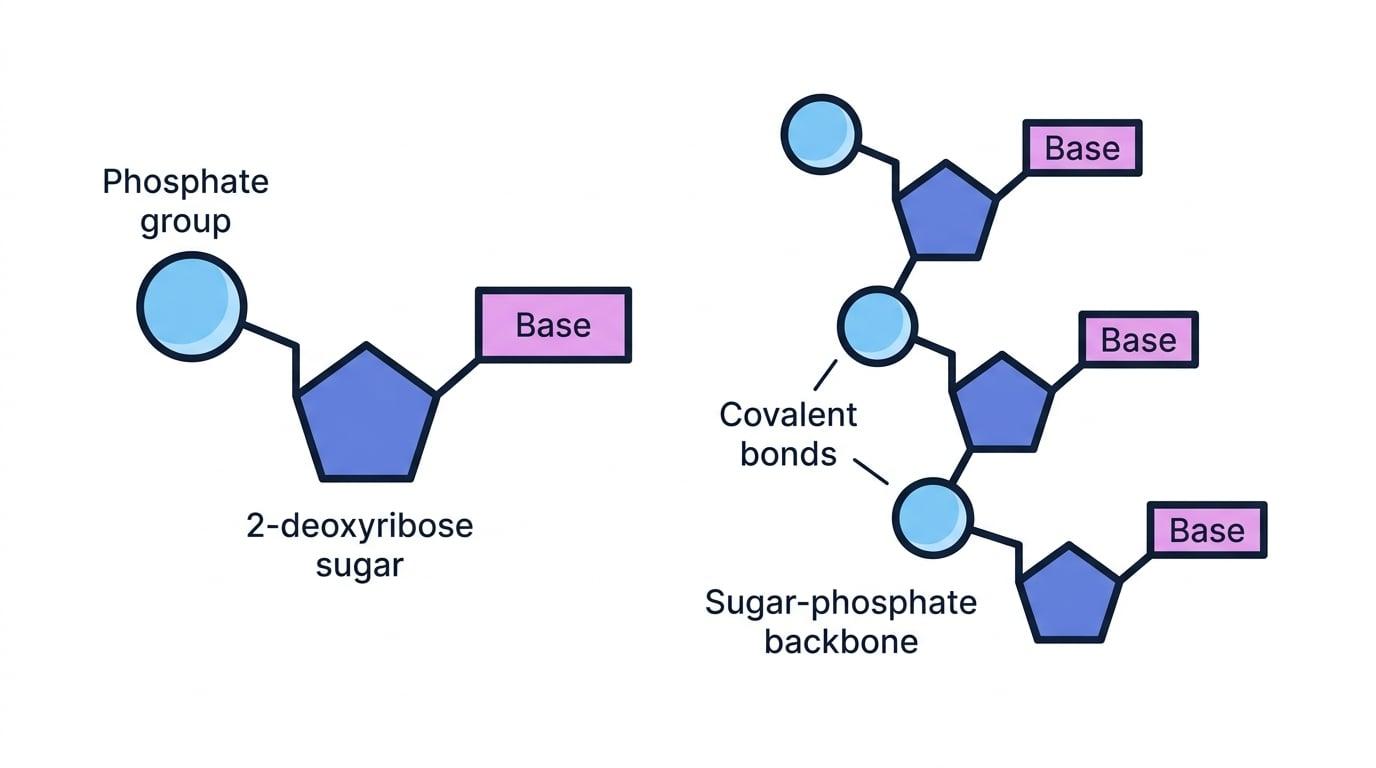
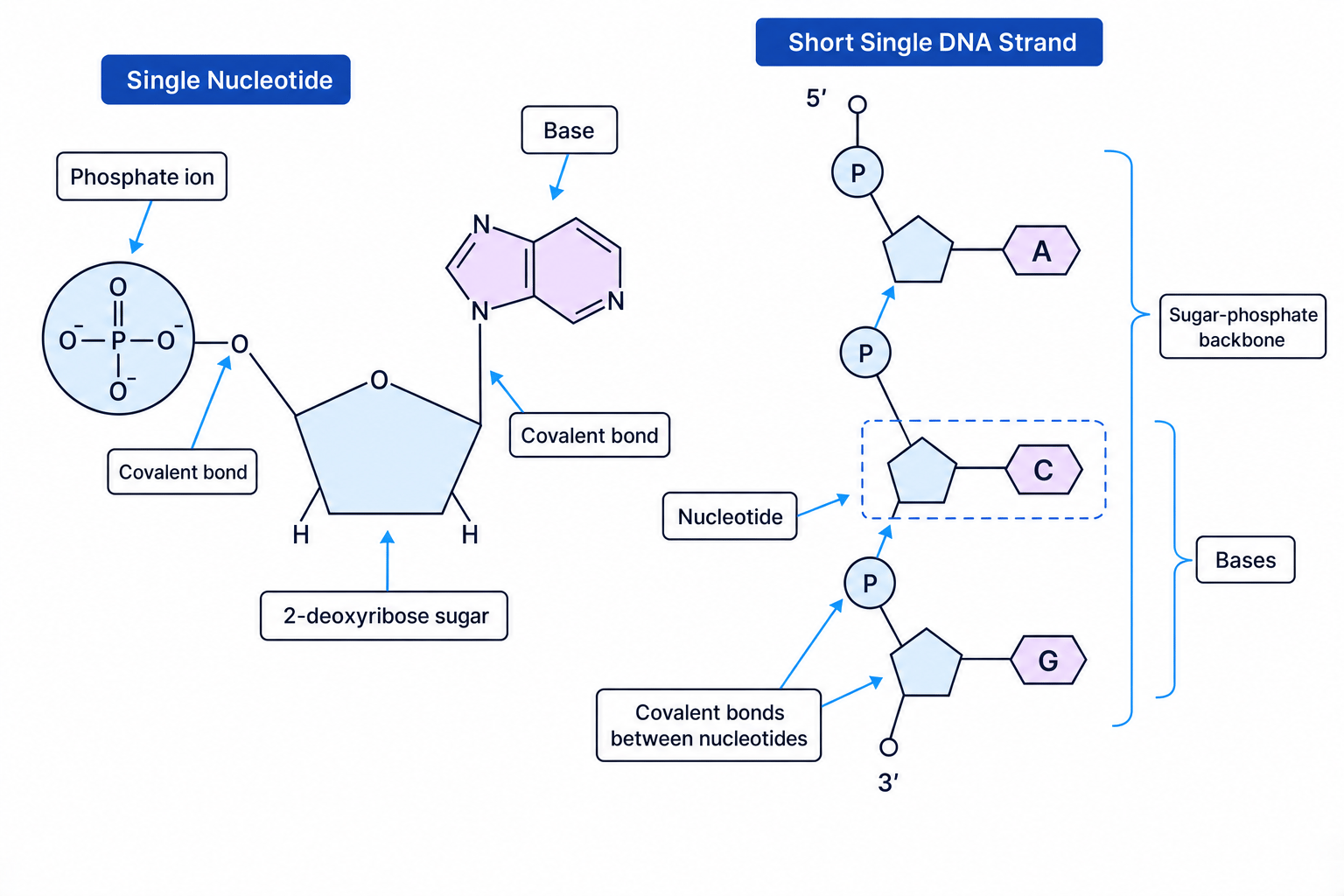
A nucleotide is made from a phosphate ion bonded to 2-deoxyribose, which is in turn bonded to one of the four bases: adenine, cytosine, guanine or thymine.
So every DNA nucleotide has the same basic phosphate-sugar framework. What changes is the base attached to the sugar.
A single DNA strand: the sugar-phosphate backbone
A single strand of DNA is a polymer of nucleotides. The nucleotides are linked by covalent bonds between the phosphate group of one nucleotide and the 2-deoxyribose sugar of another nucleotide.
This produces an alternating chain:
phosphate - sugar - phosphate - sugar - phosphate - sugar
The bases are attached to the sugar units, so they stick out from the chain rather than forming the chain itself.
Sugar-phosphate backbone
The sugar-phosphate backbone is the repeating chain of 2-deoxyribose and phosphate groups in a DNA strand, held together by covalent bonds.
You may also see the covalent links in the backbone called phosphodiester links. At A-level Chemistry, the key point is that these are covalent bonds joining nucleotides within one strand.
Do not put the bases in the backbone
The backbone is made from sugar and phosphate units. The bases are attached to the sugars and project from the backbone, where they can pair with bases on the other strand.
Two strands: complementary base pairing
DNA normally exists as two strands arranged together. The bases on one strand form pairs with bases on the other strand.
The pairing rules are:
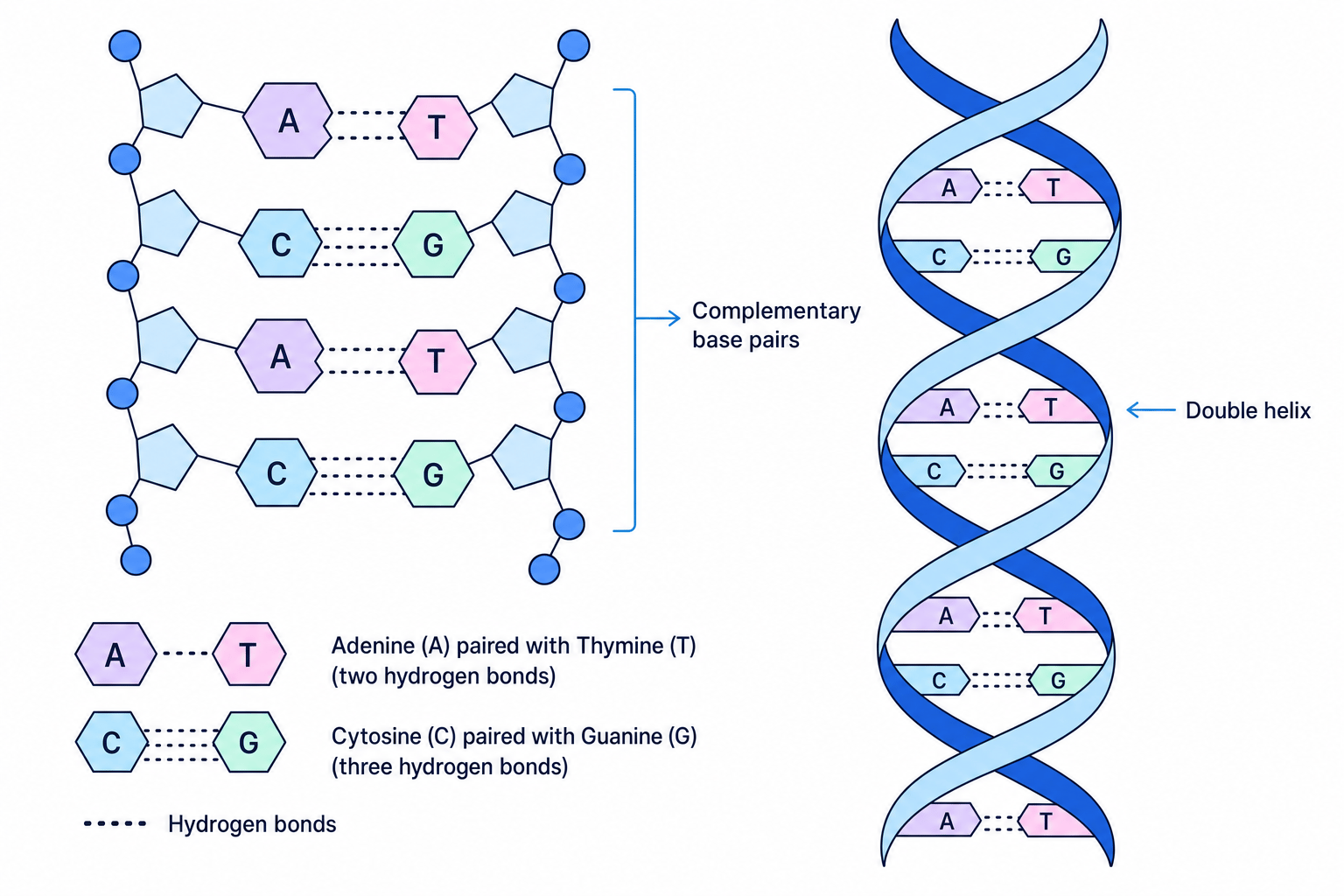
- adenine pairs with thymine
- cytosine pairs with guanine
These are called complementary base pairs because the base on one strand determines the matching base on the other strand.
Hydrogen bond
A hydrogen bond is an attraction between a hydrogen atom covalently bonded to a very electronegative atom, such as nitrogen or oxygen, and a lone pair of electrons on another electronegative atom.
In DNA:
- A and T form two hydrogen bonds between them.
- C and G form three hydrogen bonds between them.
The exact positions of atoms in the bases matter. A fits with T because their hydrogen-bonding positions match. C fits with G for the same reason. Other pairings do not line up correctly.
Finding a complementary DNA strand
A short DNA strand has the base sequence A C G T T A C. Give the complementary strand, written directly underneath from left to right.
- Apply the DNA base-pairing rules: A pairs with T, and C pairs with G.
- Convert each base in order: A becomes T, C becomes G, G becomes C, T becomes A, T becomes A, A becomes T, and C becomes G.
- The complementary sequence is therefore T G C A A T G.
The double helix
Double helix
A double helix is an arrangement where two strands twist around each other in a spiral shape.
In DNA, the sugar-phosphate backbones are on the outside of the helix, while the complementary base pairs are on the inside. You can picture it like a twisted ladder: the sugar-phosphate backbones are the sides, and the base pairs are the rungs.
The hydrogen bonds between base pairs are weaker than covalent bonds, but there are many of them along a DNA molecule. Together, they help stabilise the double helix.
Counting hydrogen bonds in base pairs
A short section of DNA contains the base pairs A-T, C-G, C-G, A-T and G-C. Work out the total number of hydrogen bonds between the two strands in this section.
- Classify the base pairs: there are two A-T pairs and three C-G pairs, remembering that G-C is the same pairing as C-G.
- Use the hydrogen bonding numbers: each A-T pair has two hydrogen bonds, so A-T contributes 2×2=42 \times 2 = 42×2=4 hydrogen bonds.
- Each C-G pair has three hydrogen bonds, so C-G contributes 3×3=93 \times 3 = 93×3=9 hydrogen bonds.
- Add the contributions: 4+9=134 + 9 = 134+9=13, so there are 13 hydrogen bonds in total.
A compact explanation
If asked how hydrogen bonding leads to complementary strands, say that A forms hydrogen bonds specifically with T, and C forms hydrogen bonds specifically with G. Therefore, the base sequence on one strand determines the base sequence on the other strand.
Covalent versus hydrogen bonding
Do not say hydrogen bonds join nucleotides within a strand. Covalent bonds join nucleotides in the sugar-phosphate backbone; hydrogen bonds act between complementary bases on different strands.
Pulling it together
DNA structure is built up in layers:
- A phosphate group, 2-deoxyribose and one base make a nucleotide.
- Nucleotides join by covalent bonds to make a sugar-phosphate backbone.
- Bases attached to the sugars pair by hydrogen bonding.
- Two complementary strands twist into a double helix.
In the exam
- Use the precise names: phosphate, 2-deoxyribose, base, nucleotide, sugar-phosphate backbone.
- Separate the bond types clearly: covalent bonds within a strand, hydrogen bonds between strands.
- For complementary sequences, work base by base using A with T and C with G, then check that every base has one partner.
Check yourself
- What three chemical parts make up one DNA nucleotide?
- Which bonds hold nucleotides together within a single DNA strand?
- If one DNA strand has the sequence T A C G G A, what complementary sequence would align with it?