Balanced equations and associated calculations
What you'll learn
- How to write full and ionic balanced equations.
- How the coefficients in a balanced equation give mole ratios.
- How to use balanced equations to calculate masses, gas volumes, concentrations and titres.
- How to calculate and interpret percentage yield and percentage atom economy.
The essential idea: reactions happen in mole ratios
A balanced equation is more than a “tidy” chemical sentence. It tells you the exact ratio in which particles react, and because particles are counted in moles, it becomes a calculation tool.
Amount of substance
The amount of substance, symbol nnn, is the number of moles of a substance. One mole contains Avogadro’s constant of particles.
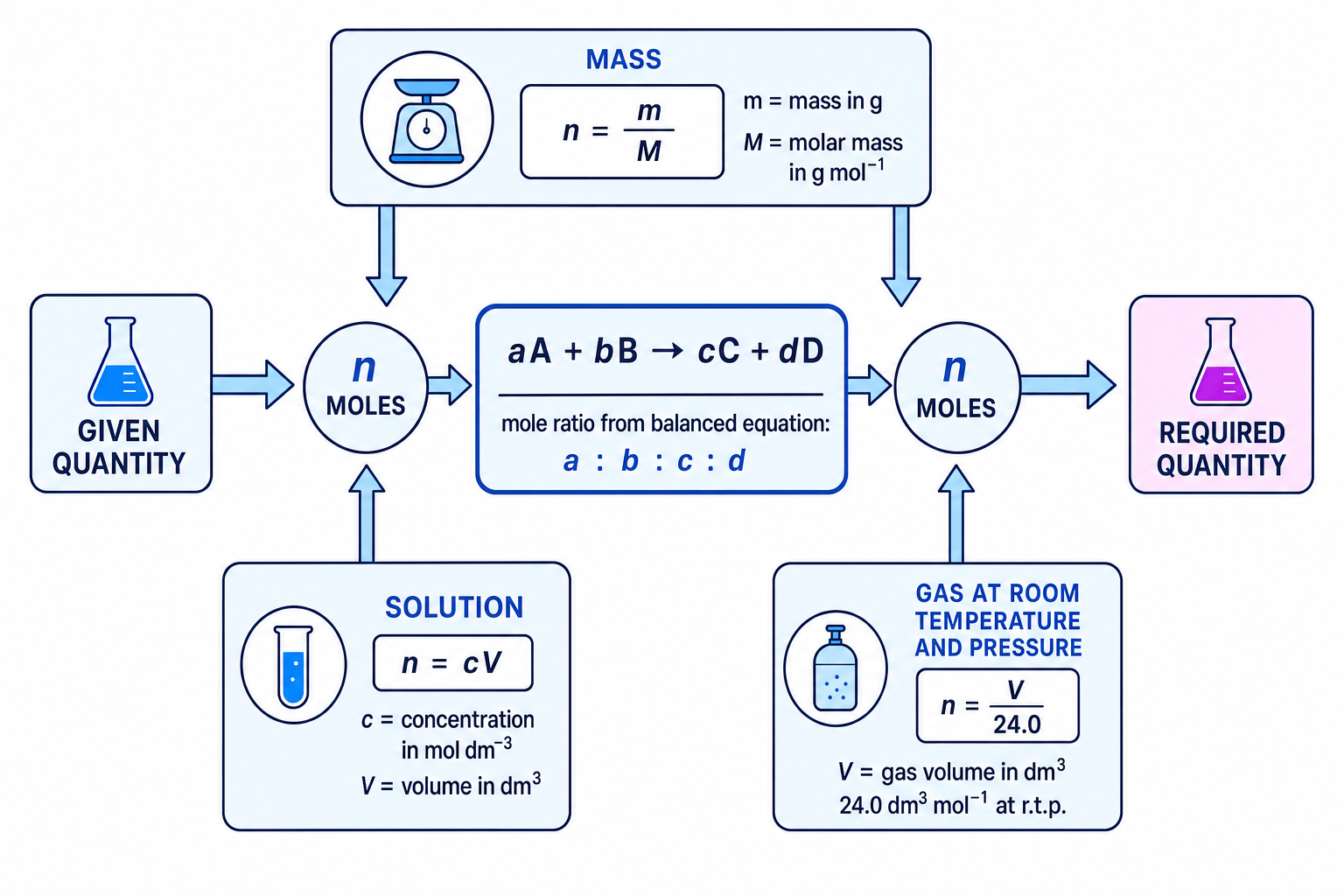
The main conversions you need are:
- From mass: n=mMn = \frac{m}{M}n=Mm, where mmm is mass in g and MMM is molar mass in g mol⁻¹.
- From solution concentration: n=cVn = cVn=cV, where ccc is concentration in mol dm⁻³ and VVV is volume in dm³.
- From gas volume at room temperature and pressure: n=V24.0n = \frac{V}{24.0}n=24.0V, where VVV is in dm³.
Volume units
For solution calculations, volumes must usually be in dm³, not cm³. Convert by dividing cm³ by 1000, so 25.0 cm³ becomes 0.0250 dm³.
The calculation route is usually: convert the given quantity to moles, use the balanced equation ratio, then convert to the quantity required.
Full balanced equations
A full equation shows the reactants and products using their chemical formulae. It may include state symbols: (s), (l), (g) and (aq).
Balanced equation
A balanced equation has the same number of atoms of each element on both sides. The numbers placed in front of formulae are called stoichiometric coefficients.
To balance equations, you may change coefficients, but you must not change the formula of a substance. For example, you can write 2H2O2\text{H}_2\text{O}2H2O, but you cannot change water into H2O2\text{H}_2\text{O}_2H2O2.
Balancing an unfamiliar equation
Balance: aluminium reacts with sulfuric acid to form aluminium sulfate and hydrogen.
-
Write the correct formulae first: Al+H2SO4→Al2(SO4)3+H2\text{Al} + \text{H}_2\text{SO}_4 \to \text{Al}_2(\text{SO}_4)_3 + \text{H}_2Al+H2SO4→Al2(SO4)3+H2.
-
Balance aluminium by placing 2 in front of Al: 2Al+H2SO4→Al2(SO4)3+H22\text{Al} + \text{H}_2\text{SO}_4 \to \text{Al}_2(\text{SO}_4)_3 + \text{H}_22Al+H2SO4→Al2(SO4)3+H2.
-
Treat sulfate, SO42−\text{SO}_4^{2-}SO42−, as a group because it stays together. There are 3 sulfate groups on the right, so place 3 in front of sulfuric acid: 2Al+3H2SO4→Al2(SO4)3+H22\text{Al} + 3\text{H}_2\text{SO}_4 \to \text{Al}_2(\text{SO}_4)_3 + \text{H}_22Al+3H2SO4→Al2(SO4)3+H2.
-
Balance hydrogen last. The left side now has 6 H atoms, so place 3 in front of hydrogen gas: 2Al+3H2SO4→Al2(SO4)3+3H22\text{Al} + 3\text{H}_2\text{SO}_4 \to \text{Al}_2(\text{SO}_4)_3 + 3\text{H}_22Al+3H2SO4→Al2(SO4)3+3H2.
Ionic equations
Some equations include ions that are present but do not actually change during the reaction.
Spectator ion
A spectator ion is an ion that appears unchanged on both sides of an ionic equation. It is cancelled out when writing the net ionic equation.
Ionic equation
An ionic equation shows only the species that actually react. It removes spectator ions from the full equation.
A good method is to split soluble ionic substances into ions, then cancel anything unchanged. Do not split solids, gases, liquids, or covalent molecules such as water.
Writing an ionic equation
Write the ionic equation for the reaction between silver nitrate solution and sodium chloride solution.
-
Start with the full equation: AgNO3(aq)+NaCl(aq)→AgCl(s)+NaNO3(aq)\text{AgNO}_3(\text{aq}) + \text{NaCl}(\text{aq}) \to \text{AgCl}(\text{s}) + \text{NaNO}_3(\text{aq})AgNO3(aq)+NaCl(aq)→AgCl(s)+NaNO3(aq).
-
Split the aqueous ionic substances into ions, but keep the precipitate as a solid: Ag+(aq)+NO3−(aq)+Na+(aq)+Cl−(aq)→AgCl(s)+Na+(aq)+NO3−(aq)\text{Ag}^+(\text{aq}) + \text{NO}_3^-(\text{aq}) + \text{Na}^+(\text{aq}) + \text{Cl}^-(\text{aq}) \to \text{AgCl}(\text{s}) + \text{Na}^+(\text{aq}) + \text{NO}_3^-(\text{aq})Ag+(aq)+NO3−(aq)+Na+(aq)+Cl−(aq)→AgCl(s)+Na+(aq)+NO3−(aq).
-
Cancel the spectator ions, Na+\text{Na}^+Na+ and NO3−\text{NO}_3^-NO3−, because they are unchanged: Ag+(aq)+Cl−(aq)→AgCl(s)\text{Ag}^+(\text{aq}) + \text{Cl}^-(\text{aq}) \to \text{AgCl}(\text{s})Ag+(aq)+Cl−(aq)→AgCl(s).
Cancelling the reacting ion
Do not cancel an ion if it changes state or becomes part of a product. In the example above, Ag+\text{Ag}^+Ag+ and Cl−\text{Cl}^-Cl− are not spectators because they form solid silver chloride.
Using mole ratios in calculations
The coefficients in a balanced equation give reacting ratios in moles. For example:
2Mg+O2→2MgO2\text{Mg} + \text{O}_2 \to 2\text{MgO}2Mg+O2→2MgOThis means 2 mol Mg reacts with 1 mol oxygen to form 2 mol MgO. So the mole ratio of Mg to MgO is 1:1.
The mole ratio is the bridge
Balanced equations do not compare masses directly. They compare amounts in moles. Always go through moles before using the ratio.
Calculating a mass from a mass
What mass of magnesium oxide forms when 1.20 g of magnesium burns completely in oxygen?
-
Use the balanced equation: 2Mg+O2→2MgO2\text{Mg} + \text{O}_2 \to 2\text{MgO}2Mg+O2→2MgO, so the ratio Mg:MgO is 1:1.
-
Convert magnesium mass to moles: n(Mg)=1.20 g24.3 g mol−1=0.0494 moln(\text{Mg}) = \frac{1.20\ \text{g}}{24.3\ \text{g mol}^{-1}} = 0.0494\ \text{mol}n(Mg)=24.3 g mol−11.20 g=0.0494 mol.
-
Use the 1:1 ratio, so n(MgO)=0.0494 moln(\text{MgO}) = 0.0494\ \text{mol}n(MgO)=0.0494 mol.
-
Convert moles of MgO to mass: m=nM=0.0494 mol×40.3 g mol−1=1.99 gm = nM = 0.0494\ \text{mol} \times 40.3\ \text{g mol}^{-1} = 1.99\ \text{g}m=nM=0.0494 mol×40.3 g mol−1=1.99 g.
Gas volume calculations
At room temperature and pressure, one mole of any gas occupies 24.0 dm³. This lets you move between moles and gas volume.
Calculating a gas volume
Calcium carbonate decomposes on heating: CaCO3→CaO+CO2\text{CaCO}_3 \to \text{CaO} + \text{CO}_2CaCO3→CaO+CO2. Calculate the volume of carbon dioxide formed at room temperature and pressure from 5.00 g of calcium carbonate.
-
Convert calcium carbonate to moles: n(CaCO3)=5.00 g100.1 g mol−1=0.04995 moln(\text{CaCO}_3) = \frac{5.00\ \text{g}}{100.1\ \text{g mol}^{-1}} = 0.04995\ \text{mol}n(CaCO3)=100.1 g mol−15.00 g=0.04995 mol.
-
Use the balanced equation. The ratio CaCO3:CO2\text{CaCO}_3:\text{CO}_2CaCO3:CO2 is 1:1, so n(CO2)=0.04995 moln(\text{CO}_2) = 0.04995\ \text{mol}n(CO2)=0.04995 mol.
-
Convert moles to gas volume: V=n×24.0=0.04995×24.0=1.20 dm3V = n \times 24.0 = 0.04995 \times 24.0 = 1.20\ \text{dm}^3V=n×24.0=0.04995×24.0=1.20 dm3.
Gas conditions
The 24.0 dm³ mol⁻¹ shortcut applies at room temperature and pressure. If different temperature and pressure data are given, use the ideal gas equation from the gas calculations section.
Solutions, concentrations and titrations
For solutions, concentration tells you how much solute is dissolved per dm³ of solution.
Concentration
Concentration, symbol ccc, is amount of substance per unit volume of solution. At A-Level it is usually measured in mol dm⁻³.
The key formula is:
n=cVn = cVn=cVwhere VVV must be in dm³.
Required practical 1: volumetric solutions and acid–base titration
In this required practical, you need to be able to make up a volumetric solution and carry out a simple acid–base titration.
Required practical 1
A volumetric flask is used to make an accurate known volume of solution. A titration uses a measured volume of one solution to find the concentration of another by reacting them in a known mole ratio.
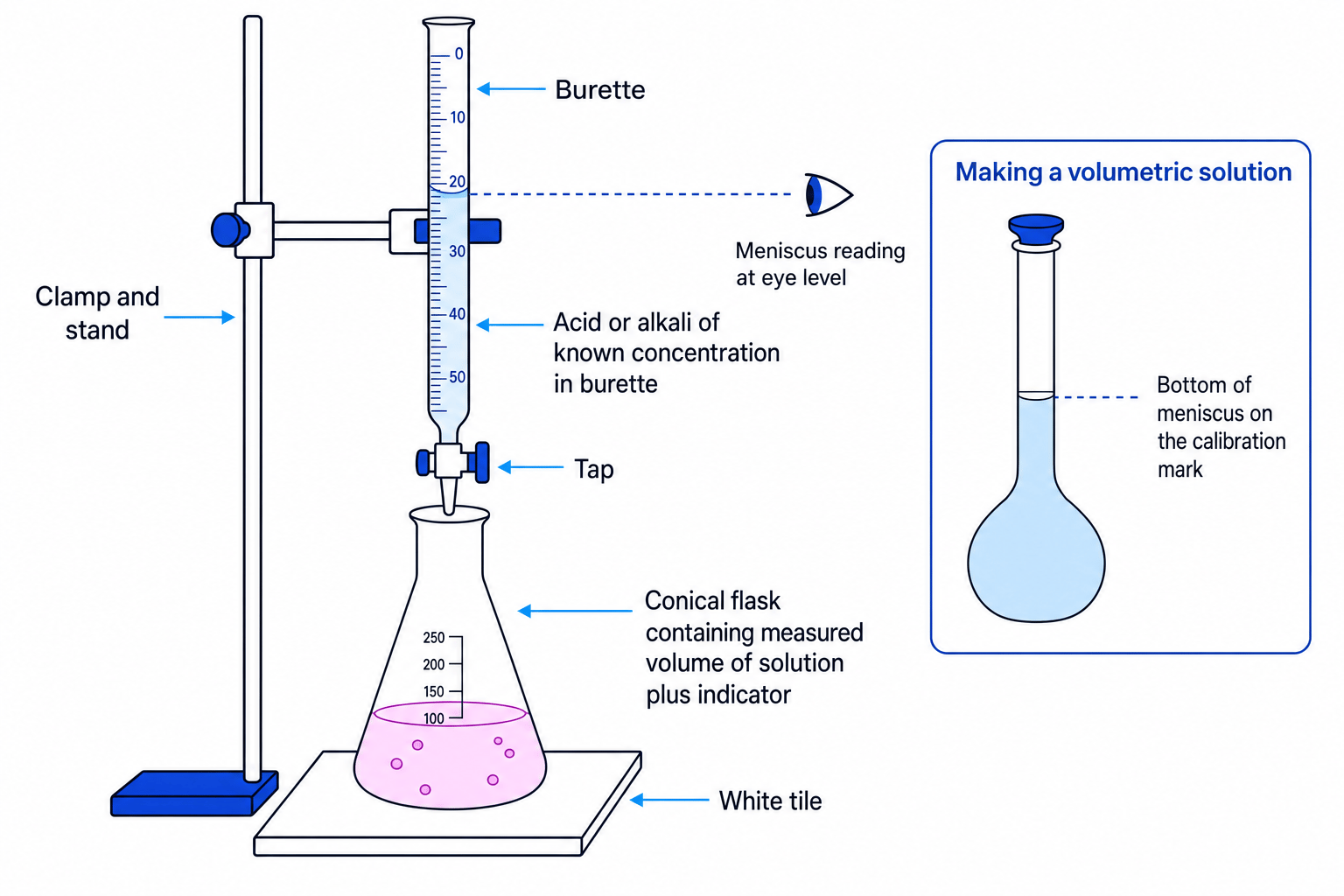
To make a volumetric solution: weigh the solid accurately, dissolve it in deionised water, transfer it to a volumetric flask with rinsings, make up to the calibration mark, stopper and invert to mix.
To titrate: use a pipette to place a known volume in the conical flask, add indicator, fill the burette with the other solution, run a rough titre, then repeat carefully until you obtain concordant titres.
Using a titration to find concentration
25.0 cm³ of sodium hydroxide solution is neutralised by 23.60 cm³ of 0.100 mol dm⁻³ hydrochloric acid. Calculate the concentration of the sodium hydroxide.
-
Write the balanced equation: HCl+NaOH→NaCl+H2O\text{HCl} + \text{NaOH} \to \text{NaCl} + \text{H}_2\text{O}HCl+NaOH→NaCl+H2O, so the ratio HCl:NaOH is 1:1.
-
Convert the acid volume to dm³ and calculate moles of HCl: n(HCl)=0.100 mol dm−3×0.02360 dm3=2.36×10⁻³ moln(\text{HCl}) = 0.100\ \text{mol dm}^{-3} \times 0.02360\ \text{dm}^3 = 2.36 \times 10^{-3}\ \text{mol}n(HCl)=0.100 mol dm−3×0.02360 dm3=2.36×10⁻³ mol.
-
Use the 1:1 ratio, so n(NaOH)=2.36×10⁻³ moln(\text{NaOH}) = 2.36 \times 10^{-3}\ \text{mol}n(NaOH)=2.36×10⁻³ mol.
-
Convert the alkali volume to dm³ and calculate concentration: c(NaOH)=2.36×10⁻³ mol0.0250 dm3=0.0944 mol dm−3c(\text{NaOH}) = \frac{2.36 \times 10^{-3}\ \text{mol}}{0.0250\ \text{dm}^3} = 0.0944\ \text{mol dm}^{-3}c(NaOH)=0.0250 dm32.36×10−3 mol=0.0944 mol dm−3.
Choosing titres
Use concordant titres to calculate the mean, and ignore clear outliers. If a titre is found from two burette readings, the uncertainty in the titre includes uncertainty from both readings.
Percentage yield
In real reactions, you often make less product than the balanced equation predicts.
Percentage yield
Percentage yield compares the actual mass of product obtained with the theoretical maximum mass predicted by the balanced equation: percentage yield=actual yieldtheoretical yield×100\text{percentage yield} = \frac{\text{actual yield}}{\text{theoretical yield}} \times 100percentage yield=theoretical yieldactual yield×100.
Yields can be below 100% because reactions may be incomplete, side reactions may occur, product may be lost during transfer or purification, or an equilibrium may limit conversion.
Calculating percentage yield
A reaction is predicted to make 1.99 g of MgO, but only 1.82 g is collected. Calculate the percentage yield.
-
Identify the theoretical yield as 1.99 g and the actual yield as 1.82 g.
-
Substitute into the percentage yield formula: percentage yield=1.821.99×100\text{percentage yield} = \frac{1.82}{1.99} \times 100percentage yield=1.991.82×100.
-
Calculate the value: percentage yield=91.5%\text{percentage yield} = 91.5\%percentage yield=91.5%.
Percentage atom economy
Yield tells you how much product you actually made. Atom economy tells you how efficiently a reaction design puts atoms from reactants into the desired product.
Atom economy
Percentage atom economy is molecular mass of desired productsum of molecular masses of all reactants×100\frac{\text{molecular mass of desired product}}{\text{sum of molecular masses of all reactants}} \times 100sum of molecular masses of all reactantsmolecular mass of desired product×100. If the balanced equation contains coefficients, multiply each molecular mass by its coefficient.
A high atom economy is valuable because more reactant atoms become useful product, so there is less waste.
Calculating atom economy
Glucose can ferment to form ethanol and carbon dioxide: C6H12O6→2C2H5OH+2CO2\text{C}_6\text{H}_{12}\text{O}_6 \to 2\text{C}_2\text{H}_5\text{OH} + 2\text{CO}_2C6H12O6→2C2H5OH+2CO2. Calculate the atom economy for ethanol.
-
Calculate the total molar mass of the desired product in the balanced equation: 2×46.0=92.0 g mol−12 \times 46.0 = 92.0\ \text{g mol}^{-1}2×46.0=92.0 g mol−1.
-
Calculate the total molar mass of the reactants: glucose has M=180.0 g mol−1M = 180.0\ \text{g mol}^{-1}M=180.0 g mol−1.
-
Substitute into the formula: atom economy=92.0180.0×100=51.1%\text{atom economy} = \frac{92.0}{180.0} \times 100 = 51.1\%atom economy=180.092.0×100=51.1%.
Why industry cares
Processes with high atom economy often have economic, environmental and ethical advantages: less raw material wasted, lower separation and disposal costs, reduced pollution, better use of finite resources, and less harm to society and ecosystems.
Yield versus atom economy
A reaction can have high atom economy but low percentage yield, or low atom economy but high percentage yield. Yield depends on what actually happens in the experiment; atom economy depends on the balanced equation.
In the exam
- Balance the equation first, then use the coefficients as mole ratios.
- Convert the given quantity into moles before comparing substances.
- Keep volumes for solution calculations in dm³, not cm³.
- For titrations, use only concordant titres when calculating the mean titre.
- For atom economy, include coefficients and focus only on the desired product.
Check yourself
- Can you write the ionic equation for a precipitation reaction by removing spectator ions?
- Can you calculate a product mass from a given reactant mass using a balanced equation?
- Can you explain why a high atom economy is useful to industry and society?