What you'll learn
- Why benzene is a planar molecule with all six C–C bonds the same length.
- How delocalised p electrons make benzene more stable than the theoretical molecule cyclohexa-1,3,5-triene.
- How enthalpies of hydrogenation provide thermochemical evidence for benzene’s extra stability.
- Why benzene tends to undergo substitution rather than addition reactions.
The starting point: what benzene is
Benzene has the molecular formula C₆H₆. It is the key example of an aromatic compound: in A-Level Chemistry, this means a benzene-like ring with a particularly stable system of delocalised electrons.
Benzene
Benzene is a planar cyclic hydrocarbon with six carbon atoms and six hydrogen atoms, where the six carbon atoms form a ring and the pi electrons are delocalised around the whole ring.
Older drawings often show benzene as a hexagon with alternating single and double bonds. That drawing is called a Kekulé structure. It is useful as a shorthand, but it does not show the true bonding in benzene.
The sigma framework: the flat ring
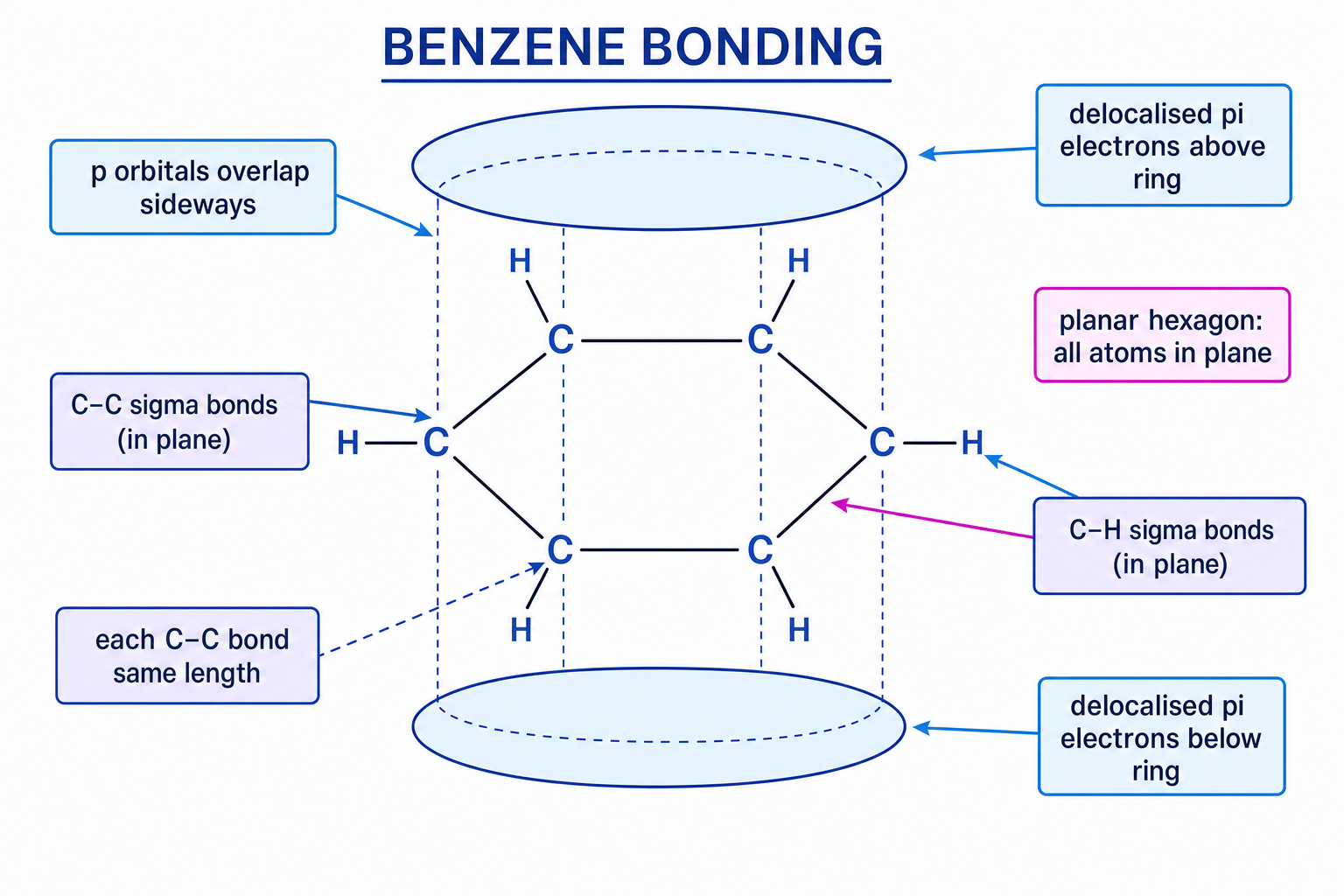
Benzene is planar, meaning the ring is flat and the atoms in the ring lie in one plane. Each carbon atom is bonded to:
- two neighbouring carbon atoms
- one hydrogen atom
These are all sigma bonds.
Sigma and pi bonds
A sigma bond is a covalent bond formed by overlap directly along the line between two nuclei. A pi bond is formed by sideways overlap of p orbitals, giving electron density above and below the plane of the atoms.
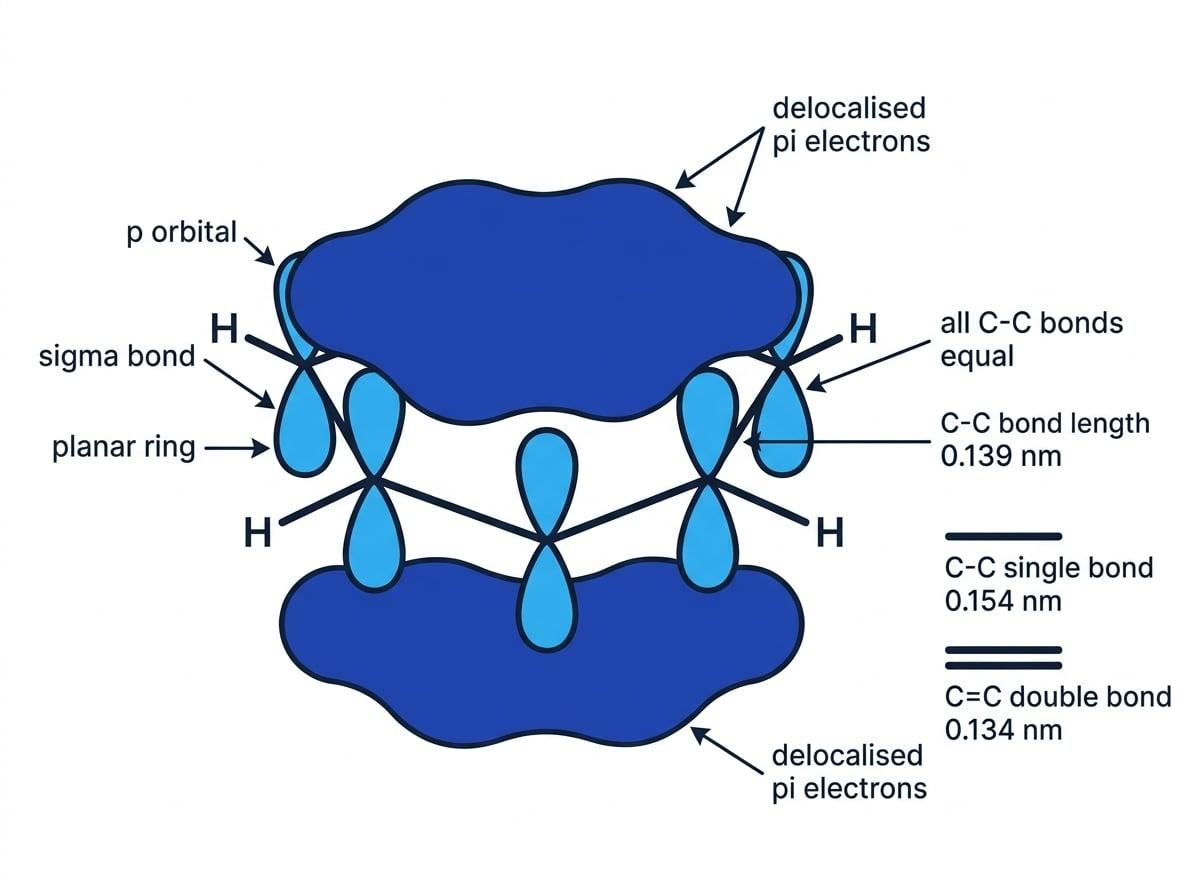
A p orbital is a dumbbell-shaped region around an atom where electrons may be found. In benzene, each carbon atom has one p orbital sticking out perpendicular to the plane of the ring. These p orbitals overlap sideways all the way around the ring.
Delocalised p electrons
The six p orbitals in benzene overlap to form one continuous pi electron system. The electrons are not fixed between particular pairs of carbon atoms.
Delocalised electrons
Delocalised electrons are electrons that are spread over several atoms rather than being confined to one atom or one bond.
This means benzene does not contain three separate C=C double bonds. Instead, all six C–C bonds are identical.
A normal C–C single bond is about 0.154 nm. A normal C=C double bond is about 0.134 nm. In benzene, every C–C bond is about 0.139 nm, which is intermediate between a single and a double bond.
Benzene bond lengths
All six C–C bonds in benzene are the same length because the pi electrons are delocalised around the whole ring. Benzene is not cyclohexa-1,3,5-triene with alternating single and double bonds.
Using bond length evidence
A molecule with formula C₆H₆ has six C–C bond lengths, all measured as 0.139 nm. Explain why this supports the delocalised model of benzene rather than the Kekulé model.
-
Compare the measured value with typical bond lengths: 0.139 nm is shorter than a C–C single bond, about 0.154 nm, but longer than a C=C double bond, about 0.134 nm.
-
If benzene really had alternating single and double bonds, you would expect two different C–C bond lengths: three longer single bonds and three shorter double bonds.
-
Since all six C–C bonds are identical and intermediate in length, the bonding must be the same around the whole ring. This supports a delocalised pi system rather than three localised C=C bonds.
Bonds are not rapidly switching
Do not say that benzene’s double bonds “move around” or “switch positions”. The real structure has delocalised pi electrons spread around the ring at the same time.
Why delocalisation makes benzene more stable
Delocalisation lowers the energy of benzene. In chemistry, “more stable” usually means lower in energy.
The evidence for this comes from thermochemical evidence, meaning evidence based on measured enthalpy changes in reactions.
Enthalpy of hydrogenation
The enthalpy of hydrogenation is the enthalpy change when one mole of an unsaturated compound reacts with hydrogen to form a more saturated compound.
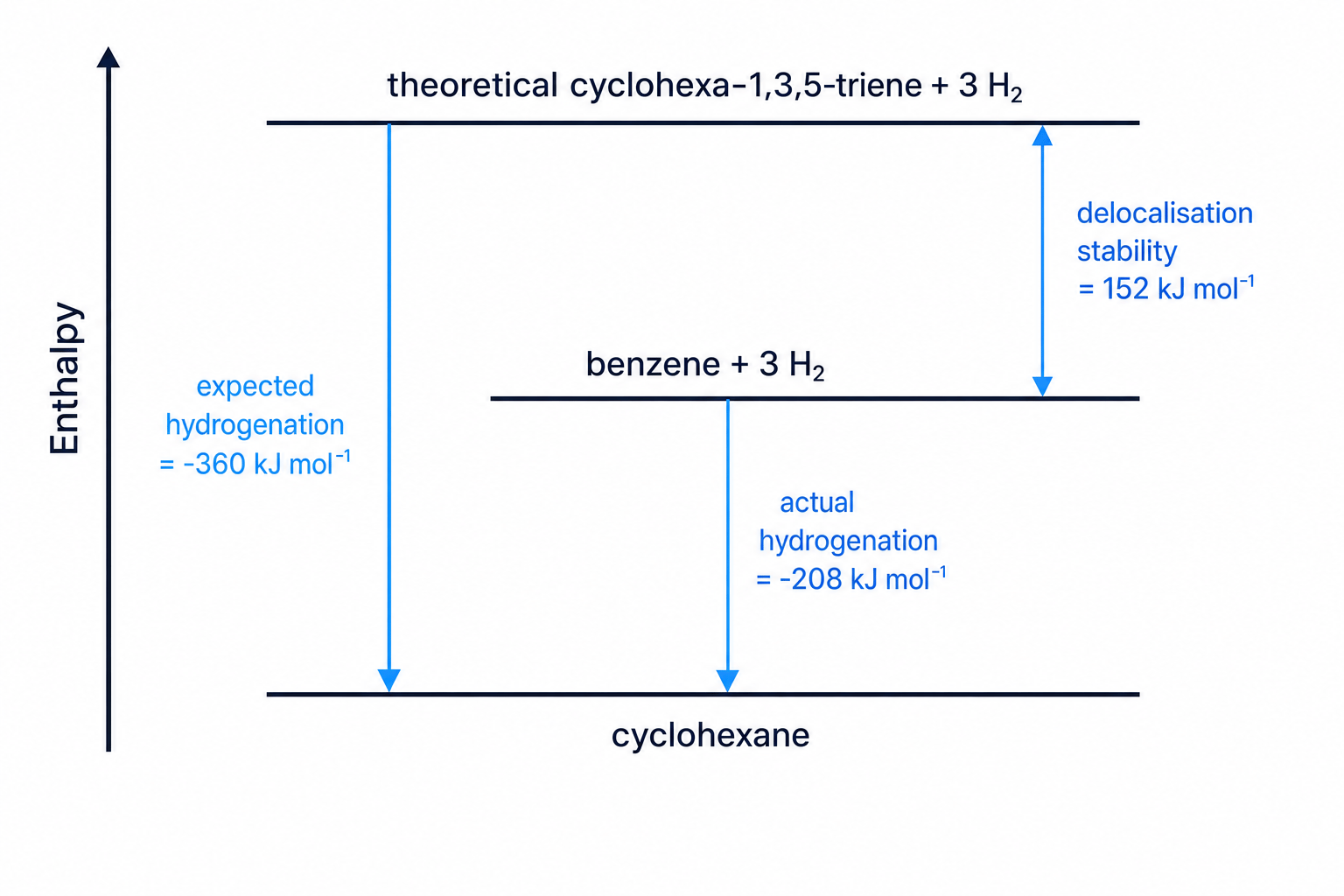
Hydrogenation is normally exothermic, so its enthalpy change is negative. For example, hydrogenating one C=C bond in cyclohexene releases about 120 kJ mol⁻¹:
ΔH=−120 kJ mol−1\Delta H = -120\ \text{kJ mol}^{-1}ΔH=−120 kJ mol−1If benzene behaved like the theoretical molecule cyclohexa-1,3,5-triene, with three separate C=C bonds, you would expect:
ΔHexpected=3×(−120 kJ mol−1)=−360 kJ mol−1\Delta H_{\text{expected}} = 3 \times (-120\ \text{kJ mol}^{-1}) = -360\ \text{kJ mol}^{-1}ΔHexpected=3×(−120 kJ mol−1)=−360 kJ mol−1But the actual enthalpy of hydrogenation of benzene is only about:
ΔHactual=−208 kJ mol−1\Delta H_{\text{actual}} = -208\ \text{kJ mol}^{-1}ΔHactual=−208 kJ mol−1So benzene releases 152 kJ mol⁻¹ less energy than expected. Because both reactions end at the same product, cyclohexane, benzene must have started at a lower energy than the theoretical triene.
Calculating benzene’s delocalisation stability
Use the enthalpy of hydrogenation of cyclohexene, −120 kJ mol−1-120\ \text{kJ mol}^{-1}−120 kJ mol−1, and the actual enthalpy of hydrogenation of benzene, −208 kJ mol−1-208\ \text{kJ mol}^{-1}−208 kJ mol−1, to calculate the extra stability of benzene.
-
Treat the theoretical cyclohexa-1,3,5-triene as having three separate C=C bonds, so the expected enthalpy of hydrogenation is:
ΔHexpected=3×(−120 kJ mol−1)=−360 kJ mol−1\Delta H_{\text{expected}} = 3 \times (-120\ \text{kJ mol}^{-1}) = -360\ \text{kJ mol}^{-1}ΔHexpected=3×(−120 kJ mol−1)=−360 kJ mol−1 -
Compare the actual value with the expected value:
(−208)−(−360)=+152 kJ mol−1(-208) - (-360) = +152\ \text{kJ mol}^{-1}(−208)−(−360)=+152 kJ mol−1 -
The actual hydrogenation is 152 kJ mol⁻¹ less exothermic than expected. Since the product is the same, benzene is 152 kJ mol⁻¹ more stable than the theoretical cyclohexa-1,3,5-triene.
Getting the sign backwards
The key point is not that benzene is “less stable because it releases less energy”. It releases less energy because it is already lower in energy before hydrogenation.
Why benzene prefers substitution to addition
Benzene has a region of electron density above and below the ring, so it can attract electrophiles. An electrophile is an electron-pair acceptor.
However, benzene usually reacts by substitution, not addition.
Addition and substitution
An addition reaction adds atoms across a multiple bond, with no atoms lost from the original molecule. A substitution reaction replaces one atom or group in a molecule with another atom or group.
In an addition reaction, benzene would lose part of its delocalised pi system. That destroys the aromatic stability.
In a substitution reaction, one hydrogen atom on the ring is replaced by another atom or group. The delocalised pi system is restored, so the stable benzene ring is retained.
Substitution preserves aromatic stability
Benzene undergoes substitution in preference to addition because substitution allows the delocalised pi system to be restored, whereas addition would permanently disrupt it.
Comparing benzene and cyclohexene reactions
Cyclohexene readily undergoes addition with bromine, but benzene reacts with bromine by substitution in the presence of a halogen carrier such as FeBr₃. Explain the difference.
-
Cyclohexene contains a localised C=C bond. Adding bromine across that double bond breaks the pi bond, but there is no large aromatic stabilisation energy to lose.
-
Benzene has delocalised pi electrons spread around the whole ring. Addition to benzene would disrupt this delocalisation and remove the extra stability.
-
In substitution, a hydrogen atom is replaced by bromine and the delocalised pi system is restored. This keeps the aromatic ring stable, so substitution is preferred.
Benzene can react by addition under harsh conditions
Benzene is not completely unable to undergo addition. For example, it can be hydrogenated to cyclohexane under suitable conditions, but addition is much less favourable than for ordinary alkenes because aromatic stability is lost.
How to word this in answers
A strong exam answer links structure, evidence, and reactivity:
- Benzene is planar.
- Each carbon has a p orbital overlapping sideways with neighbouring p orbitals.
- Six pi electrons are delocalised above and below the ring.
- All C–C bonds are equal and intermediate between single and double.
- Delocalisation makes benzene more stable than cyclohexa-1,3,5-triene.
- Substitution is preferred because it preserves the delocalised ring.
Use the evidence chain
For benzene bonding questions, try to move from p-orbital overlap to delocalised pi electrons, then to equal bond lengths, extra stability, and finally substitution rather than addition.
In the exam
-
For bond length questions, say that all C–C bonds are the same length and intermediate between single and double, showing that the pi electrons are delocalised.
-
For hydrogenation questions, calculate the expected value from three C=C bonds, compare it with the actual value, then state that benzene is more stable by the difference.
-
For reactivity questions, explain that addition would destroy the delocalised pi system, while substitution allows the aromatic stability to be restored.
Check yourself
- Why are all six C–C bonds in benzene the same length?
- How does enthalpy of hydrogenation evidence show that benzene is more stable than cyclohexa-1,3,5-triene?
- Why does benzene prefer substitution reactions to addition reactions?