

Welcome to the A-Level only side of electrochemistry! In this topic, we take what you already know about redox reactions and apply it to generating electricity.
What you'll learn:
- How to set up an electrochemical cell and why a salt bridge is essential.
- How we use the Standard Hydrogen Electrode (SHE) to measure standard electrode potentials (E⊖E^\ominusE⊖).
- How to write the shorthand "conventional representation" of a cell.
- How to calculate cell EMF and use the electrochemical series to predict the direction of redox reactions.
Electrochemical cells: The basics
If you put a piece of zinc metal into a solution of copper(II) sulfate, a redox reaction happens directly on the surface of the zinc. Zinc is oxidised, copper is reduced, and chemical energy is released as heat.
But if we separate the zinc and the copper into two different beakers and connect them with a wire, the electrons are forced to travel through the wire to get from the zinc to the copper. We have just created an electrical current. This setup is called an electrochemical cell.
To build one, you need two half-cells. A simple half-cell consists of a metal electrode dipped into a solution of its own aqueous ions (e.g., a strip of zinc in aqueous Zn2+\text{Zn}^{2+}Zn2+). When you connect two different half-cells with a wire and a voltmeter, electrons flow from the more reactive metal (which wants to give away electrons) to the less reactive metal.
However, a wire isn't enough. As electrons move from left to right, the left beaker becomes full of positive ions and the right beaker becomes full of negative ions. The reaction would stop instantly due to this charge buildup. To complete the circuit, we use a salt bridge.
Salt bridge
A piece of filter paper soaked in an unreactive aqueous ioninc compound (usually potassium nitrate, KNO3\text{KNO}_3KNO3). It connects the two solutions, allowing ions to flow between the half-cells to balance the charges.
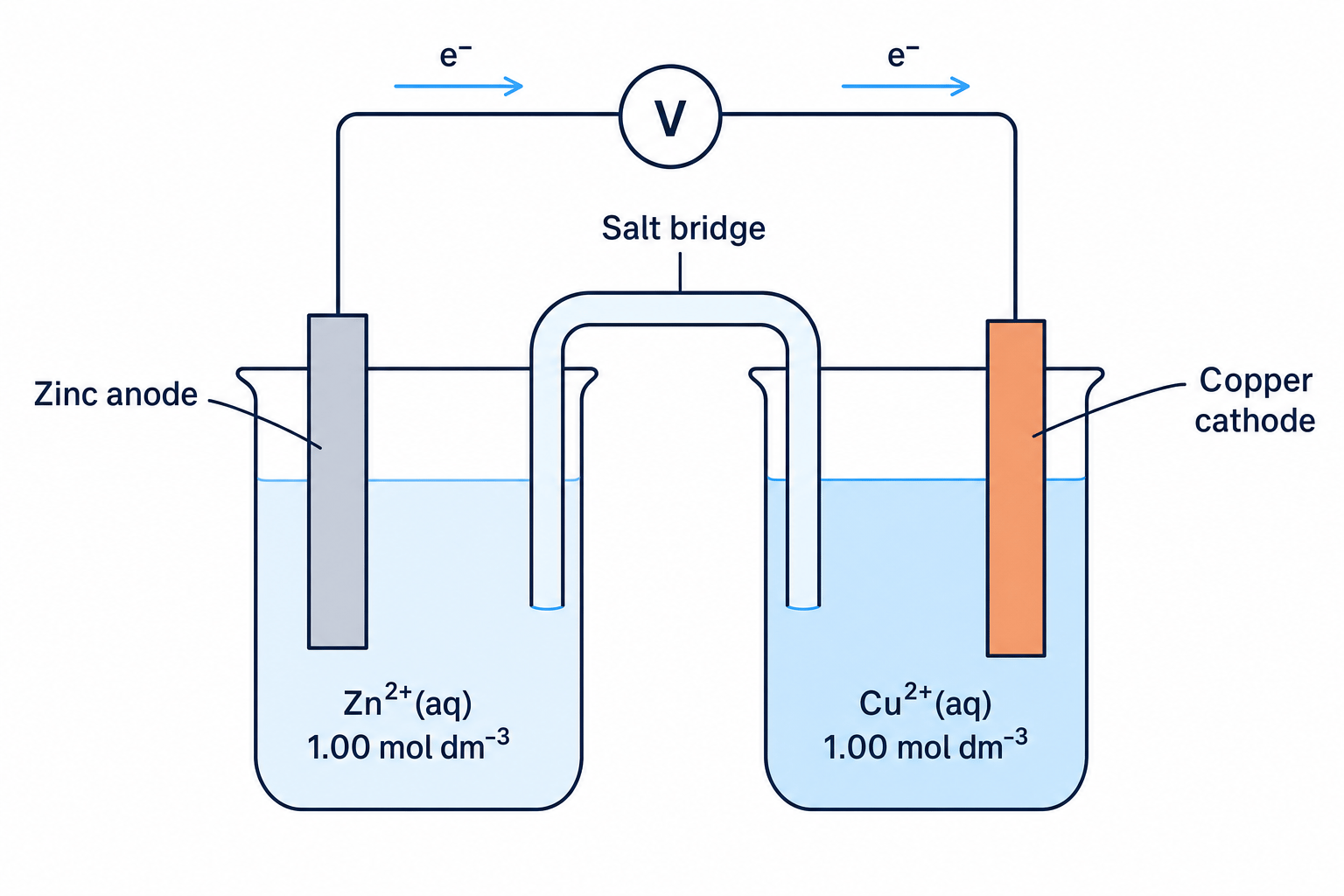
Choosing the wrong salt bridge
Never use a salt bridge that will react with the ions in your half-cells! For example, if one of your half-cells contains silver ions (Ag+\text{Ag}^+Ag+), using potassium chloride (KCl\text{KCl}KCl) for the salt bridge will cause a solid precipitate of silver chloride (AgCl\text{AgCl}AgCl) to form, ruining the cell.
The Standard Hydrogen Electrode (SHE)
A voltmeter measures the difference in electrical potential between two half-cells (the electromotive force, or EMF). You cannot measure the absolute potential of a single half-cell in isolation.
To give every half-cell a value, chemists agreed to pick one specific half-cell, assign it a value of exactly 0.00 V0.00 \text{ V}0.00 V, and measure everything else against it. This reference point is the Standard Hydrogen Electrode (SHE).
Standard conditions
Electrode potentials are very sensitive to temperature, pressure, and concentration. To make fair comparisons, the standard electrode potential (E⊖E^\ominusE⊖) is always measured under standard conditions:
- A temperature of 298 K.
- A pressure of 100 kPa (for any gases).
- A concentration of 1.00 mol dm−31.00 \text{ mol dm}^{-3}1.00 mol dm−3 for all aqueous ions.
The SHE consists of hydrogen gas bubbling over a platinum electrode in a solution of aqueous H+\text{H}^+H+ ions (like hydrochloric acid).
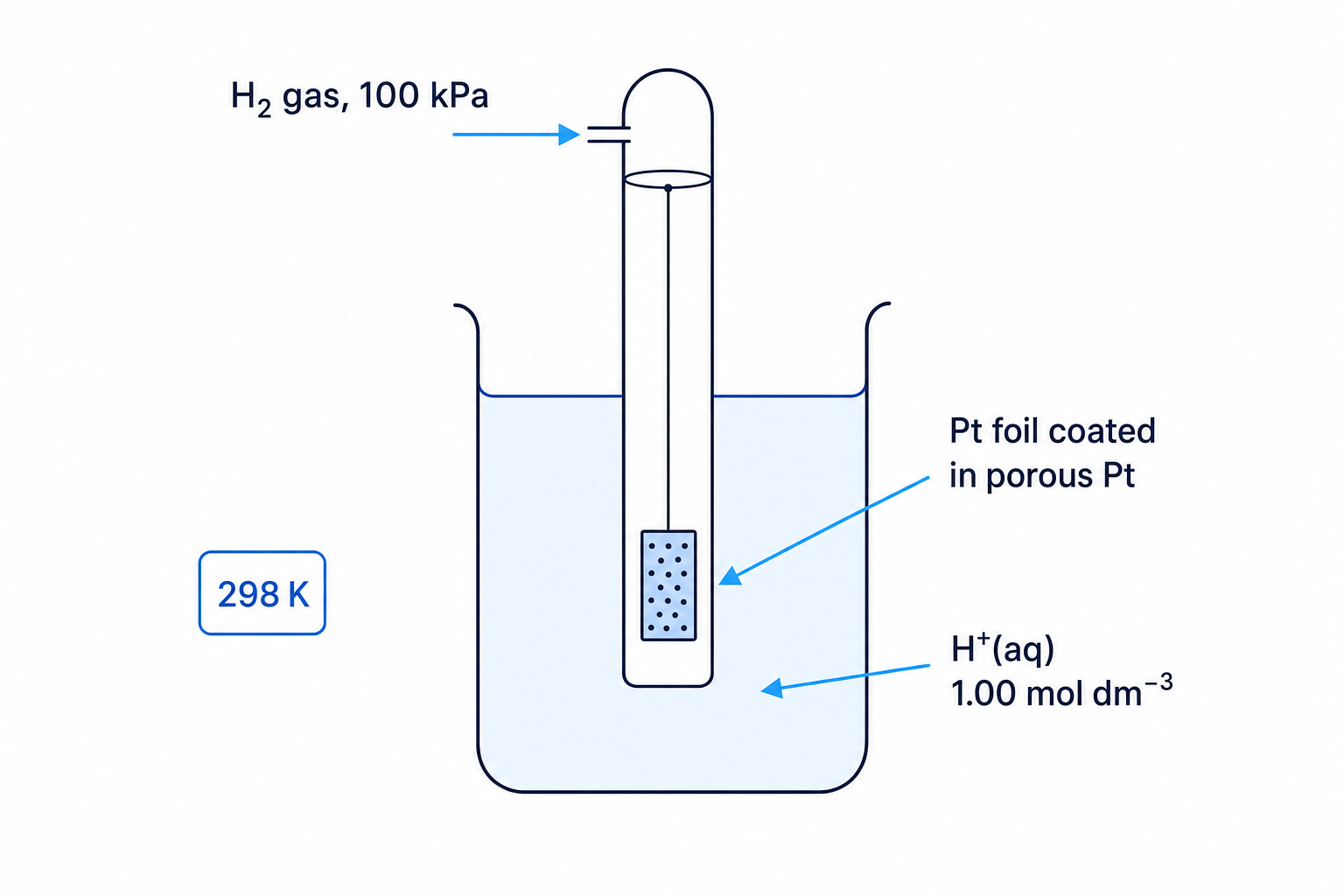
Because hydrogen is a gas and H+\text{H}^+H+ is aqueous, there is no solid metal to conduct the electricity. We use a platinum electrode because it is inert (unreactive) and conducts electricity well. The platinum is usually coated in fine, porous platinum black to increase the surface area for the gas to interact with the ions.
Standard electrode potentials (E⊖E^\ominusE⊖) and the IUPAC convention
When you connect any half-cell to the Standard Hydrogen Electrode under standard conditions, the reading on the voltmeter is the standard electrode potential (E⊖E^\ominusE⊖) for that half-cell.
By IUPAC convention, we always write half-equations for electrode reactions as reductions (electrons on the left):
Zn2+(aq)+2e−⇌Zn(s)E⊖=−0.76 V \text{Zn}^{2+}(\text{aq}) + 2\text{e}^- \rightleftharpoons \text{Zn}(\text{s}) \quad E^\ominus = -0.76 \text{ V} Zn2+(aq)+2e−⇌Zn(s)E⊖=−0.76 V Cu2+(aq)+2e−⇌Cu(s)E⊖=+0.34 V \text{Cu}^{2+}(\text{aq}) + 2\text{e}^- \rightleftharpoons \text{Cu}(\text{s}) \quad E^\ominus = +0.34 \text{ V} Cu2+(aq)+2e−⇌Cu(s)E⊖=+0.34 VThese values form the electrochemical series.
- A highly positive E⊖E^\ominusE⊖ means the substance strongly wants to gain electrons (it is a strong oxidising agent and easily reduced).
- A highly negative E⊖E^\ominusE⊖ means the substance strongly wants to lose electrons (it is a strong reducing agent and easily oxidised).
Calculating the EMF of a cell
When you connect two half-cells together, the one with the more positive E⊖E^\ominusE⊖ value will undergo reduction (go forwards), forcing the one with the more negative E⊖E^\ominusE⊖ value to undergo oxidation (go backwards).
To calculate the total voltage (EMF) of the newly formed cell, use this formula:
Ecell⊖=Eright⊖−Eleft⊖ E^\ominus_{\text{cell}} = E^\ominus_{\text{right}} - E^\ominus_{\text{left}} Ecell⊖=Eright⊖−Eleft⊖By convention, we put the more positive half-cell on the right, and the more negative half-cell on the left.
Calculating standard cell EMF
Calculate the EMF of an electrochemical cell made by connecting a magnesium half-cell to a silver half-cell under standard conditions.
Given: Mg2+(aq)+2e−⇌Mg(s)E⊖=−2.37 V\text{Mg}^{2+}(\text{aq}) + 2\text{e}^- \rightleftharpoons \text{Mg}(\text{s}) \quad E^\ominus = -2.37 \text{ V}Mg2+(aq)+2e−⇌Mg(s)E⊖=−2.37 V Ag+(aq)+e−⇌Ag(s)E⊖=+0.80 V\text{Ag}^{+}(\text{aq}) + \text{e}^- \rightleftharpoons \text{Ag}(\text{s}) \quad E^\ominus = +0.80 \text{ V}Ag+(aq)+e−⇌Ag(s)E⊖=+0.80 V
- Identify the right-hand (most positive) and left-hand (most negative) half-cells. Silver is +0.80 V+0.80 \text{ V}+0.80 V, so it is the right-hand cell. Magnesium is −2.37 V-2.37 \text{ V}−2.37 V, so it is the left-hand cell.
- Substitute the values into the formula:
- The overall standard cell EMF is +3.17 V+3.17 \text{ V}+3.17 V.
Sanity check for EMF
The standard EMF of a working cell should always be a positive number. If you calculate a negative cell EMF, it means the reaction will not happen in the direction you are assuming!
Conventional representation of cells
Instead of drawing full beakers and salt bridges every time, chemists use a shorthand notation to represent electrochemical cells.
The rules for standard cell notation are:
- The half-cell with the most negative potential goes on the left (where oxidation happens).
- The half-cell with the most positive potential goes on the right (where reduction happens).
- A single vertical line
|represents a phase boundary (e.g., between a solid electrode and an aqueous solution). - A double vertical line
||represents the salt bridge. - The highest oxidation state species for each half-cell sit closest to the salt bridge in the middle.
Writing a conventional cell representation
Write the conventional representation for a cell made of a zinc half-cell (E⊖=−0.76 VE^\ominus = -0.76 \text{ V}E⊖=−0.76 V) and a copper half-cell (E⊖=+0.34 VE^\ominus = +0.34 \text{ V}E⊖=+0.34 V).
- Identify left and right. Zinc is more negative, so it goes on the left. Copper is more positive, so it goes on the right.
- Write the oxidation reaction for the left side: Solid zinc turns into aqueous zinc ions. Separate them with a phase boundary: Zn(s) ∣ Zn2+(aq)\text{Zn}(\text{s}) \,|\, \text{Zn}^{2+}(\text{aq})Zn(s)∣Zn2+(aq)
- Write the reduction reaction for the right side: Aqueous copper ions turn into solid copper. Cu2+(aq) ∣ Cu(s)\text{Cu}^{2+}(\text{aq}) \,|\, \text{Cu}(\text{s})Cu2+(aq)∣Cu(s)
- Combine them, placing the highest oxidation states (Zn2+\text{Zn}^{2+}Zn2+ and Cu2+\text{Cu}^{2+}Cu2+) next to the double-line salt bridge.
Handling ions of the same phase
If a half-cell involves two ions in the same state (like aqueous Fe2+\text{Fe}^{2+}Fe2+ and Fe3+\text{Fe}^{3+}Fe3+), there is no phase boundary between them. Use a comma to separate them. Because there is no solid metal, you must include a Platinum (Pt) electrode on the outside of the notation.
Example: Pt(s) ∣ Fe2+(aq),Fe3+(aq) ∣∣ Ag+(aq) ∣ Ag(s)\text{Pt}(\text{s}) \,|\, \text{Fe}^{2+}(\text{aq}), \text{Fe}^{3+}(\text{aq}) \,||\, \text{Ag}^{+}(\text{aq}) \,|\, \text{Ag}(\text{s})Pt(s)∣Fe2+(aq),Fe3+(aq)∣∣Ag+(aq)∣Ag(s)
Predicting the direction of redox reactions
You can use standard electrode potentials to predict if a redox reaction is feasible (whether it will actually happen).
The rule is simple: The more positive E⊖E^\ominusE⊖ value always acts as the reduction (forwards), forcing the less positive E⊖E^\ominusE⊖ value to be the oxidation (backwards).
Predicting reaction feasibility
Will aqueous chlorine (Cl2\text{Cl}_2Cl2) oxidise aqueous bromide ions (Br−\text{Br}^-Br−) to bromine (Br2\text{Br}_2Br2)?
Given: Cl2(aq)+2e−⇌2Cl−(aq)E⊖=+1.36 V\text{Cl}_2(\text{aq}) + 2\text{e}^- \rightleftharpoons 2\text{Cl}^-(\text{aq}) \quad E^\ominus = +1.36 \text{ V}Cl2(aq)+2e−⇌2Cl−(aq)E⊖=+1.36 V Br2(aq)+2e−⇌2Br−(aq)E⊖=+1.09 V\text{Br}_2(\text{aq}) + 2\text{e}^- \rightleftharpoons 2\text{Br}^-(\text{aq}) \quad E^\ominus = +1.09 \text{ V}Br2(aq)+2e−⇌2Br−(aq)E⊖=+1.09 V
- Compare the E⊖E^\ominusE⊖ values. The chlorine half-equation is more positive (+1.36 V+1.36 \text{ V}+1.36 V).
- The more positive half-equation will run forwards (reduction): Cl2\text{Cl}_2Cl2 will gain electrons to become 2Cl−2\text{Cl}^-2Cl−.
- The less positive half-equation must run backwards (oxidation): 2Br−2\text{Br}^-2Br− will lose electrons to become Br2\text{Br}_2Br2.
- Combine them to see the overall feasible reaction: Cl2(aq)+2Br−(aq)→2Cl−(aq)+Br2(aq)\text{Cl}_2(\text{aq}) + 2\text{Br}^-(\text{aq}) \to 2\text{Cl}^-(\text{aq}) + \text{Br}_2(\text{aq})Cl2(aq)+2Br−(aq)→2Cl−(aq)+Br2(aq).
- Conclude: Yes, chlorine will oxidise bromide ions.
Required Practical 8: Measuring the EMF of an electrochemical cell
In the lab, you will build your own simple cells and measure their electrode potentials.
Key apparatus and technique points to remember:
- Always clean the solid metal electrodes with emery paper (sandpaper) before use. This removes any oxide layer that may have formed on the surface, ensuring a pure metal surface makes contact with the ions.
- Rinse the electrodes with distilled water after sanding.
- Make a salt bridge by soaking a strip of filter paper in saturated potassium nitrate solution (KNO3\text{KNO}_3KNO3).
- Connect the two electrodes using crocodile clips and leads to a high resistance voltmeter. A high resistance voltmeter is crucial because it draws near-zero current. If current flows, the ion concentrations will change, and the cell will no longer be under standard conditions.
In the exam
- When asked to write a half-equation, look closely at the question. If they ask for the conventional IUPAC half-equation, always write it as a reduction (electrons on the left). If they ask for the reaction happening at the negative electrode, write it as an oxidation (electrons on the right).
- If an exam question gives you conditions that aren't 298 K298 \text{ K}298 K or 1.00 mol dm−31.00 \text{ mol dm}^{-3}1.00 mol dm−3, remember that Le Chatelier's principle applies to half-equations. If you increase the concentration of the reactant ions, the equilibrium shifts to the right, making the electrode potential more positive.
- In shorthand cell notation, double-check your ordering: Left = negative, Right = positive. The salt bridge
||is always in the middle, flanked immediately by the highest oxidation state species.
Check yourself
- What three specific conditions define standard conditions for an electrode potential?
- Why is platinum used as the electrode in the Standard Hydrogen Electrode?
- If half-cell A has an E⊖E^\ominusE⊖ of +0.15 V+0.15 \text{ V}+0.15 V and half-cell B has an E⊖E^\ominusE⊖ of −0.44 V-0.44 \text{ V}−0.44 V, which cell will undergo oxidation?
- What would be the conventional representation for a cell combining an Ag+/Ag\text{Ag}^+/\text{Ag}Ag+/Ag half-cell and a Cl2/Cl−\text{Cl}_2/\text{Cl}^-Cl2/Cl− half-cell (with a Pt electrode)?
