

What you'll learn
- How electrochemical cells act as commercial sources of electrical energy.
- How to decide which electrode reactions happen using electrode potential data.
- The simplified chemistry of lithium cells and alkaline hydrogen–oxygen fuel cells.
- The main benefits and risks of batteries and fuel cells in society.
Starting point: electrochemical cells and redox
An electrochemical cell uses a redox reaction to produce a potential difference. In a redox reaction, one species is oxidised and another is reduced.
Oxidation and reduction
Oxidation is loss of electrons. Reduction is gain of electrons. A helpful memory aid is OIL RIG: Oxidation Is Loss, Reduction Is Gain.
In a cell that is delivering current, electrons leave the electrode where oxidation happens, travel through the external circuit, and arrive at the electrode where reduction happens. This flow of electrons through the wire is what can power a device.
Electrode and electrolyte
An electrode is a conductor where oxidation or reduction happens. An electrolyte is an ionic substance, usually molten or in solution, that allows ions to move and complete the circuit inside the cell.
For a cell during discharge:
- Negative electrode: oxidation happens and electrons are released.
- Positive electrode: reduction happens and electrons are accepted.
- Electrons flow through the external circuit from negative to positive.
- Ions move through the electrolyte to maintain charge balance.
How cells generate current
A cell produces current because a spontaneous redox reaction separates electron loss and electron gain into two different places, forcing electrons to travel through the external circuit.
Using electrode potentials to predict cell reactions
An electrode potential, written as E⊖E^\ominusE⊖, measures the tendency of a half-cell to gain electrons under standard conditions. More positive E⊖E^\ominusE⊖ values mean the species is more likely to be reduced.
Standard electrode potential
The standard electrode potential, E⊖E^\ominusE⊖, is the voltage of a half-cell compared with the standard hydrogen electrode, measured under standard conditions.
To predict what happens in a cell using given electrode data:
- The half-equation with the more positive E⊖E^\ominusE⊖ stays as a reduction.
- The half-equation with the less positive E⊖E^\ominusE⊖ is reversed, so it becomes oxidation.
- The cell EMF is calculated using:
A positive value of Ecell⊖E^\ominus_{\text{cell}}Ecell⊖ means the cell reaction is feasible under standard conditions.
Deducing reactions and EMF from electrode data
A cell is made from these half-cells:
Ag++e−→AgE⊖=+0.80 V\text{Ag}^+ + \text{e}^- \to \text{Ag} \qquad E^\ominus = +0.80\ \text{V}Ag++e−→AgE⊖=+0.80 V Zn2++2e−→ZnE⊖=−0.76 V\text{Zn}^{2+} + 2\text{e}^- \to \text{Zn} \qquad E^\ominus = -0.76\ \text{V}Zn2++2e−→ZnE⊖=−0.76 V-
Compare the electrode potentials: silver has the more positive value, so silver ions are reduced at the positive electrode.
-
Reverse the zinc half-equation because it has the less positive value:
Zn→Zn2++2e−\text{Zn} \to \text{Zn}^{2+} + 2\text{e}^-Zn→Zn2++2e− -
Balance electrons by doubling the silver half-equation:
2Ag++2e−→2Ag2\text{Ag}^+ + 2\text{e}^- \to 2\text{Ag}2Ag++2e−→2Ag -
Add the half-equations and cancel electrons:
Zn+2Ag+→Zn2++2Ag\text{Zn} + 2\text{Ag}^+ \to \text{Zn}^{2+} + 2\text{Ag}Zn+2Ag+→Zn2++2Ag -
Calculate the EMF:
Ecell⊖=+0.80 V−(−0.76 V)=+1.56 VE^\ominus_{\text{cell}} = +0.80\ \text{V} - (-0.76\ \text{V}) = +1.56\ \text{V}Ecell⊖=+0.80 V−(−0.76 V)=+1.56 V
Reversing the wrong half-equation
Do not reverse the half-equation with the more positive E⊖E^\ominusE⊖ value. The more positive half-equation is the reduction reaction during discharge.
Non-rechargeable and rechargeable cells
Commercial cells are useful because they store chemical energy and release it as electrical energy.
Non-rechargeable cell
A non-rechargeable cell, also called a primary cell, produces electrical energy from reactions that are not easily reversed. Once the reactants are used up, the cell is discarded or recycled.
Rechargeable cell
A rechargeable cell, also called a secondary cell, can be restored by applying an external potential difference, which drives the cell reactions in the reverse direction.
During discharge, a rechargeable cell behaves like any other electrochemical cell: oxidation occurs at the negative electrode and reduction occurs at the positive electrode. During charging, an external power supply forces the reactions to reverse.
Discharge versus recharge
In exam questions, first decide whether the cell is discharging or being recharged. Discharge uses the spontaneous reaction. Recharge uses the reverse reaction, driven by an external power supply.
Lithium cells
Lithium cells are widely used because lithium is very light and can form cells with a high potential difference. This makes lithium-based cells useful in phones, laptops, electric vehicles and many portable devices.
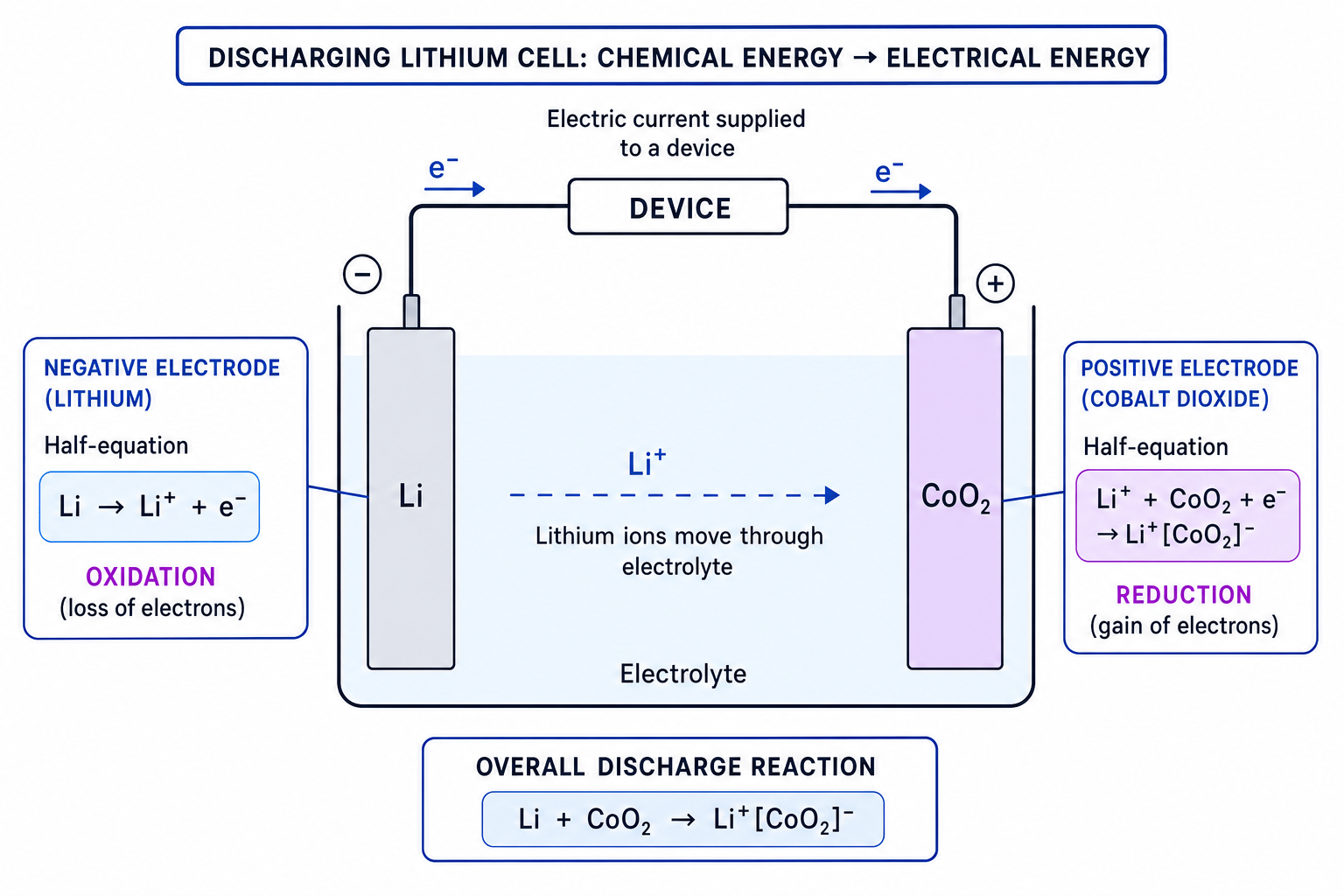
The simplified electrode reactions in a lithium cell during discharge are:
Positive electrode:
Li++CoO2+e−→Li+[CoO2]−\text{Li}^+ + \text{CoO}_2 + \text{e}^- \to \text{Li}^+[\text{CoO}_2]^-Li++CoO2+e−→Li+[CoO2]−Negative electrode:
Li→Li++e−\text{Li} \to \text{Li}^+ + \text{e}^-Li→Li++e−At the negative electrode, lithium atoms are oxidised. The electrons released travel through the external circuit to the positive electrode. Lithium ions move through the electrolyte towards the positive electrode, where the reduction process involves cobalt dioxide.
Combining the lithium-cell half-equations
-
Write the oxidation reaction at the negative electrode:
Li→Li++e−\text{Li} \to \text{Li}^+ + \text{e}^-Li→Li++e− -
Write the reduction reaction at the positive electrode:
Li++CoO2+e−→Li+[CoO2]−\text{Li}^+ + \text{CoO}_2 + \text{e}^- \to \text{Li}^+[\text{CoO}_2]^-Li++CoO2+e−→Li+[CoO2]− -
Add the equations and cancel the electron appearing on both sides:
Li+Li++CoO2→Li++Li+[CoO2]−\text{Li} + \text{Li}^+ + \text{CoO}_2 \to \text{Li}^+ + \text{Li}^+[\text{CoO}_2]^-Li+Li++CoO2→Li++Li+[CoO2]− -
Cancel the Li+\text{Li}^+Li+ that appears unchanged on both sides:
Li+CoO2→Li+[CoO2]−\text{Li} + \text{CoO}_2 \to \text{Li}^+[\text{CoO}_2]^-Li+CoO2→Li+[CoO2]−
Lithium-cell discharge
In a lithium cell, lithium is oxidised at the negative electrode, electrons flow through the device, and reduction occurs at the positive electrode.
Fuel cells
A fuel cell is an electrochemical cell that generates electricity from a continuous supply of fuel and oxidant. Unlike a rechargeable battery, it does not need to be electrically recharged; instead, more reactants are supplied.
Fuel cell
A fuel cell is an electrochemical cell that uses a continuous supply of fuel and oxygen or air to generate an electric current.
Fuel cells can keep producing electricity as long as the reactants are supplied and products are removed.
The alkaline hydrogen–oxygen fuel cell
In an alkaline hydrogen–oxygen fuel cell:
- Hydrogen is supplied to the negative electrode, the anode.
- Oxygen is supplied to the positive electrode, the cathode.
- The electrolyte contains hydroxide ions, OH−\text{OH}^-OH−.
- Water is the overall product.
The electrode reactions are:
Negative electrode / anode:
H2+2OH−→2H2O+2e−\text{H}_2 + 2\text{OH}^- \to 2\text{H}_2\text{O} + 2\text{e}^-H2+2OH−→2H2O+2e−Positive electrode / cathode:
O2+2H2O+4e−→4OH−\text{O}_2 + 2\text{H}_2\text{O} + 4\text{e}^- \to 4\text{OH}^-O2+2H2O+4e−→4OH−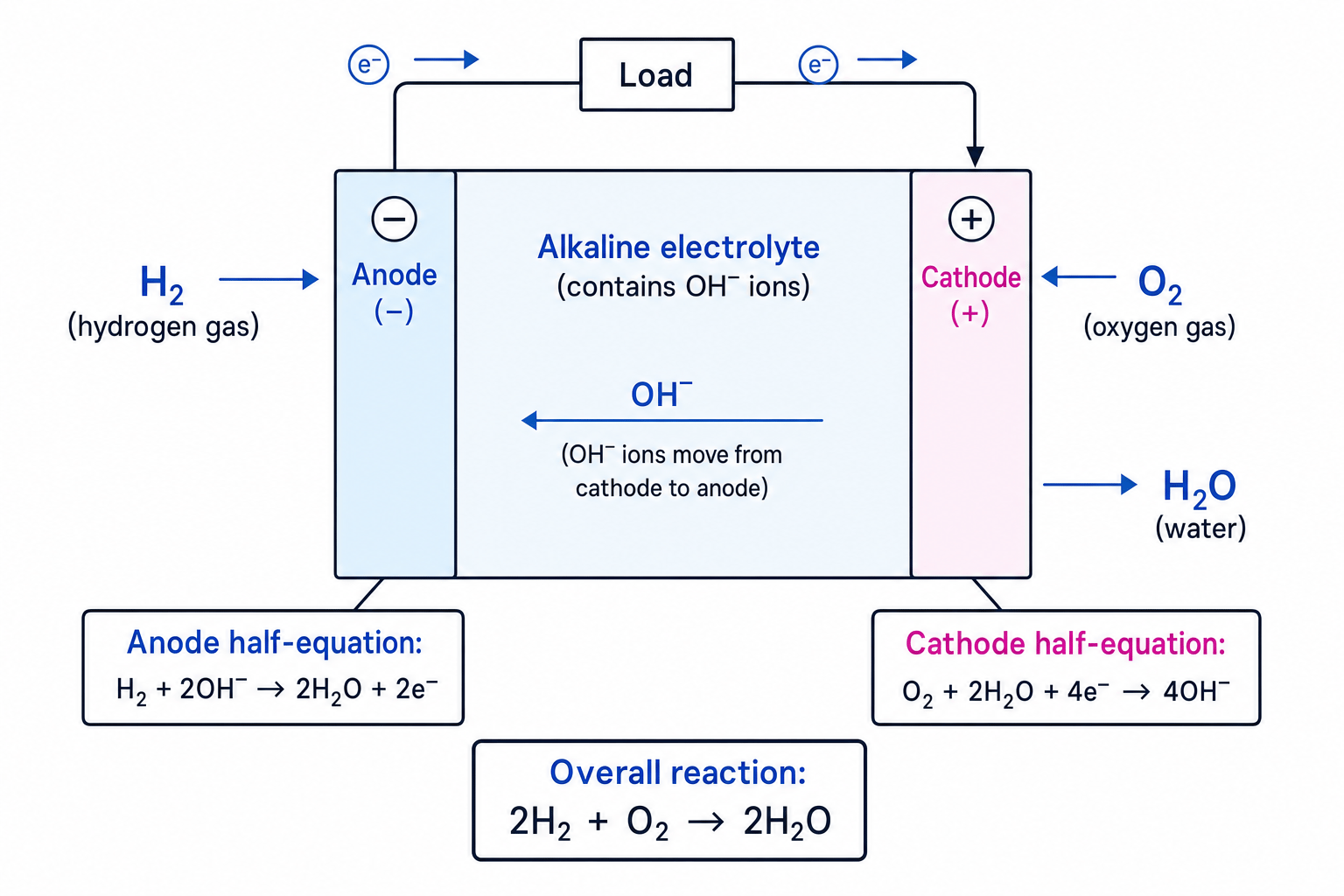
Finding the overall fuel-cell equation
-
The anode equation produces 2 electrons, but the cathode equation uses 4 electrons, so multiply the anode equation by 2:
2H2+4OH−→4H2O+4e−2\text{H}_2 + 4\text{OH}^- \to 4\text{H}_2\text{O} + 4\text{e}^-2H2+4OH−→4H2O+4e− -
Add the cathode equation:
O2+2H2O+4e−→4OH−\text{O}_2 + 2\text{H}_2\text{O} + 4\text{e}^- \to 4\text{OH}^-O2+2H2O+4e−→4OH− -
Cancel 4 electrons and 4 hydroxide ions from opposite sides. Then cancel 2 water molecules from both sides:
2H2+O2→2H2O2\text{H}_2 + \text{O}_2 \to 2\text{H}_2\text{O}2H2+O2→2H2O
Thinking hydroxide ions are used up overall
In the alkaline hydrogen–oxygen fuel cell, OH−\text{OH}^-OH− ions appear in the half-equations, but they cancel out in the overall reaction. They help transfer charge inside the cell.
Benefits and risks to society
Commercial electrochemical cells are important because they allow energy to be used where and when it is needed. However, they also come with environmental, safety and economic issues.
Benefits
Lithium cells are lightweight and can store a large amount of energy for their mass, which is valuable for portable electronics and electric vehicles. Rechargeable cells reduce the need to dispose of batteries after one use.
Hydrogen–oxygen fuel cells produce water as the direct product, so there are no carbon dioxide emissions at the point of use. They can also be more efficient than combustion engines because chemical energy is converted directly into electrical energy rather than first into heat.
Risks and limitations
Lithium cells can overheat and may catch fire if damaged, incorrectly charged or poorly manufactured. Extraction of lithium and cobalt can cause environmental damage, and cobalt mining raises ethical concerns. Recycling is important but can be technically difficult and expensive.
Hydrogen fuel cells need hydrogen, which is often produced from fossil fuels unless renewable electricity is used for electrolysis. Hydrogen is also flammable and difficult to store because it has a low density, so it may need high-pressure tanks or very low temperatures.
Point-of-use emissions are not the whole story
A hydrogen fuel cell may produce only water in the vehicle, but the overall environmental impact depends on how the hydrogen is produced, transported and stored.
In the exam
-
When using electrode potentials, keep the more positive half-equation as reduction and reverse the less positive one.
-
For EMF calculations, use Ecell⊖=Epositive electrode⊖−Enegative electrode⊖E^\ominus_{\text{cell}} = E^\ominus_{\text{positive electrode}} - E^\ominus_{\text{negative electrode}}Ecell⊖=Epositive electrode⊖−Enegative electrode⊖ and include units of V.
-
For fuel cells, explain both parts: electrode reactions produce electrons, and electron flow through the external circuit generates current.
Check yourself
- In a discharging lithium cell, which electrode produces electrons?
- Why does a fuel cell not need to be electrically recharged?
- How would you decide which half-equation is reversed when given two E⊖E^\ominusE⊖ values?
