

What you'll learn
- Why polyalkenes are chemically inert and non-biodegradable.
- Why polyesters and polyamides can be broken down by hydrolysis.
- How to compare polymer disposal methods, including recycling, landfill and incineration.
- How to write balanced A-Level explanations about environmental advantages and disadvantages.
The structural idea behind this topic
A polymer is a very large molecule made by joining many small molecules together. The small starting molecules are called monomers.
The key question in this topic is:
Does the polymer chain contain bonds that water, enzymes or other chemical reagents can break?
If the main chain is hard to break, the polymer persists in the environment. If the main chain contains hydrolysable links, the chain can be cut into smaller molecules.
Key polymer terms
- A repeat unit is the section of the polymer chain that repeats many times.
- The polymer backbone is the main chain of atoms running through the polymer.
- A functional group is a reactive group of atoms that gives a molecule characteristic chemical reactions, such as an ester group or amide group.
- Biodegradable means microorganisms can break the material down by chemical reactions, usually enzyme-catalysed, into smaller substances.
Polyalkenes, polyesters and polyamides have different backbones, and that difference controls their biodegradability.
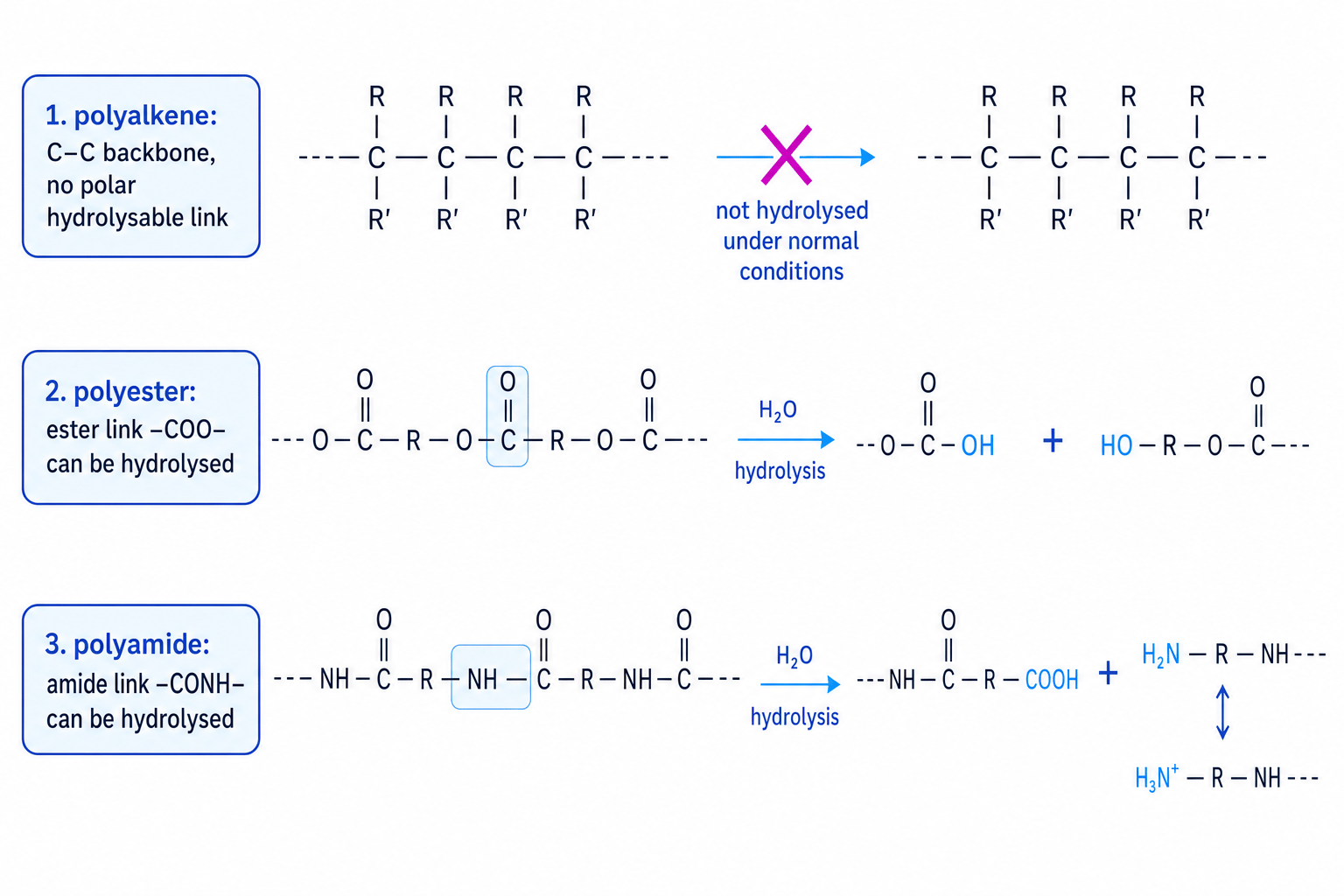
Polyalkenes: chemically inert and non-biodegradable
Polyalkenes are addition polymers made from alkene monomers. Examples include poly(ethene), poly(propene) and poly(chloroethene), also called PVC.
During addition polymerisation, the carbon–carbon double bond in the alkene opens up and many monomers join together. The resulting polymer has a saturated carbon–carbon backbone.
Why polyalkenes persist
Polyalkenes are non-biodegradable because their main chains contain strong, mostly non-polar C–C bonds and no hydrolysable ester or amide links.
Polyalkenes are described as chemically inert because they do not react readily under normal environmental conditions. Water does not easily attack their C–C backbone, and most microorganisms do not have enzymes that can efficiently break these chains.
This is useful while the polymer is being used: plastic bags, pipes and packaging are durable. The problem is that the same durability makes disposal difficult.
Explaining why poly(ethene) resists hydrolysis
-
Poly(ethene) has a backbone made from C–C bonds, with C–H bonds attached to the chain.
-
Hydrolysis requires water to split a bond, but there is no polar ester or amide link in the poly(ethene) backbone for water to attack.
-
Therefore the polymer chain is not cut into smaller molecules under normal environmental conditions, so poly(ethene) is chemically inert and non-biodegradable.
Saying “strong plastic” instead of giving chemistry
In exam answers, do not just say polyalkenes are “strong” or “hard to break down”. Link this to their C–C backbone and the absence of hydrolysable bonds.
Hydrolysis: the reaction that can cut some polymer chains
Hydrolysis means breaking a chemical bond using water. In polymer chemistry, hydrolysis matters when the bond being broken is part of the main polymer chain.
Hydrolysis
Hydrolysis is a reaction in which water breaks a bond. In a polymer, hydrolysis can split the long chain into shorter molecules if the hydrolysed bond is in the backbone.
Polyesters and polyamides contain polar functional groups in their backbones. These groups include carbonyl bonds, C=O, which make part of the chain more reactive than a simple hydrocarbon chain.
Polyesters: ester links can be hydrolysed
A polyester is a polymer containing ester links in its backbone. An ester link is commonly written as –COO–.
When an ester link is hydrolysed, the polymer chain is cut. The products formed at the broken link are an alcohol group and a carboxylic acid group. In alkaline hydrolysis, a carboxylate salt may form instead of the carboxylic acid.
Because the chain is cut into smaller molecules, microorganisms can more easily break the material down further.
Polyamides: amide links can be hydrolysed
A polyamide is a polymer containing amide links in its backbone. An amide link is commonly written as –CONH–.
When an amide link is hydrolysed, the chain is cut to form carboxylic acid and amine groups. In acidic conditions, the amine group may be protonated to form an ammonium group.
Amide links are usually less easily hydrolysed than ester links because the amide group is relatively stable, but for A-Level you should remember the key comparison: polyamides can be hydrolysed, whereas polyalkenes cannot.
Fast structure check
Look for the link in the main chain. A backbone containing –COO– suggests a polyester; a backbone containing –CONH– suggests a polyamide. Both can be hydrolysed. A backbone containing only C–C bonds suggests a polyalkene, which is not hydrolysed under normal conditions.
Identifying whether a polymer is hydrolysable
Suppose you are given two repeat units:
- Polymer A: –CH₂–CH(CH₃)–
- Polymer B: –O–CH₂–CH₂–O–CO–C₆H₄–CO–
-
In polymer A, the backbone is made from carbon atoms joined by C–C bonds. There is no ester or amide link in the chain.
-
In polymer B, the backbone contains –COO– groups. These are ester links.
-
Polymer B can be hydrolysed because water can break the ester links and cut the chain. Polymer A is a polyalkene-type structure and is non-biodegradable under normal conditions.
Biodegradable does not mean instantly harmless
A hydrolysable polymer may still break down slowly if conditions are not suitable. Temperature, moisture, oxygen, microorganisms, surface area and polymer crystallinity can all affect the rate of biodegradation.
Disposal of polymers: the main options
Disposal means dealing with polymer waste after use. No method is perfect, so exam questions often reward balanced comparisons.
The main routes are:
- recycling
- incineration
- landfill
- composting or biodegradation, for suitable biodegradable polymers
Recycling
Recycling means processing waste materials so they can be used again to make new products.
Mechanical recycling involves sorting, washing, melting and remoulding the polymer. This works best when the waste is clean and made from one type of polymer.
Chemical recycling, sometimes called feedstock recycling, breaks polymers into smaller molecules, monomers or useful chemical feedstocks. This can be useful for some mixed or contaminated plastics, but it often requires more energy and specialised equipment.
Advantages of recycling include:
- less crude oil or other raw material needed
- less waste sent to landfill
- often lower energy use than making polymer from new raw materials
- reduced environmental impact if collection and sorting are efficient
Disadvantages include:
- polymers must often be sorted carefully
- contamination by food, dyes or other polymers can reduce quality
- repeated melting can degrade polymer chains
- collection, transport and processing cost money and energy
Assuming recycling is always simple
Recycling is usually environmentally preferable, but it is not automatic. Mixed, dirty or composite plastics can be difficult and expensive to recycle.
Incineration
Incineration means burning waste. For polymers, this can reduce the volume of waste and release energy, which may be used for heating or electricity generation.
Complete combustion of polymers mainly made of carbon and hydrogen produces carbon dioxide and water. However, real waste streams may contain chlorine, nitrogen, sulfur, dyes, plasticisers and fillers. These can produce harmful gases or residues if not carefully controlled.
For example, burning PVC can produce hydrogen chloride gas, HCl, which is acidic and must be removed using gas scrubbing.
Advantages of incineration include:
- large reduction in waste volume
- energy can be recovered
- useful when waste is too contaminated for recycling
Disadvantages include:
- carbon dioxide emissions contribute to climate change
- toxic gases may form if conditions are not controlled
- ash still needs disposal
- useful material is destroyed rather than reused
Landfill
Landfill means burying waste in managed sites.
For non-biodegradable polyalkenes, landfill is a long-term storage problem. The polymer may remain for many years, taking up space and potentially breaking into smaller fragments called microplastics.
Biodegradable polymers may break down in landfill, but conditions are often anaerobic, meaning without oxygen. Anaerobic decomposition can produce methane, a greenhouse gas, unless it is captured.
Advantages of landfill include:
- relatively cheap and simple
- can handle mixed waste
- does not require complex sorting before disposal
Disadvantages include:
- land use and limited space
- long-term persistence of non-biodegradable polymers
- possible leachate pollution if sites are poorly managed
- methane production from biodegradable waste under anaerobic conditions
Composting biodegradable polymers
Some biodegradable polymers can be composted, especially under controlled industrial conditions. Composting requires suitable microorganisms, moisture, oxygen and temperature.
This is not the same as saying the polymer will quickly disappear if dropped as litter. Industrial composting conditions are much more controlled than soil, seawater or landfill.
Choosing a suitable disposal method
A local authority has two waste streams: clean sorted PET bottles and mixed dirty packaging containing poly(ethene) film and PVC. Suggest suitable disposal options.
-
The clean PET bottles are sorted and mostly one polymer type, so mechanical recycling is likely to be suitable. This saves raw materials and reduces landfill waste.
-
The mixed dirty packaging is harder to recycle because contamination and mixed polymers reduce the quality of recycled material.
-
Incineration with energy recovery may be considered for the contaminated waste, but PVC can produce HCl when burned, so gas scrubbing is needed. Landfill is simple but leaves non-biodegradable polyalkenes in the environment for a long time.
How to compare disposal methods in exam answers
When asked for advantages and disadvantages, try to compare using clear criteria:
- environmental impact
- energy use or energy recovery
- cost
- ease of sorting and processing
- emissions or toxic products
- whether the polymer is biodegradable
- whether useful material is conserved or destroyed
A strong answer is usually not “recycling good, landfill bad”. A stronger answer explains when a method is suitable and what the trade-offs are.
In the exam
-
For biodegradability questions, identify the backbone first: C–C only means polyalkene and non-biodegradable; –COO– or –CONH– means hydrolysable.
-
Use the word hydrolysis precisely: water breaks ester or amide links, cutting the polymer chain into smaller molecules.
-
For disposal questions, give balanced advantages and disadvantages, and mention practical issues such as sorting, contamination, toxic gases, carbon dioxide emissions and energy recovery.
Check yourself
- Why can a polyester be hydrolysed but poly(ethene) cannot?
- What are two advantages and two disadvantages of recycling polymers?
- Why might incinerating PVC require extra pollution control?
