

What you'll learn
- Why particles must collide before a chemical reaction can happen.
- What activation energy, EaE_aEa, means and how to define it precisely.
- Why most collisions between particles do not lead to a reaction.
- How to use collision theory language in clear A-Level explanations.
The starting point: particles are moving
In gases and solutions, reacting particles — atoms, molecules or ions — are constantly moving. Because they are moving, they have kinetic energy, which is energy due to motion.
When particles move randomly, they sometimes hit each other. These hits are called collisions. For a chemical reaction to happen, the reacting particles must come close enough for old bonds or attractions to be disrupted and new ones to form.
Collision theory
Collision theory is the model that explains chemical reactions in terms of particles colliding. A reaction can only occur when reacting particles collide with enough energy.
Not every collision causes a reaction. In fact, most do not. A collision is only useful if it has the conditions needed to form products.
Necessary, not sufficient
A collision is necessary for a reaction, but a collision by itself is not enough. The collision must also have sufficient energy, and often the correct orientation.
Successful collisions
A successful collision is a collision that leads to a chemical reaction. You may also see the phrase effective collision; it means the same thing.
For a collision to be successful, the particles must have enough energy to overcome an energy barrier. For many reactions involving molecules, the particles must also collide in a suitable orientation so that the right bonds can break and form.
For example, if two molecules collide “side-on” when they need a particular atom or bond to meet, they may simply bounce apart unchanged.
Activation energy
Chemical reactions involve rearranging particles. Bonds may need to be stretched, weakened or broken before new bonds can form. This requires energy.
Activation energy
The activation energy, EaE_aEa, is the minimum energy that colliding particles must have for a reaction to occur.
The word minimum is important. Particles do not need exactly the activation energy; they need at least this much energy.
Activation energy is usually measured in kJ mol⁻¹. It represents the energy barrier that must be overcome before reactants can become products.
Activation energy is not enthalpy change
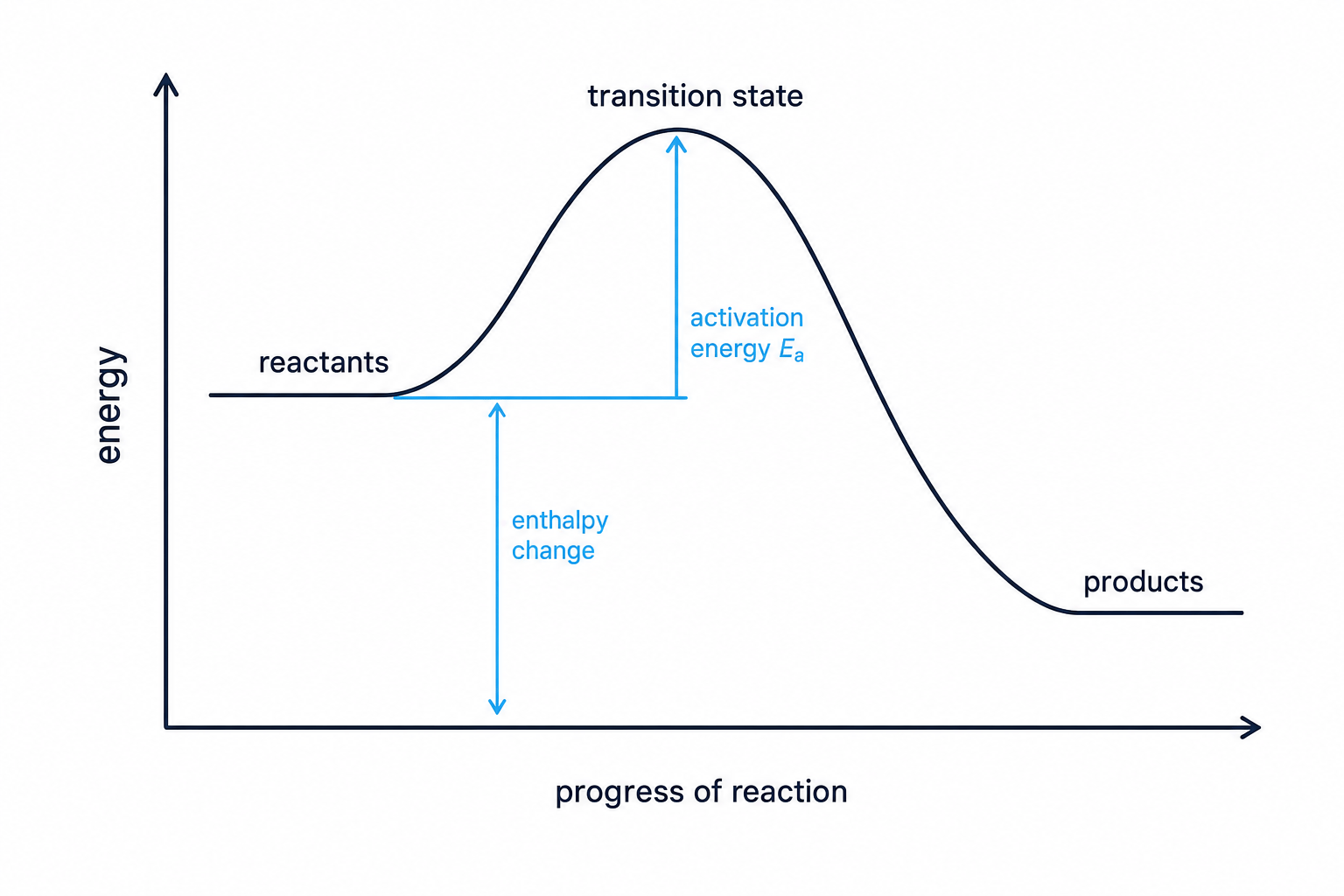
Do not define activation energy as “the energy change of the reaction”. The overall energy change is ΔH\Delta HΔH. Activation energy is the energy needed to get from the reactants to the top of the energy barrier.
Reaction profile diagrams
A reaction profile diagram shows how the energy changes as reactants turn into products. The highest point represents a very unstable arrangement of atoms called the transition state.
The activation energy is measured from the energy level of the reactants up to the peak of the curve.
Calculating activation energy from an energy profile
A reaction profile has reactants at 75 kJ mol⁻¹, products at 20 kJ mol⁻¹, and a peak at 145 kJ mol⁻¹. Calculate the activation energy and decide whether the reaction is exothermic or endothermic.
-
Identify the two energy levels needed for EaE_aEa: the reactants are at 75 kJ mol⁻¹ and the peak is at 145 kJ mol⁻¹.
-
Calculate the activation energy from reactants to peak: Ea=145−75=70E_a = 145 - 75 = 70Ea=145−75=70 kJ mol⁻¹.
-
Compare products with reactants: the products are lower in energy than the reactants, so energy has been released. The reaction is exothermic, with ΔH=20−75=−55\Delta H = 20 - 75 = -55ΔH=20−75=−55 kJ mol⁻¹.
Why most collisions do not lead to reaction
Particles collide extremely often, especially in gases and solutions. However, only a small fraction of those collisions are successful.
There are two main reasons.
1. The particles may not have enough energy
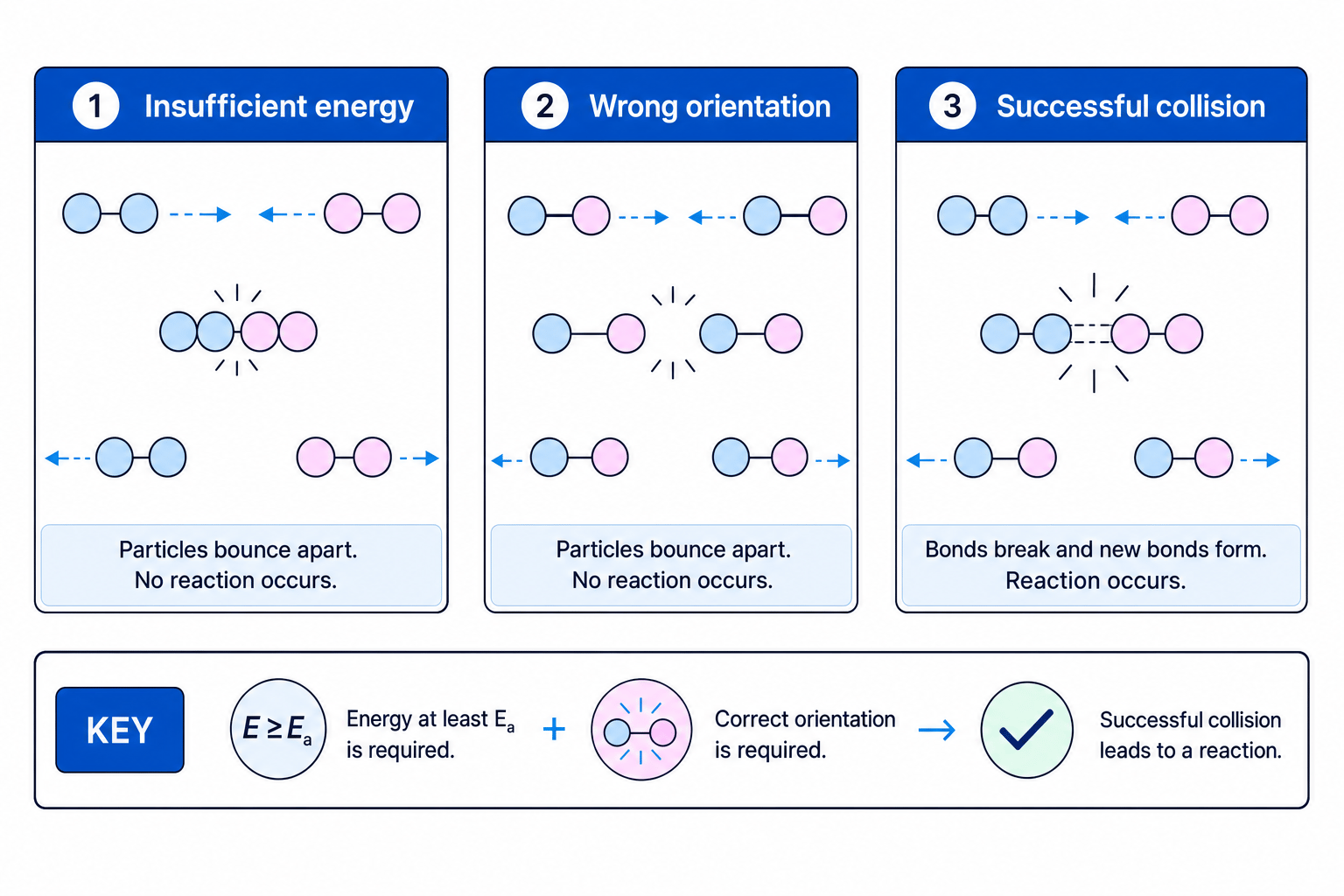
If the collision energy is less than the activation energy, the particles cannot overcome the energy barrier. They collide and then separate again without reacting.
In symbols, the collision is only energetic enough if:
E≥EaE \ge E_aE≥Eawhere EEE is the energy of the collision.
2. The particles may have the wrong orientation
Even if the particles have enough energy, they may not hit each other in the correct way. For a reaction to occur, the parts of the particles that need to interact must meet.
This matters especially in reactions involving larger molecules, where only certain bonds or atoms are reactive.
The diagram below shows three possible outcomes when particles collide.
Two conditions for a successful collision
A successful collision needs particles to collide with energy at least equal to EaE_aEa and, where relevant, in the correct orientation.
Identifying why collisions fail
A reaction has activation energy Ea=60E_a = 60Ea=60 kJ mol⁻¹. Three collisions are observed:
- Collision A: energy 45 kJ mol⁻¹, correct orientation.
- Collision B: energy 80 kJ mol⁻¹, wrong orientation.
- Collision C: energy 65 kJ mol⁻¹, correct orientation.
Decide which collision is successful.
-
Compare each collision energy with EaE_aEa: A has too little energy because 45 is less than 60, while B and C have enough energy.
-
Apply the orientation condition: B has enough energy but the wrong orientation, so it still does not lead to reaction.
-
Conclude that only C is successful, because it has energy greater than EaE_aEa and the correct orientation.
Linking collision theory to rate
The rate of reaction tells you how quickly reactants are used up or products are made. Collision theory explains rate in terms of the number of successful collisions per unit time.
A reaction is faster when there are more successful collisions each second. A reaction is slower when there are fewer successful collisions each second.
For this sub-topic, the most important point is not just “more collisions”, but more successful collisions.
Use the word successful
In explanations, try to write “more frequent successful collisions” rather than just “more collisions”. This shows the examiner you understand that many collisions do not cause reaction.
The exam definition you need
For AQA, your definition of activation energy should include:
- minimum energy
- colliding particles
- needed for a reaction to occur
A strong definition is:
Activation energy is the minimum energy that colliding particles must have for a reaction to occur.
Saying particles need more than the activation energy
Particles do not need energy greater than EaE_aEa only. A collision with energy equal to EaE_aEa is energetic enough. The correct phrase is “energy equal to or greater than the activation energy”.
Why some reactions need a spark
Some reactions are thermodynamically possible but do not happen noticeably until energy is supplied. For example, a mixture of hydrogen and oxygen can react explosively, but it needs a spark to start.
The spark gives some particles enough energy to overcome the activation energy. Once the reaction begins, the energy released can help more particles reach the activation energy, so the reaction continues rapidly.
Explaining why a spark starts a reaction
Hydrogen and oxygen gases are mixed at room temperature, but there is no visible reaction until a spark is applied. Explain this using collision theory.
-
The hydrogen and oxygen molecules are already colliding, so lack of collisions is not the main issue.
-
Most collisions at room temperature do not have enough energy to overcome the activation energy, so the molecules usually bounce apart unchanged.
-
The spark supplies energy to some molecules, allowing successful collisions to occur and starting the reaction.
In the exam
-
Define activation energy as the minimum energy that colliding particles must have for a reaction to occur.
-
When asked why most collisions do not react, say that many collisions have energy less than EaE_aEa and may have the wrong orientation.
-
If using a reaction profile, measure EaE_aEa from the reactants’ energy level to the peak, not from reactants to products.
-
For rate explanations, link your answer to the number of successful collisions per unit time.
Check yourself
- What are the three key words or phrases needed in a good definition of activation energy?
- Why can two particles collide and still not react?
- On a reaction profile diagram, where is EaE_aEa measured from and to?
