What you'll learn
- What mean bond enthalpy means, and why it is always a positive value.
- How to estimate ΔH\Delta HΔH using bond enthalpy data.
- How to count bonds correctly from displayed or structural formulae.
- Why bond enthalpy answers differ from values found using Hess’s law.
Before we start: enthalpy changes
An enthalpy change, ΔH\Delta HΔH, is the heat energy change for a reaction at constant pressure, usually given in kJ mol⁻¹.
For reactions:
- Exothermic means heat is released, so ΔH\Delta HΔH is negative.
- Endothermic means heat is absorbed, so ΔH\Delta HΔH is positive.
Bond enthalpy calculations are a way of estimating ΔH\Delta HΔH by thinking about what happens to bonds during a reaction.
Bonds store energy — but breaking them needs energy
A covalent bond is a shared pair of electrons between two atoms.
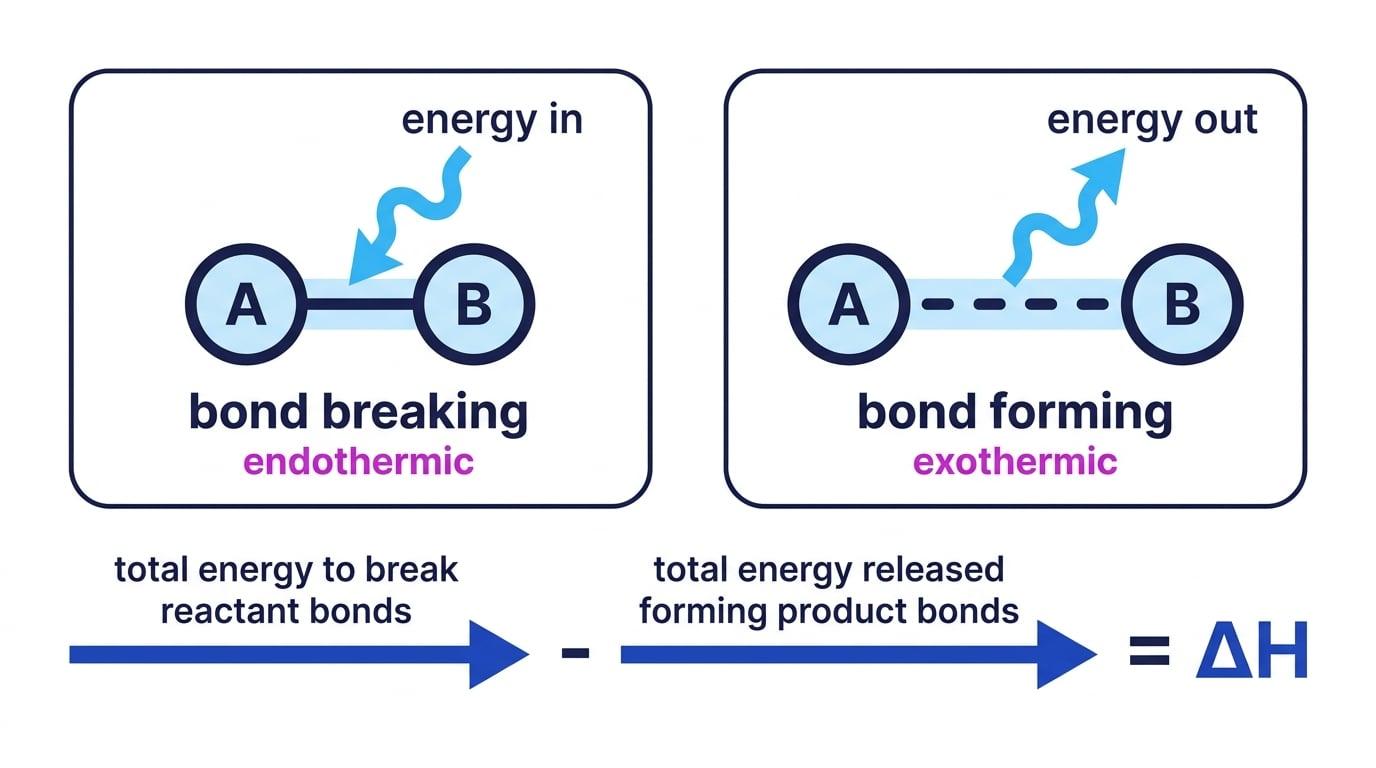
To break a covalent bond, you must put energy in. Bond breaking is always endothermic.
When a covalent bond forms, energy is released. Bond forming is always exothermic.
Breaking and forming bonds
Bond breaking absorbs energy; bond forming releases energy. The overall ΔH\Delta HΔH depends on which total is bigger.
Mean bond enthalpy
Mean bond enthalpy
The mean bond enthalpy is the enthalpy change required to break one mole of a specified covalent bond in gaseous molecules, averaged over a range of compounds.
There are three important parts of this definition.
1. “Break one mole of bonds”
If the H–H bond enthalpy is 436 kJ mol⁻¹, this means 436 kJ is needed to break one mole of H–H bonds:
H2(g)→2H(g)\text{H}_2(g) \to 2\text{H}(g)H2(g)→2H(g)It is not the energy to break one molecule. It is for one mole of those bonds.
2. “In gaseous molecules”
Mean bond enthalpies refer to bonds in the gas phase. This matters because energy may also be involved in changing state, such as liquid water becoming steam.
3. “Averaged over a range of compounds”
A C–H bond in methane is not exactly the same as a C–H bond in ethane or methanol. Data books often give a mean C–H value, averaged across many compounds.
Forgetting the word mean
Mean bond enthalpies are averages, so calculations using them give approximate ΔH\Delta HΔH values, not perfectly exact experimental values.
The bond enthalpy equation
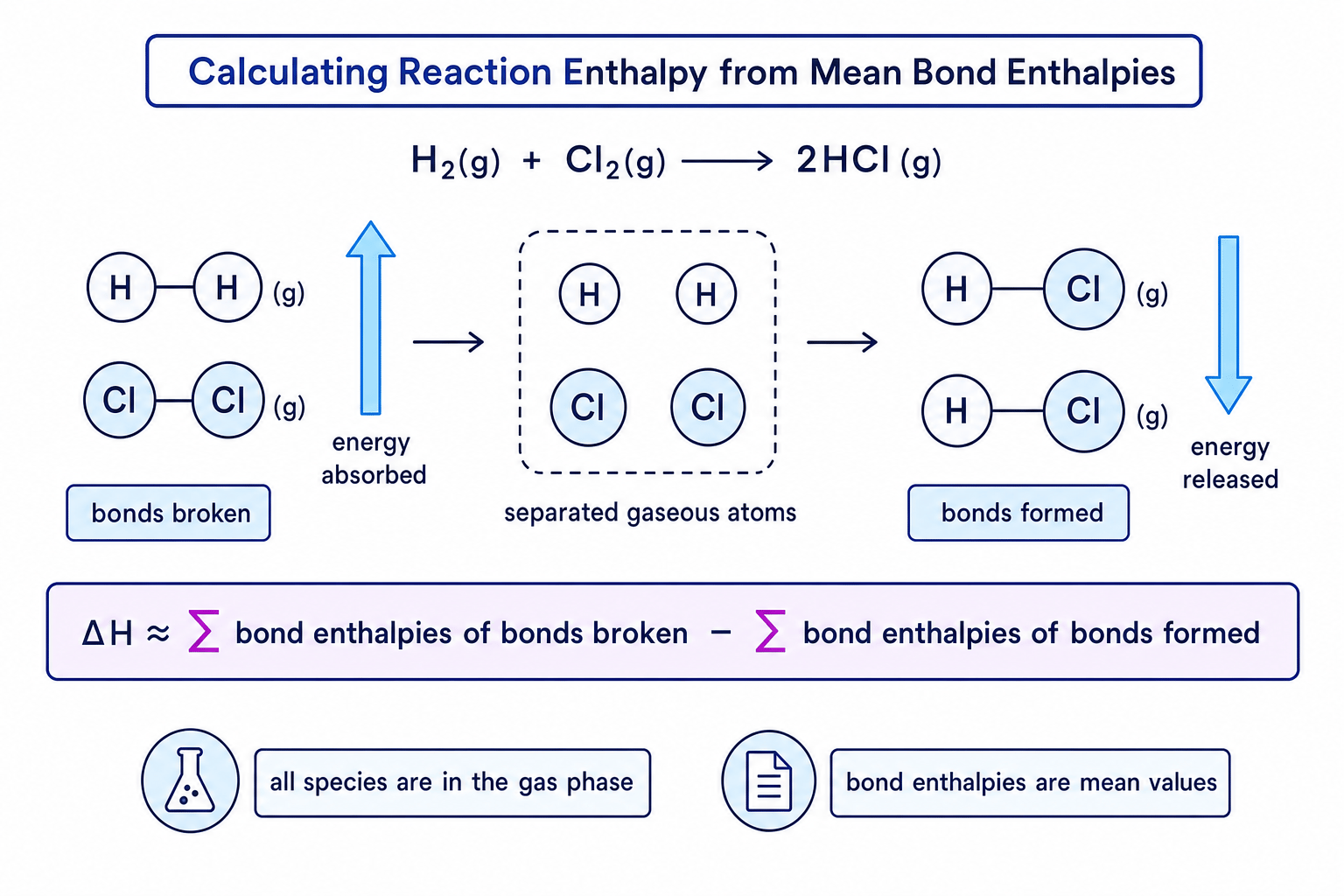
For a gaseous reaction:
ΔH≈∑Ebonds broken−∑Ebonds formed\Delta H \approx \sum E_\text{bonds broken} - \sum E_\text{bonds formed}ΔH≈∑Ebonds broken−∑Ebonds formedA shorter way to remember it is:
ΔH≈broken−formed\Delta H \approx \text{broken} - \text{formed}ΔH≈broken−formedWhy this works:
- Breaking bonds takes in energy, so it contributes positively.
- Forming bonds gives out energy, so it is subtracted.
Sanity check
If much stronger bonds are formed than broken, the reaction is likely to be exothermic, so your final ΔH\Delta HΔH should be negative.
The method
Use this approach every time.
- Write the balanced equation, including state symbols if given.
- Draw or imagine the displayed formulae so you can see every bond.
- Count the bonds broken in the reactants.
- Count the bonds formed in the products.
- Substitute into:
A simple calculation
Let’s calculate the enthalpy change for:
H2(g)+Cl2(g)→2HCl(g)\text{H}_2(g) + \text{Cl}_2(g) \to 2\text{HCl}(g)H2(g)+Cl2(g)→2HCl(g)Bond enthalpies:
- H–H = 436 kJ mol⁻¹
- Cl–Cl = 242 kJ mol⁻¹
- H–Cl = 431 kJ mol⁻¹
Calculating the enthalpy change for hydrogen and chlorine
-
Count the bonds broken in the reactants: one H–H bond and one Cl–Cl bond.
∑Ebroken=436+242=678 kJ mol−1\sum E_\text{broken} = 436 + 242 = 678\ \text{kJ mol}^{-1}∑Ebroken=436+242=678 kJ mol−1 -
Count the bonds formed in the products: two H–Cl bonds are formed because the equation makes 2HCl.
∑Eformed=2×431=862 kJ mol−1\sum E_\text{formed} = 2 \times 431 = 862\ \text{kJ mol}^{-1}∑Eformed=2×431=862 kJ mol−1 -
Apply ΔH≈broken−formed\Delta H \approx \text{broken} - \text{formed}ΔH≈broken−formed.
ΔH≈678−862=−184 kJ mol−1\Delta H \approx 678 - 862 = -184\ \text{kJ mol}^{-1}ΔH≈678−862=−184 kJ mol−1 -
Interpret the sign: the reaction is exothermic because more energy is released forming H–Cl bonds than is absorbed breaking H–H and Cl–Cl bonds.
Counting bonds in larger molecules
The most common exam skill is not the arithmetic — it is counting the bonds correctly.
For example, methane has formula CH₄, so it contains four C–H bonds. Oxygen, O₂, contains one O=O double bond. Carbon dioxide, CO₂, contains two C=O double bonds.
Ignoring balancing numbers
If the equation contains 2O₂, you have two O=O bonds in total. If it contains 2H₂O, you have four O–H bonds in total.
Combustion of methane using mean bond enthalpies
For complete combustion of methane with water as steam:
CH4(g)+2O2(g)→CO2(g)+2H2O(g)\text{CH}_4(g) + 2\text{O}_2(g) \to \text{CO}_2(g) + 2\text{H}_2\text{O}(g)CH4(g)+2O2(g)→CO2(g)+2H2O(g)Bond enthalpies:
- C–H = 412 kJ mol⁻¹
- O=O = 498 kJ mol⁻¹
- C=O in CO₂ = 805 kJ mol⁻¹
- O–H = 463 kJ mol⁻¹
Estimating the enthalpy change for methane combustion
-
Count and total the bonds broken in the reactants. Methane has four C–H bonds, and 2O₂ has two O=O bonds.
∑Ebroken=4(412)+2(498)=1648+996=2644 kJ mol−1\begin{aligned} \sum E_\text{broken} &= 4(412) + 2(498) \\ &= 1648 + 996 \\ &= 2644\ \text{kJ mol}^{-1} \end{aligned}∑Ebroken=4(412)+2(498)=1648+996=2644 kJ mol−1 -
Count and total the bonds formed in the products. CO₂ has two C=O bonds, and 2H₂O has four O–H bonds.
∑Eformed=2(805)+4(463)=1610+1852=3462 kJ mol−1\begin{aligned} \sum E_\text{formed} &= 2(805) + 4(463) \\ &= 1610 + 1852 \\ &= 3462\ \text{kJ mol}^{-1} \end{aligned}∑Eformed=2(805)+4(463)=1610+1852=3462 kJ mol−1 -
Subtract the energy released by forming bonds from the energy absorbed breaking bonds.
ΔH≈2644−3462=−818 kJ mol−1\begin{aligned} \Delta H &\approx 2644 - 3462 \\ &= -818\ \text{kJ mol}^{-1} \end{aligned}ΔH≈2644−3462=−818 kJ mol−1 -
Link the answer to the chemistry: the negative sign shows that methane combustion is exothermic.
Gas-phase reactions only
AQA expects bond enthalpy calculations for gaseous species. If water is shown as H₂O(l), mean bond enthalpies alone do not account for the energy involved in condensing steam to liquid water.
Why mean bond enthalpy values are approximate
Mean bond enthalpy calculations usually differ from experimental values or Hess’s law values.
This is not because Hess’s law has “gone wrong”. It is because the data sources describe different things.
Mean bond enthalpies use averages
A bond enthalpy such as C–H is a mean value taken from many different compounds. The real C–H bond strength depends on the molecule it is in.
For example, a C–H bond next to an oxygen atom may not have exactly the same strength as a C–H bond in an alkane.
Hess’s law uses measured enthalpy changes
Hess’s law says that the enthalpy change for a reaction is independent of the route taken, provided the initial and final conditions are the same.
Hess’s law calculations often use experimental data such as standard enthalpies of formation or combustion. These values are usually more accurate for the actual substances and states in the equation.
Bond enthalpies versus Hess’s law
Mean bond enthalpy calculations are estimates because the bond enthalpies are averaged gaseous values. Hess’s law values are usually more accurate because they use experimental enthalpy changes for specific substances and states.
Explaining differences in exam answers
If asked why a bond enthalpy value differs from a Hess’s law value, you can say:
- Mean bond enthalpies are averages from a range of compounds.
- Actual bond enthalpies vary depending on the molecular environment.
- Mean bond enthalpies apply to gaseous molecules.
- Hess’s law data may refer to actual standard states, such as liquids or solids.
- Therefore the bond enthalpy answer is only approximate.
Explaining a difference from Hess’s law
-
Identify the type of data used in the bond enthalpy method: it uses mean values, so each bond is treated as if it has the same strength in every compound.
-
Compare this with Hess’s law data: Hess’s law often uses experimental enthalpy changes for the actual substances in their stated physical states.
-
Explain the consequence: the bond enthalpy calculation gives an approximate value, so it may not match the Hess’s law value exactly.
Final reminders
Bond enthalpy calculations are really about careful bookkeeping. Once the equation is balanced, the key is to count every bond on each side.
Quick bond-counting checks
For common small molecules: CH₄ has four C–H bonds, NH₃ has three N–H bonds, H₂O has two O–H bonds, CO₂ has two C=O bonds, and O₂ has one O=O bond.
In the exam
- Balance the equation first, then count bonds using the balanced coefficients.
- Use ΔH≈∑Ebroken−∑Eformed\Delta H \approx \sum E_\text{broken} - \sum E_\text{formed}ΔH≈∑Ebroken−∑Eformed and keep the sign in your final answer.
- If asked about accuracy, mention that mean bond enthalpies are averaged gaseous values, so the calculated ΔH\Delta HΔH is only approximate.
Check yourself
- Why is bond breaking always endothermic?
- In the reaction CH₄ + 2Cl₂ → CH₂Cl₂ + 2HCl, how many C–H, Cl–Cl, C–Cl and H–Cl bonds are involved?
- Why might a mean bond enthalpy calculation differ from an enthalpy change found using Hess’s law?