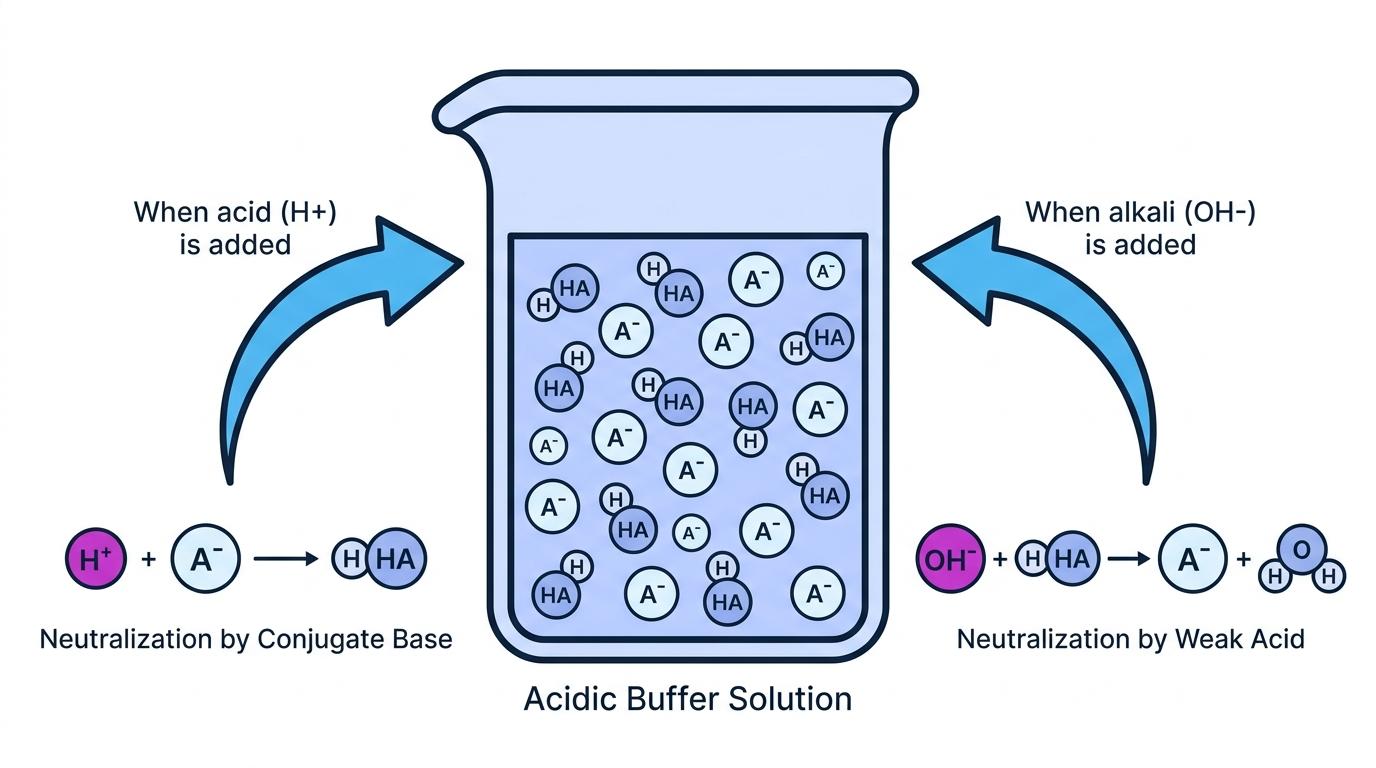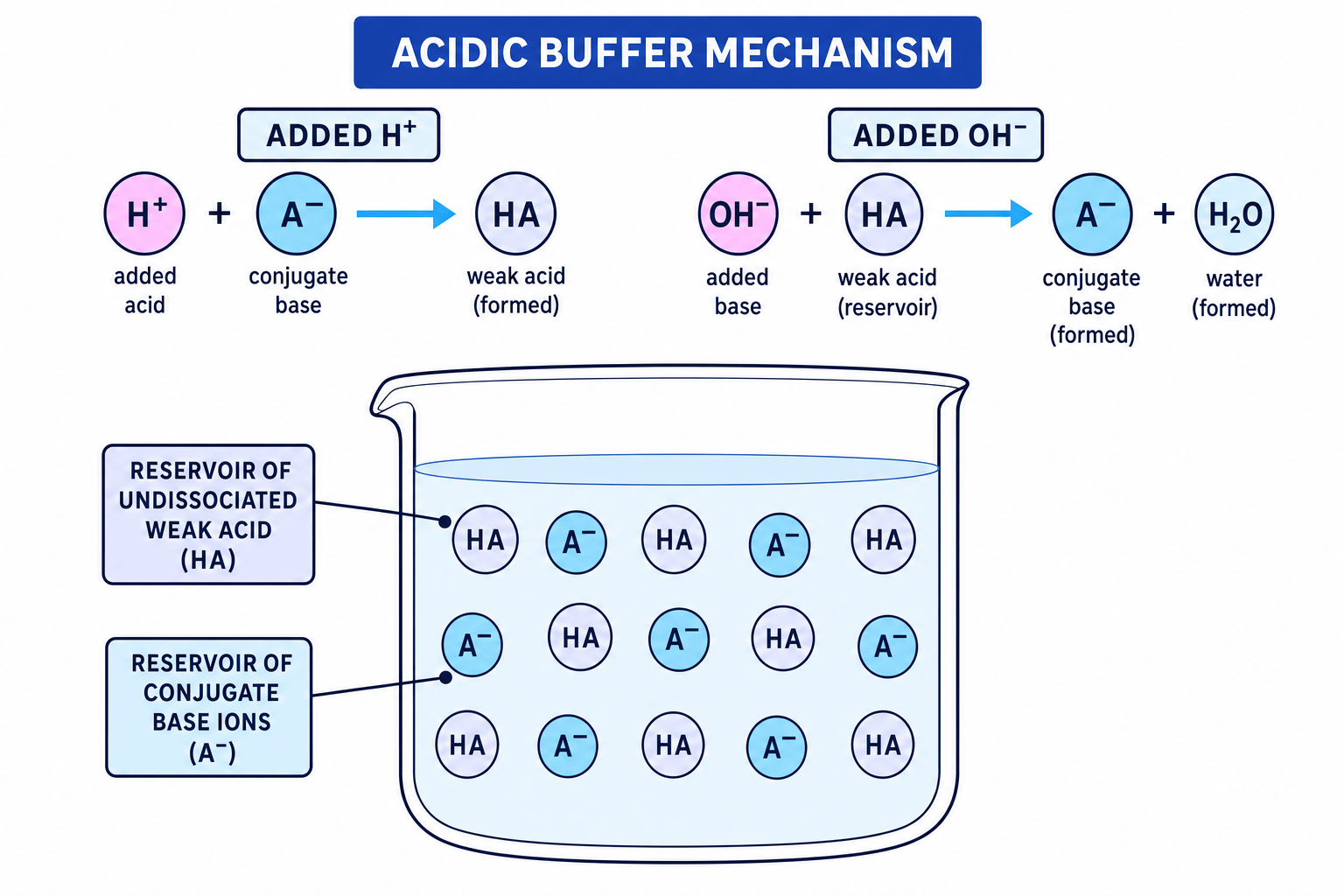
If we add a small amount of acid (adding H+H^+H+ ions):
- The extra H+H^+H+ ions react with the conjugate base (A−A^-A−) in the reservoir to form more weak acid (HAHAHA).
- Equation: H++A−→HAH^+ + A^- \to HAH++A−→HA
- Most of the added H+H^+H+ is removed, so the pH barely drops.
If we add a small amount of base (adding OH−OH^-OH− ions):
- The added OH−OH^-OH− ions react with the H+H^+H+ ions in the solution to form water.
- This temporarily lowers the [H+][H^+][H+], but by Le Chatelier's principle, the weak acid (HAHAHA) in the reservoir dissociates to replace the lost H+H^+H+ ions.
- Alternatively, you can just think of the OH−OH^-OH− reacting directly with the weak acid: OH−+HA→H2O+A−OH^- + HA \to H_2O + A^-OH−+HA→H2O+A−
- The OH−OH^-OH− is removed, and the H+H^+H+ is restored, so the pH barely rises.
Basic buffers
A basic buffer works on exactly the same principle, but it uses a weak base and the salt of that weak base.
A classic example is ammonia (NH3\text{NH}_3NH3) mixed with ammonium chloride (NH4Cl\text{NH}_4\text{Cl}NH4Cl).
- The weak base equilibrium: NH3+H2O⇌NH4++OH−\text{NH}_3 + \text{H}_2\text{O} \rightleftharpoons \text{NH}_4^+ + \text{OH}^-NH3+H2O⇌NH4++OH−
- The salt fully dissociates: NH4Cl→NH4++Cl−\text{NH}_4\text{Cl} \to \text{NH}_4^+ + \text{Cl}^-NH4Cl→NH4++Cl−
Here, the reservoirs are the weak base (NH3\text{NH}_3NH3) and its conjugate acid (NH4+\text{NH}_4^+NH4+).
- If you add acid (H+H^+H+), it reacts with the weak base: H++NH3→NH4+H^+ + \text{NH}_3 \to \text{NH}_4^+H++NH3→NH4+.
- If you add base (OH−OH^-OH−), it reacts with the conjugate acid: OH−+NH4+→NH3+H2OOH^- + \text{NH}_4^+ \to \text{NH}_3 + \text{H}_2\text{O}OH−+NH4+→NH3+H2O.
Applications of buffers
Buffer solutions are essential in many everyday products and natural systems:
- Biological systems: Your blood is buffered (mainly by the carbonic acid / hydrogencarbonate system) to stay at a pH of around 7.4. Even a small drop to 7.35 can cause severe health problems.
- Biological washing powders: These contain enzymes that only work effectively at a specific pH. Buffers are added to keep the pH exactly where the enzyme is most active.
- Shampoos: Hair is sensitive to high pH (which can cause the cuticles to open and hair to feel rough). Shampoos are often buffered to a slightly acidic pH (around 5.5) to keep hair smooth.
Calculating the pH of an acidic buffer
Because a buffer is essentially a weak acid equilibrium that has been tampered with, we can calculate its pH using the same acid dissociation constant (KaK_aKa) we use for normal weak acids.
Ka=[H+][A−][HA]K_a = \frac{[H^+][A^-]}{[HA]}Ka=[HA][H+][A−]If we rearrange this to make [H+][H^+][H+] the subject, we get the master equation for acidic buffer calculations:
[H+]=Ka×[HA][A−][H^+] = K_a \times \frac{[HA]}{[A^-]}[H+]=Ka×[A−][HA]Using moles instead of concentration
Because the weak acid (HAHAHA) and its salt (A−A^-A−) are mixed together in the exact same container, they share the same total volume. This means the ratio of their concentrations is exactly equal to the ratio of their moles.
You can rewrite the buffer equation as:
[H+]=Ka×moles of HAmoles of A− [H^+] = K_a \times \frac{\text{moles of } HA}{\text{moles of } A^-} [H+]=Ka×moles of A−moles of HAThis trick saves you having to calculate final concentrations!
The two big mathematical approximations
When we plug numbers into this equation, we make two important approximations:
- [A−][A^-][A−] at equilibrium ≈\approx≈ Initial [A−][A^-][A−] from the salt. We assume all the A−A^-A− comes from the fully dissociated salt, and the tiny amount produced by the weak acid dissociating is negligible.
- [HA][HA][HA] at equilibrium ≈\approx≈ Initial [HA][HA][HA]. We assume the weak acid barely dissociates at all (especially since the added salt pushes the equilibrium even further left).
There are two main styles of buffer calculation you will face. Let's look at a worked example for each.
Calculation Type 1: Direct mixing
This is the simpler scenario. The question will tell you that a certain amount of weak acid is mixed with a certain amount of its salt. You just need to find the moles of each.
Calculating pH of a simple buffer mixture
Calculate the pH of a buffer solution made by mixing 500 cm3500 \text{ cm}^3500 cm3 of 0.10 mol dm−30.10 \text{ mol dm}^{-3}0.10 mol dm−3 ethanoic acid with 500 cm3500 \text{ cm}^3500 cm3 of 0.05 mol dm−30.05 \text{ mol dm}^{-3}0.05 mol dm−3 sodium ethanoate. The KaK_aKa of ethanoic acid is 1.7×10⁻⁵ mol dm−31.7 \times 10^{-5} \text{ mol dm}^{-3}1.7×10⁻⁵ mol dm−3.
- Calculate the moles of the weak acid, HAHAHA (ethanoic acid):
- Calculate the moles of the salt, A−A^-A− (sodium ethanoate):
- Substitute these values into the rearranged KaK_aKa expression:
- Calculate the pH:
Calculation Type 2: Partial neutralisation
This scenario is harder. You are reacting an excess of weak acid with a strong base (like NaOH). The strong base reacts with some of the weak acid to make the salt. You have to figure out how much weak acid is left over, and how much salt was created.
Calculating pH after partial neutralisation
Calculate the pH of the solution formed when 20 cm320 \text{ cm}^320 cm3 of 0.10 mol dm−30.10 \text{ mol dm}^{-3}0.10 mol dm−3 sodium hydroxide is added to 50 cm350 \text{ cm}^350 cm3 of 0.10 mol dm−30.10 \text{ mol dm}^{-3}0.10 mol dm−3 methanoic acid. The KaK_aKa of methanoic acid is 1.6×10⁻⁴ mol dm−31.6 \times 10^{-4} \text{ mol dm}^{-3}1.6×10⁻⁴ mol dm−3.
- Calculate the initial moles of the weak acid (HAHAHA) before any reaction:
- Calculate the moles of the strong base (OH−OH^-OH−) added:
- Calculate the moles of HAHAHA remaining. The OH−OH^-OH− neutralises the acid in a 1:1 ratio.
- Calculate the moles of A−A^-A− formed. Every mole of OH−OH^-OH− added turns one mole of HAHAHA into one mole of A−A^-A−.
- Substitute the remaining moles of HAHAHA and the formed moles of A−A^-A− into the expression:
- Calculate the pH:
Forgetting to subtract moles
In partial neutralisation questions, a very common error is forgetting that the HAHAHA gets used up. Students often plug the initial moles of HAHAHA straight into the buffer equation. Always calculate the remaining moles of HAHAHA by subtracting the moles of base added!
In the exam
- Spot the buffer: If a question involves a weak acid mixed with its salt, OR an excess of weak acid mixed with a strong base, alarm bells should ring: it's a buffer calculation!
- Use the moles shortcut: Unless the question specifically asks for the final concentration of the components, use the moles ratio shortcut in your [H+][H^+][H+] calculation to save time.
- Qualitative questions: If asked how a buffer works, always state the equations for both the weak acid dissociating and the salt dissociating, then clearly state which species reacts with added H+H^+H+ and which reacts with added OH−OH^-OH−.
Check yourself
- Can you define what a buffer solution is?
- What two components are required to make an acidic buffer solution?
- When H+H^+H+ is added to a mixture of ethanoic acid and sodium ethanoate, which specific species does it react with?
- In a calculation involving partial neutralisation, how do you find the moles of the conjugate base (A−A^-A−) in the final mixture?