

What you'll learn:
- How changing the concentration of a solution affects the rate of a reaction.
- How changing the pressure of a gas affects the rate of a reaction.
- Why collision frequency is the crucial scientific link that explains both effects.
- How to calculate the initial rate of reaction from a continuous monitoring graph.
The basics of Collision Theory
For any chemical reaction to happen, two things must be true when reactant particles meet. First, they must collide with at least the activation energy (EaE_aEa). Second, they must collide with the correct spatial orientation.
If we want to speed up a reaction, we need to increase the number of successful collisions per second. There are two main ways to achieve this:
- Increase the proportion of collisions that are successful (e.g., by raising the temperature or adding a catalyst).
- Increase the total number of collisions happening every second, so that by pure probability, more successful collisions occur.
Changing the concentration or pressure relies entirely on the second method.
The effect of concentration (in solutions)
When a reaction takes place in a solution, the reactant particles (ions or molecules) are moving randomly amongst the solvent molecules.
Concentration
Concentration is a measure of how many particles of a solute are dissolved in a given volume of solvent. In A-Level Chemistry, it is usually measured in mol dm−3\text{mol dm}^{-3}mol dm−3.
When you increase the concentration of a reactant, you are packing more reactant particles into the exact same volume. Because the space is more crowded, the reactant particles are physically closer together. As they move around randomly, the fact that they are closer together means they will bump into one another more often.
Therefore, an increase in concentration leads to an increase in collision frequency, which results in a higher rate of reaction.
Energy does not change
A very common error is stating that higher concentration gives particles "more energy" to collide, or that it lowers the activation energy. This is entirely false. Changing the concentration does nothing to the energy of the particles. It only increases the number of particles in a given volume.
Visualising concentration on a graph
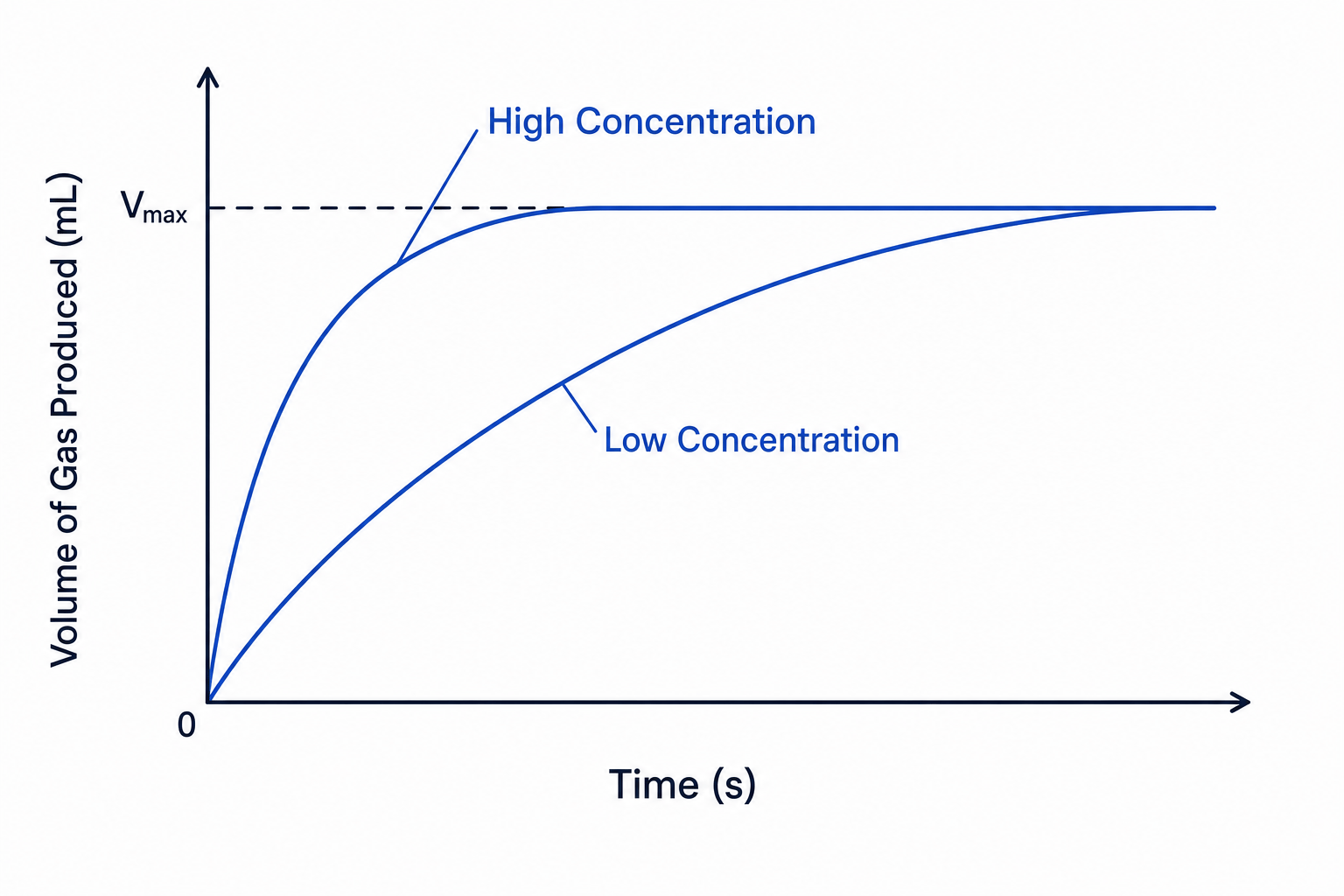
If you plot the volume of a product gas against time for a reaction at two different concentrations, you will notice two key features:
- The curve for the higher concentration is initially steeper (a faster rate).
- If the total number of moles of reactant used is exactly the same in both experiments, both curves will eventually level off at the exact same maximum volume.
The effect of pressure (in gases)
Concentration is a term we use for solutions. When we are dealing with gases, we talk about pressure instead, but the underlying chemistry is identical.
If you increase the pressure of a reacting gas mixture—usually by compressing it into a smaller volume—you are forcing the same number of gas molecules to occupy less space.
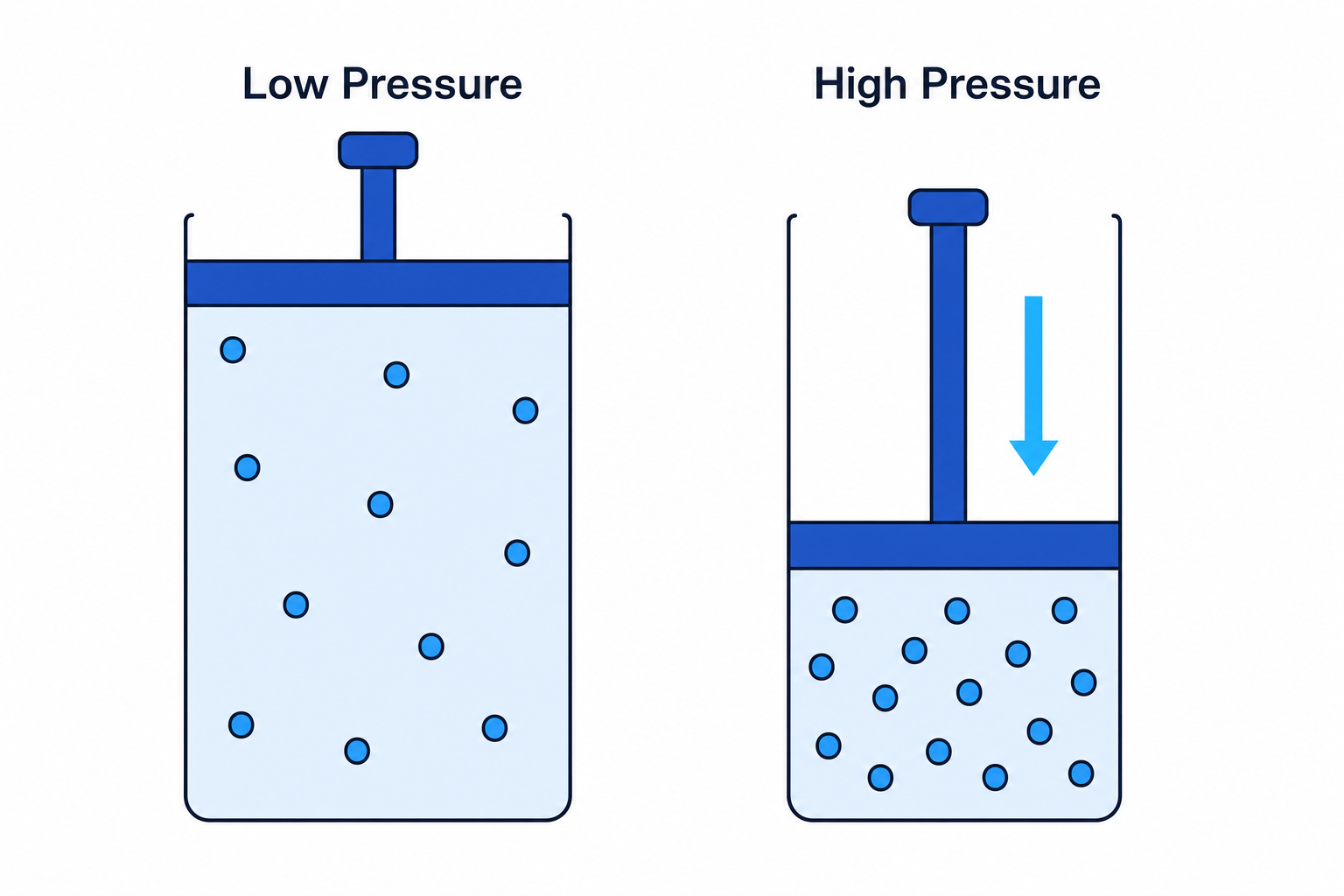
Just like in a highly concentrated solution, the gas molecules are now closer together. There are more particles per unit volume. Because they are more tightly packed, they will collide more often.
The Golden Phrase: Collision Frequency
Whether you are dealing with a concentrated solution or a high-pressure gas, the fundamental reason the rate increases is always the same: the collision frequency increases. Examiners actively look for the word "frequency" or the phrase "more collisions per unit time". Just writing "more collisions" is often too vague to earn the mark.
Investigating the effect: Continuous monitoring
To see the effect of concentration in action, you can investigate how the rate of a reaction changes when you alter the concentration of an acid. A classic A-Level practical involves reacting solid calcium carbonate (marble chips) with hydrochloric acid:
CaCO3(s)+2HCl(aq)→CaCl2(aq)+H2O(l)+CO2(g) \text{CaCO}_3\text{(s)} + 2\text{HCl}\text{(aq)} \to \text{CaCl}_2\text{(aq)} + \text{H}_2\text{O}\text{(l)} + \text{CO}_2\text{(g)} CaCO3(s)+2HCl(aq)→CaCl2(aq)+H2O(l)+CO2(g)Because this reaction produces carbon dioxide gas, you can continuously monitor the reaction as it happens. You can either:
- Collect the gas in a gas syringe and measure the volume produced at regular time intervals.
- Place the reaction flask on a mass balance and measure the mass lost (as the CO2\text{CO}_2CO2 escapes) at regular intervals.
By plotting a graph of volume (or mass lost) against time, you can find the initial rate of the reaction. The initial rate is taken at time t=0t = 0t=0 because this is the only time when you know the exact concentration of the acid (before any of it has been used up).
Calculating the initial rate from a graph
Suppose you have plotted a curve of CO2\text{CO}_2CO2 volume (in cm3\text{cm}^3cm3) against time (in s\text{s}s). The curve starts at the origin (0,0)(0, 0)(0,0) and curves upwards, gradually getting less steep. Here is how to find the initial rate:
- Place a ruler along the very beginning of the curve so that it touches the origin and follows the initial trajectory of the line. Draw a straight line extending upwards. This is your tangent at t=0t = 0t=0.
- Pick two points on this straight tangent line that are far apart. Picking points far apart reduces reading errors. Let's say your line passes through (0,0)(0, 0)(0,0) and (40 s,20 cm3)(40\text{ s}, 20\text{ cm}^3)(40 s,20 cm3).
- Use the formula for a gradient: Gradient=ΔyΔx\text{Gradient} = \frac{\Delta y}{\Delta x}Gradient=ΔxΔy
- Substitute your values into the formula to calculate the initial rate:
Units of Rate
The units for the rate of reaction depend entirely on what you plotted. If you plotted mass in g\text{g}g against time in s\text{s}s, the rate unit is g s−1\text{g s}^{-1}g s−1. If you plotted concentration in mol dm−3\text{mol dm}^{-3}mol dm−3 against time in s\text{s}s, the rate unit is mol dm−3 s−1\text{mol dm}^{-3} \text{ s}^{-1}mol dm−3 s−1. Always check your axes!
In the exam
- Never write "more collisions". Always write "more frequent collisions" or "higher collision frequency".
- Be specific about space. State that there are "more particles per unit volume" when explaining concentration or pressure. Do not just say "there are more particles", because if the volume scaled up equally, the concentration wouldn't have changed!
- Match the state to the factor. Only discuss pressure if the reaction involves gases. If the reactants are all aqueous solutions, stick exclusively to concentration.
Check yourself
- Why does compressing a gaseous mixture increase the rate of reaction?
- True or False: Increasing the concentration of a solution increases the proportion of collisions that are successful.
- How do you graphically determine the initial rate of a reaction from a continuous monitoring curve?

