

What you'll learn
- Why Hess’s law lets you calculate enthalpy changes for reactions you cannot measure directly.
- How to use enthalpies of formation to calculate a reaction enthalpy change.
- How to use enthalpies of combustion to calculate a reaction enthalpy change.
- How calorimetry data can be combined with Hess cycles in practical contexts.
The prerequisite idea: enthalpy changes
An enthalpy change, ΔH\Delta HΔH, is the heat energy change for a reaction at constant pressure. In A-Level Chemistry, it is usually given in kJ mol⁻¹.
The “per mole” always means per mole of reaction as written in the balanced equation. If you double every coefficient in an equation, you double the enthalpy change too.
A reaction is exothermic if it releases heat, so ΔH\Delta HΔH is negative. A reaction is endothermic if it absorbs heat, so ΔH\Delta HΔH is positive.
Standard conditions
Standard enthalpy changes, written with ΔH⊖\Delta H^\ominusΔH⊖, refer to substances in their standard states under standard conditions: 100 kPa, usually 298 K, and solutions at 1 mol dm⁻³.
Hess’s law
Hess’s law is based on the idea that enthalpy is a state function: the overall enthalpy change depends only on the starting substances and final substances, not on the route taken.
Hess’s law
The enthalpy change for a reaction is independent of the route taken, provided the initial and final conditions are the same.
So if you cannot measure a reaction directly, you can often build an alternative route using reactions whose enthalpy changes are known.
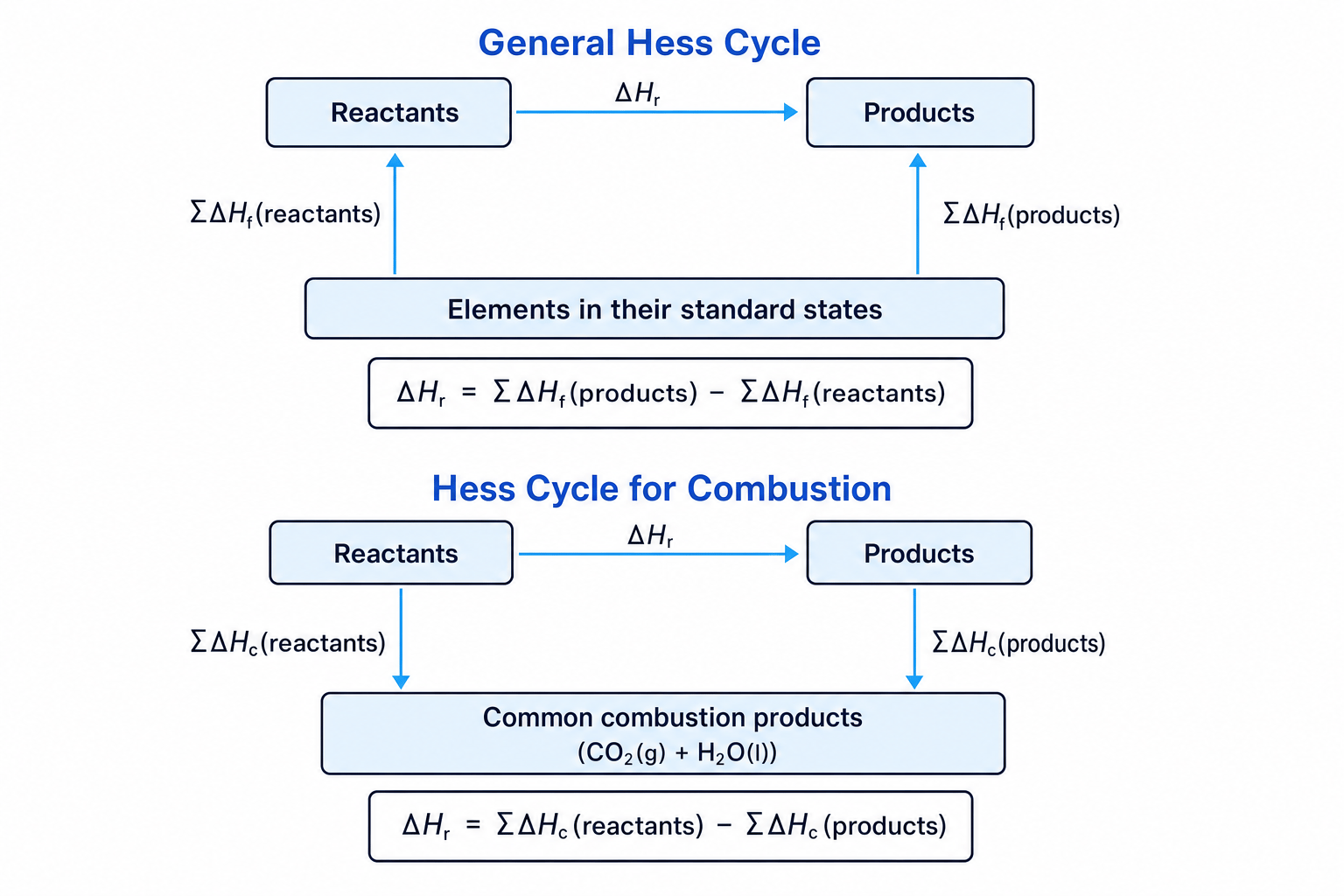
The whole trick
In a Hess cycle, different routes between the same start and finish must have the same total ΔH\Delta HΔH.
Two arrow rules you must be fluent with
When manipulating thermochemical equations:
- If you reverse a reaction, you change the sign of ΔH\Delta HΔH.
- If you multiply a reaction equation by a number, you multiply ΔH\Delta HΔH by the same number.
Combining two enthalpy changes
Find ΔH\Delta HΔH for:
C(graphite)+12O2(g)→CO(g)\text{C(graphite)} + \frac{1}{2}\text{O}_2\text{(g)} \to \text{CO(g)}C(graphite)+21O2(g)→CO(g)Given:
C(graphite)+O2(g)→CO2(g)ΔH=−394 kJ mol−1\text{C(graphite)} + \text{O}_2\text{(g)} \to \text{CO}_2\text{(g)} \qquad \Delta H = -394\text{ kJ mol}^{-1}C(graphite)+O2(g)→CO2(g)ΔH=−394 kJ mol−1 CO(g)+12O2(g)→CO2(g)ΔH=−283 kJ mol−1\text{CO(g)} + \frac{1}{2}\text{O}_2\text{(g)} \to \text{CO}_2\text{(g)} \qquad \Delta H = -283\text{ kJ mol}^{-1}CO(g)+21O2(g)→CO2(g)ΔH=−283 kJ mol−1-
The direct route from carbon to carbon dioxide can be split into two stages: first form CO, then combust CO to CO₂.
-
Write the enthalpy relationship:
ΔHtarget+(−283)=−394\Delta H_\text{target} + (-283) = -394ΔHtarget+(−283)=−394 -
Rearrange:
ΔHtarget=−394+283=−111 kJ mol−1\Delta H_\text{target} = -394 + 283 = -111\text{ kJ mol}^{-1}ΔHtarget=−394+283=−111 kJ mol−1
Using enthalpies of formation
The standard enthalpy of formation is one of the most common data types used in Hess’s law calculations.
Standard enthalpy of formation
The standard enthalpy of formation, ΔHf⊖\Delta H_f^\ominusΔHf⊖, is the enthalpy change when one mole of a compound is formed from its elements in their standard states under standard conditions.
For example, the formation equation for carbon dioxide is:
C(graphite)+O2(g)→CO2(g)\text{C(graphite)} + \text{O}_2\text{(g)} \to \text{CO}_2\text{(g)}C(graphite)+O2(g)→CO2(g)Elements in their standard states have ΔHf⊖=0\Delta H_f^\ominus = 0ΔHf⊖=0. For example, O₂(g), H₂(g), N₂(g), Cl₂(g), Na(s), and C(graphite) all have zero standard enthalpy of formation.
The formation formula
For a reaction:
ΔHr⊖=∑ΔHf⊖(products)−∑ΔHf⊖(reactants)\Delta H_r^\ominus = \sum \Delta H_f^\ominus\text{(products)} - \sum \Delta H_f^\ominus\text{(reactants)}ΔHr⊖=∑ΔHf⊖(products)−∑ΔHf⊖(reactants)This is often remembered as:
products minus reactants.
Using formation enthalpies
Calculate ΔHr⊖\Delta H_r^\ominusΔHr⊖ for the combustion of methane:
CH4(g)+2O2(g)→CO2(g)+2H2O(l)\text{CH}_4\text{(g)} + 2\text{O}_2\text{(g)} \to \text{CO}_2\text{(g)} + 2\text{H}_2\text{O(l)}CH4(g)+2O2(g)→CO2(g)+2H2O(l)Data:
- ΔHf⊖\Delta H_f^\ominusΔHf⊖ of CH₄(g) = -75 kJ mol⁻¹
- ΔHf⊖\Delta H_f^\ominusΔHf⊖ of CO₂(g) = -394 kJ mol⁻¹
- ΔHf⊖\Delta H_f^\ominusΔHf⊖ of H₂O(l) = -286 kJ mol⁻¹
- ΔHf⊖\Delta H_f^\ominusΔHf⊖ of O₂(g) = 0 kJ mol⁻¹
-
Add the formation enthalpies of the products, remembering the coefficient for water:
∑ΔHf⊖(products)=−394+2(−286)=−966 kJ mol−1\sum \Delta H_f^\ominus\text{(products)} = -394 + 2(-286) = -966\text{ kJ mol}^{-1}∑ΔHf⊖(products)=−394+2(−286)=−966 kJ mol−1 -
Add the formation enthalpies of the reactants:
∑ΔHf⊖(reactants)=−75+2(0)=−75 kJ mol−1\sum \Delta H_f^\ominus\text{(reactants)} = -75 + 2(0) = -75\text{ kJ mol}^{-1}∑ΔHf⊖(reactants)=−75+2(0)=−75 kJ mol−1 -
Apply products minus reactants:
ΔHr⊖=−966−(−75)=−891 kJ mol−1\Delta H_r^\ominus = -966 - (-75) = -891\text{ kJ mol}^{-1}ΔHr⊖=−966−(−75)=−891 kJ mol−1
Forgetting coefficients
If the equation contains 2H₂O, you must include 2ΔHf⊖2\Delta H_f^\ominus2ΔHf⊖ for water. Hess calculations are based on the balanced equation.
Using enthalpies of combustion
The standard enthalpy of combustion is another common route through a Hess cycle, especially for organic compounds.
Standard enthalpy of combustion
The standard enthalpy of combustion, ΔHc⊖\Delta H_c^\ominusΔHc⊖, is the enthalpy change when one mole of a substance burns completely in oxygen under standard conditions.
For complete combustion of compounds containing carbon and hydrogen, the common final products are usually CO₂(g) and H₂O(l).
The combustion formula
When using combustion data:
ΔHr⊖=∑ΔHc⊖(reactants)−∑ΔHc⊖(products)\Delta H_r^\ominus = \sum \Delta H_c^\ominus\text{(reactants)} - \sum \Delta H_c^\ominus\text{(products)}ΔHr⊖=∑ΔHc⊖(reactants)−∑ΔHc⊖(products)This is the opposite order from formation data.
Formation versus combustion
Formation cycles usually go up from elements, giving products minus reactants. Combustion cycles usually go down to combustion products, giving reactants minus products.
Using combustion enthalpies
Calculate ΔHr⊖\Delta H_r^\ominusΔHr⊖ for hydrogenation of ethene:
C2H4(g)+H2(g)→C2H6(g)\text{C}_2\text{H}_4\text{(g)} + \text{H}_2\text{(g)} \to \text{C}_2\text{H}_6\text{(g)}C2H4(g)+H2(g)→C2H6(g)Data:
- ΔHc⊖\Delta H_c^\ominusΔHc⊖ of C₂H₄(g) = -1411 kJ mol⁻¹
- ΔHc⊖\Delta H_c^\ominusΔHc⊖ of H₂(g) = -286 kJ mol⁻¹
- ΔHc⊖\Delta H_c^\ominusΔHc⊖ of C₂H₆(g) = -1560 kJ mol⁻¹
-
Add the combustion enthalpies of the reactants:
∑ΔHc⊖(reactants)=−1411+(−286)=−1697 kJ mol−1\sum \Delta H_c^\ominus\text{(reactants)} = -1411 + (-286) = -1697\text{ kJ mol}^{-1}∑ΔHc⊖(reactants)=−1411+(−286)=−1697 kJ mol−1 -
Add the combustion enthalpies of the products:
∑ΔHc⊖(products)=−1560 kJ mol−1\sum \Delta H_c^\ominus\text{(products)} = -1560\text{ kJ mol}^{-1}∑ΔHc⊖(products)=−1560 kJ mol−1 -
Apply reactants minus products:
ΔHr⊖=−1697−(−1560)=−137 kJ mol−1\Delta H_r^\ominus = -1697 - (-1560) = -137\text{ kJ mol}^{-1}ΔHr⊖=−1697−(−1560)=−137 kJ mol−1
Using the wrong subtraction order
For combustion data, do not automatically do products minus reactants. The reliable method is to draw the cycle and follow the arrows.
Using calorimetry with Hess’s law
In practical work, you may measure enthalpy changes indirectly using calorimetry.
Calorimetry
Calorimetry is the experimental measurement of heat changes, usually by measuring the temperature change of water or a solution.
The key equation is:
q=mcΔTq = mc\Delta Tq=mcΔTwhere qqq is heat energy in J, mmm is mass in g, ccc is specific heat capacity in J g⁻¹ K⁻¹, and ΔT\Delta TΔT is the temperature change in K.
For dilute aqueous solutions, you usually take c=4.18c = 4.18c=4.18 J g⁻¹ K⁻¹ and approximate the mass of solution using its volume, assuming 1.00 g cm⁻³.
The heat change of the reaction is the opposite sign to the heat change of the solution:
qreaction=−qsolutionq_\text{reaction} = -q_\text{solution}qreaction=−qsolutionThis can then be converted into kJ mol⁻¹ using:
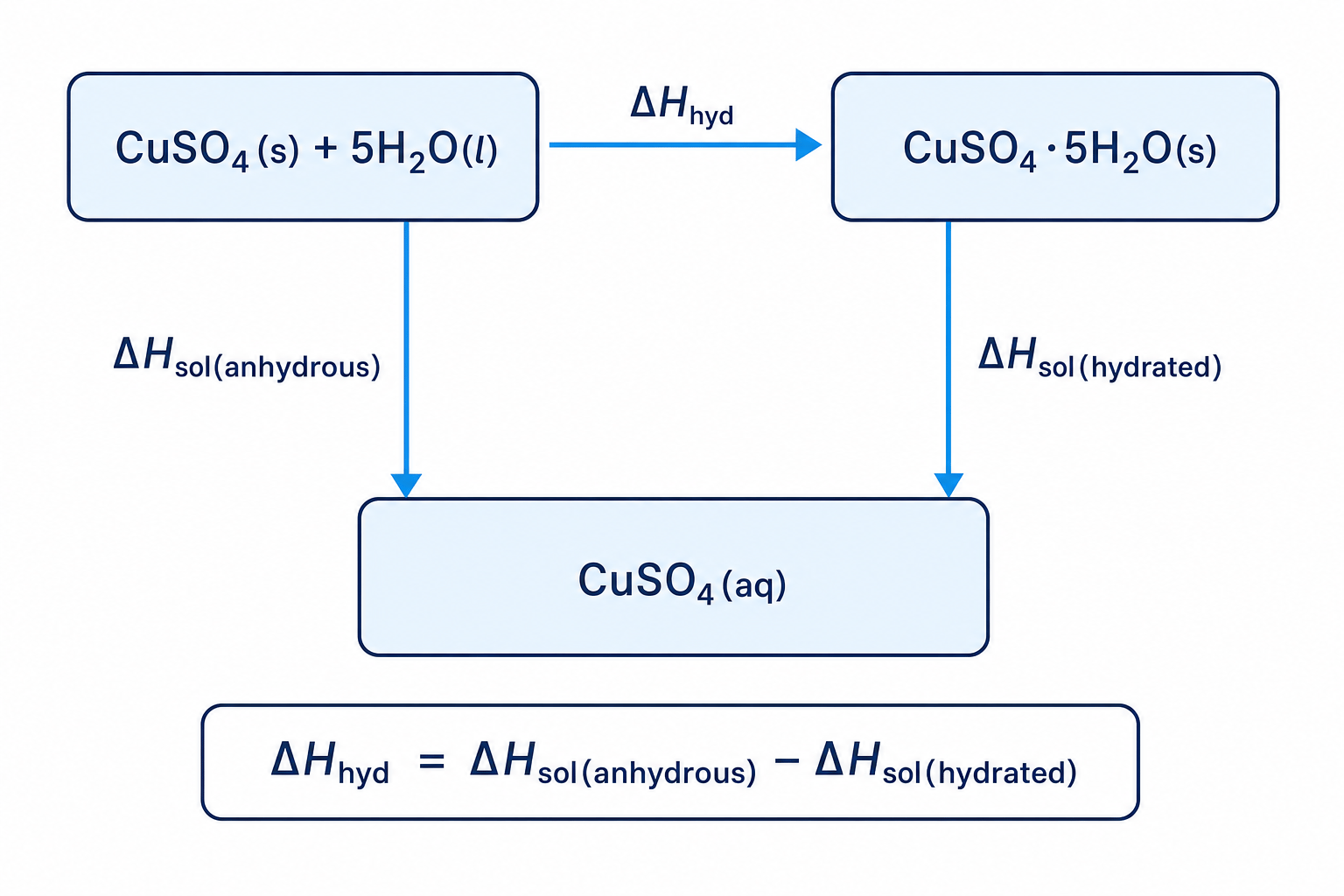
ΔH=qreactionn\Delta H = \frac{q_\text{reaction}}{n}ΔH=nqreactionA typical Hess’s law practical is finding the enthalpy change of hydration of an anhydrous salt, such as copper(II) sulfate.
Finding an enthalpy of hydration from solution data
In two calorimetry experiments:
- 2.50 g of anhydrous CuSO₄ dissolves in 50.0 g of water and the temperature rises by 5.0 K.
- 3.90 g of CuSO₄·5H₂O dissolves in 50.0 g of water and the temperature falls by 0.90 K.
Use Ar/CuSO₄ = 159.6 and Mr/CuSO₄·5H₂O = 249.6. Find ΔHhyd\Delta H_\text{hyd}ΔHhyd for:
CuSO4(s)+5H2O(l)→CuSO4⋅5H2O(s)\text{CuSO}_4\text{(s)} + 5\text{H}_2\text{O(l)} \to \text{CuSO}_4\cdot 5\text{H}_2\text{O(s)}CuSO4(s)+5H2O(l)→CuSO4⋅5H2O(s)-
For anhydrous CuSO₄, calculate the heat gained by the solution and convert to reaction enthalpy:
qsolution=50.0×4.18×5.0=1045 J=1.045 kJq_\text{solution} = 50.0 \times 4.18 \times 5.0 = 1045\text{ J} = 1.045\text{ kJ}qsolution=50.0×4.18×5.0=1045 J=1.045 kJSince the solution warms, the reaction releases heat, so qreaction=−1.045q_\text{reaction} = -1.045qreaction=−1.045 kJ.
-
Calculate the solution enthalpy for anhydrous CuSO₄:
n=2.50159.6=0.0157 moln = \frac{2.50}{159.6} = 0.0157\text{ mol}n=159.62.50=0.0157 mol ΔHsol, anhydrous=−1.0450.0157=−66.6 kJ mol−1\Delta H_\text{sol, anhydrous} = \frac{-1.045}{0.0157} = -66.6\text{ kJ mol}^{-1}ΔHsol, anhydrous=0.0157−1.045=−66.6 kJ mol−1 -
For hydrated CuSO₄, calculate the solution enthalpy:
qsolution=50.0×4.18×(−0.90)=−188 J=−0.188 kJq_\text{solution} = 50.0 \times 4.18 \times (-0.90) = -188\text{ J} = -0.188\text{ kJ}qsolution=50.0×4.18×(−0.90)=−188 J=−0.188 kJThe solution cools, so the reaction absorbs heat: qreaction=+0.188q_\text{reaction} = +0.188qreaction=+0.188 kJ.
n=3.90249.6=0.0156 moln = \frac{3.90}{249.6} = 0.0156\text{ mol}n=249.63.90=0.0156 mol ΔHsol, hydrated=+0.1880.0156=+12.1 kJ mol−1\Delta H_\text{sol, hydrated} = \frac{+0.188}{0.0156} = +12.1\text{ kJ mol}^{-1}ΔHsol, hydrated=0.0156+0.188=+12.1 kJ mol−1 -
Use the Hess cycle:
ΔHhyd=ΔHsol, anhydrous−ΔHsol, hydrated\Delta H_\text{hyd} = \Delta H_\text{sol, anhydrous} - \Delta H_\text{sol, hydrated}ΔHhyd=ΔHsol, anhydrous−ΔHsol, hydrated ΔHhyd=−66.6−(+12.1)=−78.7 kJ mol−1\Delta H_\text{hyd} = -66.6 - (+12.1) = -78.7\text{ kJ mol}^{-1}ΔHhyd=−66.6−(+12.1)=−78.7 kJ mol−1
Calorimetry is approximate
Simple school calorimetry often loses heat to the surroundings and assumes the solution has the same specific heat capacity and density as water, so experimental values may differ noticeably from data-book values.
Choosing the right route
A quick way to decide:
- If you are given ΔHf⊖\Delta H_f^\ominusΔHf⊖ values, use products minus reactants.
- If you are given ΔHc⊖\Delta H_c^\ominusΔHc⊖ values, use reactants minus products.
- If you are given experimental temperature changes, first calculate solution enthalpies, then use a Hess cycle.
In the exam
- Start by writing or checking the balanced equation, because coefficients control the enthalpy calculation.
- Identify the data type: formation, combustion, or calorimetry-derived enthalpy changes.
- Draw a small Hess cycle if the sign is not obvious, especially for combustion or hydration questions.
- Carry units through carefully: J from q=mcΔTq = mc\Delta Tq=mcΔT, then convert to kJ mol⁻¹.
- Check the sign at the end: combustion is usually exothermic, and hydration of many anhydrous salts is often exothermic.
Check yourself
- Why is ΔHf⊖\Delta H_f^\ominusΔHf⊖ for O₂(g) equal to zero, but not necessarily for ozone, O₃(g)?
- In a Hess calculation using combustion data, why is the formula reactants minus products?
- How would a temperature fall in a calorimetry experiment affect the sign of the reaction enthalpy?
