What you'll learn
- How metals are arranged in a giant metallic lattice.
- The definition of metallic bonding.
- How the charge and size of metal ions affect the strength of a metallic bond.
- How this structure explains the physical properties of metals.
When you look at a piece of copper wire or aluminium foil, you are looking at billions of atoms joined together. Unlike covalent substances (which can form small, separate molecules) or ionic substances (which are made of non-metals and metals combined), pure metals bond to themselves in a very specific way.
Let's break down exactly what is happening inside a chunk of metal.
The Giant Metallic Lattice
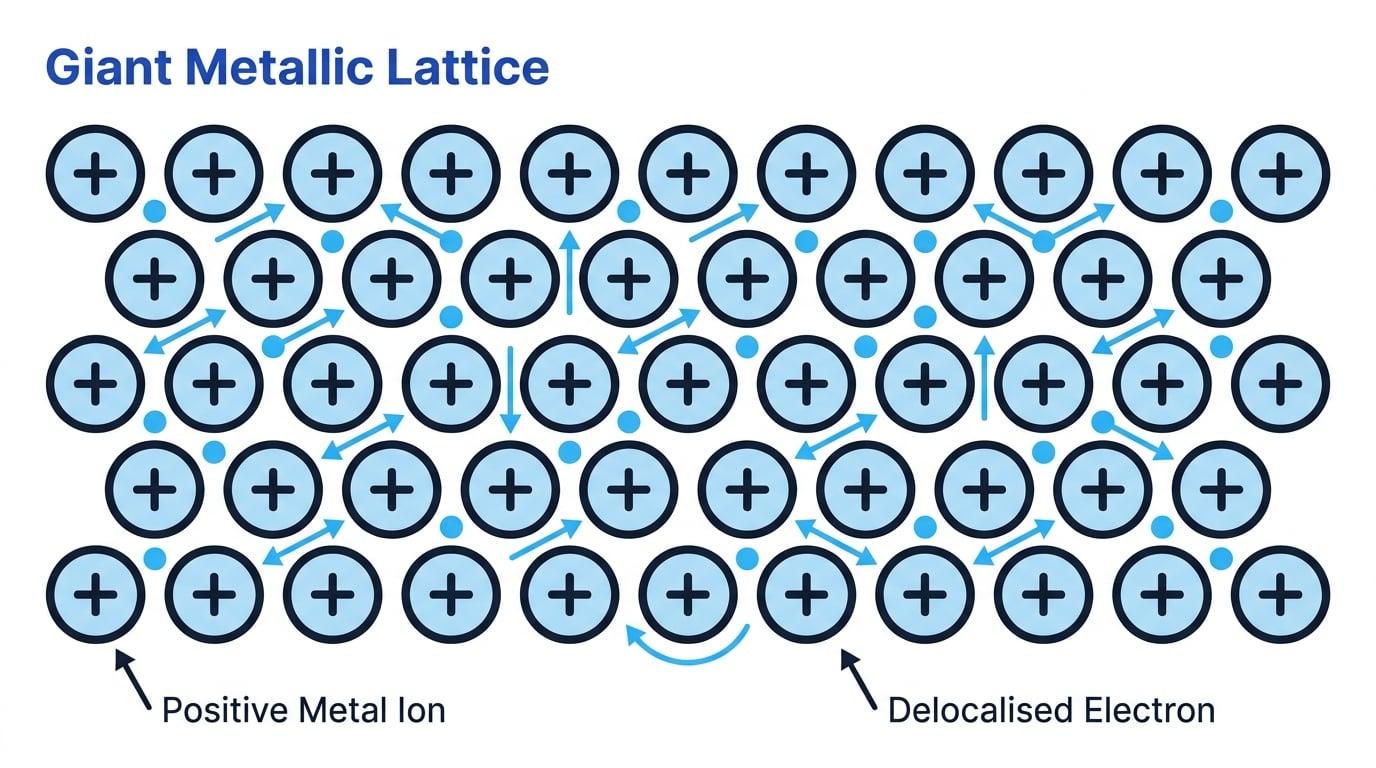
Metals do not exist as individual atoms or molecules. Instead, they form a giant structure — a continuous, regular 3D arrangement that extends in all directions. We call this a lattice.
When metal atoms pack tightly together in this lattice, their outermost electrons break away from the individual atoms. These outer electrons are no longer tied to one specific nucleus; they are free to move throughout the entire structure.
Delocalised electrons
Electrons that are not associated with a single atom or covalent bond, but instead are free to move throughout a structure. In metals, they form a "sea" around the positive ions.
Because the metal atoms have lost their negatively charged outer electrons, they are no longer neutral atoms. They have become positive ions (cations).
Confusing atoms and ions
Students often write "a lattice of positive metal atoms". Atoms are neutral by definition! Once the atoms release their outer electrons into the "sea", they must be called positive ions.
What is a Metallic Bond?
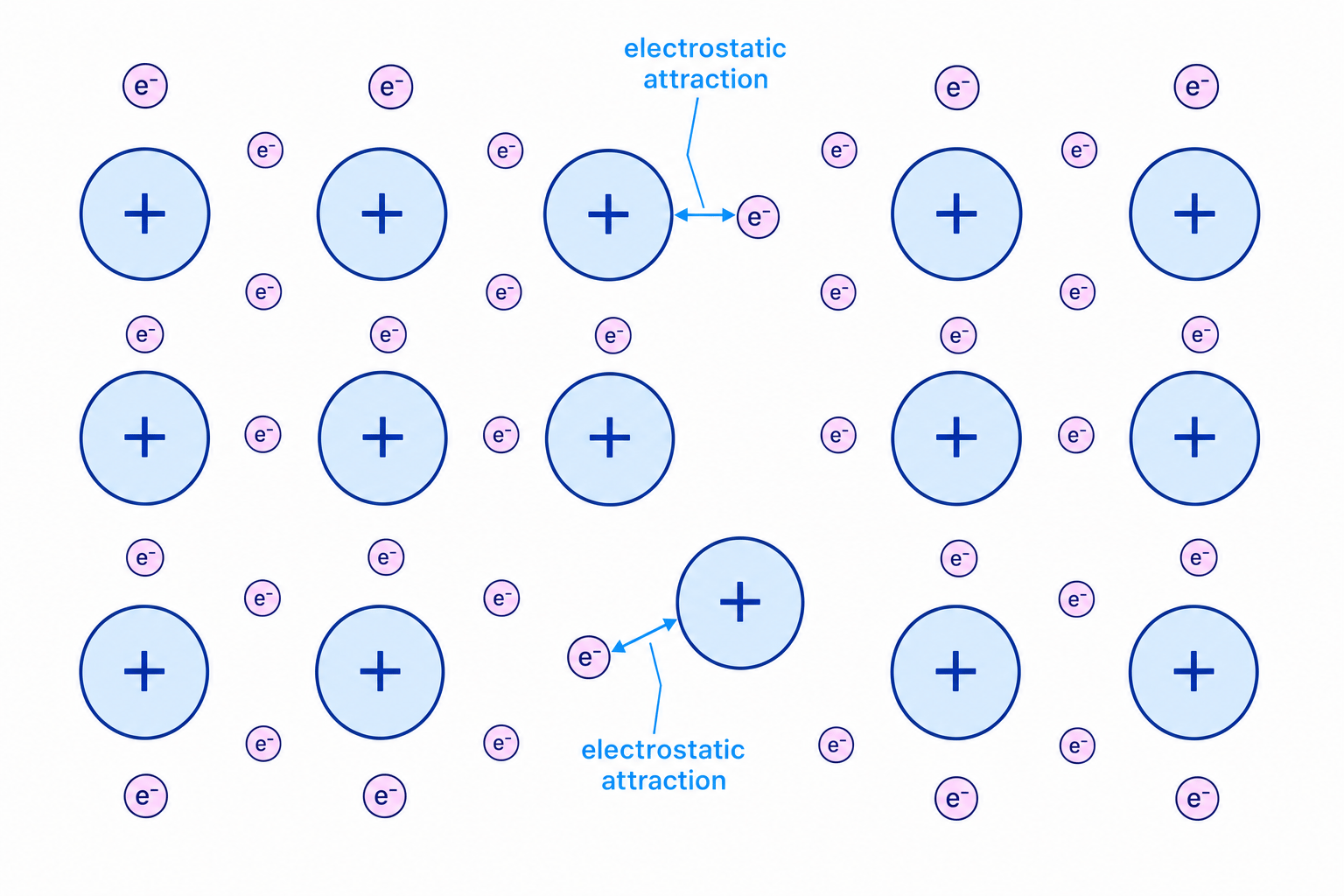
Now that we have a grid of positive metal ions and a sea of negative delocalised electrons swarming around them, the laws of physics take over. Opposite charges attract.
The positive ions are strongly attracted to the negative electrons. This electrostatic attraction holds the entire structure together.
Metallic bond
The strong electrostatic attraction between a lattice of positive metal ions and a sea of delocalised electrons.
The 'Glue' of the Metal
Think of the positive ions as bricks and the delocalised electrons as the cement. The positive ions naturally repel each other, but the negative electron "glue" flowing between them is so strongly attracted to the ions that it overrides that repulsion and binds the whole lattice tightly together.
Factors Affecting the Strength of Metallic Bonding
Not all metals are equally strong, and they don't all melt at the same temperature. The strength of the metallic bond varies depending on two main factors:
- The charge on the metal ion: Metals in Group 1 (like sodium) lose one electron to form a 1+1+1+ ion. Metals in Group 2 (like magnesium) lose two electrons to form a 2+2+2+ ion. A greater charge on the ion means a stronger electrostatic attraction to the electrons. Also, metals that form highly charged ions release more delocalised electrons into the sea, further increasing that attraction.
- The size of the metal ion (ionic radius): As you go down a group in the periodic table, the ions get larger because they have more electron shells. In a larger ion, the positive nucleus is further away from the delocalised electrons. This greater distance weakens the electrostatic attraction.
Comparing the melting points of sodium and magnesium
Sodium and magnesium are adjacent metals in Period 3. Let's walk through how to compare their melting points based on their bonding.
- Identify the ions formed: Sodium is in Group 1, so it forms Na+\text{Na}^+Na+ ions. Magnesium is in Group 2, so it forms Mg2+\text{Mg}^{2+}Mg2+ ions.
- Determine the number of delocalised electrons: Each sodium atom donates one electron to the sea. Each magnesium atom donates two electrons. Magnesium has double the number of delocalised electrons per ion.
- Compare the charges and radii: The Mg2+\text{Mg}^{2+}Mg2+ ion has a higher positive charge than Na+\text{Na}^+Na+. Furthermore, because magnesium has more protons pulling on the same number of inner electron shells, the Mg2+\text{Mg}^{2+}Mg2+ ion is slightly smaller than the Na+\text{Na}^+Na+ ion.
- Evaluate the electrostatic attraction: The combination of a higher ionic charge, a smaller ionic radius, and more delocalised electrons means the electrostatic attraction in magnesium is much stronger than in sodium.
- Conclude on melting point: Because the metallic bonds in magnesium are stronger, more thermal energy is required to break them. Therefore, magnesium has a higher melting point than sodium.
Explaining the Properties of Metals
The giant metallic lattice structure perfectly explains the everyday properties of metals you are familiar with:
High melting and boiling points
Because the electrostatic attraction between the positive ions and the delocalised electrons is very strong throughout the giant lattice, a huge amount of energy is required to overcome these forces and separate the ions. This results in high melting and boiling points.
Good electrical and thermal conductivity
If you apply a voltage across a piece of metal, the delocalised electrons are free to move through the lattice towards the positive terminal. This flow of electrons is an electric current. They also transfer kinetic energy through the structure, making metals excellent conductors of heat.
Carrying the charge
When explaining electrical conductivity in an exam, always state clearly that it is the delocalised electrons that move and carry the charge. Do not say the ions move (they are fixed in the lattice) or that "electrons carry the charge" without specifying that they are delocalised.
Malleability and ductility
Metals can be hammered into shapes (malleable) or drawn into wires (ductile). This is because the positive ions are arranged in neat, regular layers. When a force is applied, these layers can slide over one another. Crucially, the metal does not shatter when this happens because the delocalised electrons move with the layers, maintaining the strong electrostatic "glue" in the new shape.
In the exam
When asked to describe metallic bonding or explain a metal's melting point:
- Always use the phrase "electrostatic attraction".
- Clearly identify the two components attracting each other: "positive metal ions" and "delocalised electrons".
- State that the structure is a "giant metallic lattice".
- If comparing two metals, explicitly compare their ionic charge and ionic radius before linking back to the strength of the electrostatic attraction.
Check yourself
- What happens to the outer electrons of metal atoms when they form a lattice?
- Why is the metallic bonding in aluminium stronger than in sodium?
- Which particles move when a metal conducts electricity?
- Why don't metals shatter into pieces when they are bent?