What you'll learn:
- The structures of acid anhydrides, acyl chlorides, and amides.
- The step-by-step nucleophilic addition–elimination mechanism for these highly reactive compounds.
- How they react with water, alcohols, ammonia, and primary amines.
- Why acid anhydrides are preferred over acyl chlorides in the industrial synthesis of aspirin.
Meet the Acyl Group
Acylation is simply the process of substituting an acyl group into a molecule. The acyl group has the structure R-C=O\text{R-C=O}R-C=O. You can think of it as a carboxylic acid that has lost its −OH-\text{OH}−OH group.
In this topic, we focus on two highly reactive carboxylic acid derivatives: acyl chlorides and acid anhydrides. Because they are so reactive, they are excellent reagents for attaching an acyl group to another molecule.
When these compounds react with different nucleophiles, they often form amides (or esters/carboxylic acids).
Key Structures
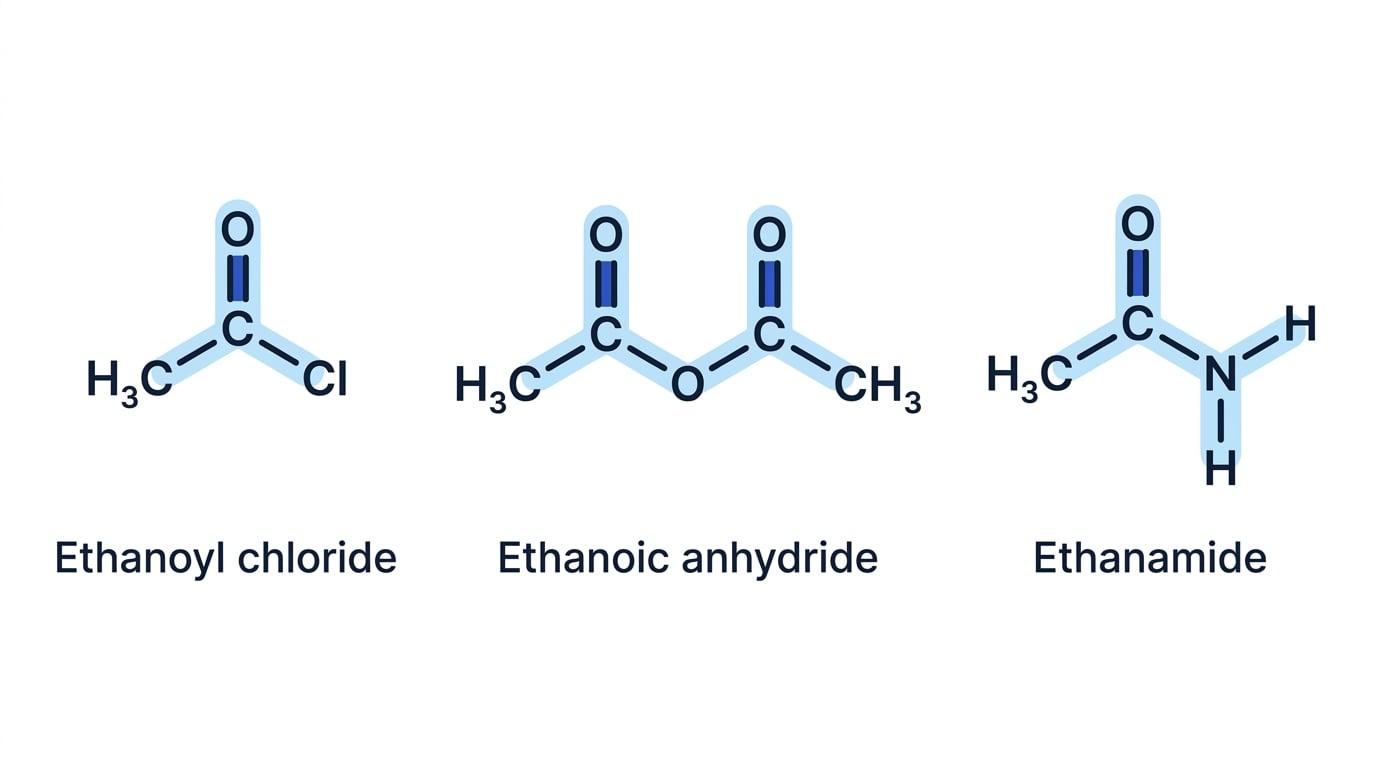
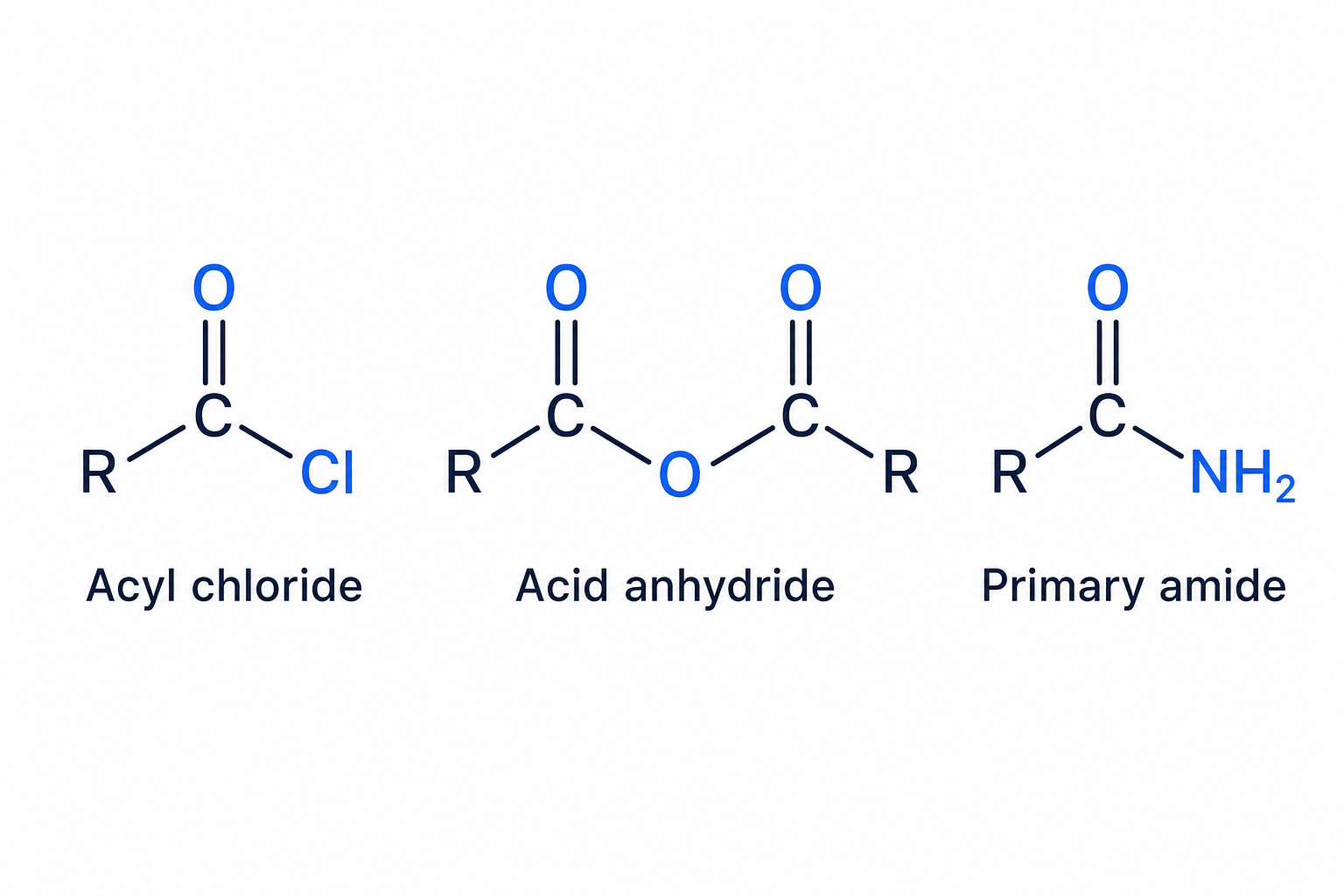
- Acyl chloride: Contains the −COCl-\text{COCl}−COCl functional group. Named with the suffix -oyl chloride (e.g. ethanoyl chloride).
- Acid anhydride: Contains two acyl groups joined by a central oxygen atom, giving the structure (RCO)2O(\text{RCO})_2\text{O}(RCO)2O. Named with the suffix -oic anhydride (e.g. ethanoic anhydride).
- Amide: Contains the −CONH2-\text{CONH}_2−CONH2 functional group. Named with the suffix -amide (e.g. ethanamide).
The Core Mechanism: Nucleophilic Addition–Elimination
Acyl chlorides and acid anhydrides are incredibly reactive. Let's look at an acyl chloride to understand why.
The central carbon atom is bonded to two highly electronegative atoms: oxygen and chlorine. Both of these pull electron density away from the carbon, leaving it with a very large δ+\delta+δ+ charge. This makes the carbon highly attractive to nucleophiles (electron pair donors).
When a nucleophile attacks, the reaction proceeds via a nucleophilic addition–elimination mechanism.
The two stages of the mechanism
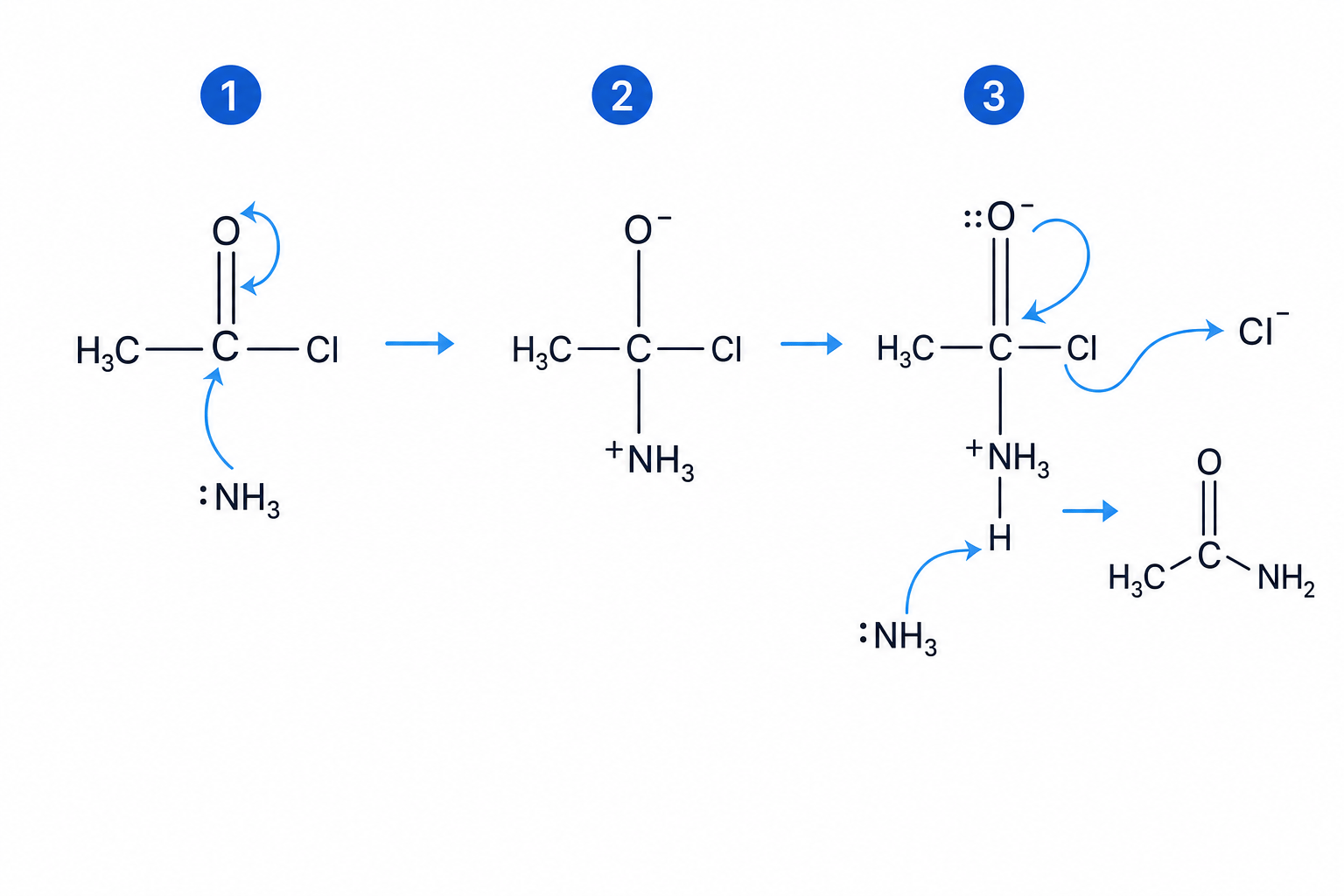
- Addition: The nucleophile attacks the δ+\delta+δ+ carbon, and the C=O\text{C=O}C=O double bond breaks, pushing a pair of electrons onto the oxygen to form a negatively charged intermediate.
- Elimination: The lone pair on the oxygen drops back down to reform the C=O\text{C=O}C=O double bond. This forces the leaving group (the chloride ion, Cl−\text{Cl}^-Cl−, or the carboxylate ion in an anhydride) to break off.
Here is the mechanism showing the reaction between ethanoyl chloride and ammonia:
Drawing the nucleophilic addition-elimination mechanism
- Draw the attack (Addition): Draw a curly arrow from the lone pair on the nucleophile to the δ+\delta+δ+ carbon of the acyl group. Draw a second curly arrow from the middle of the C=O\text{C=O}C=O double bond to the oxygen atom.
- Draw the intermediate: Draw the tetrahedral intermediate. The oxygen now has a single bond and a negative charge (O−\text{O}^-O−). The nucleophile is now attached to the carbon and will have a positive charge (if it was a neutral molecule like ammonia or water).
- Draw the elimination: Draw a curly arrow from the lone pair on the O−\text{O}^-O− back to the C-O\text{C-O}C-O single bond to reform the double bond. Draw another curly arrow from the C-Cl\text{C-Cl}C-Cl bond (or the C-O\text{C-O}C-O bond if it's an anhydride) onto the leaving group to kick it out.
- Remove the extra proton: If your initial nucleophile was neutral (like H2O\text{H}_2\text{O}H2O, NH3\text{NH}_3NH3, or an alcohol), the attached group will still have a positive charge. Draw a final curly arrow from the N-H\text{N-H}N-H or O-H\text{O-H}O-H bond onto the positively charged atom to release an H+\text{H}^+H+ ion and leave the neutral organic product.
Forgetting the intermediate step
Students often try to draw this as a one-step substitution reaction (like an SN2\text{S}_\text{N}2SN2 mechanism) by having the nucleophile attack and the leaving group depart simultaneously. This is wrong. You must show the tetrahedral intermediate where the C=O\text{C=O}C=O double bond has temporarily broken into a C-O−\text{C-O}^-C-O− single bond.
The Four Key Nucleophiles
You need to know the products formed when acyl chlorides and acid anhydrides react with four specific nucleophiles. The organic products are the same whether you use an acyl chloride or an acid anhydride; the only difference is the small by-product eliminated at the end.
- Acyl chlorides eliminate a chloride ion, which pairs with the lost proton to form hydrogen chloride gas (HCl\text{HCl}HCl). This appears as steamy white fumes.
- Acid anhydrides eliminate a carboxylate ion, which pairs with the lost proton to form a carboxylic acid.
1. Water
Water acts as a nucleophile to form a carboxylic acid. With acyl chlorides, this is a violent, highly exothermic reaction at room temperature that produces steamy white fumes of HCl\text{HCl}HCl. Acid anhydrides react similarly but less vigorously, producing two molecules of carboxylic acid (one from the main chain, one as the leaving group).
2. Alcohols
Alcohols react to form esters. This is much faster and less reversible than reacting an alcohol with a carboxylic acid, and it doesn't require an acid catalyst.
3. Ammonia
Ammonia (NH3\text{NH}_3NH3) acts as a nucleophile to form a primary amide. For example, ethanoyl chloride + ammonia →\rightarrow→ ethanamide + hydrogen chloride.
4. Primary Amines
A primary amine (e.g. methylamine, CH3NH2\text{CH}_3\text{NH}_2CH3NH2) reacts to form an N-substituted amide (a secondary amide). Because the nitrogen in the amine still has a lone pair, it attacks the acyl group. The product has an alkyl group attached directly to the nitrogen, which is denoted by an "N-" in the name (e.g. N-methylethanamide).
Identifying the organic product
To quickly predict the organic product, take the acyl group (R-C=O\text{R-C=O}R-C=O) and attach it directly to the nucleophile minus one of its hydrogen atoms.
- H2O\text{H}_2\text{O}H2O loses an H\text{H}H →\rightarrow→ attach −OH-\text{OH}−OH
- R-OH\text{R-OH}R-OH loses an H\text{H}H →\rightarrow→ attach −OR-\text{OR}−OR
- NH3\text{NH}_3NH3 loses an H\text{H}H →\rightarrow→ attach −NH2-\text{NH}_2−NH2
- R-NH2\text{R-NH}_2R-NH2 loses an H\text{H}H →\rightarrow→ attach −NHR-\text{NHR}−NHR
Industrial Acylation: Making Aspirin
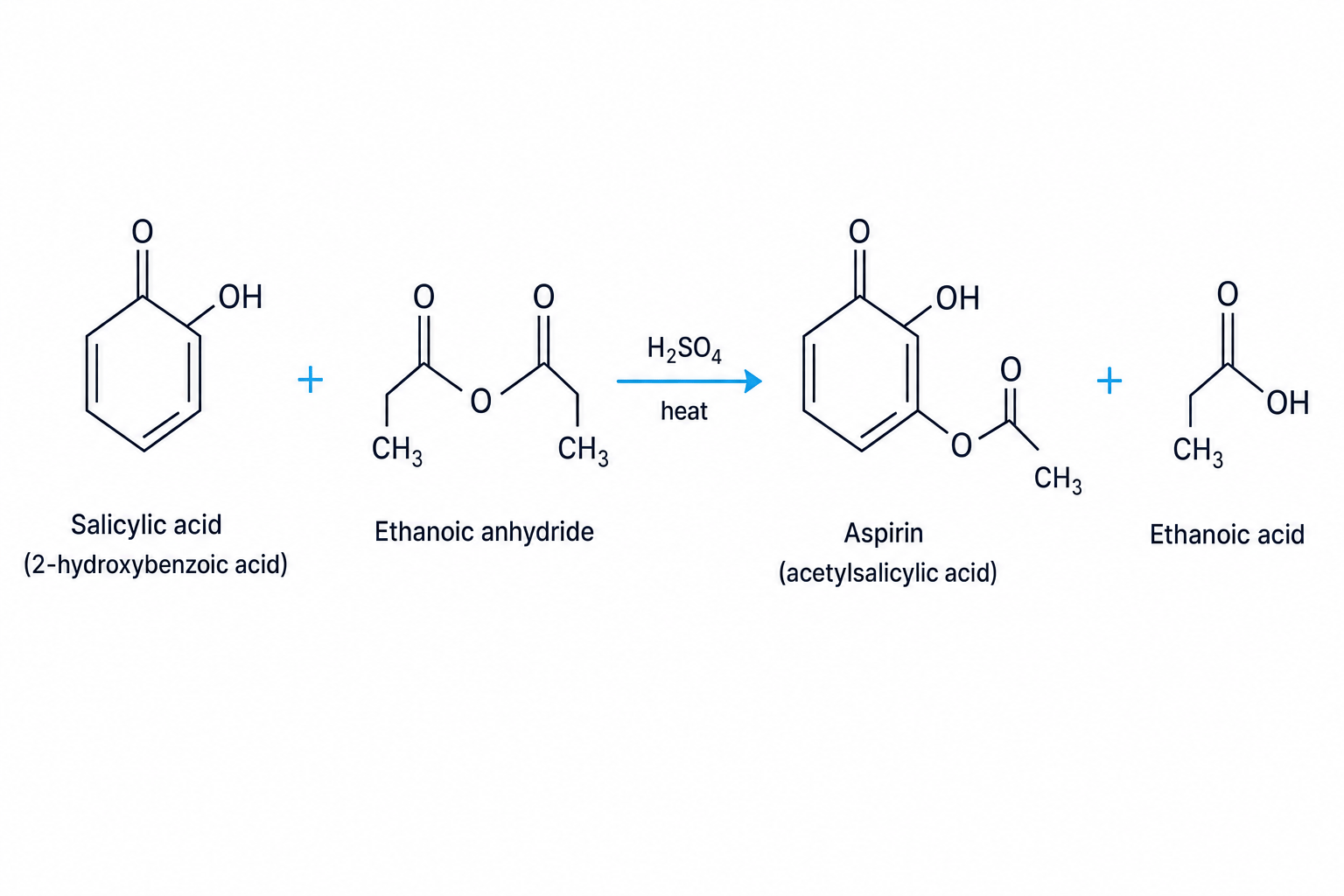
Aspirin is an ester made by acylating salicylic acid (2-hydroxybenzoic acid). The salicylic acid acts as the alcohol nucleophile, and we need an acylating agent to provide an ethanoate group.
We could use ethanoyl chloride, but industrially, ethanoic anhydride is always used instead.
Why ethanoic anhydride is preferred in industry
- It is cheaper than ethanoyl chloride.
- It is less corrosive, making it easier to store and transport.
- It is safer because it reacts more slowly and doesn't violently react with traces of water.
- It does not produce toxic HCl\text{HCl}HCl gas. Instead, the by-product is ethanoic acid, which is less dangerous and can be recycled.
Required Practical 10: Preparation and Purification
In the lab, you will likely synthesise aspirin (or another solid like benzoic acid) and then purify it. This tests your practical skills (PS 2.1, 2.3) in handling organic solids.
1. Synthesis
The reaction mixture is heated. Often, reactions involving volatile liquids are heated under reflux to prevent the solvent or reactants from escaping.
2. Purification by Recrystallisation
The impure solid is purified using recrystallisation. The crude product is dissolved in the minimum volume of hot solvent. It is filtered hot to remove any insoluble impurities. As the solution cools, the pure product crystallises out, leaving soluble impurities behind in the solution. Finally, the crystals are filtered under reduced pressure (using a Buchner funnel), washed with a little cold solvent, and dried.
3. Testing Purity
You test the purity of your solid by measuring its melting point. A pure sample will melt exactly at its data-book value, over a very narrow range (e.g., 135 ∘C135 \text{ }^\circ\text{C}135 ∘C to 136 ∘C136 \text{ }^\circ\text{C}136 ∘C). If the sample is impure, the melting point will be lower than the true value and will melt over a broader range of temperatures.
In the exam
- When drawing the nucleophilic addition-elimination mechanism, always ensure the curly arrow from the double bond goes exactly to the oxygen atom, not floating in space.
- Pay close attention to the charge on the intermediate nitrogen or oxygen atom before it loses its proton. A missing '+' sign will cost you a mark.
- If an exam question asks for the advantages of ethanoic anhydride over ethanoyl chloride, do not just write "safer". You must specify why (e.g. "produces ethanoic acid instead of toxic HCl\text{HCl}HCl gas").
- For recrystallisation questions, explicitly mention the "minimum volume" of "hot" solvent. Both adjectives are usually required for the mark.
Check yourself
- Can you name the mechanism by which ammonia reacts with propanoyl chloride?
- What are the two products formed when ethanol reacts with ethanoic anhydride?
- Why do we use the minimum volume of hot solvent during recrystallisation?
- What visual observation would you make if you added water dropwise to ethanoyl chloride?