

What you'll learn
- What an amino acid is, and which functional groups it contains.
- Why amino acids can behave as both acids and bases.
- How zwitterions form.
- How to draw amino acids in acid solution and alkaline solution.
The starting point: functional groups
Amino acids are organic compounds that contain two important functional groups:
- an amino group,
–NH₂ - a carboxyl group,
–COOH
A functional group is the atom or group of atoms in an organic molecule that gives it its characteristic chemical reactions.
Most amino acids you meet in this topic are α-amino acids. This means the amino group and carboxyl group are attached to the same carbon atom, called the alpha carbon. The general structure is:
H2N−CH(R)−COOH\mathrm{H_2N{-}CH(R){-}COOH}H2N−CH(R)−COOHThe R group is the side chain. It changes from one amino acid to another. For example, in glycine, R is H; in alanine, R is CH₃.
Amino acid
An amino acid is an organic compound containing both an amino group, –NH₂, and a carboxyl group, –COOH.
The two important groups
For this sub-topic, most of the chemistry comes from just two groups: –COOH can donate a proton, and –NH₂ can accept a proton.
Acids, bases and protons
In this topic, use the Brønsted–Lowry definitions:
- an acid is a proton donor
- a base is a proton acceptor
A proton is written as H+\mathrm{H^+}H+. Strictly, in water it is usually present as H3O+\mathrm{H_3O^+}H3O+, but A-Level organic chemistry commonly writes H+\mathrm{H^+}H+ as shorthand.
The carboxyl group can act as an acid:
RCOOH⇌RCOO−+H+\mathrm{RCOOH \rightleftharpoons RCOO^- + H^+}RCOOH⇌RCOO−+H+The amino group can act as a base:
RNH2+H+⇌RNH3+\mathrm{RNH_2 + H^+ \rightleftharpoons RNH_3^+}RNH2+H+⇌RNH3+Because amino acids contain both groups, they can show both acidic and basic behaviour.
Amphoteric
A substance is amphoteric if it can behave as both an acid and a base. Amino acids are amphoteric because they contain both –COOH and –NH₂.
Zwitterions
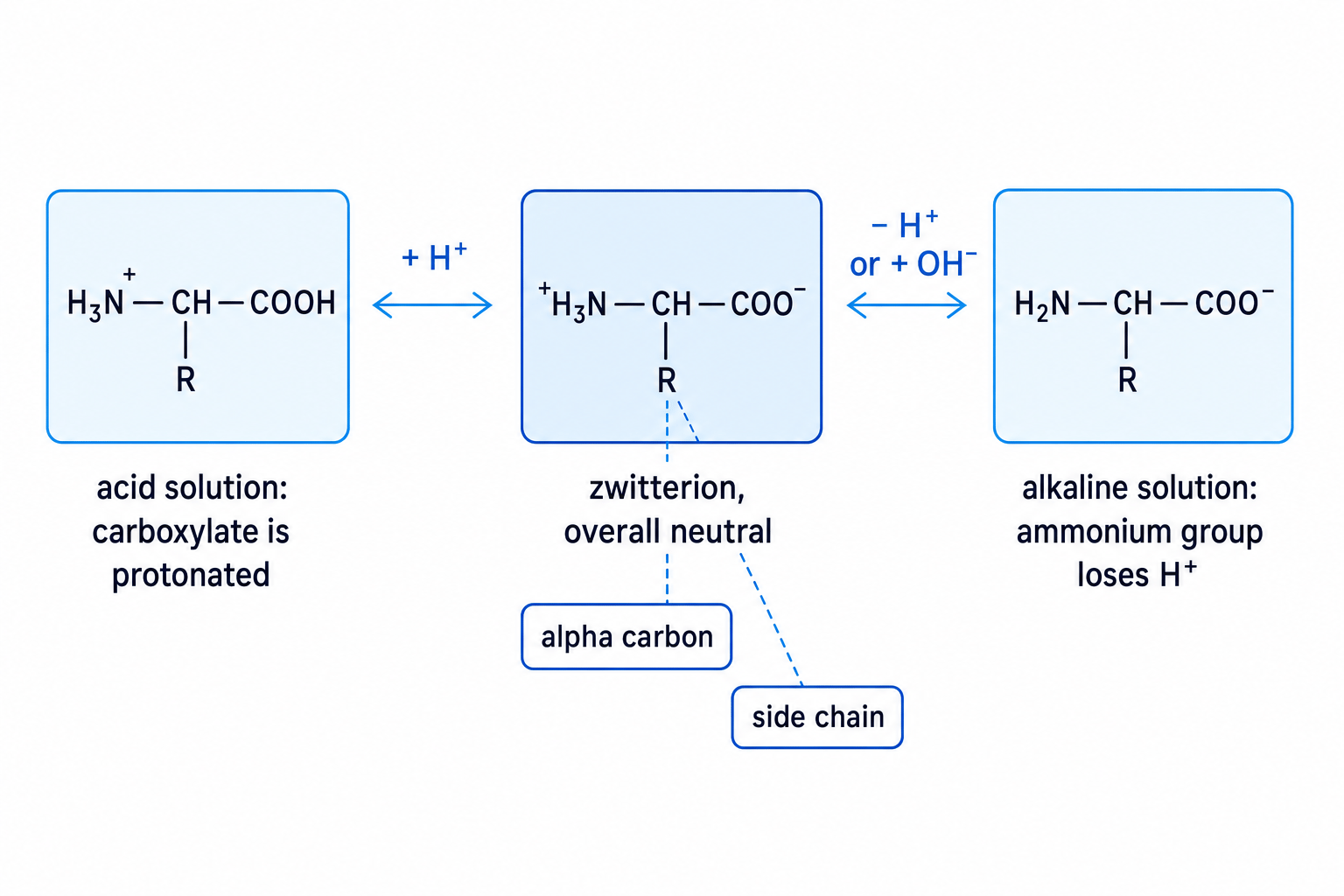
Amino acids often exist as zwitterions. A zwitterion is a species with both a positive charge and a negative charge in the same molecule, but with no overall charge.
For a simple α-amino acid, the carboxyl group donates a proton to the amino group:
H2N−CH(R)−COOH⇌H3N+−CH(R)−COO−\mathrm{H_2N{-}CH(R){-}COOH \rightleftharpoons H_3N^+{-}CH(R){-}COO^-}H2N−CH(R)−COOH⇌H3N+−CH(R)−COO−So the amino acid has:
–NH₃⁺, a positively charged ammonium group–COO⁻, a negatively charged carboxylate group
The total charge is zero overall, because +1 and −1 cancel.
Drawing the zwitterion of alanine
Alanine has the structure H2N−CH(CH3)−COOH\mathrm{H_2N{-}CH(CH_3){-}COOH}H2N−CH(CH3)−COOH. Draw its zwitterion.
-
Identify the side chain: in alanine, the
Rgroup is CH₃, so the carbon skeleton stays as −CH(CH3)−\mathrm{{-}CH(CH_3){-}}−CH(CH3)−. -
Change the carboxyl group from
–COOHto–COO⁻, because it has donated a proton. -
Change the amino group from
–NH₂to–NH₃⁺, because it has accepted that proton. -
Combine the unchanged side chain with the new charged groups:
H3N+−CH(CH3)−COO−\mathrm{H_3N^+{-}CH(CH_3){-}COO^-}H3N+−CH(CH3)−COO−
Forgetting the molecule is neutral overall
A zwitterion is not a positive ion and it is not a negative ion overall. It has internal charges, but the total charge is zero.
Amino acids in acid solution
An acid solution contains an excess of protons, H+\mathrm{H^+}H+.
In acid solution, the amino acid becomes more protonated. Protonated means a species has gained a proton.
For a simple amino acid:
- the amino group is protonated as
–NH₃⁺ - the carboxylate group is also protonated, becoming
–COOH
So the acid solution form is:
H3N+−CH(R)−COOH\mathrm{H_3N^+{-}CH(R){-}COOH}H3N+−CH(R)−COOHThis has an overall charge of +1, so it is a cation. A cation is a positively charged ion.
Acid solution form
In acid solution, a simple amino acid is fully protonated: –NH₃⁺ and –COOH.
Amino acids in alkaline solution
An alkaline solution contains hydroxide ions, OH−\mathrm{OH^-}OH−.
In alkaline solution, protons are removed. Deprotonated means a species has lost a proton.
For a simple amino acid:
- the carboxyl group is deprotonated to
–COO⁻ - the ammonium group loses a proton, becoming
–NH₂
So the alkaline solution form is:
H2N−CH(R)−COO−\mathrm{H_2N{-}CH(R){-}COO^-}H2N−CH(R)−COO−This has an overall charge of −1, so it is an anion. An anion is a negatively charged ion.
Alkaline solution form
In alkaline solution, a simple amino acid is fully deprotonated: –NH₂ and –COO⁻.
Drawing acid and alkaline forms of glycine
Glycine has the structure H2N−CH2−COOH\mathrm{H_2N{-}CH_2{-}COOH}H2N−CH2−COOH. Draw the ions formed in acid solution and alkaline solution.
-
Identify the two reactive groups: glycine contains an amino group,
–NH₂, and a carboxyl group,–COOH. -
In acid solution, add a proton to the amino group and keep the carboxyl group protonated. The structure is:
H3N+−CH2−COOH\mathrm{H_3N^+{-}CH_2{-}COOH}H3N+−CH2−COOH -
Check the charge in acid solution:
–NH₃⁺gives +1, while–COOHis neutral, so the ion has overall charge +1. -
In alkaline solution, remove a proton from the carboxyl group and keep the amino group as
H2N−CH2−COO−\mathrm{H_2N{-}CH_2{-}COO^-}H2N−CH2−COO−–NH₂. The structure is: -
Check the charge in alkaline solution:
–NH₂is neutral, while–COO⁻gives −1, so the ion has overall charge −1.
A quick decision method
For the simple amino acids in this part of the specification, think in terms of protonation level.
Acid solution: add protons
The acid form is the most protonated form:
H3N+−CH(R)−COOH\mathrm{H_3N^+{-}CH(R){-}COOH}H3N+−CH(R)−COOHZwitterion: one internal proton transfer
The zwitterion has one positive and one negative charge:
H3N+−CH(R)−COO−\mathrm{H_3N^+{-}CH(R){-}COO^-}H3N+−CH(R)−COO−Alkaline solution: remove protons
The alkaline form is the most deprotonated form:
H2N−CH(R)−COO−\mathrm{H_2N{-}CH(R){-}COO^-}H2N−CH(R)−COO−Memory shortcut
Acid adds/keeps H: –NH₃⁺ and –COOH. Alkali removes H: –NH₂ and –COO⁻.
Changing the carbon skeleton
When converting between forms, do not change the R group or the carbon chain. Only change the hydrogens and charges on the amino and carboxyl groups.
Why zwitterions matter
Zwitterions help explain why amino acids often behave more like ionic compounds than typical small covalent organic molecules.
Because zwitterions contain charged groups, amino acids often have:
- relatively high melting points
- good solubility in water
- poor solubility in non-polar solvents
This comes from strong attractions between oppositely charged groups and interactions with polar water molecules.
Side chains can complicate things
Some amino acids have acidic or basic side chains, but for this specification point you are usually expected to focus on the amino group and carboxyl group in the main amino acid structure.
In the exam
-
If asked for the zwitterion, draw both charges:
–NH₃⁺and–COO⁻, with no overall charge. -
If asked for the ion in acid solution, draw the fully protonated form:
–NH₃⁺and–COOH. -
If asked for the ion in alkaline solution, draw the fully deprotonated form:
–NH₂and–COO⁻.
Check yourself
- What two functional groups are present in an amino acid?
- Why does a zwitterion have no overall charge?
- What are the structures of glycine in acid solution and alkaline solution?
