What you'll learn
- How alkenes and substituted alkenes form addition polymers.
- How to draw a repeating unit from a monomer, and work backwards to the monomer.
- How to name addition polymers using IUPAC-style names such as poly(ethene).
- Why addition polymers are generally unreactive, and how PVC can be made rigid or flexible.
Prerequisites: alkenes and the C=C bond
An alkene is a hydrocarbon containing at least one carbon-carbon double bond, C=C. Because it contains a double bond, an alkene is described as unsaturated.
A substituted alkene is an alkene where one or more hydrogen atoms have been replaced by another atom or group. For example:
- chloroethene has Cl attached to the alkene structure
- phenylethene has a phenyl group, C₆H₅, attached to the alkene structure
- propene has a CH₃ group attached to one of the alkene carbons
The key idea is that the C=C double bond is reactive. In addition polymerisation, the double bond opens up so many alkene molecules can join together.
What is addition polymerisation?
Addition polymerisation
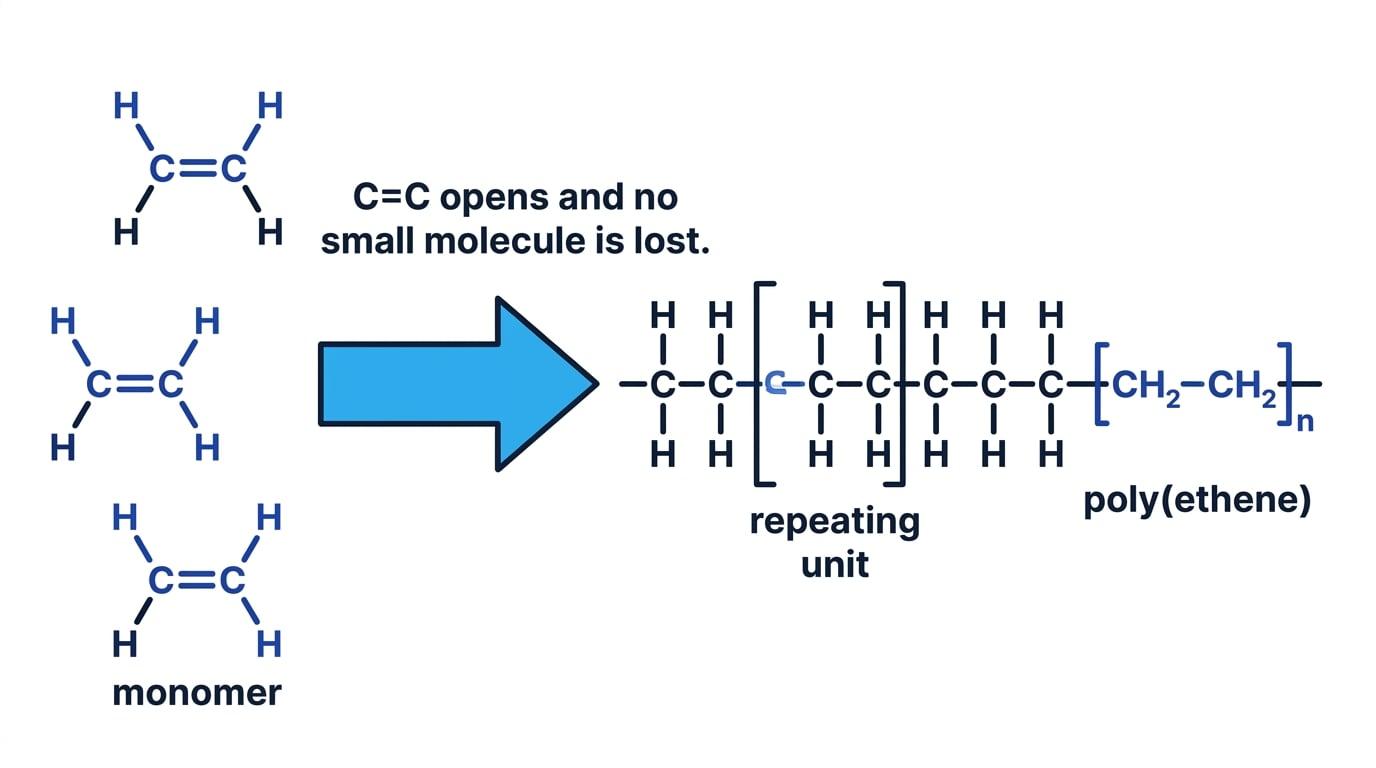
Addition polymerisation is the formation of a polymer by the joining together of many alkene or substituted alkene monomers, with no small molecule eliminated.
A monomer is a small molecule that can join to many others to form a polymer. A polymer is a very large molecule made from many repeating units joined in a chain.
For ethene:
n CH2=CH2→[−CH2−CH2−]nn\,\text{CH}_2=\text{CH}_2 \to \left[-\text{CH}_2-\text{CH}_2-\right]_nnCH2=CH2→[−CH2−CH2−]nThe double bonds in the monomers open up, and new C–C single bonds form between monomer units.
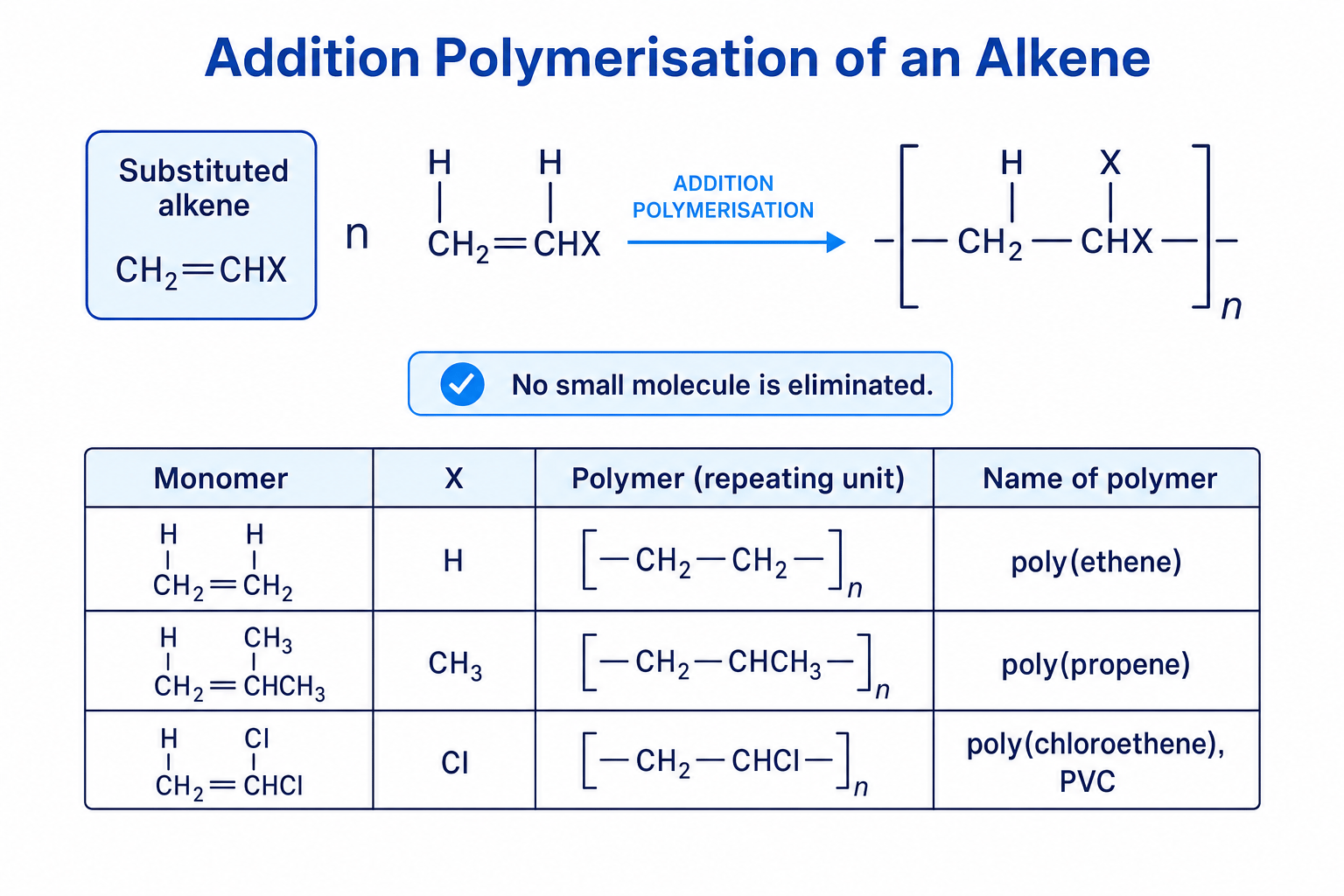
No small molecule is lost
Addition polymerisation is an addition reaction: all atoms from the monomers are retained in the polymer. This is different from condensation polymerisation, where small molecules such as water or HCl may be eliminated.
The repeating unit
Repeating unit
The repeating unit is the smallest section of a polymer chain that repeats over and over again to make the polymer.
For addition polymers made from one alkene monomer, the repeating unit normally contains the two carbon atoms that used to be in the C=C double bond.
Drawing a repeating unit from a monomer
To draw the repeating unit from an alkene monomer:
- Identify the two carbon atoms in the C=C double bond.
- Change the C=C double bond into a C–C single bond.
- Keep all atoms or groups attached to the same carbon atoms.
- Put square brackets around the repeating unit.
- Show bonds going out through the brackets, and put nnn outside the bracket.
Drawing the repeating unit from propene
Draw the repeating unit of poly(propene) from propene, CH2=CHCH3\text{CH}_2=\text{CHCH}_3CH2=CHCH3.
- The two alkene carbons are the carbon in CH2\text{CH}_2CH2 and the carbon in CHCH3\text{CHCH}_3CHCH3.
- Open the C=C double bond and replace it with a C–C single bond, so the backbone becomes −CH2−CH−-\text{CH}_2-\text{CH}-−CH2−CH−.
- Keep the CH3\text{CH}_3CH3 group attached to the second carbon, because it was attached there in the monomer.
- Put the repeating unit in brackets with continuation bonds:
Losing the side group
Do not drop substituents such as CH3\text{CH}_3CH3, Cl or C6H5\text{C}_6\text{H}_5C6H5. They do not disappear during addition polymerisation; they stay attached to the same carbon atom in the repeating unit.
Drawing a repeating unit from a polymer chain
Sometimes you are given a section of polymer chain rather than the monomer.
For example:
−CH2−CHCl−CH2−CHCl−CH2−CHCl−-\text{CH}_2-\text{CHCl}-\text{CH}_2-\text{CHCl}-\text{CH}_2-\text{CHCl}-−CH2−CHCl−CH2−CHCl−CH2−CHCl−The smallest section that keeps repeating is:
−CH2−CHCl−-\text{CH}_2-\text{CHCl}-−CH2−CHCl−So the repeating unit is:
[−CH2−CHCl−]n\left[-\text{CH}_2-\text{CHCl}-\right]_n[−CH2−CHCl−]nFind the shortest repeating pattern
In addition polymers, look along the carbon backbone and find the smallest block of atoms that repeats exactly. Do not put two or three repeats inside the bracket if one repeat is enough.
Working backwards: polymer to monomer
To find the monomer from an addition polymer:
- Take one repeating unit.
- Remove the brackets and the continuation bonds.
- Put a C=C double bond between the two backbone carbon atoms.
- Keep all side groups attached to the same carbon atoms.
Finding the monomer from a repeating unit
Find the monomer for this polymer:
[−CH2−CH(C6H5)−]n\left[-\text{CH}_2-\text{CH}\left(\text{C}_6\text{H}_5\right)-\right]_n[−CH2−CH(C6H5)−]n- The repeating unit has two backbone carbon atoms: CH2\text{CH}_2CH2 and CH(C6H5)\text{CH}\left(\text{C}_6\text{H}_5\right)CH(C6H5).
- To reverse addition polymerisation, put a double bond between those two carbons.
- Keep the C6H5\text{C}_6\text{H}_5C6H5 group attached to the second carbon.
- The monomer is:
This monomer is phenylethene, so the polymer is poly(phenylethene).
Assume a single alkene monomer unless told otherwise
At this level, when you are asked to work backwards from a simple addition polymer, the repeating unit usually comes from one alkene or substituted alkene monomer.
Naming addition polymers
The IUPAC-style naming pattern is:
poly(monomer name)
Examples:
- ethene forms poly(ethene)
- propene forms poly(propene)
- chloroethene forms poly(chloroethene), commonly called PVC
- phenylethene forms poly(phenylethene)
Forgetting the brackets in the name
The preferred A-Level format is poly(ethene) rather than “polyethene” when using the monomer-based name. The brackets show that the name inside is the monomer name.
Why addition polymers are unreactive
Addition polymers made from alkenes have a saturated carbon chain. This means the C=C double bonds from the monomers have been converted into C–C single bonds in the polymer.
This matters because C=C double bonds are a common reactive site in organic chemistry. Once the polymer has formed, the chain mostly contains strong C–C and C–H bonds, and often lacks a reactive functional group.
So poly(ethene), poly(propene) and many similar polymers are chemically resistant under normal conditions.
Unreactive does not mean indestructible
Addition polymers are relatively unreactive in many everyday chemical conditions, but they can still burn, soften when heated, or degrade slowly in sunlight depending on the polymer and additives.
Intermolecular forces between polymer chains
A polymer sample contains many long polymer molecules packed together. The attractions between separate polymer chains are intermolecular forces.
For simple polyalkenes such as poly(ethene) and poly(propene), the chains are mostly non-polar hydrocarbons. The main intermolecular forces are London forces, also called induced dipole-dipole forces.
Although each London force is weak, polymer chains are very long, so there are many points of contact between chains. Together, these attractions can make the material strong and solid.
In substituted polymers, extra intermolecular forces may be present. For example, poly(chloroethene), PVC, contains polar C–Cl bonds, so permanent dipole-dipole attractions can occur between chains as well as London forces.
Explaining why long polymer chains can form strong solids
Explain why poly(ethene) is a solid even though London forces are weak.
- Poly(ethene) molecules are very long chains, so each chain has a large surface area in contact with neighbouring chains.
- London forces act at many points along the chains.
- The total attraction between chains is the sum of many weak interactions, so a large amount of energy is needed to separate the chains.
Putting covalent bonds between chains
In ordinary polyalkenes, the strong covalent bonds are within each polymer chain. The attractions between chains are intermolecular forces, not covalent bonds.
PVC and plasticisers
Poly(chloroethene), commonly called PVC, can be made as either a rigid or flexible material.
Rigid PVC is used for things such as:
- drainpipes
- window frames
- guttering
- bottles or packaging
Flexible PVC is used for things such as:
- electrical cable insulation
- flooring
- rainwear
- flexible tubing
Plasticiser
A plasticiser is a substance added to a polymer to make it more flexible by reducing the effectiveness of attractions between polymer chains.
In PVC, plasticiser molecules get between the polymer chains. This increases the separation between chains and reduces how strongly they attract each other. The chains can then slide past each other more easily, making the material more flexible.
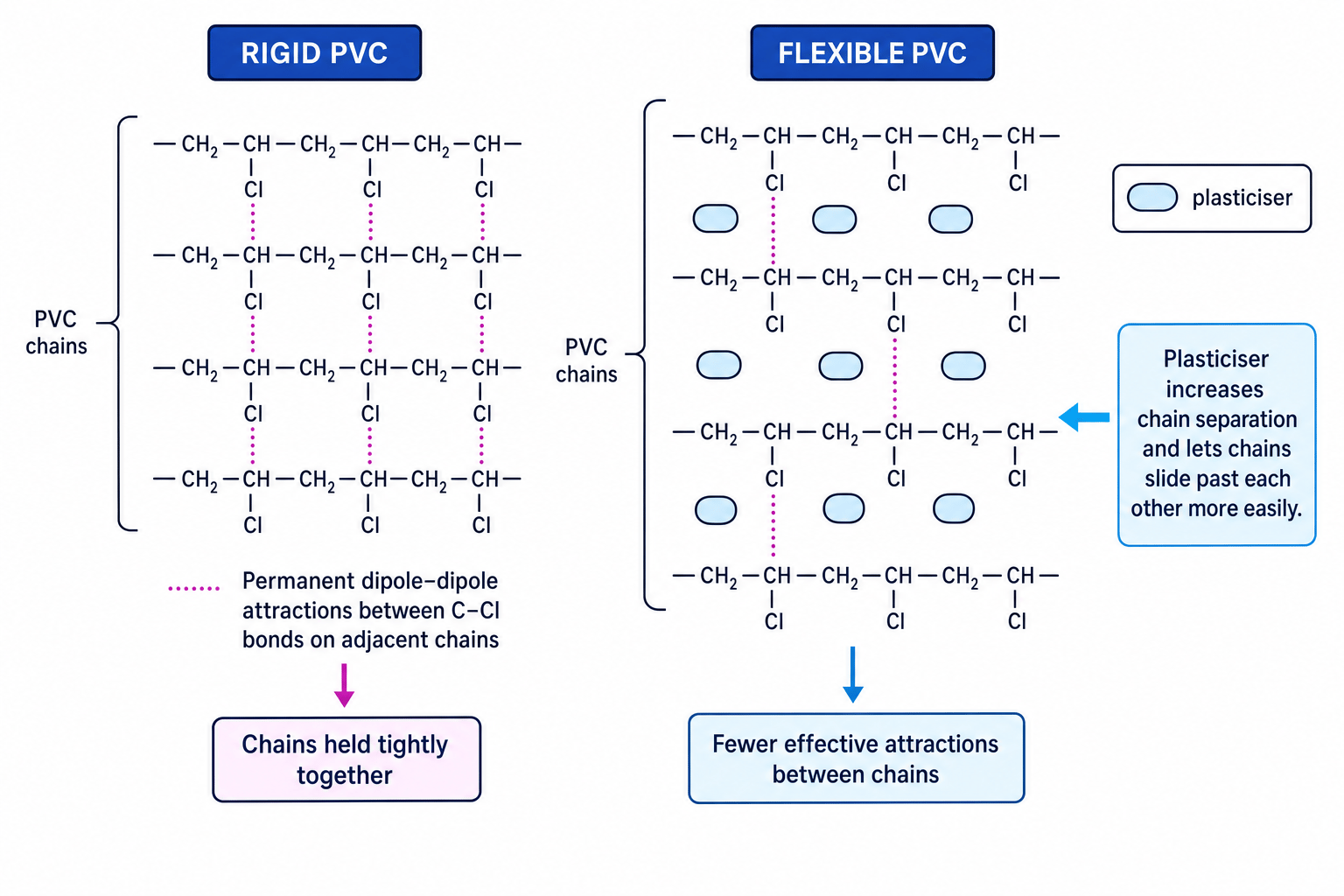
This is a good example of how polymer science has developed over time. Chemists learned that the properties of polymers depend not only on the monomer, but also on chain length, chain packing, branching and additives such as plasticisers.
Explaining the effect of a plasticiser on PVC
Explain why adding a plasticiser makes PVC more flexible.
- PVC chains have attractions between them, including London forces and permanent dipole-dipole attractions from polar C–Cl bonds.
- Plasticiser molecules fit between the PVC chains and increase the distance between them.
- The intermolecular attractions between chains become less effective, so the chains can slide over each other more easily.
- Because the chains can move more freely, the PVC becomes more flexible.
A note on making poly(phenylethene)
In the laboratory, phenylethene can be polymerised to make poly(phenylethene). This usually involves conditions that generate reactive species to start the polymerisation.
You do not need the full radical mechanism for this section, but you should recognise the overall change: the alkene double bond in phenylethene opens, and many monomers join into a saturated polymer chain.
In the exam
- When drawing a repeating unit, always show square brackets, continuation bonds through the brackets, and nnn outside.
- When working backwards to the monomer, put the C=C double bond between the two backbone carbons of the repeat unit.
- When explaining unreactivity, link it to the loss of the reactive C=C bond and the presence of strong covalent bonds in a saturated chain.
- For PVC and plasticisers, focus on intermolecular forces: plasticisers increase chain separation and allow chains to slide more easily.
Check yourself
- Can you draw the repeating unit for chloroethene and name the polymer?
- Given a polymer section such as −CH2−CH(CH3)−CH2−CH(CH3)−-\text{CH}_2-\text{CH}\left(\text{CH}_3\right)-\text{CH}_2-\text{CH}\left(\text{CH}_3\right)-−CH2−CH(CH3)−CH2−CH(CH3)−, can you find the monomer?
- Can you explain why poly(ethene) is relatively unreactive compared with ethene?