

What you'll learn
- Why cells need cellular respiration to transfer energy to ATP.
- How the structure of a mitochondrion links to aerobic respiration.
- The stages of aerobic respiration: glycolysis, link reaction, Krebs cycle and oxidative phosphorylation.
- How anaerobic respiration, respiratory substrates, RQ and respirometers are used in practical and exam questions.
Why cells need respiration
Cellular respiration and ATP
Cellular respiration is the enzyme-controlled process in which energy stored in complex organic molecules is transferred to ATP. ATP, or adenosine triphosphate, is the immediate energy-transfer molecule used by cells.
Respiration does not “make energy”; it transfers energy into a useful form. ATP can be hydrolysed to ADP and inorganic phosphate, releasing energy in small, manageable amounts for cellular processes.
All living organisms respire:
- Plants need ATP for active transport of mineral ions into root hair cells, loading sucrose into phloem, and synthesising molecules such as cellulose, starch and proteins.
- Animals need ATP for muscle contraction, nerve impulse transmission, active transport, protein synthesis and DNA replication before cell division.
- Microorganisms need ATP for active transport of nutrients, movement, enzyme synthesis and making cell walls or membranes.
Respiration is not breathing
Breathing is ventilation: moving air into and out of lungs. Cellular respiration is a chemical process occurring inside cells, including plant and microorganism cells.
The mitochondrion
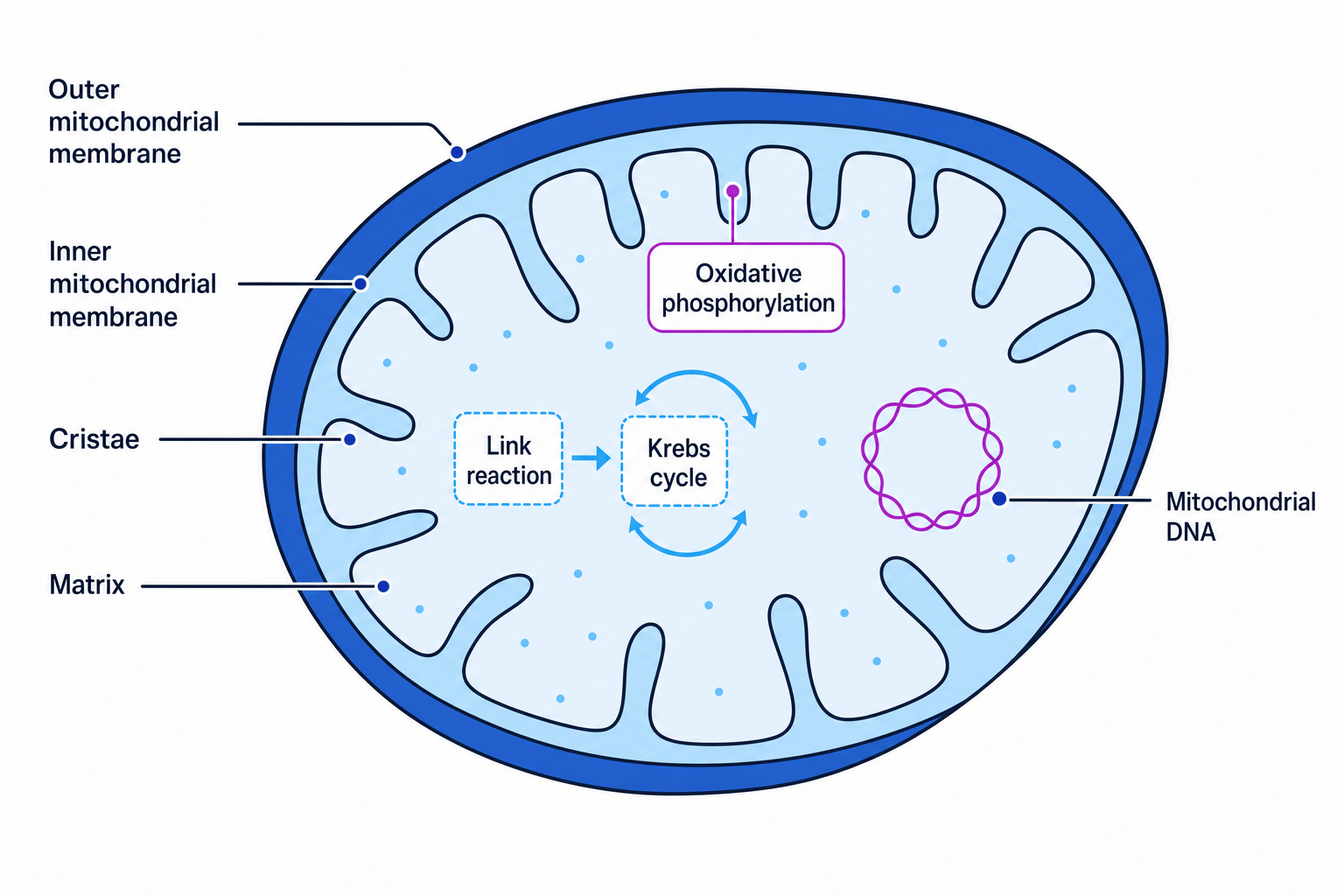
A mitochondrion is the organelle where most aerobic respiration occurs in eukaryotic cells. It has an outer mitochondrial membrane, an inner mitochondrial membrane folded into cristae, a fluid-filled matrix, and its own mitochondrial DNA.
The matrix contains enzymes for the link reaction and Krebs cycle. The cristae increase the surface area for electron carriers and ATP synthase used in oxidative phosphorylation.
Structure matches function
The matrix is the site of the link reaction and Krebs cycle; the inner mitochondrial membrane and cristae are the site of oxidative phosphorylation.
Key chemistry: oxidation, reduction and coenzymes
Oxidation is loss of electrons or hydrogen. Reduction is gain of electrons or hydrogen. In respiration, many molecules are oxidised by dehydrogenation, meaning hydrogen is removed.
A coenzyme is a small non-protein molecule that helps an enzyme work. In respiration:
- NAD and FAD carry hydrogen/electrons from dehydrogenation reactions to the electron transport chain.
- Reduced NAD and reduced FAD are the loaded forms.
- Coenzyme A carries a two-carbon acetyl group into the Krebs cycle.
Aerobic respiration: the overall route
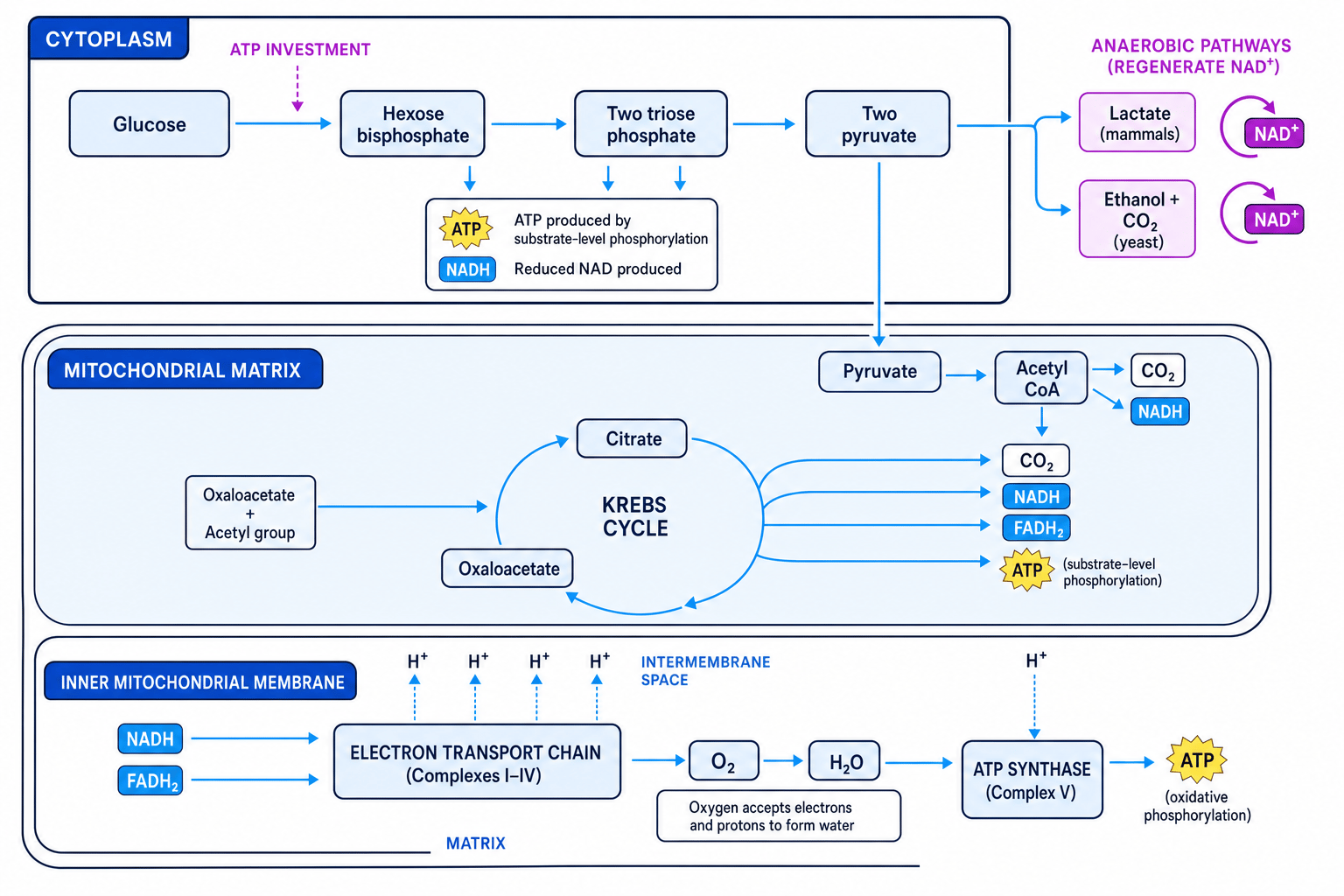
Aerobic respiration uses oxygen and has four linked stages: glycolysis, link reaction, Krebs cycle and oxidative phosphorylation.
1. Glycolysis in the cytoplasm
Glycolysis occurs in the cytoplasm and does not directly require oxygen.
- Glucose is phosphorylated using ATP to form hexose bisphosphate.
- Hexose bisphosphate splits into two triose phosphate molecules.
- Each triose phosphate is oxidised to pyruvate.
- NAD is reduced to reduced NAD.
- ATP is produced by substrate-level phosphorylation, where phosphate is transferred directly from an intermediate molecule to ADP.
Per glucose molecule, glycolysis gives a small net yield of 2 ATP, 2 reduced NAD and 2 pyruvate.
2. The link reaction in the mitochondrial matrix
The link reaction occurs in the mitochondrial matrix. Each pyruvate is:
- Decarboxylated: carbon dioxide is removed.
- Dehydrogenated: hydrogen is removed and NAD is reduced.
- Combined with coenzyme A to form acetyl coenzyme A.
Per glucose molecule, the link reaction happens twice, forming 2 acetyl coenzyme A, 2 carbon dioxide and 2 reduced NAD.
3. The Krebs cycle in the mitochondrial matrix
The Krebs cycle also occurs in the matrix. The acetyl group from acetyl coenzyme A combines with oxaloacetate to form citrate. Citrate is then converted back to oxaloacetate through a series of reactions.
You do not need the names of the intermediate compounds between citrate and oxaloacetate, but you do need the key processes:
- Decarboxylation releases carbon dioxide.
- Dehydrogenation reduces NAD and FAD.
- Substrate-level phosphorylation produces ATP.
Per turn of the cycle, one acetyl group produces 2 carbon dioxide, 3 reduced NAD, 1 reduced FAD and 1 ATP.
Tracking products up to the end of the Krebs cycle
-
One glucose molecule forms 2 pyruvate in glycolysis, so the link reaction and Krebs cycle each run twice.
-
The link reaction produces 1 carbon dioxide and 1 reduced NAD per pyruvate, so per glucose it produces 2 carbon dioxide and 2 reduced NAD.
-
The Krebs cycle produces 2 carbon dioxide, 3 reduced NAD, 1 reduced FAD and 1 ATP per turn, so per glucose it produces 4 carbon dioxide, 6 reduced NAD, 2 reduced FAD and 2 ATP.
-
Up to the end of the Krebs cycle, complete oxidation of one glucose has produced 6 carbon dioxide in total, matching the 6 carbons originally in glucose.
Oxidative phosphorylation and chemiosmosis
Oxidative phosphorylation is ATP production using energy released from the oxidation of reduced NAD and reduced FAD. It occurs on the inner mitochondrial membrane.
Electrons pass along electron carriers in the electron transport chain. The energy released pumps protons, H⁺, from the matrix into the intermembrane space. This creates a proton gradient.
Protons then diffuse back into the matrix through ATP synthase. This movement of protons down an electrochemical gradient is called chemiosmosis, and it drives ATP production from ADP and inorganic phosphate.
Oxygen is the final electron acceptor. It combines with electrons and protons to form water. Without oxygen, the electron transport chain stops, so reduced NAD and reduced FAD cannot be reoxidised efficiently.
Chemiosmosis links respiration and photosynthesis
The same principle is used in oxidative phosphorylation and photophosphorylation: an electron transport chain creates a proton gradient, and ATP synthase uses proton flow to make ATP.
Anaerobic respiration in eukaryotes
Anaerobic respiration releases ATP without oxygen. It produces much less ATP than aerobic respiration because only glycolysis continues; the link reaction, Krebs cycle and oxidative phosphorylation cannot continue properly.
In mammals, pyruvate accepts hydrogen from reduced NAD to form lactate. This regenerates NAD, allowing glycolysis to continue during intense exercise when oxygen supply is limited.
In yeast, pyruvate is converted to ethanol and carbon dioxide. Reduced NAD is oxidised back to NAD, again allowing glycolysis to continue. This is useful for yeast in low-oxygen conditions and is exploited in brewing and bread-making.
Investigating yeast respiration
For yeast, you can compare aerobic and anaerobic respiration by measuring carbon dioxide production over time.
Typical good practice includes:
- Use yeast suspension, glucose solution and a buffer to control pH.
- Keep temperature constant using a water bath.
- Provide oxygen for aerobic conditions, for example by shaking or leaving air space.
- Exclude oxygen for anaerobic conditions, for example using a layer of oil.
- Measure carbon dioxide with a gas syringe or another calibrated method.
- Repeat, calculate a mean rate, and identify anomalies.
Respiratory substrates and energy values
A respiratory substrate is an organic molecule used in respiration.
Carbohydrates, lipids and proteins can all be respired, but they differ in energy value:
- Carbohydrates release about 17 kJ g⁻¹ and are commonly used as immediate substrates.
- Lipids release about 39 kJ g⁻¹ because they have many carbon-hydrogen bonds, so they store more chemical energy per gram.
- Proteins release about 17 kJ g⁻¹, but amino acids must first be deaminated, so proteins are not usually the preferred respiratory substrate.
Respiratory quotient, RQ
The respiratory quotient, RQ, compares carbon dioxide produced with oxygen consumed:
RQ=carbon dioxide producedoxygen consumedRQ = \frac{\text{carbon dioxide produced}}{\text{oxygen consumed}}RQ=oxygen consumedcarbon dioxide producedTypical values are:
- Carbohydrate: RQ about 1.0
- Lipid: RQ about 0.7
- Protein: RQ about 0.8 to 0.9
Lipids have a lower RQ because they require more oxygen for complete oxidation.
Calculating RQ
A sample of germinating seeds produces 5.0 cm³ of carbon dioxide and consumes 7.1 cm³ of oxygen in the same time period.
-
Use the RQ formula with matching units for both gases.
-
Substitute the values:
RQ=5.0 cm37.1 cm3=0.704RQ = \frac{5.0\ \text{cm}^3}{7.1\ \text{cm}^3} = 0.704RQ=7.1 cm35.0 cm3=0.704 -
The units cancel, so RQ has no unit. An RQ of about 0.70 suggests lipid is the main respiratory substrate.
Investigating respiration rate with a respirometer
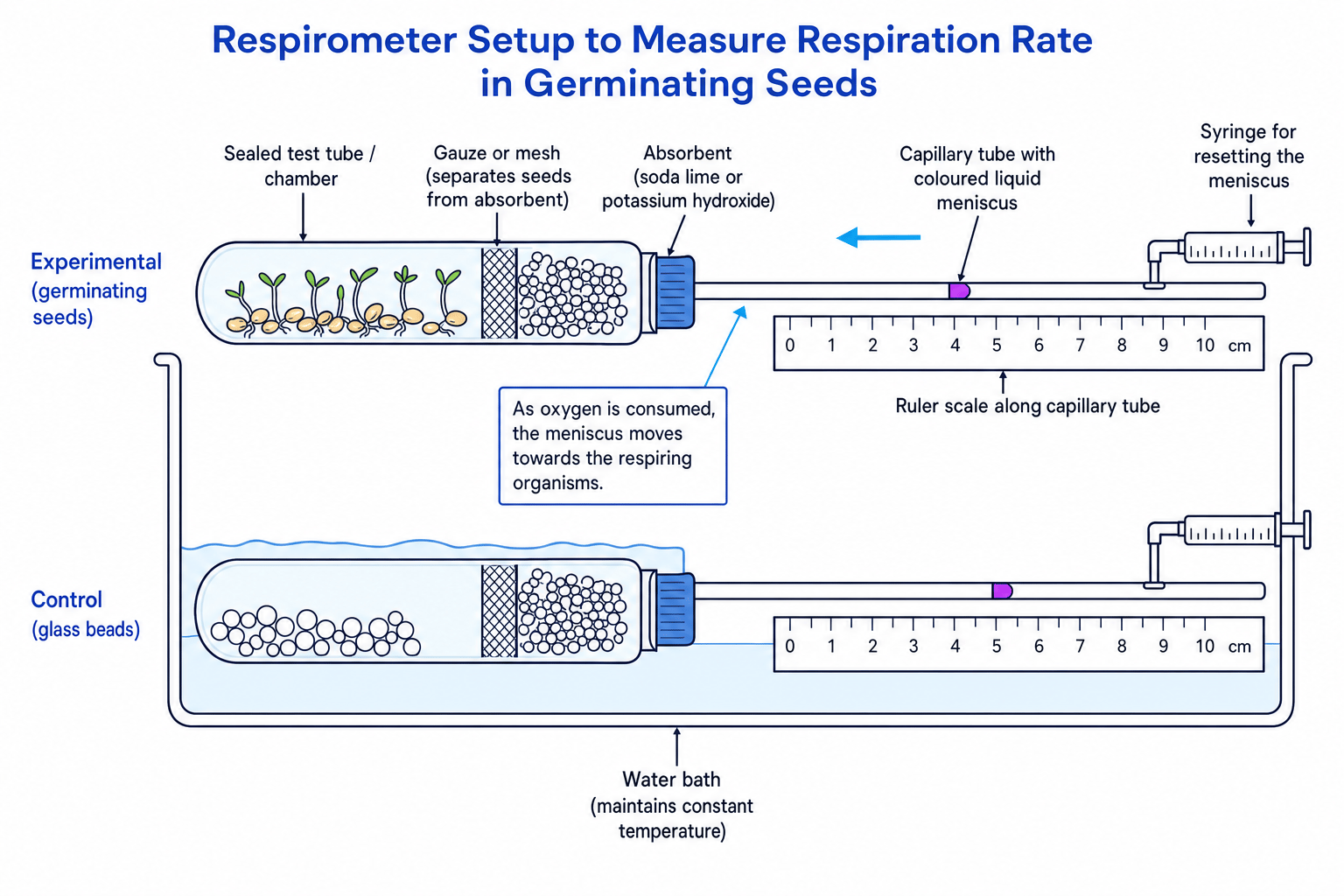
A respirometer measures oxygen uptake by respiring organisms. Carbon dioxide is absorbed by soda lime or potassium hydroxide, so any decrease in gas volume is due to oxygen being used in respiration.
You can investigate factors such as:
- Temperature: use a water bath; respiration usually increases with temperature up to an optimum, then decreases if enzymes denature.
- Substrate concentration: with yeast, increase glucose concentration and measure rate until another factor becomes limiting.
- Different respiratory substrates: compare substrates fairly by controlling organism mass, temperature, pH, volume and concentration where possible.
Forgetting the control tube
A control tube with glass beads of equal volume corrects for changes in pressure or temperature that are not due to respiration.
Calculating respiration rate
In a respirometer, the experimental meniscus moves 18.0 mm in 300 s. The control meniscus moves 2.0 mm in the same direction. The capillary tube cross-sectional area is 0.80 mm².
-
Correct the movement using the control:
corrected distance=18.0 mm−2.0 mm=16.0 mm\text{corrected distance} = 18.0\ \text{mm} - 2.0\ \text{mm} = 16.0\ \text{mm}corrected distance=18.0 mm−2.0 mm=16.0 mm -
Convert distance moved into oxygen volume:
volume=16.0 mm×0.80 mm2=12.8 mm3\text{volume} = 16.0\ \text{mm} \times 0.80\ \text{mm}^2 = 12.8\ \text{mm}^3volume=16.0 mm×0.80 mm2=12.8 mm3 -
Calculate rate:
rate=12.8 mm3300 s=0.0427 mm3 s−1\text{rate} = \frac{12.8\ \text{mm}^3}{300\ \text{s}} = 0.0427\ \text{mm}^3\ \text{s}^{-1}rate=300 s12.8 mm3=0.0427 mm3 s−1 -
In SI base units, this is:
0.0427 mm3 s−1=4.27×10⁻¹¹ m3 s−10.0427\ \text{mm}^3\ \text{s}^{-1} = 4.27 \times 10^{-11}\ \text{m}^3\ \text{s}^{-1}0.0427 mm3 s−1=4.27×10⁻¹¹ m3 s−1
In the exam
- State both the process and the site: for example, glycolysis in the cytoplasm, Krebs cycle in the matrix, oxidative phosphorylation on the inner mitochondrial membrane.
- Link reduced NAD and reduced FAD to the electron transport chain; do not just say they “make ATP”.
- For practical questions, name the independent variable, dependent variable, control variables, repeats, and how rate is calculated.
Check yourself
- Why does lack of oxygen stop the Krebs cycle even though oxygen is used at the electron transport chain?
- How are NAD, FAD and coenzyme A different in their roles?
- What would an RQ of about 0.7 suggest about the respiratory substrate?
