

What you'll learn
- How photosynthesis and respiration are linked by their raw materials and products.
- Where the light-dependent stage and Calvin cycle happen inside a chloroplast.
- How pigments harvest light, including how TLC separates leaf pigments.
- How limiting factors affect photosynthesis rate and levels of GP, TP and RuBP.
The big picture: photosynthesis and respiration
Photosynthesis
Photosynthesis is the process in which light energy is harvested and used to synthesise organic molecules from inorganic molecules, mainly carbon dioxide and water.
The overall equation is often simplified to:
6CO2+6H2O→light energyC6H12O6+6O26\text{CO}_2 + 6\text{H}_2\text{O} \xrightarrow{\text{light energy}} \text{C}_6\text{H}_{12}\text{O}_6 + 6\text{O}_26CO2+6H2Olight energyC6H12O6+6O2Aerobic respiration uses glucose and oxygen to release energy for ATP production:
C6H12O6+6O2→6CO2+6H2O+energy transferred to ATP\text{C}_6\text{H}_{12}\text{O}_6 + 6\text{O}_2 \to 6\text{CO}_2 + 6\text{H}_2\text{O} + \text{energy transferred to ATP}C6H12O6+6O2→6CO2+6H2O+energy transferred to ATPSo the products of photosynthesis are the raw materials for respiration, and the products of respiration are the raw materials for photosynthesis. Photosynthesis stores energy in organic molecules; respiration releases energy from those molecules.
Interrelationship
Photosynthesis and respiration are not “opposites” in every detail, but their overall raw materials and products are closely linked through carbon dioxide, water, glucose and oxygen.
Chloroplast structure: where photosynthesis happens
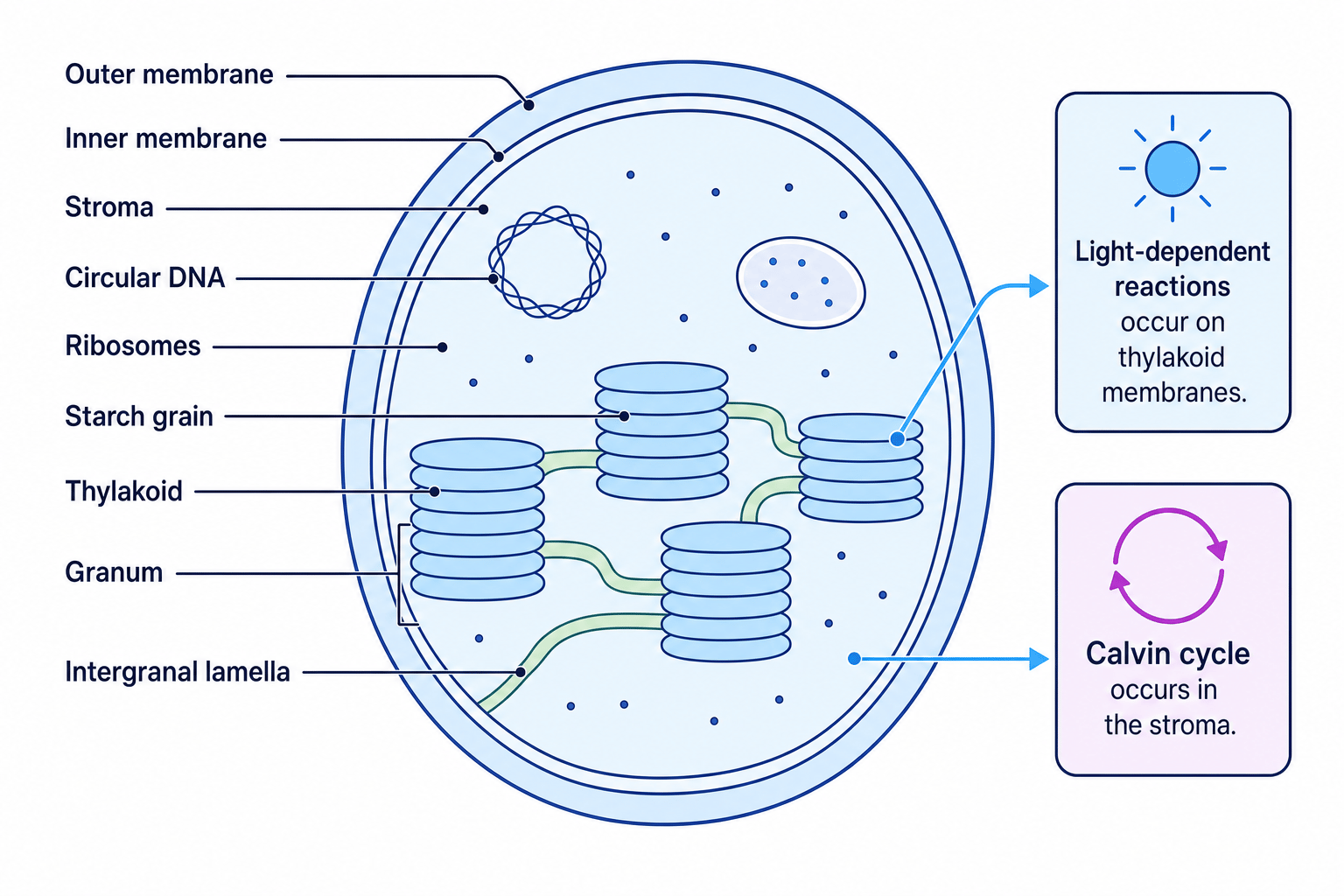
A chloroplast is the organelle in plant cells and algal cells where photosynthesis occurs. It is surrounded by a double membrane called the chloroplast envelope.
Inside the chloroplast is the stroma, a fluid-filled matrix containing enzymes, circular DNA and other structures. Suspended in the stroma are membrane sacs called thylakoids. A stack of thylakoids is a granum; several stacks are grana. Thin membranes connecting grana are lamellae.
The two main stages happen in different places:
- Light-dependent stage: thylakoid membranes.
- Light-independent stage, also called the Calvin cycle: stroma.
Photosynthetic pigments and light harvesting
A photosynthetic pigment is a molecule that absorbs particular wavelengths of light. Examples include chlorophyll a, chlorophyll b and carotenoids.
Pigments are arranged in light-harvesting systems in the thylakoid membranes. These systems contain many pigment molecules that absorb light and transfer the energy to a reaction centre chlorophyll molecule in a photosystem.
There are two photosystems involved in non-cyclic photophosphorylation:
- Photosystem II, often written PSII.
- Photosystem I, often written PSI.
PSII comes first
In the light-dependent stage, electrons pass through PSII before PSI. The names are historical, not the order in which they act.
Separating pigments using TLC
Thin layer chromatography, or TLC, separates substances in a mixture because they move different distances with a solvent.
The stationary phase is the TLC plate coating, often silica gel. The mobile phase is the solvent. A pigment that is more soluble in the solvent and less strongly attracted to the stationary phase travels further.
The Rf value is calculated as:
Rf=distance moved by pigment spotdistance moved by solvent frontR_f = \frac{\text{distance moved by pigment spot}}{\text{distance moved by solvent front}}Rf=distance moved by solvent frontdistance moved by pigment spotRf values have no units because they are ratios.
Calculating an Rf value
A pigment spot moves 48 mm from the origin. The solvent front moves 80 mm from the origin.
-
Substitute the measured distances into the formula:
Rf=48 mm80 mmR_f = \frac{48\ \text{mm}}{80\ \text{mm}}Rf=80 mm48 mm -
Cancel the units because both distances are measured in millimetres:
Rf=4880R_f = \frac{48}{80}Rf=8048 -
Calculate the ratio:
Rf=0.60R_f = 0.60Rf=0.60
TLC practical details
Draw the origin line in pencil, keep the pigment spot above the solvent level, mark the solvent front before it evaporates, and repeat measurements to improve reliability.
The light-dependent stage
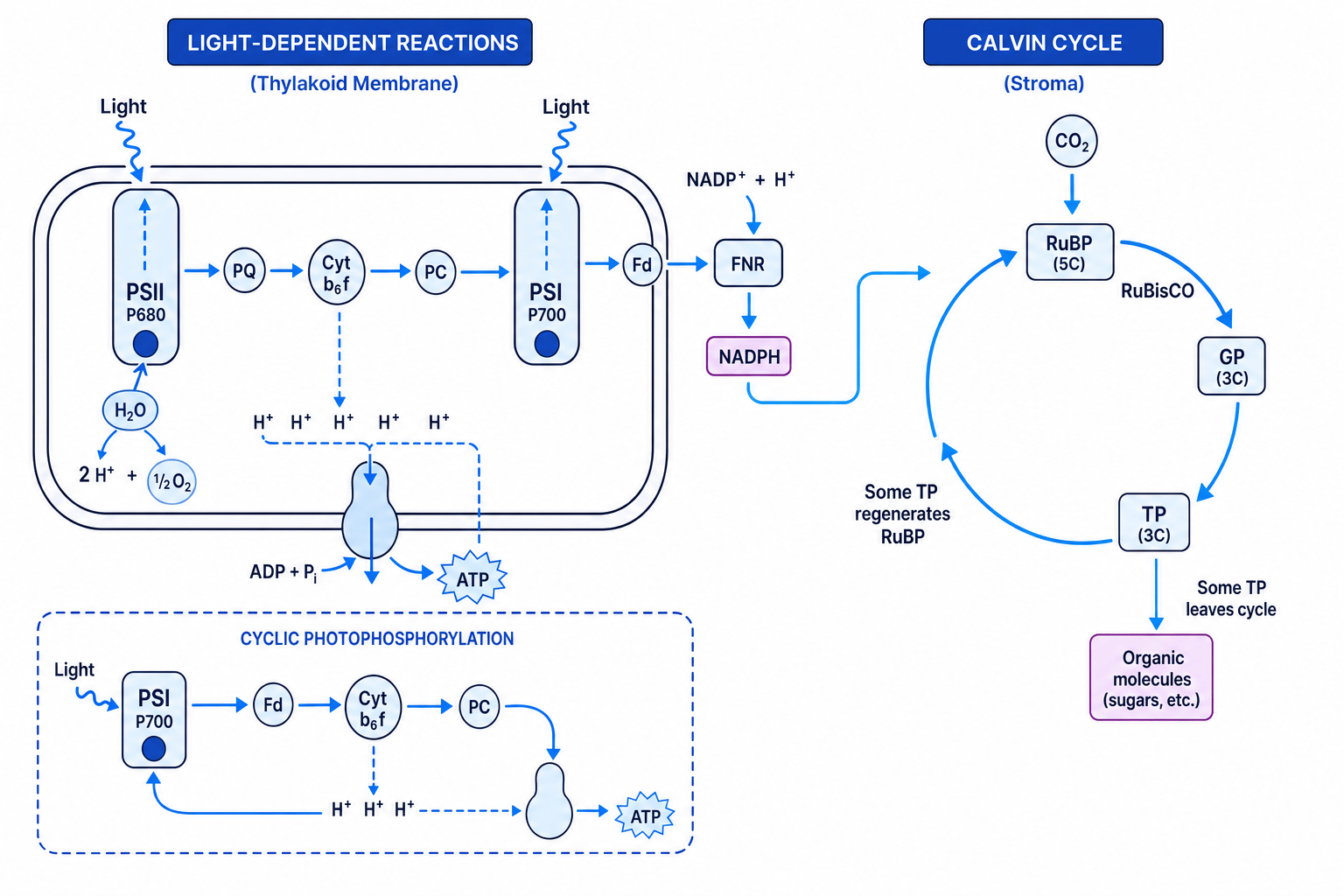
The light-dependent stage uses light energy to make ATP and reduced NADP. Reduced NADP is often written as NADPH, but OCR commonly uses the term reduced NADP.
Non-cyclic photophosphorylation
Photophosphorylation means making ATP using light energy.
In non-cyclic photophosphorylation, electrons do not return to the chlorophyll molecule they came from.
-
Light energy is absorbed by PSII, exciting electrons in chlorophyll.
-
Water is split by photolysis to replace the lost electrons:
2H2O→4H++4e−+O22\text{H}_2\text{O} \to 4\text{H}^{+} + 4\text{e}^{-} + \text{O}_22H2O→4H++4e−+O2 -
Excited electrons move along electron carriers in the thylakoid membrane.
-
Energy from electron movement pumps hydrogen ions into the thylakoid space.
-
Hydrogen ions diffuse back through ATP synthase, producing ATP.
-
Light excites electrons again at PSI.
-
NADP accepts electrons and hydrogen ions to form reduced NADP.
Oxygen is released as a waste product from photolysis of water.
Cyclic photophosphorylation
In cyclic photophosphorylation, only PSI is involved. Excited electrons leave PSI, pass along electron carriers, and return to PSI.
This produces ATP, but does not produce reduced NADP or oxygen.
Products of the light-dependent stage
The light-dependent stage produces ATP and reduced NADP for the Calvin cycle. Water provides replacement electrons and hydrogen ions, and oxygen is released.
The Calvin cycle: fixing carbon dioxide
Carbon fixation
Carbon fixation is the conversion of inorganic carbon dioxide into an organic carbon compound.
The Calvin cycle takes place in the stroma. It uses ATP and reduced NADP from the light-dependent stage.
You only need the named intermediates and enzyme at this level:
- RuBP: ribulose bisphosphate, a 5-carbon carbon dioxide acceptor.
- RuBisCO: ribulose bisphosphate carboxylase, the enzyme that fixes carbon dioxide.
- GP: glycerate 3-phosphate, a 3-carbon compound.
- TP: triose phosphate, a 3-carbon compound.
The sequence is:
- Carbon dioxide combines with RuBP, catalysed by RuBisCO.
- This forms GP.
- GP is reduced to TP using ATP and reduced NADP.
- Some TP leaves the cycle for synthesis of useful organic molecules.
- Some TP is recycled to regenerate RuBP, allowing more carbon dioxide to be fixed.
Light-independent does not mean happens in the dark
The Calvin cycle does not directly require light, but it depends on ATP and reduced NADP from the light-dependent stage. In darkness, it soon slows or stops.
Uses of triose phosphate
TP is a very important starting material. It can be used to synthesise:
- Carbohydrates, including glucose, sucrose, starch and cellulose.
- Lipids, such as fatty acids and glycerol-based molecules.
- Amino acids, when combined with nitrogen-containing ions such as nitrate ions.
- More RuBP, by recycling TP within the Calvin cycle.
TP is the useful output
The first carbohydrate product you should focus on is TP, not glucose. TP is the flexible starting point for making many biological molecules.
Limiting factors of photosynthesis
Limiting factor
A limiting factor is the factor in shortest supply that restricts the rate of a process.
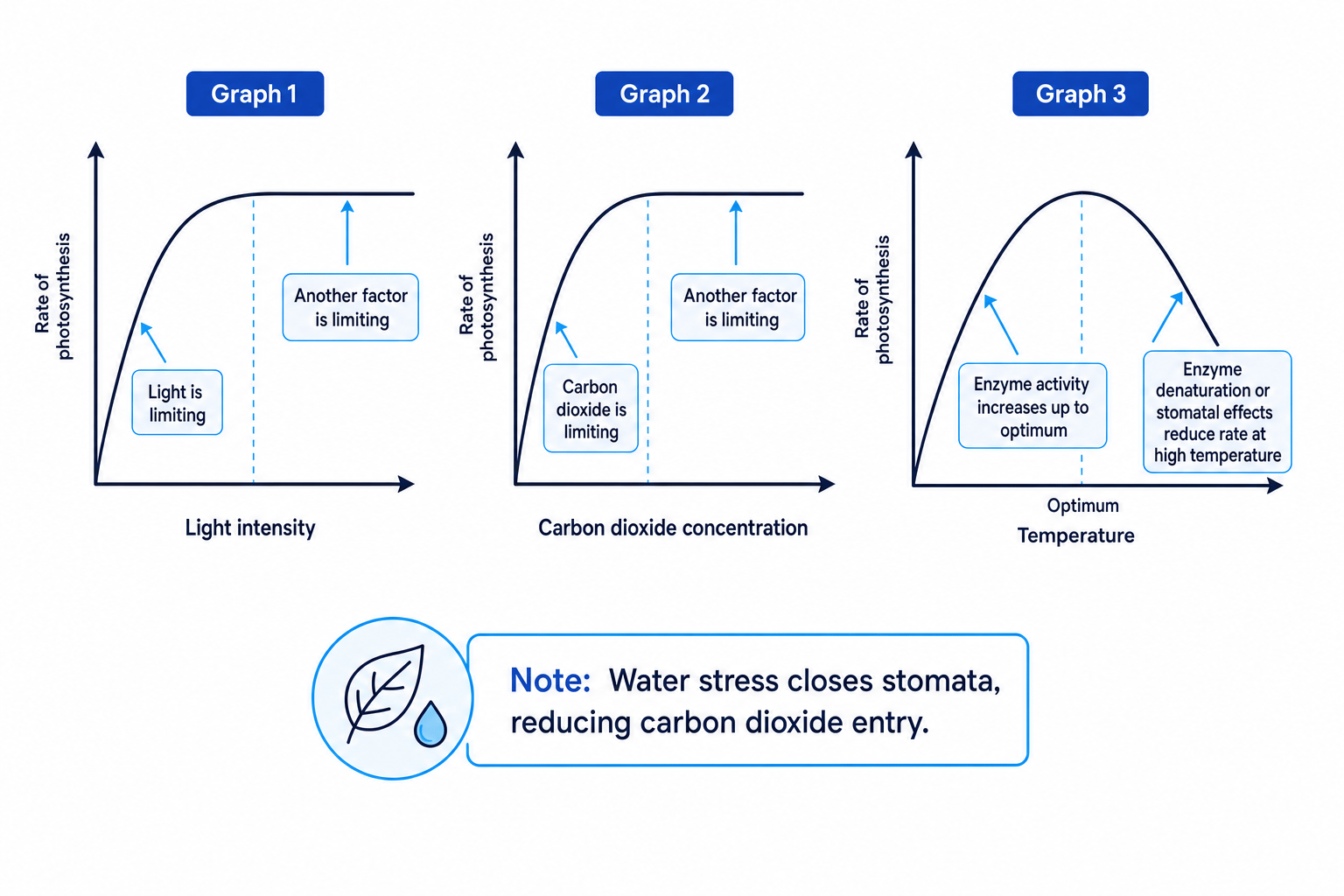
The main limiting factors for photosynthesis are carbon dioxide concentration, light intensity and temperature. Water stress also matters because it causes stomata to close, reducing carbon dioxide entry.
Light intensity
At low light intensity, light is limiting, so increasing light increases the rate. Eventually the graph plateaus because another factor, such as carbon dioxide concentration or temperature, becomes limiting.
If light intensity decreases:
- Less ATP and reduced NADP are produced.
- GP is not reduced to TP as quickly, so GP increases.
- TP decreases.
- RuBP decreases because less TP is available to regenerate it.
Carbon dioxide concentration
At low carbon dioxide concentration, carbon dioxide is limiting. Increasing carbon dioxide increases the rate until another factor becomes limiting.
If carbon dioxide concentration decreases:
- Less carbon dioxide combines with RuBP.
- GP decreases.
- TP decreases.
- RuBP increases because it is not being used up as quickly.
Temperature
Temperature affects enzyme-controlled reactions, especially in the Calvin cycle. As temperature rises towards the optimum, enzyme activity and photosynthesis rate increase. Above the optimum, enzymes may denature and stomata may close, reducing the rate.
If Calvin-cycle enzyme activity is reduced, GP may accumulate because it is not converted to TP quickly enough, while TP and RuBP tend to fall. If the question specifically describes stomatal closure causing carbon dioxide shortage, use the carbon dioxide pattern: RuBP increases while GP and TP decrease.
Temperature questions need pathway logic
Temperature affects several enzymes and can also affect stomata, so do not memorise one pattern blindly. Link the stated change to the step it affects.
Predicting Calvin-cycle intermediate changes
A plant is moved from bright light into very dim light while carbon dioxide concentration stays constant.
-
Dim light reduces the light-dependent stage, so less ATP and reduced NADP are produced.
-
GP cannot be reduced to TP as quickly because that step needs ATP and reduced NADP.
-
GP therefore increases, while TP decreases.
-
Less TP is available to regenerate RuBP, so RuBP also decreases.
Investigating the rate of photosynthesis
A common practical uses an aquatic plant and measures oxygen production. Oxygen volume can be measured with a gas syringe; counting bubbles is simpler but less valid because bubbles vary in size.
You can investigate:
- Light intensity by changing lamp distance or using a light meter.
- Carbon dioxide concentration using different sodium hydrogencarbonate concentrations.
- Temperature using a water bath.
Control other variables such as plant species, plant mass or leaf area, wavelength of light, pH, carbon dioxide concentration and temperature where appropriate.
Lamp distance
If you use distance from a lamp, light intensity is not directly proportional to distance. It is better to measure intensity with a light meter; otherwise remember that intensity approximately follows I=kd2I = \frac{k}{d^2}I=d2k.
Calculating photosynthesis rate
An aquatic plant produces 4.8×10⁻⁶ m34.8 \times 10^{-6}\ \text{m}^34.8×10⁻⁶ m3 of oxygen in 120 s.
-
Use the rate formula:
rate=volume of oxygen producedtime\text{rate} = \frac{\text{volume of oxygen produced}}{\text{time}}rate=timevolume of oxygen produced -
Substitute the values with units:
rate=4.8×10⁻⁶ m3120 s\text{rate} = \frac{4.8 \times 10^{-6}\ \text{m}^3}{120\ \text{s}}rate=120 s4.8×10−6 m3 -
Calculate the rate:
rate=4.0×10⁻⁸ m3 s−1\text{rate} = 4.0 \times 10^{-8}\ \text{m}^3\ \text{s}^{-1}rate=4.0×10⁻⁸ m3 s−1
In the exam
- Always state the site: light-dependent reactions on thylakoid membranes; Calvin cycle in the stroma.
- For limiting-factor questions, name the affected step, then predict the effect on GP, TP and RuBP.
- In practical questions, mention repeats, control variables, a valid rate calculation, and why a gas syringe is better than counting bubbles.
Check yourself
- Why does reduced NADP production fall when light intensity is low?
- What happens to GP and RuBP when carbon dioxide concentration decreases?
- How does TLC separate chlorophylls and carotenoids from a leaf extract?
