A researcher investigates the gravitropic response of roots in Arabidopsis thaliana seedlings. A wild-type seedling and a mutant seedling lacking functional PIN proteins (auxin efflux carriers) are placed horizontally in the dark.
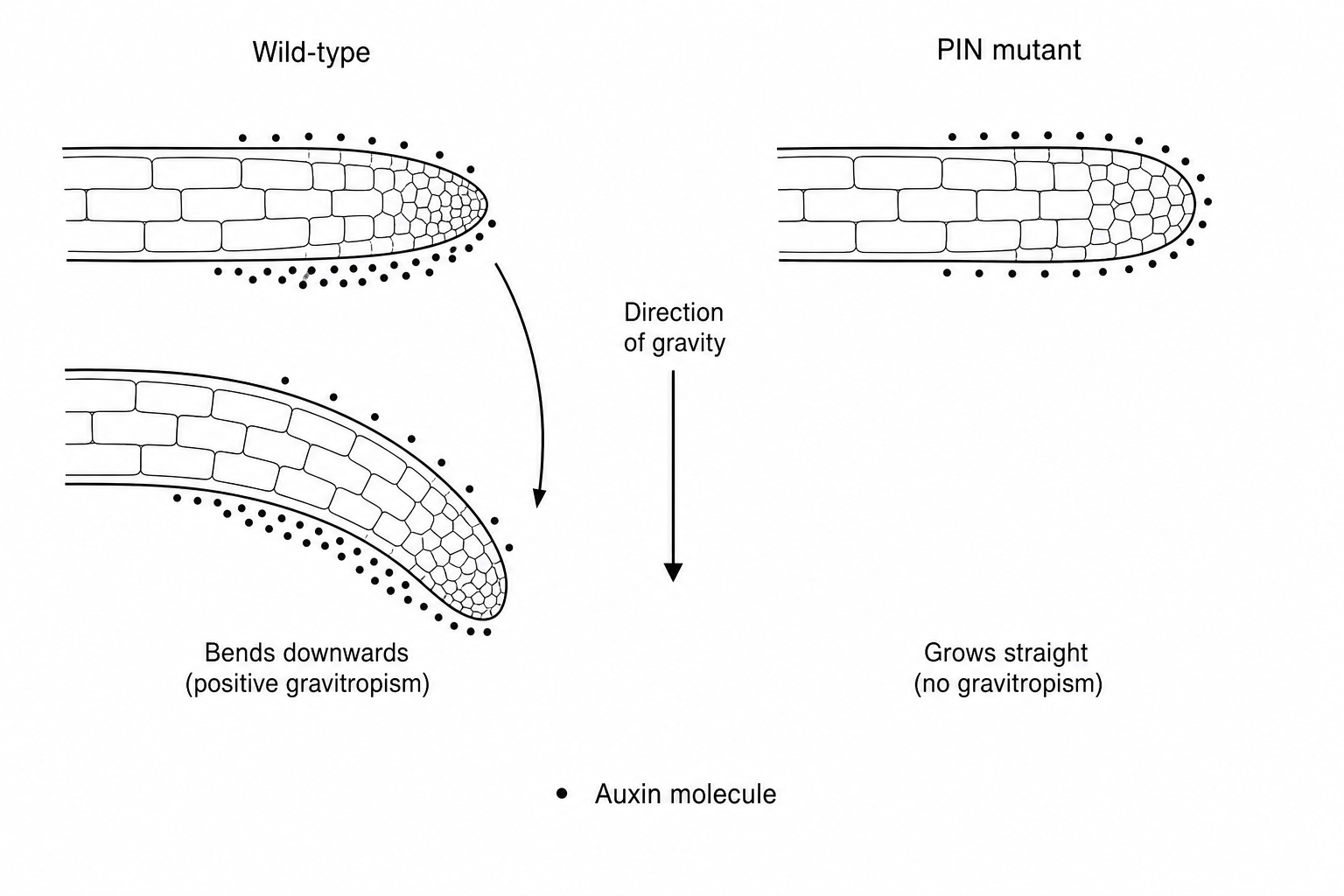
Based on the diagram and your knowledge of plant growth factors, which statement correctly describes the redistribution of auxin (indole-3-acetic acid, IAA) and the resulting growth response?
In wild-type roots, PIN proteins actively transport IAA to the upper side of the root, where high concentrations of IAA stimulate cell elongation to cause downward bending.
In wild-type roots, PIN proteins actively transport IAA to the lower side of the root, where high concentrations of IAA inhibit cell elongation, causing downward bending.
In mutant roots, the absence of PIN proteins causes IAA to accumulate on the upper side via alternative pathways, which inhibits elongation and results in upward bending.
In mutant roots, IAA is synthesized predominantly on the lower side to compensate for the loss of PIN proteins, restoring the normal downward bending response.

