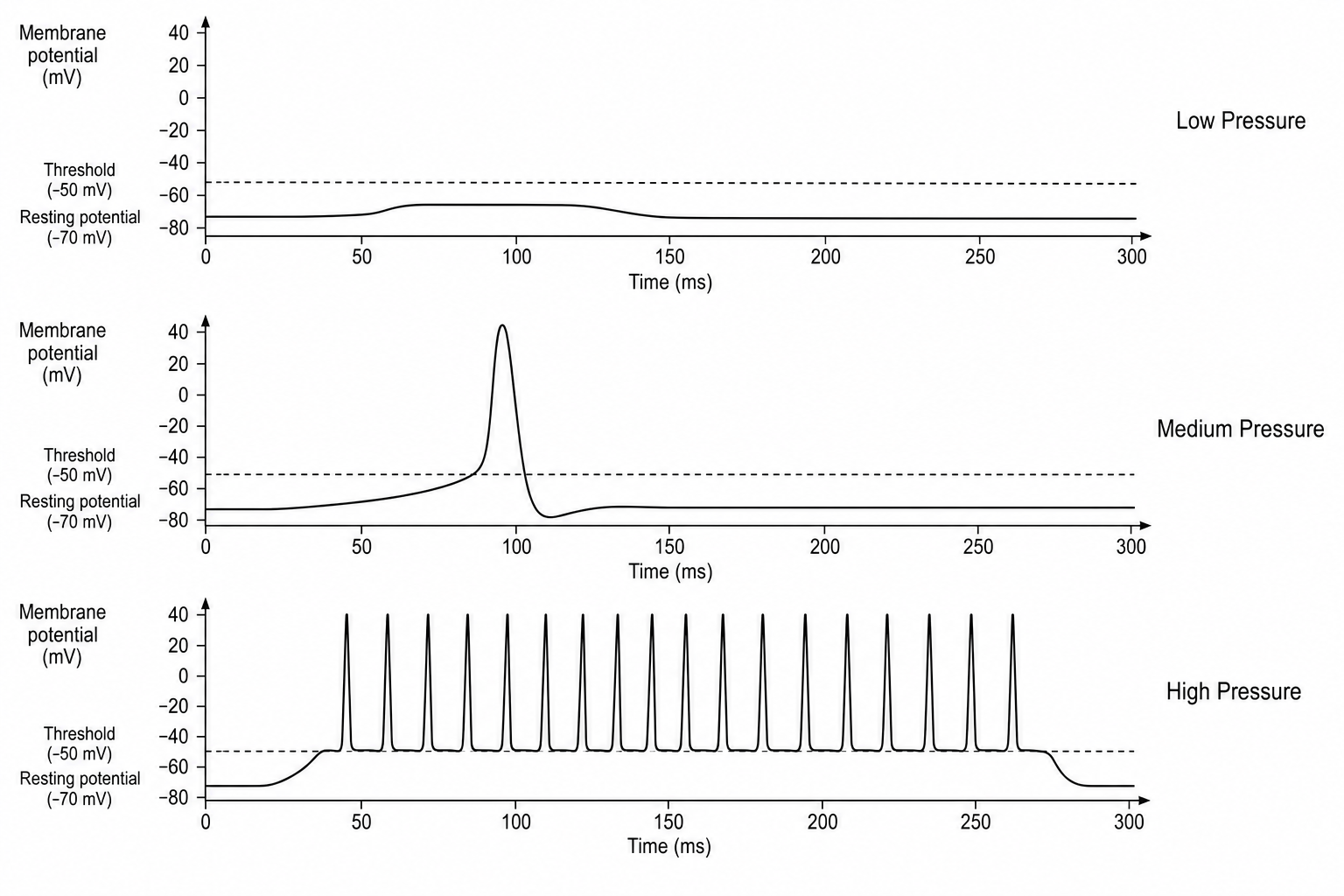
The graphs below show the electrical activity recorded from the sensory neurone of an isolated Pacinian corpuscle in response to three different levels of mechanical pressure (low, medium, and high):
Which of the following statements correctly explains the physiological mechanisms shown in the graphs?
At low pressure, stretch-mediated sodium ion channels open but fail to allow sufficient influx of Na+\text{Na}^+Na+ to reach the threshold potential, meaning voltage-gated Na+\text{Na}^+Na+ channels at the first node of Ranvier remain closed.
At high pressure, the greater force of the stimulus deforms the membrane more extensively, causing voltage-gated sodium channels at the sensory ending to open faster, increasing the amplitude of the individual action potentials.
At medium pressure, potassium ions diffuse out of the neurone via stretch-mediated channels to initiate the depolarisation phase of the action potential.
At high pressure, the prolonged generator potential prevents the refractory period of the neurone, allowing a single continuous action potential of longer duration.

