

What you'll learn
- How hormones are secreted into the blood and detected only by target cells.
- The structure and key hormone functions of the adrenal glands.
- How pancreas histology links to insulin and glucagon secretion.
- How blood glucose is controlled by negative feedback, and how diabetes treatments support this control.
Hormones as chemical messengers
Your body needs communication systems to coordinate organs that may be far apart. The endocrine system uses chemical messages carried in the blood, so it is generally slower than nervous communication but often longer-lasting.
Hormone
A hormone is a chemical messenger secreted by an endocrine gland into the blood and carried to target cells or tissues, where it produces a response.
Target cell
A target cell is a cell with a specific receptor that can bind a particular hormone. Cells without the correct receptor will not respond, even though the hormone reaches them in the blood.
Endocrine glands are ductless glands: they release hormones directly into the blood, not through tubes. This is different from exocrine glands, which secrete substances through ducts, such as digestive enzymes from the pancreas into the small intestine.
Endocrine communication
The basic pathway is: endocrine gland secretes hormone → hormone travels in blood → target cell detects hormone using a receptor → cell response occurs.
The adrenal glands
The adrenal glands are endocrine glands found above the kidneys. Each adrenal gland has two main regions: an outer cortex and an inner medulla. They secrete different hormones and are a useful example of how one gland can contain different hormone-producing tissues.
Adrenal cortex
The adrenal cortex secretes steroid hormones, including:
- Cortisol, a glucocorticoid that helps regulate metabolism, especially during longer-term stress. It can increase blood glucose by stimulating the production of glucose from non-carbohydrate sources in the liver.
- Aldosterone, a mineralocorticoid that acts on the kidneys to increase sodium ion reabsorption. Water follows by osmosis, helping to maintain blood volume and blood pressure.
- Small amounts of adrenal androgens, which contribute to sex-hormone balance.
Adrenal medulla
The adrenal medulla secretes adrenaline and noradrenaline. These are involved in the “fight or flight” response. They prepare the body for immediate action by increasing heart rate, increasing blood glucose availability, and redirecting blood flow towards skeletal muscles.
Cortex and medulla are not interchangeable
Do not write “the adrenal gland secretes adrenaline” as your whole answer if the question asks for structure. The medulla secretes adrenaline and noradrenaline; the cortex secretes steroid hormones such as cortisol and aldosterone.
The pancreas: endocrine and exocrine tissue
Histology
Histology is the study of tissues using microscopy. A stained section is a thin slice of tissue treated with dyes so that structures are easier to see under a microscope.
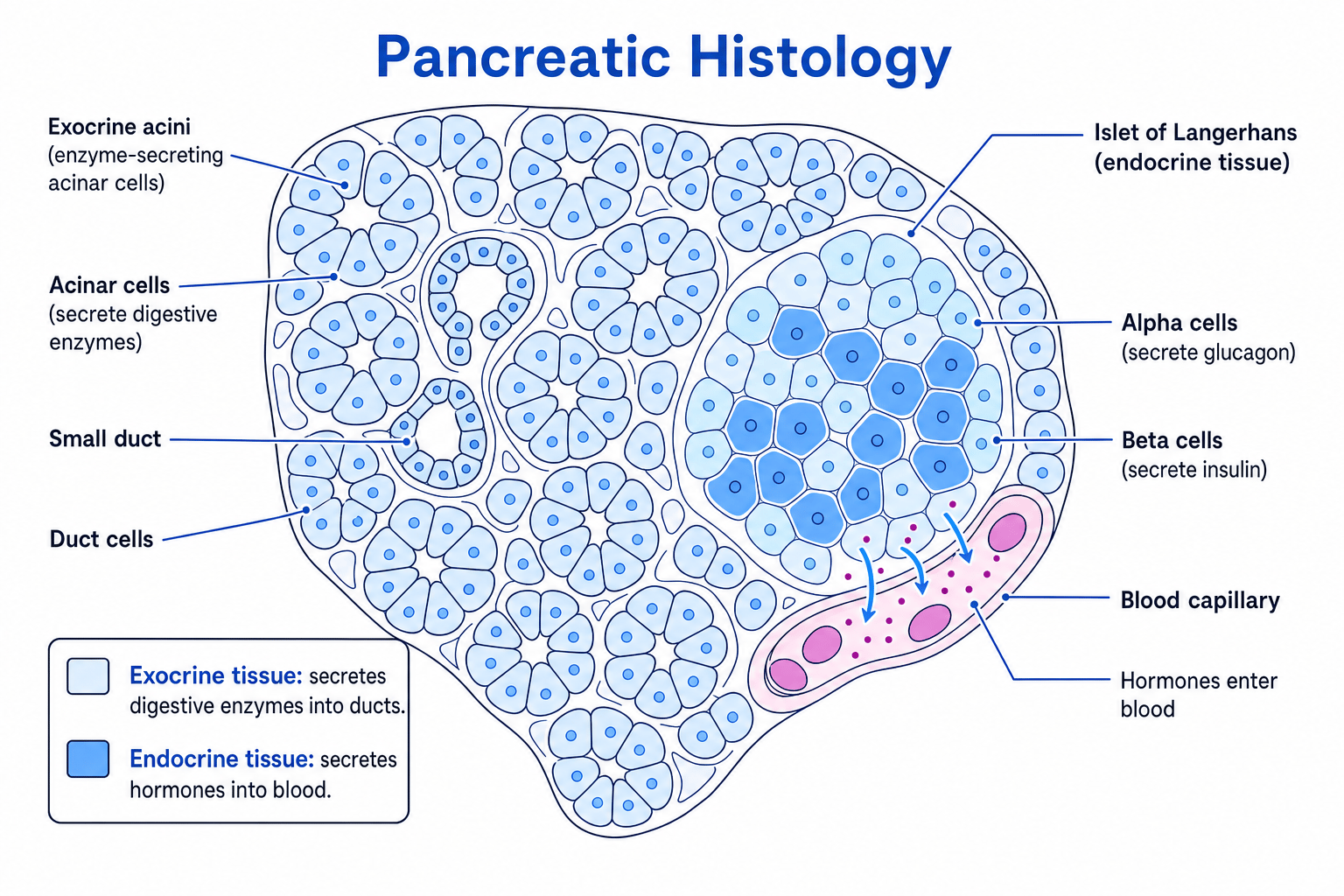
The pancreas contains both exocrine and endocrine tissue. Most of the pancreas is exocrine tissue, arranged into clusters called acini, which secrete digestive enzymes into ducts. Scattered among this tissue are pale-staining endocrine clusters called islets of Langerhans. These islets contain hormone-secreting cells, including beta cells, which secrete insulin, and alpha cells, which secrete glucagon.
The diagram below shows how endocrine islets sit among exocrine pancreatic tissue and release hormones into nearby blood capillaries.
Drawing stained sections of pancreas
When you examine a pancreas slide, focus on tissue organisation rather than trying to draw every cell.
A good biological drawing should have:
- clear, continuous lines with no sketchy shading
- a title and, if known, magnification
- labels with straight ruled label lines
- visible differences between exocrine acini, ducts and islets of Langerhans
- only structures you can actually see in the section
Over-labelling pancreas slides
In a routine stained light-microscope section, you can usually identify islets of Langerhans, acini and ducts. You may not be able to distinguish alpha and beta cells reliably unless a special stain or immunological technique is used.
Comparing tissue features in a pancreas section
- Compare the arrangement of cells: exocrine acini are tightly packed into rounded clusters, while an islet of Langerhans appears as a paler, less regularly arranged cluster.
- Use ducts as evidence: exocrine tissue connects to ducts because digestive enzymes are secreted through them; endocrine islets secrete hormones into blood, so they are associated with capillaries rather than ducts.
- Label the pale cluster as an islet of Langerhans and the darker surrounding clusters as exocrine acini, only adding alpha or beta cells if the staining method allows them to be identified.
Blood glucose regulation
Blood glucose concentration must be kept within narrow limits. Too low and cells, especially brain cells, may lack respiratory substrate. Too high and water balance, blood vessels and tissues can be damaged.
Negative feedback
Negative feedback is a control mechanism in which a change away from the normal level triggers responses that reverse the change and return the variable towards normal.
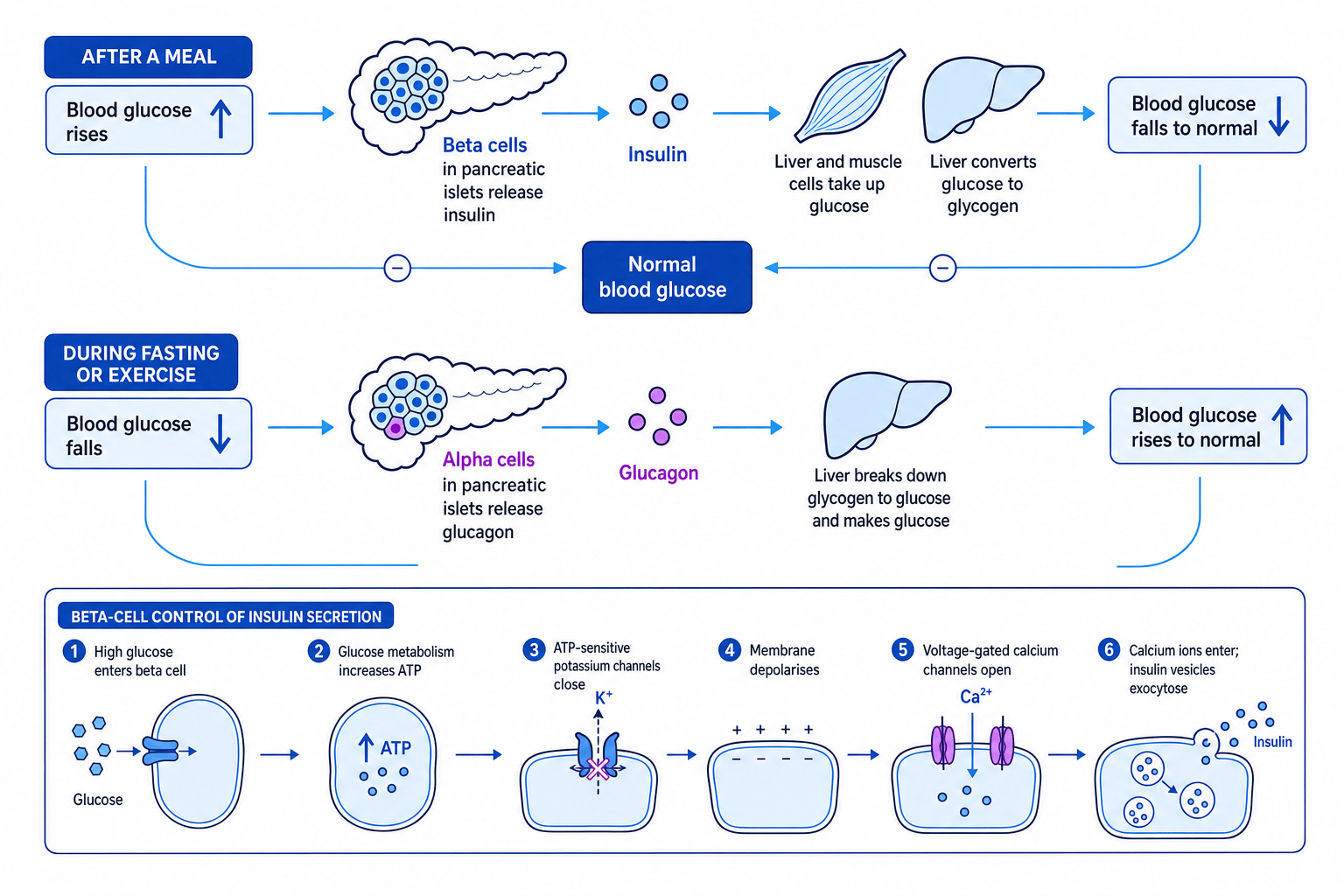
The main hormones involved are insulin and glucagon, both secreted by endocrine cells in the islets of Langerhans. The liver is central because it can store glucose as glycogen, break glycogen down, and produce glucose from non-carbohydrate sources.
The diagram below shows both feedback loops and the beta-cell ion-channel sequence that controls insulin secretion.
When blood glucose rises: insulin
After a meal, glucose is absorbed from the small intestine into the blood. Beta cells detect the rise and secrete insulin.
Inside beta cells:
- More glucose enters the beta cell and is metabolised in respiration.
- ATP concentration increases.
- ATP-sensitive potassium ion channels close, so fewer potassium ions (K+K^+K+) leave the cell.
- The beta-cell membrane depolarises.
- Voltage-gated calcium ion channels open.
- Calcium ions (Ca2+Ca^{2+}Ca2+) enter the cell and trigger exocytosis of insulin-containing vesicles.
Insulin then acts on target tissues. It stimulates liver and muscle cells to store glucose as glycogen. It also increases glucose uptake by many cells, especially muscle and adipose tissue, and promotes the use of glucose in respiration. As blood glucose falls back towards normal, insulin secretion decreases.
When blood glucose falls: glucagon
During fasting or exercise, blood glucose may fall. Alpha cells in the pancreatic islets secrete glucagon. Glucagon acts mainly on the liver, where it:
- stimulates glycogenolysis, the breakdown of glycogen to glucose
- stimulates gluconeogenesis, the production of glucose from non-carbohydrate sources
- reduces glycogen synthesis
The liver releases glucose into the blood, raising blood glucose back towards normal. As the normal level is restored, glucagon secretion decreases.
Two hormones, opposite effects
Insulin lowers blood glucose; glucagon raises blood glucose. Together, they form a negative feedback system that keeps blood glucose concentration within a suitable range.
Tracing the response after a high-carbohydrate meal
- A high-carbohydrate meal leads to glucose absorption into the blood, so blood glucose concentration rises above its normal range.
- Beta cells respond because increased glucose metabolism raises ATP, closing ATP-sensitive potassium channels and opening calcium channels after depolarisation.
- Calcium ion entry triggers insulin secretion, and insulin causes liver and muscle cells to remove glucose from the blood and store it as glycogen.
- As blood glucose falls towards normal, the original stimulus is reduced, so insulin secretion falls by negative feedback.
Insulin does not convert glucose by itself
Insulin is a hormone signal. It does not chemically convert glucose into glycogen; it binds to receptors and causes target cells, especially liver and muscle cells, to change enzyme activity and glucose transport.
Diabetes mellitus
Diabetes mellitus
Diabetes mellitus is a condition in which blood glucose concentration is not controlled properly, leading to repeated or long-term hyperglycaemia.
Type 1 diabetes
Type 1 diabetes is usually caused by an autoimmune response that destroys pancreatic beta cells. As a result, little or no insulin is secreted. The person cannot lower blood glucose effectively after meals.
Treatment usually involves:
- insulin injections or an insulin pump
- regular blood glucose monitoring, often using a continuous glucose monitor
- matching insulin dose to carbohydrate intake and exercise
- careful management to avoid both hyperglycaemia and hypoglycaemia
Type 2 diabetes
Type 2 diabetes usually begins with insulin resistance, where target cells do not respond properly to insulin. The pancreas may initially produce insulin, but over time beta cells may become less able to compensate.
Risk factors include genetic predisposition, age, obesity and low physical activity, but it should not be treated as a simple “lifestyle blame” condition.
Treatment may involve:
- dietary changes and increased physical activity
- weight management where appropriate
- drugs such as metformin, which can reduce glucose production by the liver and improve insulin sensitivity
- insulin treatment if beta-cell function declines significantly
Type 1 and Type 2 causes
Type 1 diabetes is mainly due to beta-cell destruction and lack of insulin. Type 2 diabetes is mainly due to insulin resistance, at least initially; it is not simply “no insulin”.
Potential treatments and medical technology
Modern treatment uses technology to support or replace normal hormonal control.
Insulin from genetically modified bacteria
Human insulin can be produced by genetically modified bacteria. The human insulin gene is inserted into bacterial DNA, often using a plasmid. The bacteria are grown in fermenters, produce insulin, and the insulin is extracted and purified.
This provides a reliable supply of human insulin and avoids reliance on animal insulin. It also reduces the risk of immune reactions compared with older animal-derived preparations.
Pumps, monitors and closed-loop systems
An insulin pump can deliver insulin through the day. A continuous glucose monitor can estimate blood glucose concentration in real time. Some systems link monitoring and insulin delivery in a “closed-loop” system, sometimes called an artificial pancreas, although the person still needs training and monitoring.
Insulin treatment can overshoot
Too much insulin relative to food intake or exercise can cause hypoglycaemia. That is why dose, timing, carbohydrate intake and physical activity all matter.
Stem cells
Stem cells could potentially be used to produce new insulin-secreting beta cells for people with diabetes, especially Type 1 diabetes. In principle, these cells could replace lost beta cells and restore insulin secretion.
Challenges include making the cells differentiate correctly, preventing immune rejection, preventing renewed autoimmune destruction, and ensuring the cells do not divide uncontrollably.
Choosing a diabetes treatment approach
- If a person has very low insulin secretion because beta cells have been destroyed, the main problem is hormone replacement, so insulin injections or a pump are needed.
- If a person still secretes insulin but target cells respond poorly, the main problem is insulin resistance, so treatment may begin with diet, exercise and drugs that improve sensitivity or reduce liver glucose output.
- If beta-cell replacement becomes possible using stem cells, it would be most directly useful where beta cells have been lost, but immune attack and safety would still need to be controlled.
In the exam
- Use the full communication sequence: secretion into blood → transport in blood → detection by receptors on target cells → response.
- For blood glucose questions, always name the hormone, the pancreatic cell type, and the liver process involved.
- When comparing diabetes types, separate cause from treatment: Type 1 is beta-cell destruction and insulin replacement; Type 2 is insulin resistance and often lifestyle/drug treatment first.
Check yourself
- Why do only some cells respond to a hormone that is carried throughout the blood?
- How does closure of potassium channels in beta cells lead to insulin secretion?
- What is one key difference between treating Type 1 diabetes and treating Type 2 diabetes?
