

Metabolism is the sum of all the chemical reactions occurring within a living organism. These reactions must occur rapidly and under highly controlled conditions to sustain life. Left to themselves, most biological molecules are highly stable; they would react far too slowly at body temperature to keep an organism alive. This is where enzymes play a vital role.
What you'll learn
- How enzymes function as biological catalysts to control metabolism at both cellular and whole-organism levels.
- The mechanism of enzyme action, including the transition from the lock-and-key model to the induced-fit model.
- How physical and chemical factors affect the rate of enzyme-controlled reactions, and how to calculate the temperature coefficient (Q10Q_{10}Q10).
- The essential roles of cofactors, coenzymes, and different types of inhibitors in regulating enzyme activity.
1. The Role of Enzymes in Metabolism
Metabolism
Metabolism is the complete set of chemical reactions that occur within a living organism to maintain life. It is split into anabolism (building up larger molecules from smaller ones, which requires energy) and catabolism (breaking down larger molecules into smaller ones, releasing energy).
Enzymes are globular proteins that act as biological catalysts. They increase the rate of chemical reactions without being permanently altered or consumed in the process.
Structure and Function
Enzymes do not just determine functional processes; they also determine cellular and physical structures.
- Structural roles: Enzymes catalytically synthesise structural polymers. For example, the enzyme collagen lysyl oxidase cross-links collagen fibres, giving bone, cartilage, and blood vessels their structural strength and elasticity.
- Functional roles: Enzymes catalyse the metabolic pathways that drive active transport, muscle contraction, and cell signalling.
Intracellular vs. Extracellular Enzymes
Not all enzymes operate in the same environment. Some must stay inside the cytoplasm or organelles, while others are secreted to work outside cells.
- Intracellular enzymes catalyse reactions inside the cell. A key example is catalase. Respiration and other metabolic pathways produce toxic hydrogen peroxide (H2O2H_2O_2H2O2) as a byproduct. Catalase rapidly converts this toxic chemical into harmless water (H2OH_2OH2O) and oxygen (O2O_2O2), protecting the cell from oxidative damage.
- Extracellular enzymes are synthesised inside the cell but are secreted to catalyse reactions outside the cell. For example, amylase is secreted by the salivary glands and pancreas into the mouth cavity and duodenum to catalyse the hydrolysis of insoluble starch into soluble maltose. Another example is trypsin, a protease secreted by the pancreas to digest proteins in the small intestine.
2. The Mechanism of Enzyme Action
To understand how enzymes speed up reactions, we must look at their tertiary structure. Because enzymes are proteins, their specific three-dimensional shape is dictated by the primary sequence of amino acids, which determines the folding and bonding (hydrogen bonds, ionic bonds, disulfide bridges, and hydrophobic interactions).
Active Site
The active site is a highly specific, three-dimensional cleft or pocket on the surface of an enzyme molecule, formed by a small number of amino acids. It has a shape complementary to the shape of a specific substrate molecule.
Lowering Activation Energy
Chemical reactions require a certain amount of energy to start. This is the energy needed to break bonds in the reactants so that new bonds can form.
Activation Energy
Activation energy (EaE_aEa) is the minimum amount of energy required to start a chemical reaction by breaking the existing chemical bonds in the reactant molecules.
Enzymes speed up chemical reactions by lowering the activation energy. They do this by holding the substrate molecules close together or putting physical strain on their chemical bonds, making them much easier to break.
Hypotheses of Enzyme Action
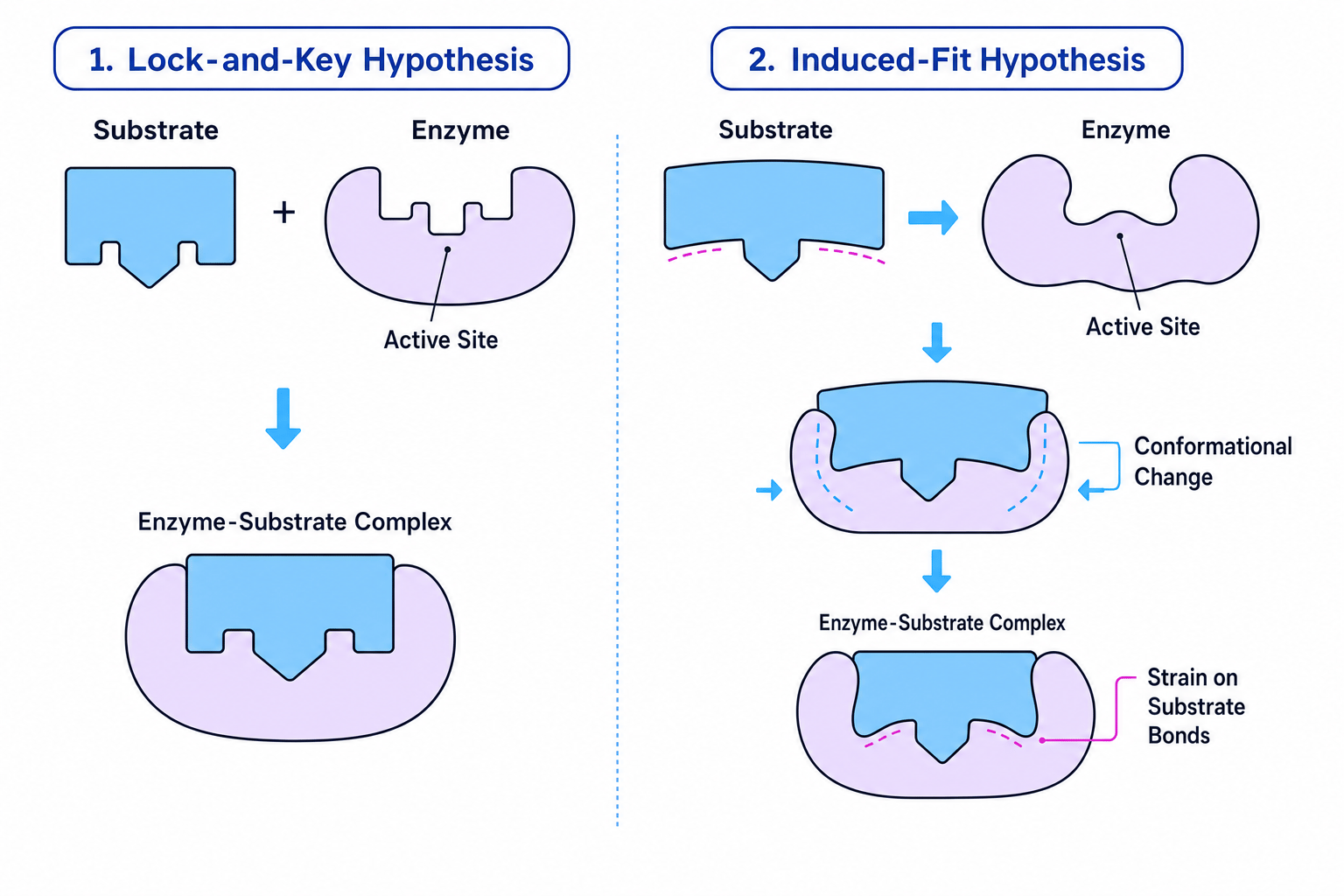
Historically, scientists explained enzyme specificity using the lock-and-key hypothesis. Over time, further experimental evidence led to the development of the induced-fit hypothesis.
The Lock-and-Key Hypothesis
This model suggests that the enzyme's active site is a rigid, fixed shape (the "lock"). The substrate has a complementary shape (the "key") that fits perfectly into the active site.
- The substrate collides successfully with the active site.
- They bind to form an enzyme-substrate complex (ESC).
- The chemical reaction occurs, temporarily forming an enzyme-product complex (EPC).
- The products leave the active site, leaving the enzyme unchanged and ready to accept another substrate.
The Induced-Fit Hypothesis
While the lock-and-key model explains specificity, it does not explain how the binding process actually lowers the activation energy. The induced-fit hypothesis addresses this. It suggests that the active site is not completely rigid, but flexible.
- The substrate collides with the active site.
- As the substrate binds, it induces a conformational change (a slight change in shape) in the active site of the enzyme.
- The active site moulds itself tightly around the substrate.
- This conformational change puts physical strain on the bonds of the substrate, destabilising them and lowering the activation energy.
- Once the reaction is complete, the products have a different shape, no longer fit the active site, and diffuse away.
3. Factors Affecting Enzyme Activity
The rate of an enzyme-controlled reaction depends heavily on the physical and chemical conditions of its environment.
Temperature
As temperature increases, the kinetic energy of the enzyme and substrate molecules increases. They move faster, resulting in more frequent, successful collisions. This leads to a higher rate of enzyme-substrate complex formation.
However, if the temperature rises above an optimum point, the thermal energy makes the atoms within the enzyme vibrate so rapidly that the weak hydrogen and ionic bonds stabilizing the tertiary structure break. The active site changes shape, losing its complementary relationship with the substrate. The enzyme is said to be denatured.
The Temperature Coefficient (Q10Q_{10}Q10)
We can quantify the effect of temperature on the rate of reaction using the temperature coefficient, Q10Q_{10}Q10.
Temperature Coefficient
The temperature coefficient (Q10Q_{10}Q10) is a measure of the rate of change of a biological or chemical system as a consequence of increasing the temperature by 10∘C10^\circ\text{C}10∘C.
The formula for calculating Q10Q_{10}Q10 is:
Q10=R2R1 Q_{10} = \frac{R_2}{R_1} Q10=R1R2where:
- R2R_2R2 is the rate of reaction at temperature (T+10)∘C(T + 10)^\circ\text{C}(T+10)∘C
- R1R_1R1 is the rate of reaction at temperature T∘CT^\circ\text{C}T∘C
For most enzyme-controlled reactions below their optimum temperature, the rate of reaction approximately doubles for every 10∘C10^\circ\text{C}10∘C rise in temperature, giving a Q10Q_{10}Q10 value of approximately 2.
Calculating the temperature coefficient
A student investigated the rate of oxygen production by catalase at different temperatures. At 15∘C15^\circ\text{C}15∘C, the rate of oxygen production was 1.4 cm3 s−11.4\text{ cm}^3\text{ s}^{-1}1.4 cm3 s−1. At 25∘C25^\circ\text{C}25∘C, the rate increased to 2.9 cm3 s−12.9\text{ cm}^3\text{ s}^{-1}2.9 cm3 s−1. Calculate the Q10Q_{10}Q10 value for this range, giving your answer to two significant figures.
- Identify the values: Choose T=15∘CT = 15^\circ\text{C}T=15∘C as the lower temperature. The rate at this temperature (R1R_1R1) is 1.4 cm3 s−11.4\text{ cm}^3\text{ s}^{-1}1.4 cm3 s−1. The rate at the higher temperature (R2R_2R2, which is (T+10)∘C=25∘C(T + 10)^\circ\text{C} = 25^\circ\text{C}(T+10)∘C=25∘C) is 2.9 cm3 s−12.9\text{ cm}^3\text{ s}^{-1}2.9 cm3 s−1.
- Substitute into the formula: Write down the Q10Q_{10}Q10 equation and substitute the values directly into it:
- Calculate and round: Perform the division to get 2.0714…2.0714\dots2.0714…. Round this value to two significant figures as requested by the question, yielding a final value of 2.1. Note that Q10Q_{10}Q10 is a ratio, so it has no units.
pH
pH is a measure of the hydrogen ion (H+\text{H}^+H+) concentration. H+\text{H}^+H+ ions have a positive charge. If the pH deviates from the optimum value for a specific enzyme, the excess H+\text{H}^+H+ ions (in acidic conditions) or lack of them (in alkaline conditions) will interact with the charged R-groups of the amino acids in the active site.
This disrupts the hydrogen and ionic bonds holding the tertiary structure together, altering the shape of the active site and preventing the substrate from binding. Extreme changes in pH lead to denaturation.
Compare pH and temperature denaturation
When an enzyme denatures due to high temperature, the covalent peptide bonds of the primary structure are untouched, but the hydrogen and ionic bonds of the tertiary structure are permanently broken. Conversely, minor changes in pH often cause a reversible change in shape because the bonds can reform when the pH returns to optimum.
Enzyme and Substrate Concentration
- Substrate concentration: As substrate concentration increases, the rate of reaction increases because there are more substrate molecules to collide with the active sites. However, at a certain point, the rate plateaus at a maximum velocity (VmaxV_{\text{max}}Vmax). At this point, all the active sites are saturated with substrate. Enzyme concentration has become the limiting factor.
- Enzyme concentration: Similarly, as enzyme concentration increases, the rate increases because there are more active sites available. Eventually, the rate plateaus when there are not enough substrate molecules to bind to the excess active sites. Here, substrate concentration becomes the limiting factor.
4. Practical Skills: Serial Dilutions
In practical investigations of enzyme activity (such as PAG 4), you are often required to make a range of concentrations of a substrate or an enzyme from a concentrated stock solution. A highly precise way to do this is through a serial dilution.
Serial Dilution
A serial dilution is a stepwise dilution of a substance in solution. The dilution factor remains constant at each step, resulting in a geometric decrease in concentration.
To perform a 2-fold (halving) serial dilution:
- Set up a row of five clean test tubes.
- Add 10 cm310\text{ cm}^310 cm3 of distilled water to tubes 2, 3, 4, and 5.
- Add 20 cm320\text{ cm}^320 cm3 of your stock solution (e.g., 2.0%2.0\%2.0% yeast suspension) to tube 1.
- Transfer 10 cm310\text{ cm}^310 cm3 of yeast suspension from tube 1 into tube 2 using a clean syringe. Mix thoroughly. Tube 2 now has a concentration of 1.0%1.0\%1.0%.
- Repeat this step-by-step transfer of 10 cm310\text{ cm}^310 cm3 from tube 2 to 3 (0.5%0.5\%0.5%), then tube 3 to 4 (0.25%0.25\%0.25%), and tube 4 to 5 (0.125%0.125\%0.125%). Finally, discard 10 cm310\text{ cm}^310 cm3 from tube 5 so all tubes contain equal volumes.
5. Cofactors and Coenzymes
Many enzymes require the presence of non-protein helper molecules to carry out their catalytic function.
| Type of Helper | Definition & Characteristics | Key OCR Example |
|---|---|---|
| Cofactor | An inorganic ion or molecule that temporarily binds to the enzyme to help stabilize the enzyme-substrate complex or ease the catalytic reaction. | Chloride ions (Cl−\text{Cl}^-Cl−) are essential cofactors for the amylase enzyme to fold correctly and bind starch. |
| Coenzyme | An organic, non-protein helper molecule that binds temporarily to the active site. They are chemically changed by the reaction and must be recycled. Many are derived from vitamins. | Vitamins (e.g., Vitamin B3 is used to make NAD, a coenzyme vital in cellular respiration). |
| Prosthetic Group | A cofactor that is permanently and covalently bound to the enzyme protein structure. | Zinc ions (Zn2+\text{Zn}^{2+}Zn2+) form a permanent prosthetic group in the structure of the enzyme carbonic anhydrase in red blood cells. |
6. Enzyme Inhibition
Enzymes can be switched off or slowed down by molecules called inhibitors. This is crucial for controlling metabolic pathways and is also the basis of many poisons and medicines.
Inhibitor
An inhibitor is a substance that reduces the rate of an enzyme-controlled reaction by interfering with the binding of the substrate to the active site.
Competitive vs. Non-Competitive Inhibitors
Competitive Inhibitors
These molecules have a similar molecular shape to the substrate.
- They bind temporarily to the active site, physically blocking the substrate from entering.
- They do not damage the active site permanently.
- Overcoming inhibition: If you drastically increase the concentration of the substrate, the substrate molecules outcompete the inhibitor molecules. The maximum rate of reaction (VmaxV_{\text{max}}Vmax) can still be reached, but it requires a much higher substrate concentration.
Non-Competitive Inhibitors
These molecules do not bind to the active site. Instead, they bind to an alternative site on the enzyme known as the allosteric site.
- Binding to the allosteric site alters the tertiary structure of the enzyme, changing the shape of the active site.
- The active site is no longer complementary to the substrate, so the substrate can no longer bind.
- Overcoming inhibition: Adding more substrate has no effect because the active sites are permanently altered. The reaction will never reach the original VmaxV_{\text{max}}Vmax.

Reversible vs. Irreversible Inhibitors
- Reversible inhibitors bind weakly (e.g., via hydrogen or ionic bonds) and can dissociate from the enzyme.
- Irreversible inhibitors form strong covalent bonds with the enzyme, permanently disabling it. Many highly toxic poisons (like cyanide, which inhibits cytochrome c oxidase in mitochondria) work as irreversible inhibitors.
End-Product Inhibition
Cells use end-product inhibition to control metabolic pathways through a negative feedback loop.
End-Product Inhibition
In a multi-step metabolic pathway, the product of the final reaction often acts as a non-competitive, reversible inhibitor for the very first enzyme in the pathway. This prevents the wasteful overproduction of the final product when it is already abundant in the cell.
Confusing 'denatured' with 'inhibited'
Do not say that inhibitors "denature" enzymes. Denaturation involves the disruption of bonds stabilizing the tertiary structure due to thermal energy or pH, which is usually irreversible. Reversible competitive or non-competitive inhibition is a controlled regulatory mechanism where bonds are not permanently destroyed.
In the exam
- Explain conformational changes: If a question asks about the induced-fit hypothesis, make sure you use the phrase "conformational change" or "the active site changes shape to wrap tightly around the substrate".
- Read graphs carefully: In inhibition questions, check the x-axis. If the rate of reaction eventually reaches the same maximum as the control at high substrate concentrations, the inhibitor is competitive. If it plateaus far lower, it is non-competitive.
- Link structure and function: When describing extracellular enzymes, remember to state that they are secreted by cells (via exocytosis) to perform their role elsewhere, rather than just saying they work "outside".
- Be precise with Q10: Keep your temperatures spaced exactly 10∘C10^\circ\text{C}10∘C apart when using the formula. If they are not 10∘C10^\circ\text{C}10∘C apart, you cannot use the standard Q10=R2/R1Q_{10} = R_2 / R_1Q10=R2/R1 equation directly.
Check yourself
- Distinguish clearly between an intracellular enzyme and an extracellular enzyme, providing a specific biological example of each.
- Explain how the induced-fit hypothesis differs from the classic lock-and-key hypothesis, focusing on the active site's structure.
- An enzyme-controlled reaction has a rate of 0.8 mmol dm−3 s−10.8\text{ mmol dm}^{-3}\text{ s}^{-1}0.8 mmol dm−3 s−1 at 20∘C20^\circ\text{C}20∘C and a rate of 1.8 mmol dm−3 s−11.8\text{ mmol dm}^{-3}\text{ s}^{-1}1.8 mmol dm−3 s−1 at 30∘C30^\circ\text{C}30∘C. Calculate its Q10Q_{10}Q10 value.
- Why can the effect of a competitive inhibitor be overcome by adding more substrate, whereas the effect of a non-competitive inhibitor cannot?
