What you'll learn
- How nucleotides are built, and how DNA and RNA nucleotides differ.
- How phosphodiester bonds join nucleotides into polynucleotides.
- How DNA structure allows accurate semi-conservative replication.
- How genes are used in transcription and translation to make polypeptides.
1. Nucleotides: the building blocks
A monomer is a small repeating unit that can join with others to form a larger molecule called a polymer. In nucleic acids, the monomers are nucleotides.
Nucleotide
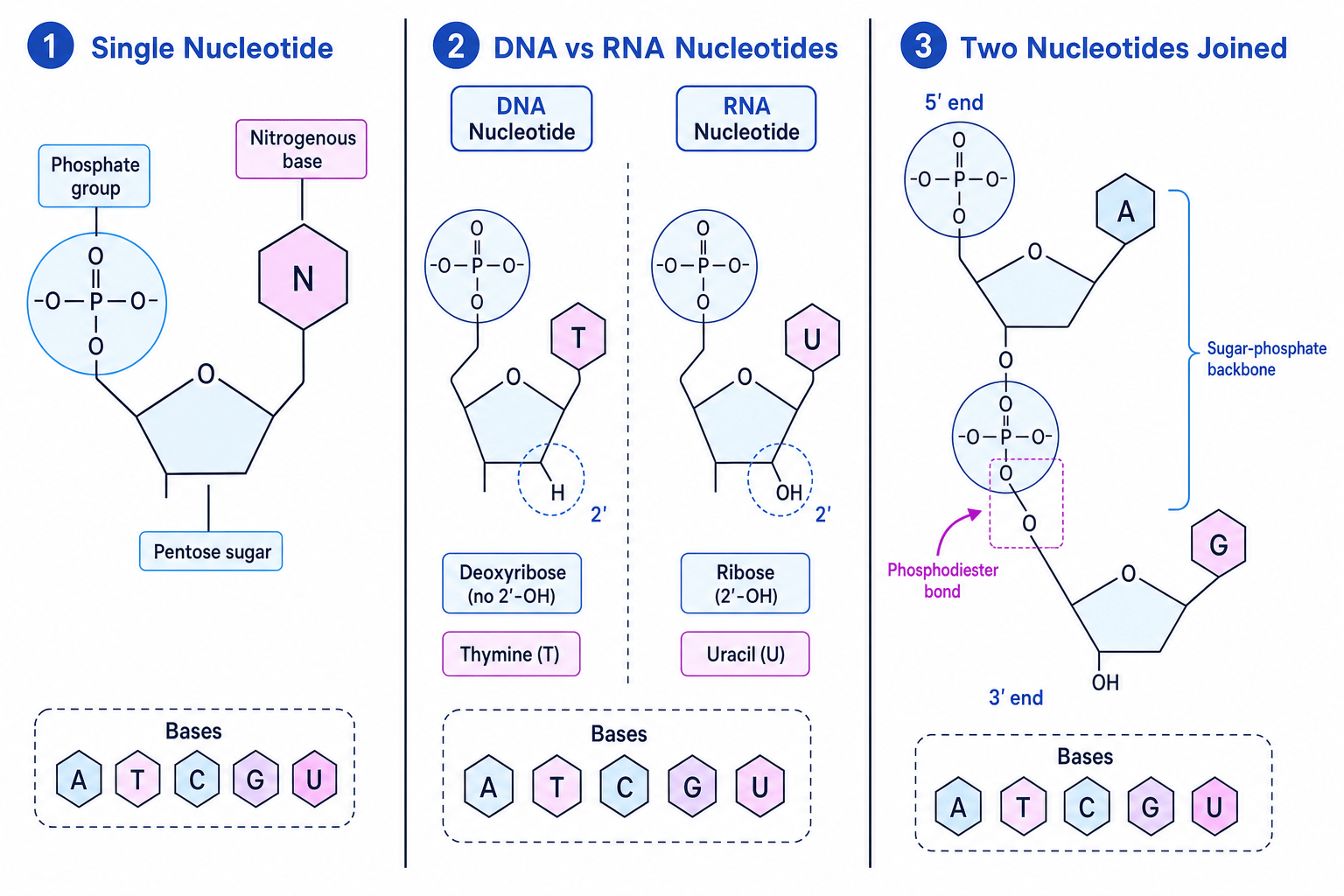
A nucleotide is made from three parts: a pentose sugar with five carbon atoms, a phosphate group, and a nitrogenous base.
The nitrogenous bases are usually written as letters:
- A = adenine
- G = guanine
- C = cytosine
- T = thymine, found in DNA
- U = uracil, found in RNA
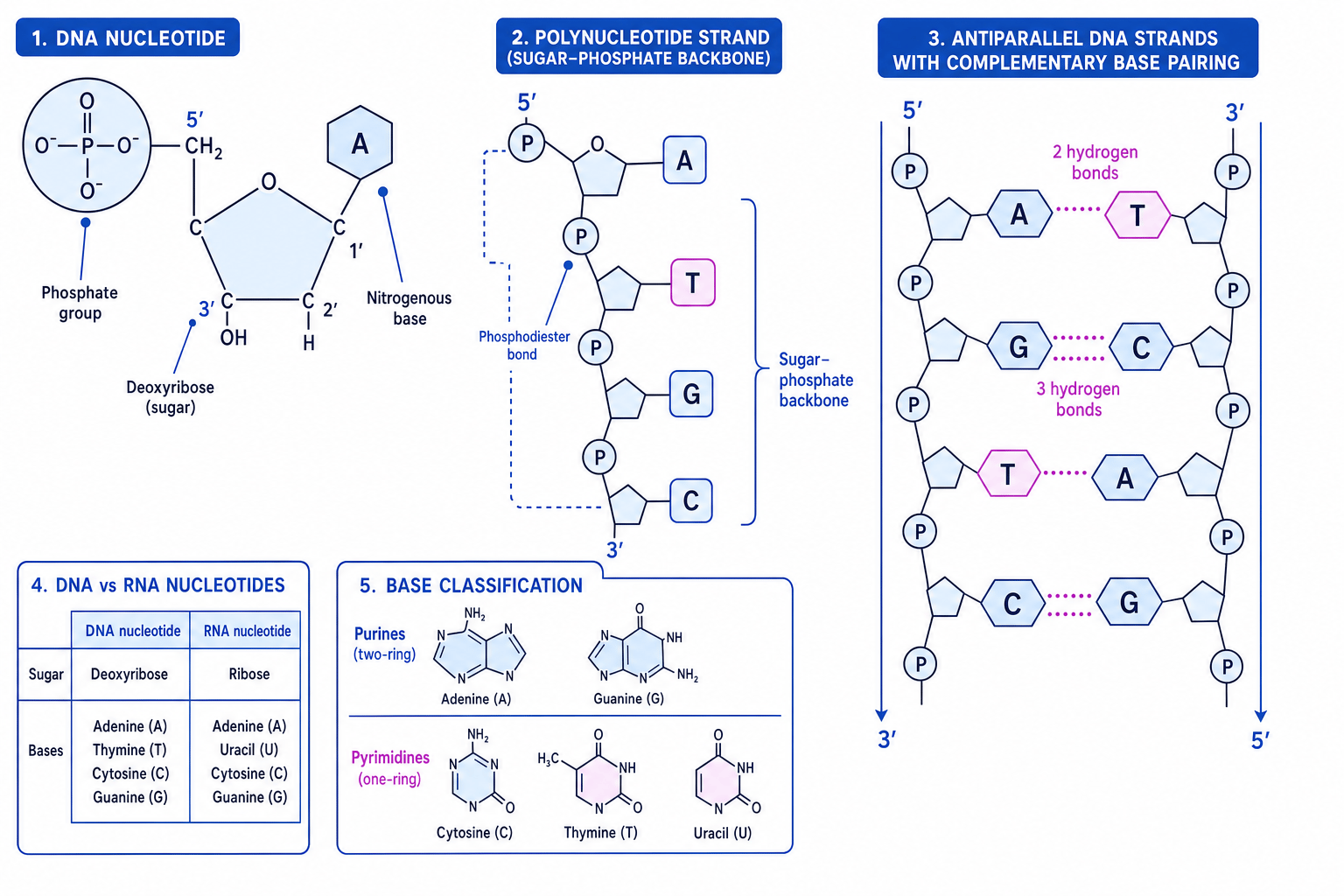
The bases are grouped by structure:
- Purines have two rings: adenine and guanine.
- Pyrimidines have one ring: cytosine, thymine and uracil.
DNA and RNA nucleotides differ in their sugar and one of their bases. DNA contains deoxyribose sugar and uses thymine. RNA contains ribose sugar and uses uracil instead of thymine.
DNA versus RNA nucleotides
DNA nucleotides contain deoxyribose and bases A, T, C and G. RNA nucleotides contain ribose and bases A, U, C and G.
Mixing up uracil and thymine
Use T in DNA and U in RNA. So an mRNA sequence should never contain thymine.
2. Polynucleotides and phosphodiester bonds
A polynucleotide is a polymer made from many nucleotides joined in a chain. DNA and RNA are both nucleic acids made from polynucleotide chains.
Phosphodiester bond
A phosphodiester bond is a strong covalent bond between the phosphate group of one nucleotide and the pentose sugar of another nucleotide.
Polynucleotides are made by condensation reactions, where two molecules join and water is released. They are broken down by hydrolysis reactions, where water is used to break the bond.
The sugar and phosphate parts form the sugar-phosphate backbone. The bases project from this backbone and carry the genetic information.
Building and breaking polynucleotides
Condensation reactions form phosphodiester bonds between nucleotides. Hydrolysis reactions break phosphodiester bonds.
3. ATP and ADP are phosphorylated nucleotides
Some nucleotides are not used to build DNA or RNA. Instead, they have other roles in cells.
ATP and ADP
ATP, adenosine triphosphate, is a phosphorylated nucleotide made from ribose, adenine and three inorganic phosphate groups. ADP, adenosine diphosphate, has the same ribose and adenine but only two phosphate groups.
“Phosphorylated” means phosphate groups have been added. ATP is important because hydrolysis of its terminal phosphate bond releases energy that can be used by cells:
ATP+H2O→ADP+PiATP + H_2O \to ADP + P_iATP+H2O→ADP+Piwhere PiP_iPi means inorganic phosphate.
ATP can be regenerated from ADP and inorganic phosphate during respiration and photosynthesis.
Spotting ATP structure
ATP contains adenine, ribose and three phosphates. If the sugar is deoxyribose, it is not ATP.
4. DNA structure
DNA stands for deoxyribonucleic acid. A DNA molecule is made from two polynucleotide strands.
The two strands are antiparallel, meaning they run in opposite directions. One strand runs from 5′ to 3′, while the other runs from 3′ to 5′. These numbers refer to carbon atoms in the pentose sugar.
The bases point inwards and pair by complementary base pairing:
- A pairs with T using two hydrogen bonds.
- G pairs with C using three hydrogen bonds.
Hydrogen bond
A hydrogen bond is a weak attraction between slightly charged parts of molecules. In DNA, many hydrogen bonds together help hold the two strands together.
Because the strands are held together by complementary base pairs and then twist, the DNA molecule forms a double helix.
Why DNA structure matters
The base sequence stores genetic information, and complementary base pairing allows DNA to be copied accurately.
Working out base percentages
A sample of double-stranded DNA contains 18% adenine. Find the percentage of each other base.
- Apply complementary base pairing: adenine pairs with thymine, so A=TA = TA=T. Therefore thymine is also 18%.
- Add the A and T percentages: 18%+18%=36%18\% + 18\% = 36\%18%+18%=36%.
- The remaining percentage is cytosine plus guanine: 100%−36%=64%100\% - 36\% = 64\%100%−36%=64%.
- Since cytosine pairs with guanine, C=GC = GC=G, so each is 64%÷2=32%64\% \div 2 = 32\%64%÷2=32%.
5. Purifying DNA by precipitation
Precipitation means making a dissolved substance come out of solution as a visible solid. DNA can be purified from cells by precipitation.
A typical method is:
- Break open the cells using detergent, which disrupts cell membranes.
- Add salt to help neutralise the negatively charged phosphate groups on DNA.
- Use a protease enzyme to break down proteins associated with DNA.
- Filter the mixture to remove larger cell debris.
- Add cold ethanol carefully so DNA becomes insoluble and precipitates as white strands.
DNA precipitation
DNA precipitation is the purification of DNA by making it insoluble, usually by adding cold ethanol, so it can be collected as visible strands.
Explaining a poor DNA precipitate
A student extracts DNA from fruit but sees only a small amount of white precipitate.
- If the detergent step was too short, fewer membranes would be disrupted, so less DNA would be released into solution.
- If the ethanol was not cold, DNA would remain more soluble, so less DNA would precipitate visibly.
- If the mixture was shaken violently, long DNA molecules could be sheared into shorter fragments, making the precipitate harder to collect.
Practical explanation marks
For DNA extraction questions, link each reagent or step to its purpose: detergent releases DNA, protease removes proteins, salt helps DNA aggregate, and cold ethanol precipitates DNA.
6. Semi-conservative DNA replication
Before a cell divides, its DNA must be copied. DNA replication is described as semi-conservative.
Semi-conservative replication
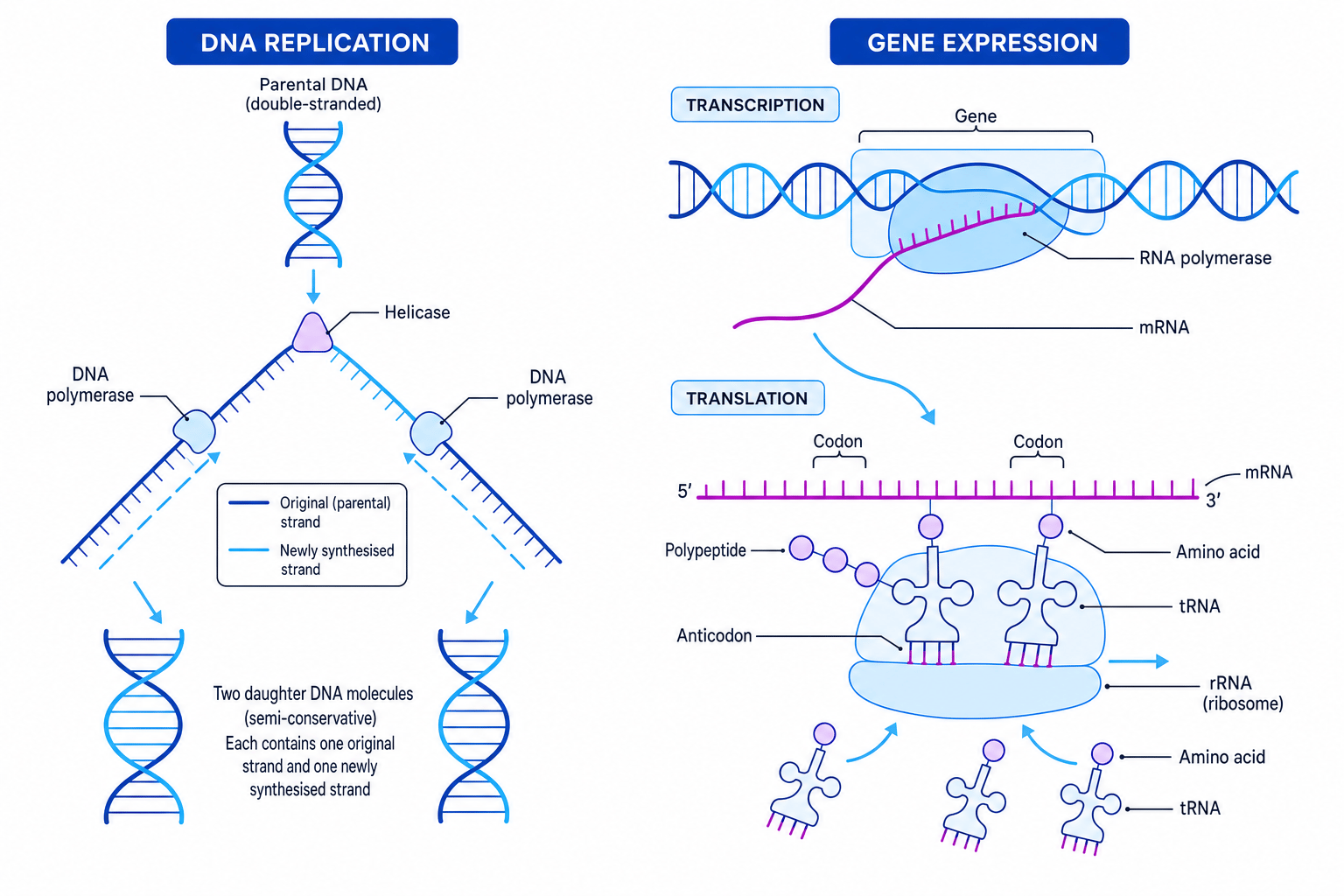
In semi-conservative replication, each new DNA molecule contains one original parental strand and one newly synthesised strand.
The process depends on complementary base pairing:
- Helicase breaks hydrogen bonds between complementary bases, separating the two DNA strands.
- Each separated strand acts as a template.
- Free DNA nucleotides line up by complementary base pairing.
- DNA polymerase joins the new nucleotides together by forming phosphodiester bonds.
This conserves genetic information because each original strand guides the formation of a matching new strand.
Accuracy and mutation
DNA replication is accurate because of complementary base pairing and enzyme action, but random, spontaneous mutations can still occur when the base sequence changes.
At AS level, you do not need to distinguish between different types of mutation here. You do need to understand that mutations are random, can arise during replication, and may alter the genetic information.
Tracking parental strands
One DNA molecule replicates twice. How many DNA molecules contain one of the original parental strands?
- After the first replication, there are two DNA molecules. Each contains one original strand and one new strand.
- During the second replication, each strand acts as a template. The two original strands are still present, but each ends up in a different DNA molecule.
- Therefore, after two rounds, there are four DNA molecules in total, and two of them contain one original parental strand.
7. The genetic code
A gene is a length of DNA with a base sequence that determines the amino acid sequence of a polypeptide.
The genetic code is the relationship between base triplets and amino acids.
Triplet code
The genetic code is a triplet code because three bases code for one amino acid.
The genetic code is:
- Triplet: three bases code for one amino acid.
- Non-overlapping: each base is read once, as part of one triplet.
- Degenerate: most amino acids are coded for by more than one triplet.
- Universal: the same triplets code for the same amino acids in almost all organisms.
The sequence of amino acids in a polypeptide is its primary structure. So a gene determines the primary structure of a protein by determining the order of amino acids.
Counting amino acids from base triplets
A coding region of mRNA contains 96 bases before the stop codon. How many amino acids will this section code for?
- Use the triplet nature of the code: three bases code for one amino acid.
- Divide the number of bases by three: 96÷3=3296 \div 3 = 3296÷3=32.
- The section codes for 32 amino acids, because the stop codon is not included in the 96 bases.
Forgetting the code is non-overlapping
Do not count triplets by sliding along one base at a time. In a non-overlapping code, bases 1–3 form one triplet, bases 4–6 form the next, and so on.
8. Transcription: making mRNA from DNA
Transcription is the process of making messenger RNA, or mRNA, from a DNA template.
mRNA
Messenger RNA, mRNA, is a single-stranded RNA molecule that carries a copy of the genetic information from DNA to a ribosome.
During transcription:
- RNA polymerase binds to the DNA at the start of a gene.
- The DNA strands separate locally.
- RNA polymerase uses one DNA strand as a template.
- Complementary RNA nucleotides join together, with A pairing with U and C pairing with G.
- The mRNA molecule separates from the DNA.
The mRNA base sequence is complementary to the template DNA strand.
9. Translation: making a polypeptide
Translation is the process of using the mRNA base sequence to assemble a polypeptide at a ribosome.
tRNA and rRNA
Transfer RNA, tRNA, carries a specific amino acid and has an anticodon that pairs with an mRNA codon. Ribosomal RNA, rRNA, forms part of the ribosome and helps translation occur.
A codon is a sequence of three bases on mRNA. An anticodon is a complementary sequence of three bases on tRNA.
During translation:
- The mRNA attaches to a ribosome.
- tRNA molecules bring specific amino acids to the ribosome.
- Each tRNA anticodon pairs with a complementary mRNA codon.
- Amino acids are joined by peptide bonds.
- The polypeptide grows until a stop codon is reached.
From gene to polypeptide
DNA base sequence determines mRNA codon sequence, which determines tRNA binding order, which determines amino acid sequence in the polypeptide.
Finding an mRNA sequence
A DNA template strand has the sequence TAC GGA CTT. Find the mRNA sequence transcribed from it.
- Use complementary RNA base pairing: DNA T pairs with RNA A, DNA A pairs with RNA U, DNA C pairs with RNA G, and DNA G pairs with RNA C.
- Convert each template triplet: TAC becomes AUG, GGA becomes CCU, and CTT becomes GAA.
- The mRNA sequence is AUG CCU GAA.
In the exam
- When comparing DNA and RNA, mention both the sugar and the base difference: deoxyribose and thymine for DNA, ribose and uracil for RNA.
- For replication questions, name the enzymes and their jobs: helicase separates strands; DNA polymerase forms the new strand.
- For protein synthesis, keep the molecules distinct: mRNA carries codons, tRNA carries amino acids, and rRNA is part of the ribosome.
Check yourself
- Why does complementary base pairing help DNA replication conserve genetic information?
- What is the difference between a codon and an anticodon?
- How do ATP and ADP differ in structure?