

What you'll learn
- Why large multicellular organisms need communication systems.
- How cells signal to neighbouring cells and distant cells.
- How homeostasis uses receptors, effectors and feedback.
- How endotherms and ectotherms control body temperature.
Why multicellular organisms need communication systems
A multicellular organism is made of many cells. In animals and plants, many of these cells are specialised, meaning they are adapted for particular roles. Groups of tissues form organs, such as the heart, lungs, leaves and roots.
Because different parts of the organism do different jobs, they must be coordinated. Coordination means making sure that several parts of the body work together in a controlled way.
A large organism also has an internal environment: the conditions around its cells, such as temperature, water availability, glucose concentration and pH. This internal environment can change because of conditions inside the body or outside the body.
For example:
- Animals must respond to external changes such as cold, heat, danger or light.
- Animals must also respond to internal changes such as increased carbon dioxide during exercise.
- Plants respond to light, gravity, water availability and pathogens.
- Different organs must be coordinated, such as the lungs, heart and muscles during exercise, or roots, shoots and leaves during drought.
Why communication matters
Multicellular organisms need communication systems because individual cells cannot respond effectively on their own: organs must exchange information so the whole organism can respond in a coordinated way.
Coordinating a response to exercise
- During exercise, muscle cells respire faster, so they use more oxygen and glucose and produce more carbon dioxide and heat.
- Communication systems coordinate several organs: the heart pumps faster, the lungs ventilate more rapidly, and blood flow to muscles increases.
- The response is useful because it matches supply and removal to demand: more oxygen and glucose reach muscle cells, while carbon dioxide and heat are removed more quickly.
Cell signalling: how cells communicate
Cell signalling is communication between cells using signals that are detected by other cells.
Cell signalling
Cell signalling occurs when one cell produces a signal that is detected by another cell, causing a response in the target cell. A target cell is a cell that has the correct receptor for that signal.
A signal molecule is a chemical messenger, such as a hormone or neurotransmitter. A receptor protein is a protein with a specific shape that binds to a particular signal molecule.
This specificity is important: a signal may travel past many cells, but only cells with the correct receptor respond.
Signalling between adjacent cells
Adjacent cells are cells next to, or very close to, each other. Signalling between adjacent cells is useful when a response needs to be local and precise.
Examples include:
- neurotransmitters crossing the tiny gap between two neurones or between a neurone and a muscle cell
- local chemical signals diffusing a short distance between nearby cells
- plant cells communicating through connections between neighbouring cells
Signalling between distant cells
Distant cells are cells far apart in the organism. Long-distance signalling is useful when several organs need to be coordinated.
Examples include:
- hormones carried in the blood in animals
- plant growth regulators transported from one part of a plant to another
Chemical signalling is often slower than electrical signalling, but it can affect many target cells and may have longer-lasting effects. Electrical signalling in animals, through neurones, is very fast and is useful for rapid responses.
Signal present does not mean response
A cell only responds to a signal if it has the correct receptor. Do not write that “all cells exposed to a hormone respond” — many cells will not have the matching receptor protein.
Principles of homeostasis
Homeostasis
Homeostasis is the maintenance of a stable internal environment within narrow limits, despite changes inside or outside the organism.
Homeostasis does not mean conditions never change. Instead, variables are kept close to a normal value.
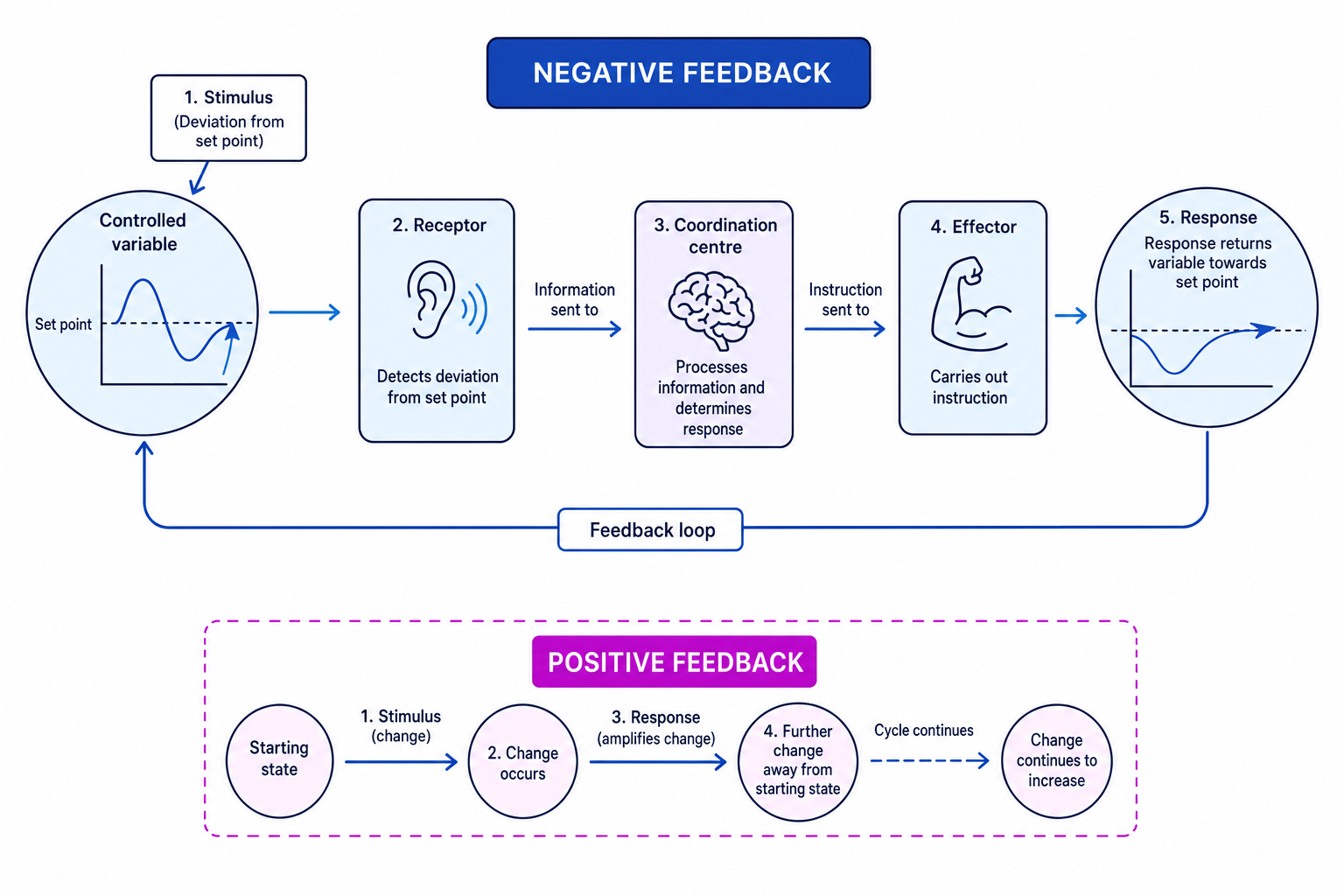
A controlled variable is a factor kept within limits, such as core body temperature or blood glucose concentration. A set point is the normal value or range that the body aims to maintain. A stimulus is a detectable change, such as body temperature rising above normal.
Most homeostatic systems have three main components:
- A receptor detects a change in a controlled variable.
- A coordination centre receives information and decides on a response. In animals, this may involve the nervous system or endocrine system.
- An effector carries out the response. Effectors include muscles and glands.
The diagram shows the general feedback pattern you should be able to apply to unfamiliar examples.
Negative feedback
Negative feedback is a control mechanism where the response reverses the original change. It brings the controlled variable back towards the set point.
For example, if body temperature rises too high, responses that increase heat loss help lower it again. If body temperature falls too low, responses that reduce heat loss or increase heat production help raise it again.
Dynamic, not fixed
In homeostasis, values often fluctuate slightly around the set point. A graph may show small rises and falls rather than a perfectly flat line.
Positive feedback
Positive feedback is a mechanism where the response increases the original change. This moves the system further away from the starting condition.
Positive feedback is not usually used to maintain a stable internal environment. It is useful in some processes that need to be driven rapidly to an endpoint, such as blood clotting, but it must eventually be stopped.
Receptors are not effectors
A receptor detects a change. An effector carries out the response. For example, a temperature receptor detects temperature change, but a sweat gland or muscle produces the response.
Following a negative-feedback loop
- If core body temperature rises above the set point, the stimulus is the increase in temperature.
- Temperature receptors detect the change, and the coordination centre compares the information with the normal range.
- Effectors such as sweat glands and skin arterioles produce responses that increase heat loss.
- As temperature returns towards the set point, the original stimulus becomes smaller, so the corrective response is reduced.
Temperature control
Thermoregulation is the control of body temperature. Temperature matters because enzyme-controlled reactions are affected by temperature: low temperatures slow reactions, while high temperatures can denature proteins and disrupt membranes.
A physiological response is an internal body process, such as sweating or shivering. A behavioural response is an action by the whole organism, such as moving into shade.
Endotherms and ectotherms
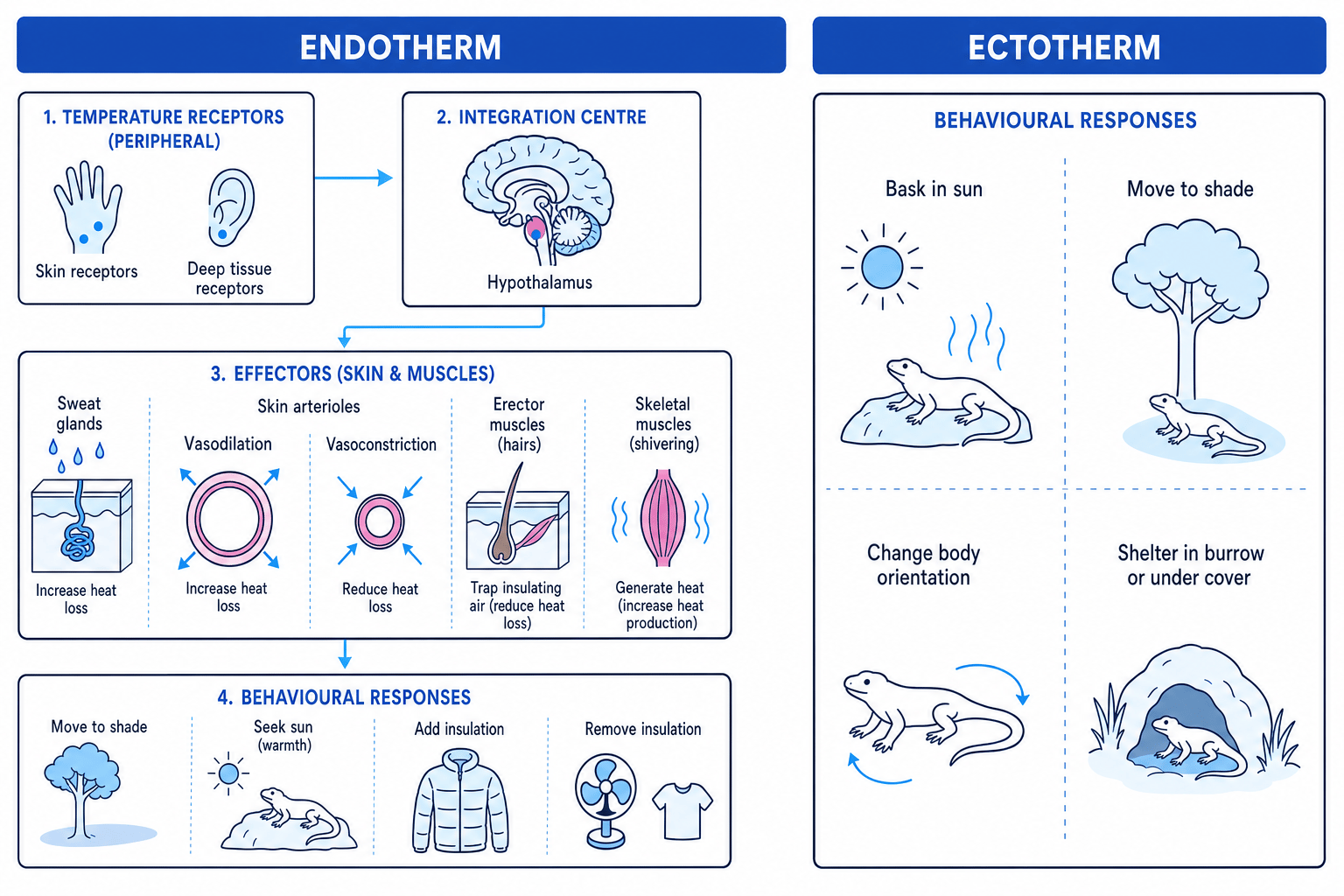
An endotherm maintains body temperature mainly using heat generated by metabolism. An ectotherm relies mainly on external heat sources, so its body temperature depends more on the environment.
The overview below compares the responses required for this topic.
Temperature control in endotherms
Endotherms include mammals and birds. They can keep a relatively constant core body temperature, often close to about 37 °C in humans.
Detecting temperature change
Peripheral temperature receptors are temperature receptors found away from the centre of the body, especially in the skin. They detect external temperature changes and help the body respond early.
The hypothalamus is a region of the brain involved in coordinating temperature control. It receives information from temperature receptors and sends signals to effectors in the skin and muscles.
If the body is too hot
Endotherms increase heat loss by:
- vasodilation, where arterioles supplying skin capillaries widen, increasing blood flow near the skin surface
- sweating, where sweat evaporates from the skin and removes heat energy
- reducing insulation, such as hairs lying flatter when erector muscles relax
- behavioural responses, such as moving into shade, removing layers or reducing activity
If the body is too cold
Endotherms reduce heat loss and increase heat production by:
- vasoconstriction, where arterioles supplying skin capillaries narrow, reducing blood flow near the skin surface
- reducing sweating
- raising hairs when erector muscles contract, trapping an insulating layer of air; this is more useful in furry mammals than in humans
- shivering, where skeletal muscles contract repeatedly, increasing respiration and releasing more heat
- behavioural responses, such as seeking shelter, adding insulation or curling up
Sweat must evaporate
Sweating cools the body only when sweat evaporates. Sweat dripping off the skin without evaporating removes much less heat.
Temperature control in ectotherms
Ectotherms include many reptiles, amphibians, fish and invertebrates. They do not maintain body temperature mainly by internal heat production, so behavioural responses are especially important.
Ectotherms may warm up by:
- basking in the sun
- moving onto warm surfaces
- orientating the body to expose a larger surface area to sunlight
They may cool down by:
- moving into shade
- sheltering in a burrow or under cover
- orientating the body to reduce exposure to sunlight
- becoming active at cooler times of day
Because ectotherms rely more on environmental heat, they often use less energy for temperature control than endotherms. However, their activity may be limited when environmental temperatures are too low or too high.
Explaining an ectotherm’s behaviour
- In the morning, a lizard’s body temperature may be below its optimum, so basking in sunlight increases heat gain from the environment.
- Around midday, the same lizard may risk overheating, so moving into shade reduces heat gain.
- This is an ectothermic response because the main control described is behavioural, not internal heat production by muscles or sweating.
Practical angle: investigating behaviour
A temperature preference experiment might place small invertebrates in a temperature gradient and record where they move. A good investigation controls other variables such as light intensity and humidity, uses repeats, records quantitative data, and treats animals ethically by avoiding harmful extremes.
In the exam
- For homeostasis questions, name the stimulus, receptor, coordination centre, effector and response, then link the response back to the set point.
- For feedback, use the key distinction: negative feedback reverses a change; positive feedback amplifies a change.
- For thermoregulation, keep endotherms and ectotherms separate: endotherms use physiological and behavioural responses, while ectotherms in this topic are described mainly by behavioural responses.
Check yourself
- Why do multicellular organisms need communication systems rather than each cell acting independently?
- What is the difference between a receptor and an effector in a homeostatic pathway?
- How would an endotherm and an ectotherm respond differently to a cold environment?
